A history drive · about 64 miles · about 2 hr of driving
The Makers' Road
For a century the towns along the St. Joseph River made things the whole country knew by name: Round Oak stoves and Heddon lures at Dowagiac, Kawneer storefronts at Niles, Studebaker wagons and cars and Oliver plows at South Bend, Ball-Band boots at Mishawaka, Conn band horns and, later, recreational vehicles at Elkhart. This drive runs downriver and then east along it, from the stove town to Goshen, stopping at the museums that keep the makers' work and the markers that stand where the factories did. Most of the great works are gone; where something survives, it is noted, and where it is a working plant or private property, you look from the road.
Open the whole drive in Google Maps Start at stop 1
The map opens here.
About 64 miles and 2 hours of driving, not counting stops (road distances from OpenStreetMap routing). The South Bend museums and the Elkhart hall of fame each deserve an hour or more; Indiana and Michigan stops on this drive are all on Eastern time.
The stops
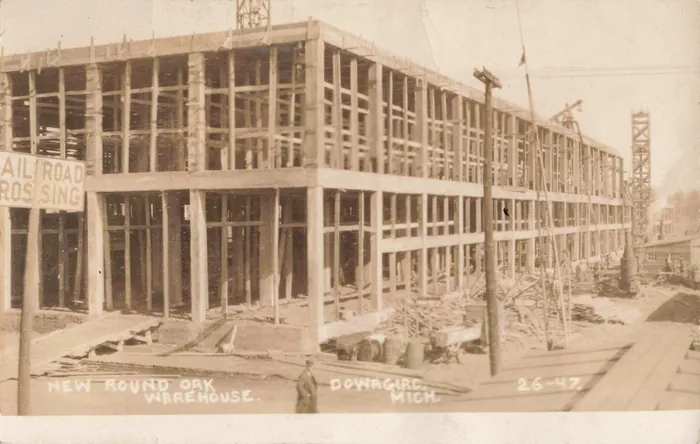
Then: New Round Oak Warehouse, Dowagiac, Mich., about 1910–1918. Tinder Collection, Clements Library, University of Michigan 1 Dowagiac Area History Museum
201 E. Division St., Dowagiac, MI 49047
The stove town's museum, free, with the story of the Round Oak Stove Company: Philo D. Beckwith cast his first stove around 1867 to heat his struggling foundry, and by 1900 Round Oak was one of the largest stove factories in the United States, with about 1,200 workers in the 1910s. The museum also keeps grain-drill artifacts from Beckwith's earlier drill trade. The 1910s Round Oak foundry complex on Spaulding Street still stands and is in industrial use; see it from the street only.
Open: Tuesday to Friday 10 to 5, Saturday 10 to 2. Free.
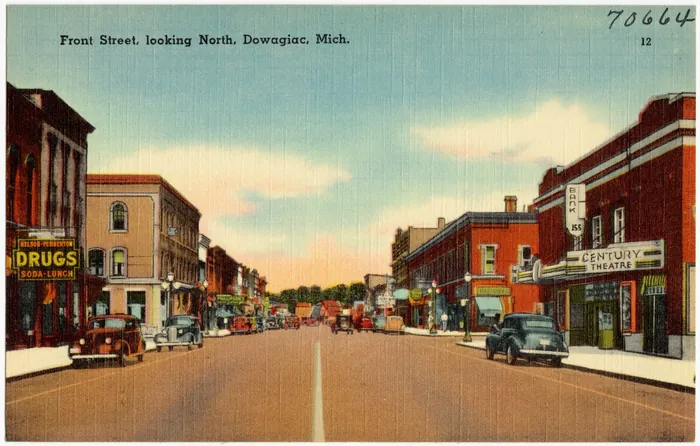
Then: Front Street, looking north, Dowagiac, Mich, about 1930–45. Boston Public Library, Tichnor Brothers Collection 2 Heddon Museum
115 S. Front St., Dowagiac, MI 49047
James Heddon, a former beekeeper, is said to have got the idea for a top-water lure by Dowagiac's Mill Pond in the late 1890s; the company was founded in 1902, began in the family kitchen, and was making lures in a Dowagiac factory by 1904, most of its workers women. Lures were made here until 1984. The museum holds more than 1,000 lures, 140 reels and 150 rods, including an original James Heddon frog.
Open: Tuesday and Friday 10 to 5; run by volunteers, so call ahead: 269-783-2560.
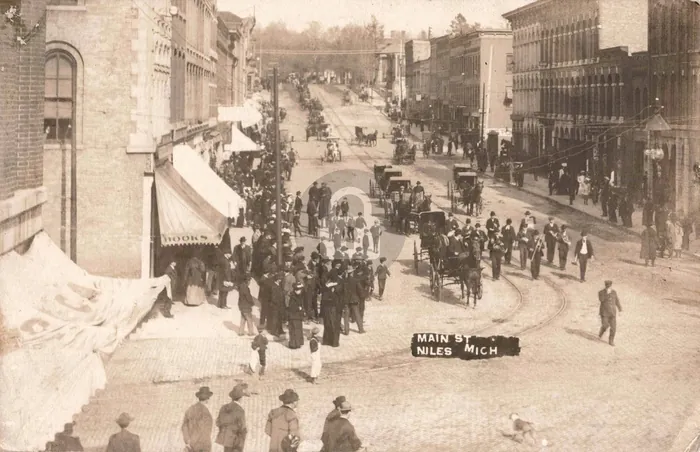
Then: Main St., Niles, Mich., about 1905–1915. Private collection; scan shared online 3 Plym Park, Niles
401 Marmont St., Niles, MI 49120
Francis J. Plym, a Swedish-born architect, patented a copper frame for plate-glass shop windows in 1906 and moved his Kawneer Company to Niles in early 1907; it grew from window frames to door frames and complete storefronts. Plym gave this park to the city, and it is still in use. It is also the Niles end of the Indiana-Michigan River Valley Trail.
Open: City park, open daily.
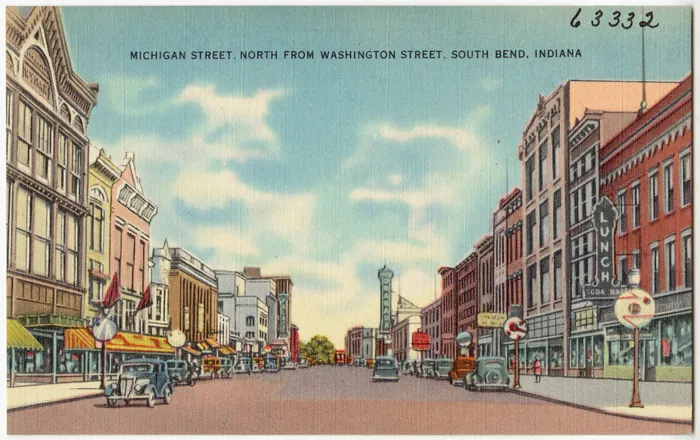
Then: Michigan Street, north from Washington Street, South Bend, Indiana, about 1930–45. Boston Public Library, Tichnor Brothers Collection 4 Studebaker National Museum, South Bend
201 Chapin St., South Bend, IN 46601
Henry and Clement Studebaker opened a blacksmith shop in South Bend on 16 February 1852 with $68, built two wagons the first year, and by 1885 were making more than 75,000 vehicles a year; they built a gasoline car in 1904 and their last wagons in 1920. South Bend production ended in December 1963. The museum tells that whole run, 'from carriages to cars.' The self-guided Studebaker-Bendix Heritage Trail, about 90 minutes, starts downtown at Michigan Street and Jefferson Boulevard.
Open: Monday to Saturday 10 to 5, Sunday 12 to 5. Admission charged; see the museum's site.
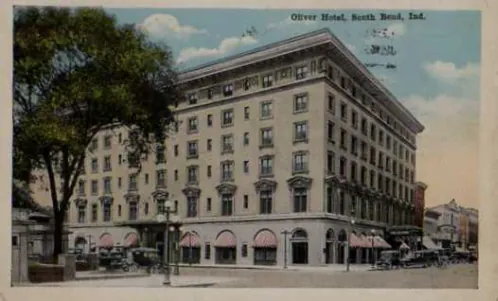
Then: Oliver Hotel, South Bend, Indiana, before 1917. none required 5 The History Museum and Copshaholm (the Oliver Mansion), South Bend
808 W. Washington St., South Bend, IN 46601
Next door to the Studebaker museum. James Oliver, a Scottish immigrant, took the first of 45 plow patents in 1857 for a chilled-iron plow that scoured clean in sticky prairie soil, and by 1901 his works called themselves the world's largest plow maker. His family's 38-room mansion, Copshaholm, completed in 1896-97, is shown on guided tours; the Oliver works' powerhouse and smokestack, still lettered with the name, are the only factory buildings left.
Open: Monday to Saturday 10 to 5, Sunday 12 to 5; mansion tours twice a day. Tickets at the visitor desk; 574-235-9664.
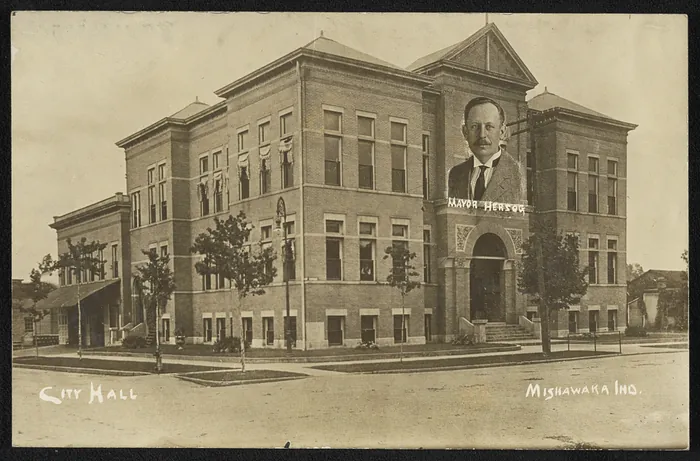
Then: City Hall, Mishawaka, Ind., Mayor Herzog, 1910. Library of Congress, Prints & Photographs Division 6 Ball-Band factory marker, Mishawaka
South bank of the St. Joseph River, reached from N. Main St. at W. Mishawaka Ave., Mishawaka, IN 46544
The marker overlooks the site of the Mishawaka Woolen Manufacturing Co., maker of Ball-Band boots and, from 1951, Red Ball Jets; at its height it had about 5,000 workers on more than 40 acres. The plant closed in 1997, the buildings came down in 2000, and Robert Buetter Riverfront Park (2005) occupies the ground. In July 2026 the city unveiled 'Shoe City,' giant Red Ball Jet sculptures around town, one at Ironworks Plaza. The Mishawaka Historical Museum, a few blocks south at 121 S. Main St., opens by appointment: call 574-217-8807.
Open: Riverside marker and park, any time.
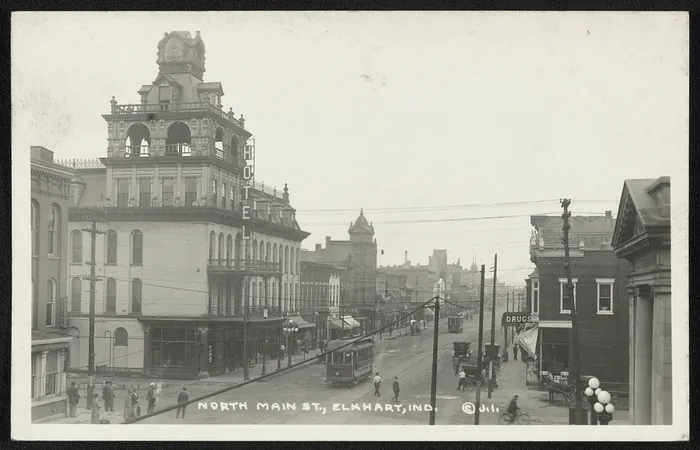
Then: North Main St., Elkhart, Ind, 1915. Library of Congress, Prints & Photographs Division 7 C. G. Conn Company marker, Elkhart
Northwest corner of Jackson Boulevard and Elkhart Avenue, Elkhart, IN 46516
Indiana's state marker (2006) stands at the site of the Conn factory until 1910. Charles G. Conn was making rubber-rimmed cornet mouthpieces by 1874, patented one in 1875 and began making instruments that year; other makers followed him, and by the 1970s about 40 percent of the world's band instruments were made in Elkhart, the 'Band Industry Capital of the World.' The Conn-Selmer name continues in the city. A second state marker, for Dr. Franklin L. Miles, whose company made Alka-Seltzer, is at 403 W. Franklin St.
Open: Outdoor marker, any time.
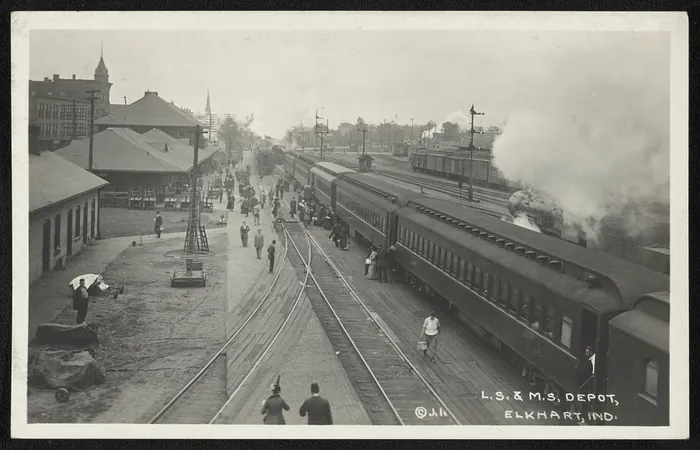
Then: L.S. & M.S. Depot, Elkhart, Ind, 1915. Library of Congress, Prints & Photographs Division 8 RV/MH Hall of Fame and Museum, Elkhart
21565 Executive Parkway, Elkhart, IN 46514
Elkhart's later industry was the recreational vehicle and the manufactured home, and this museum and hall of fame preserves the history of both and of the people who built them.
Open: April 1 to November 1: Monday to Saturday 9 to 5, Sunday 10 to 3. Closed Thanksgiving, Christmas and New Year's Day; winter hours on the museum's site.
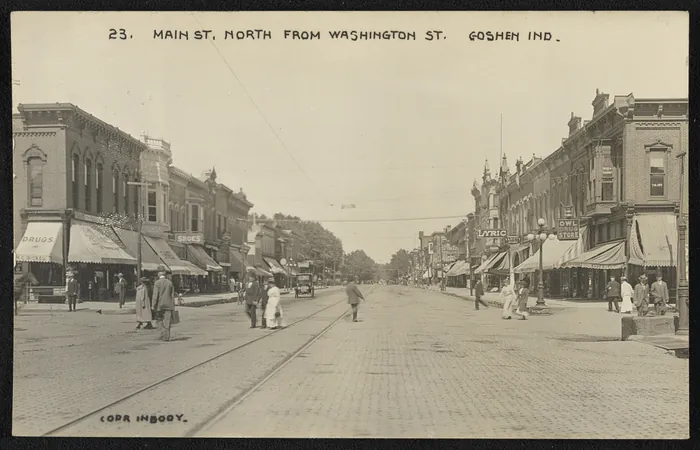
Then: Main St. north from Washington St., Goshen, Ind, 1911. Library of Congress, Prints & Photographs Division 9 Goshen Historical Society Museum
124 S. Main St., Goshen, IN 46526
Goshen's free museum is the start of the society's historic walking tour and keeps the story of the Goshen Hydraulic Canal, which gave the town water power. Goshen also drew in the mills of the country around it: in 1868 the Waterford dam, south of town, was taken down and its mill, and then the county's first pump works, moved to Goshen.
Open: Tuesday to Saturday 10 to 4, and until 8 on the first Friday of the month. Free.
Food and rest stops
Food on the way, from the site's list: Caruso's Candy & Soda Fountain and Wood Fire Trattoria, side by side at 130 and 134 S. Front St., Dowagiac (/food/eat/#caruso-s-candy-soda-fountain); Sunny Italy Cafe, Rocco's, Barnaby's and Café Navarre in South Bend (/food/eat/#sunny-italy-cafe); Goshen Brewing Company, 315 W. Washington St., and South Side Soda Shop & Diner, 1122 S. Main St., Goshen (/food/eat/#goshen-brewing-company). To stay: Oliver Inn Bed & Breakfast, South Bend, and Hotel Elkhart (/food/stay/). Restrooms: at the museums during open hours.
Before you go
- Hours change and some stops are by appointment: check each place before you set out.
- Stops marked “view from the road” are on private or working property: please stay on the road.
- Distances and times are road distances, rounded, without time spent at the stops.
Sources
- Project Scroll, Made in the Valley. link
- Dowagiac Area History Museum, Round Oak. link
- Heddon Museum. link
- City of Dowagiac, The Heddon Museum. link
- Niles Daily Star (Leader Publications), 'Francis J. Plym was once knighted by Sweden's king' (17 October 2009). link
- Studebaker National Museum. link
- Smithsonian Libraries, Studebaker exhibition. link
- The History Museum, South Bend. link
- Discover Indiana History: Oliver Chilled Plow Works. link
- Historical Marker Database: Ball-Band Factory, Mishawaka. link
- The History Museum: Mishawaka Woolen Company / Ball-Band Rubber. link
- WNDU, 'Mishawaka unveils Shoe City project' (25 July 2026). link
- Indiana Historical Bureau, marker 20.2006.1, CG Conn Company. link
- Wikipedia, 'List of Indiana state historical markers in Elkhart County' (marker locations and coordinates). link
- RV/MH Hall of Fame and Museum. link
- Goshen Historical Society. link
- History of Elkhart County, Indiana (Chicago, 1881), on Waterford. Internet Archive. link