The story
Welcome to Dowagiac
Dowagiac was laid out beside the Michigan Central track in 1848 and took the name of the creek it sits on. Within a generation it was Cass County’s busiest town, and its Round Oak stoves and grain drills went out to farms all over the country. Its restored depot still sees passenger trains, and its history museum tells the story of the stoves, the fishing lures and the Orphan Train.
The name came first to the creek. Rogers (1875) says Dowagiac “is of Indian origin, and signifies fishing-water,” and Mathews (1882) says the same of the stream, though neither gives a source, and the meaning is still debated. Before the town there was only a paper one: Venice, platted by Orlando Crane and filed for record on August 6, 1836, on the north side of the creek in Wayne Township, where not a lot was sold. William Renniston built a carding mill on the creek in 1830, where the road from Cassopolis crossed it, and later a gristmill, and Glover was told that in 1835 Patrick Hamilton was the only inhabitant of the site.
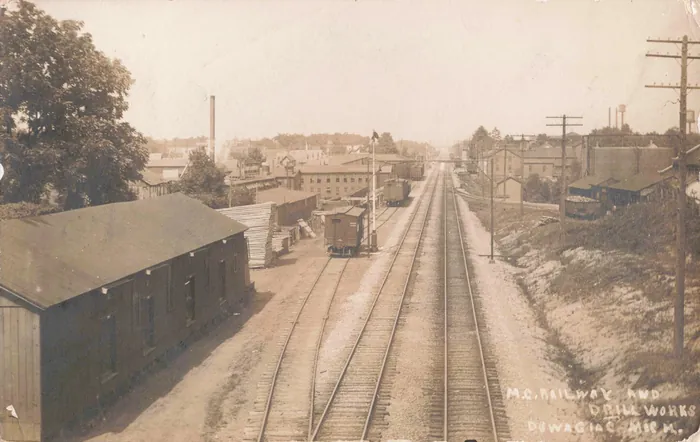
“Born of the Michigan Central Railroad,” Rogers wrote, Dowagiac “had little or no pioneer history.” In 1847 Nicholas Cheeseborough was buying the railroad’s right of way from Kalamazoo to Niles, and when the depot sites were fixed he and Jacob Beeson of Niles bought eighty acres from Patrick Hamilton in the northeast corner of Pokagon Township and platted a village. The plat was recorded February 16, 1848, and its words still explain the town’s slanting streets: “Front street runs parallel to the track of the Michigan Central railroad.” The founders gave the railroad its right of way and depot grounds, part of which became a public park. Within three years additions by Hamilton, Beeson, Jay W. McOmber and Erastus H. Spalding had carried the town into four townships.
Read the full story
The first goods sold were supplies for the railroad crews. E. S. and Joel H. Smith of Cassopolis brought the first general stock, and Glover says their one-story store at Main and Front stood for half a century. A post office opened in November 1848 in the Cataract House, a boarding house for railroad hands, with Arad C. Balch as postmaster, and the Rev. Jacob Price preached the first sermon that July in the unfinished freight house. Typhoid fever killed one in thirteen of the people in 1852. Grace Greenwood, the writer, urged the planting of shade trees in the mid-1850s, and the trees along the park and streets were, Rogers said, the chief beauty of the village by 1875. The village was incorporated by the board of supervisors in February 1858 and became a city in 1877.
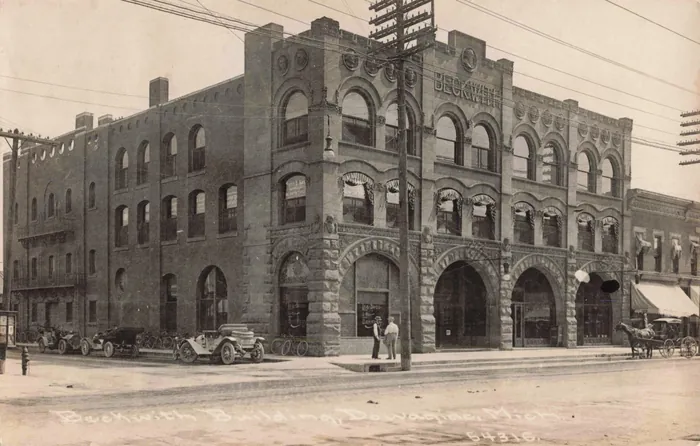
Industry made the town. Philo D. Beckwith came in 1854 with a small foundry and machine shop, began making John S. Gage’s roller grain drill, built his first heating stove in 1867 and patented the Round Oak stove in 1870. By 1906, Glover wrote, the Round Oak works employed close to eight hundred people, perhaps half the city depended on it, and “Dowagiac is associated with no other fact in thousands of minds.” The shoe drill of William Tuttle, first made in 1866, grew into the Dowagiac Manufacturing Company, which claimed the largest grain-drill plant in the world, and the Colby family ran the flour mills on the creek. On October 1, 1854, the first Orphan Train from New York, forty-five children sent west by Charles Loring Brace’s Children’s Aid Society, stopped at Dowagiac’s depot.
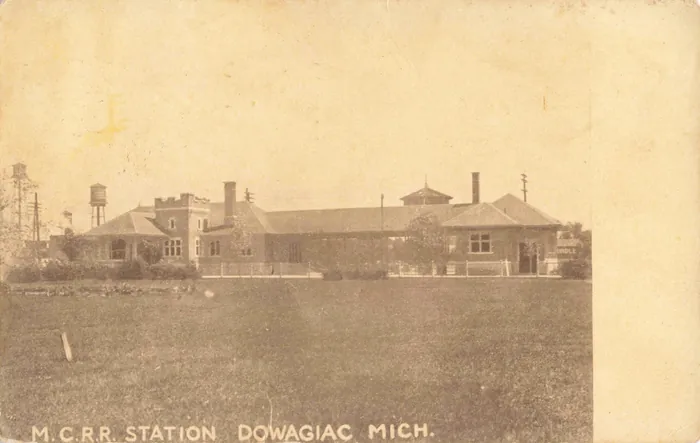
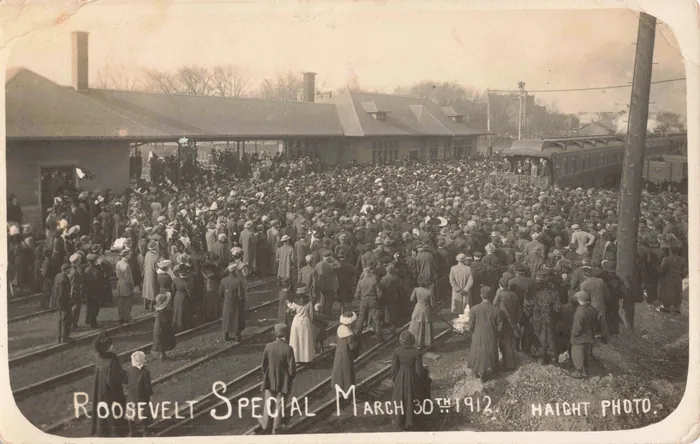
Fires in 1864 and 1866 burned the business blocks on Front Street, and merchants rebuilt in brick. The Universalists built their church on Courtland Street in 1859, where Sojourner Truth later spoke; it has been St. Paul’s Episcopal Church since 1913. Riverside Cemetery was laid out in 1872, and the Beckwith Memorial Theatre, built in red sandstone in Beckwith’s memory, was dedicated by Robert G. Ingersoll in January 1893. James Heddon, who bought the Dowagiac Times in 1885, is best remembered for the fishing lures his family made here. The Michigan Central built the present brick depot about 1903; restored in the 1990s and listed on the National Register in 1993, it still serves Amtrak trains. The 2020 census counted 5,721 people in the city.