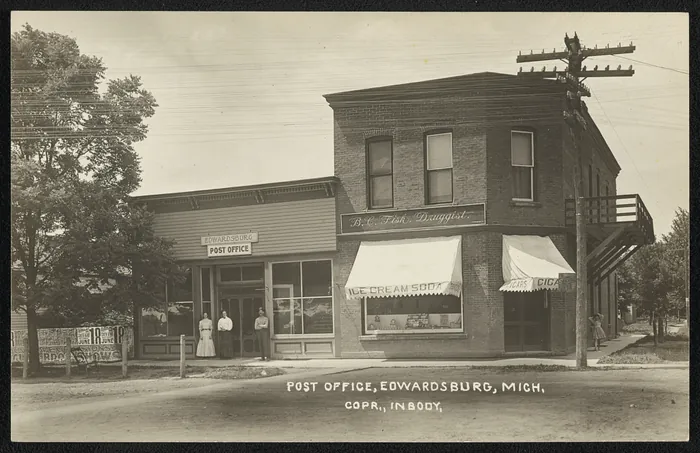
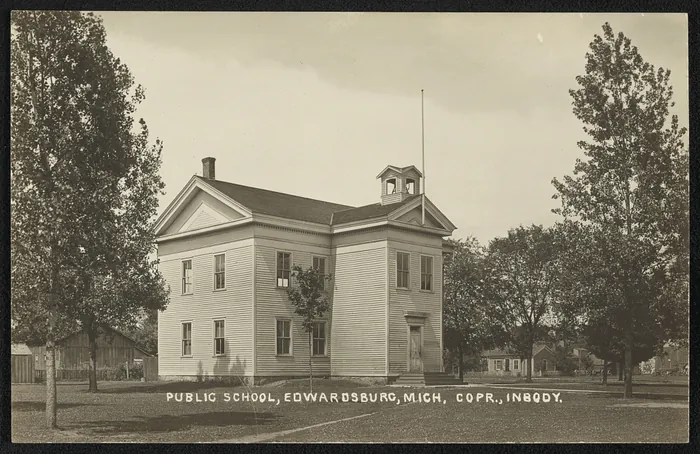
The story
Welcome to Edwardsburg
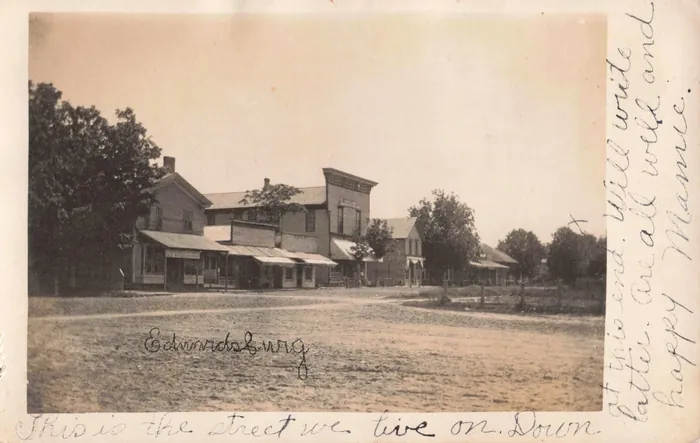
Edwardsburg grew up on the south shore of Pleasant Lake, on the old Chicago road, and for a few bright years in the 1830s it looked like the coming city of southwest Michigan. The county's first Board of Supervisors met here, and the 1882 county history called it the point from which settlers "radiated into the adjacent towns." Then the railroads passed it by, and it had to wait twenty years for a train of its own.
The village began as a store and a tavern on Beardsley's Prairie. Ezra Beardsley of Butler County, Ohio, brought his family to the prairie beside Pleasant Lake in the spring of 1826 and soon kept a tavern for the land-lookers streaming west, a tavern both the 1882 and 1906 county histories call the first in the county. In 1828 Thomas H. Edwards began selling goods from a pole shanty on Lake Street. Rogers (1875) and Mathews (1882) both say the village was named for him and call him the county's first merchant. In 1829 he hired Joseph L. Jacks to peddle goods from a wagon across the countryside and collect the accounts.
Alexander H. Edwards recorded the plat of "Edwardsburgh" on August 12, 1831. Mathews and Glover count forty-four lots, while Rogers describes thirty-one blocks. That fall Jacob and Abiel Silver bought out Thomas Edwards, and Abiel Silver added more lots in 1834 and 1836. The new town was busy with county business. The Board of Supervisors first met at Ezra Beardsley's house in Edwardsburg on October 4, 1831, the probate court sat here in April 1832, and the early circuit court met here too. Rogers says gathering a jury for that court meant a journey of more than two hundred miles, and Sheriff George Meacham had to summon nearly every qualified juror in the circuit.
Read the full story
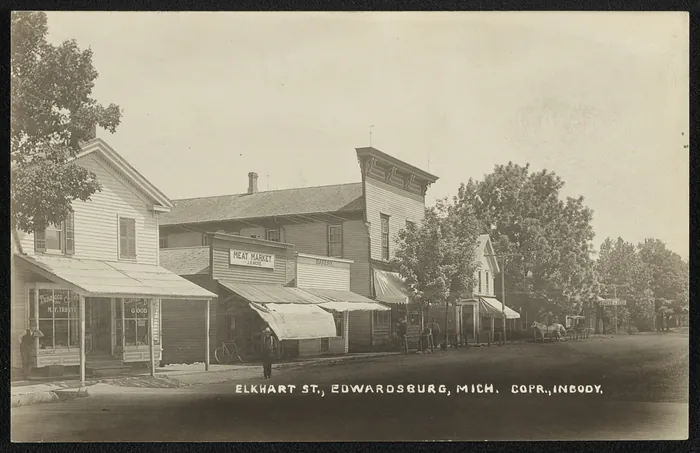
The Detroit and Chicago road made Edwardsburg. From 1832 to 1840, Mathews writes, the road was "literally lined with emigrants," and stage coaches announced by a horn carried passengers and mail through the village. Tradesmen followed. A. C. Marsh opened a foundry in 1839 that made plow castings. James Boyd ran a hat shop from 1837, which Mathews says was the only hat factory ever carried on in the county. A basket maker named Keeler peddled his wares from a cart pulled by an ox called "Bright," and once drove Bright to a political meeting at Niles with flowers on the yoke. Squire Dethic Hewett, justice of the peace from 1850, married couples from Indiana by the hundreds, because here they could wed without a license.
By 1848 the village had about three hundred people, three churches and a good school. Then the Michigan Central reached Niles and the Michigan Southern ran through Elkhart, and Edwardsburg was stranded between them. The stages stopped, merchants packed up, and by 1851 a single small store remained, kept by C. Kennedy. Glover (1906) calls the next twenty years "almost utter isolation."
The rescue came in 1871, when the railroad later known as the Grand Trunk was finished through the village. Mathews compared the town to a phoenix. By 1881 it had about five hundred people, three general stores, seven physicians, a weekly paper called the Edwardsburg Argus, and a grain elevator that shipped 89,600 bushels of wheat in a single year. It also had no saloon. The Edwardsburg Reform Club, organized in 1877, claimed credit for closing the last two. That was a long way from the day the Baptist church frame went up, when the builders refused to raise a bent until someone passed around a jug of whisky.
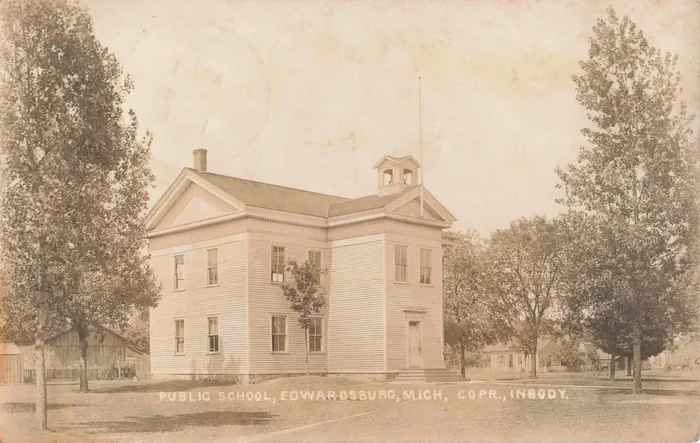
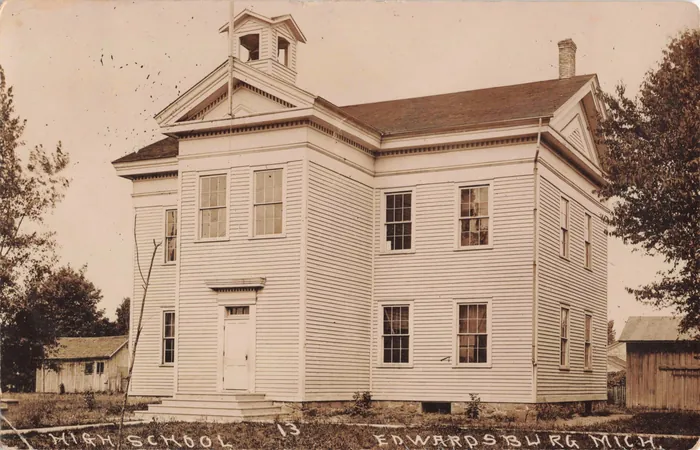
Faith and schooling came early. In March 1831 the missionary Luther Humphrey organized a church whose members pledged to give up ardent spirits. It ran on Congregational lines from 1832, joined the Presbyterians in 1877, and dedicated its second building in 1856. The Baptists organized in 1834 by Mathews's count (Rogers says 1835), and the Methodists in 1837. The first village schoolhouse went up in 1836 on a lot given by Abiel Silver, followed by the "old brick" school and, in 1861, a $3,000 schoolhouse. In 1906 Glover noted that Edwardsburg had never organized as a village and was still protected from fire by a bucket brigade. It incorporated a few years later, in 1911 by Wikipedia's account or 1912 by the Chamber of Commerce's. The 2020 census counted 1,304 people.