The story
Welcome to Coloma
Coloma began in 1849 as a sawmill and a little store on Tannery Creek, where so much business was done by barter that people called the place Dickerville. A pioneer back from the California gold fields renamed it in 1855. Its interurban station, parks and markers tell the story of a fruit-belt town that sent its peaches to Chicago overnight.
The site of Coloma was part of the large Watervliet holdings of the New York land firm of Smith & Merrick. Franklin Ellis’s History of Berrien and Van Buren Counties (1880) says that about 1840 John Williams worked the land for the firm’s agent, Israel Kellogg, living in a log house that later tenants, Adam Prouty and George Becker, took over in turn. In 1844 James S. Johnson and George C. Merrifield bought 320 acres here, and the same year Stephen R. Gilson, who had made shingles at the nearby Shingle Diggings in the 1830s, came back and bought 60 acres on Section 20, where he was still living in 1880.
The village really began in 1849, when Gilson and Gilson Osgood built a water-powered sawmill on Tannery Creek and Martin Musser and partners built a tannery on the same stream. Osgood opened a small store in a shanty. Ellis tells the story of the name: on the first day of trade, nine-tenths of the business was in “dicker,” farm produce swapped for store goods, and the budding village was called Dickerville. Ives Wallingford built the first frame house in 1850, from the first lumber sawn at the mill. Tragedy struck on April 19, 1852, when the mill’s boiler exploded and killed two children, Charlotte Osgood and Shumway Musser.
Read the full story
Gilson went to California in 1850 and came back in 1853. In 1855 he platted the village and, Ellis says, set aside “the time-worn and not very euphonious appellation of Dickerville” for Coloma, after the place where he had lived in California. Ellis adds that Coloma is a Spanish name for a fragrant flower. A post office opened in 1857 with Dr. H. M. Marvin as postmaster. Charles Bostwick’s select school of 1849 became a tavern, which Gilson Osgood bought in 1858 and ran as the Osgood House.
Churches came early. A Methodist class met about 1844 at a schoolhouse west of the village, named Mount Hope after a hill given for a cemetery, and moved into the village as it grew. A Congregational church was organized at Coloma in June 1853, and its building, finished in 1859 with help from the Methodists, was known as the Union Church; the Methodists dedicated their own church in October 1879. A Christian church was organized in 1857, and Coloma Lodge No. 162, F. and A. M., was chartered in 1865.
The Chicago and Michigan Lake Shore Railroad reached Coloma in 1869. Speculators who gave land for the depot laid out a rival “New Coloma” beside it, but local people stayed loyal to the old town, and Ellis found the new plat “a barren reminder of promised greatness.” Dr. William A. Baker, who came in 1868, gave the land for Baker Park in 1885, and Coolidge (1906) records a bank founded in 1896 by Sawyer Ball and his son.
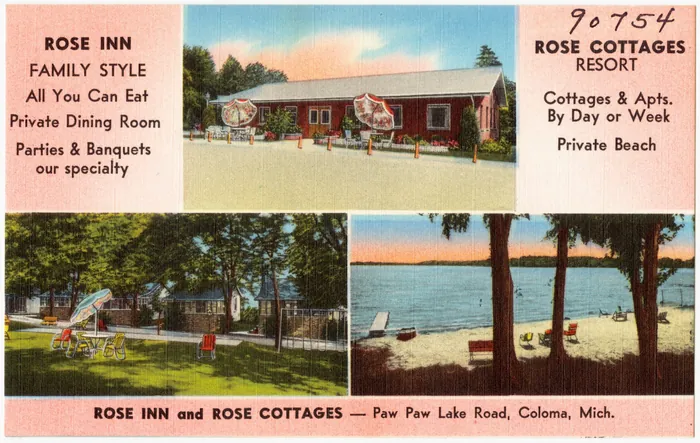
Coloma was incorporated as a village in 1893 and as a city in 1941. In 1910 the Benton Harbor–St. Joe Railway and Light Company built an interurban station here; its transformer gave Coloma its first electricity, a summer spur carried vacationers to the Paw Paw Lake resorts, and evening cars took fruit to Benton Harbor for the overnight run to the Chicago markets. The line was extended to Watervliet in 1913, and passenger and freight service ended in 1928. The city holds the Glad-Peach Festival each August. The 2020 census counted 1,465 people.