The story
Welcome to Vandalia
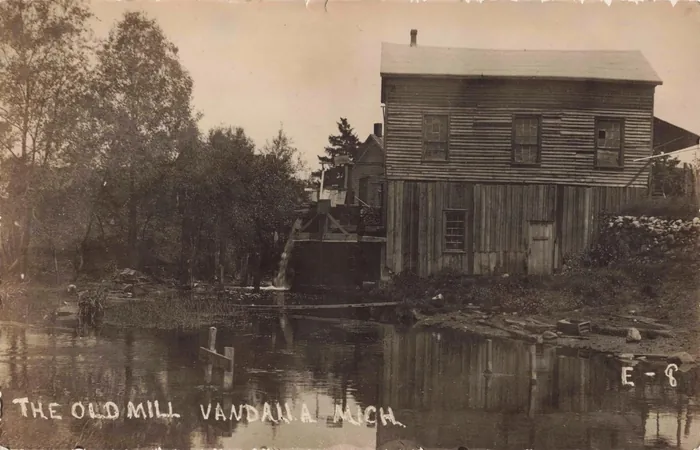
Vandalia began as a gristmill on Christiann Creek, built by two Quaker pioneers who hated slavery. Before the Civil War it stood where two lines of the Underground Railroad joined, and in 1847 its neighbors faced down a party of Kentucky slave catchers. Today it is one of the smallest incorporated villages in Michigan, with a state historical marker in its little park on M-60.
The ground under Vandalia was Potawatomi country until the tribe ceded southwestern Michigan to the United States in the Treaty of Chicago of August 29, 1821. White settlement in Penn Township began on Young's Prairie in the late 1820s, and much of it was Quaker. Howard S. Rogers (1875) says the township itself was named by Friends for William Penn, and L. H. Glover (1906) calls Penn the township 'to which most of the Quaker immigration to Cass county directed its settlement.'
One of those Quakers was Stephen Bogue, born in North Carolina in 1790, whose family had moved to Ohio in 1811 because they could not abide slavery. He entered land in Penn in 1829 and brought his family in the fall of 1831. In time he owned nearly a thousand acres. Alfred Mathews (1882) says Bogue owned the site of the village and that he and a partner built a gristmill on Christiann Creek in 1848-49. Glover dates the mill to 1849 and places it on the state road in Section 27. The partner's name is printed three ways: 'G. P. Ball' in Mathews, 'Charles P. Ball' in Rogers and 'C. P. Ball' in Glover.
Read the full story
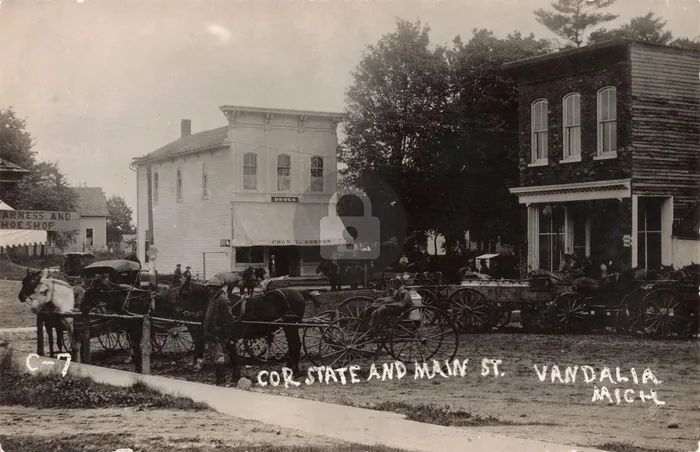
The sources also disagree on when the village was laid out. Rogers gives January 3, 1851, Mathews gives January 3, 1857, and Glover, who went to the plat books, says the plat was filed on February 21, 1851, on the east side of the creek. Everyone agrees on the first faces in town: Abraham Sigerfoos the blacksmith, Asa Kingsbury the first merchant (he ran it as a branch of his Cassopolis store) and T. J. Wilcox the first postmaster. Rogers adds that Dr. A. L. Thorp was the first physician and was still practicing in 1875.
Long before the plat, the Quaker farms around the future village were stops on the Underground Railroad. Bogue's biography in Mathews says he 'aided a very large number of fugitive slaves in their flight to Canada.' In August 1847 armed men from Kentucky came into the county at night and seized people they claimed as property at several Quaker farms, Bogue's among them. Bogue and his neighbor Zachariah Shugart spread the alarm, a crowd of citizens stopped the Kentuckians, and the whole procession went on to Cassopolis, where a court commissioner released the captives, who were hurried to Canada the same night. When the slaveholders sued, Bogue refused every offer to settle, calling such payments 'blood money.'
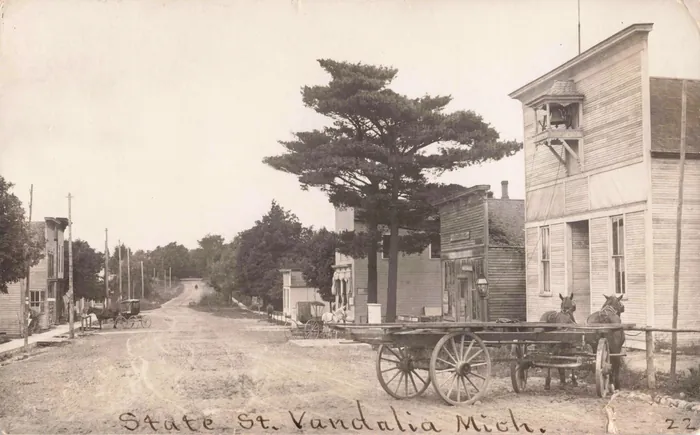
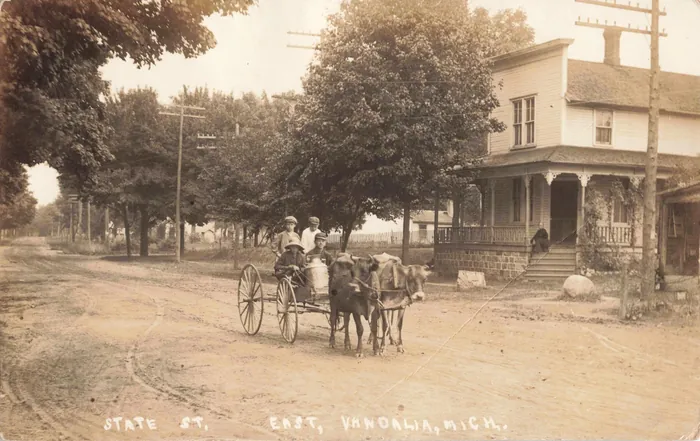
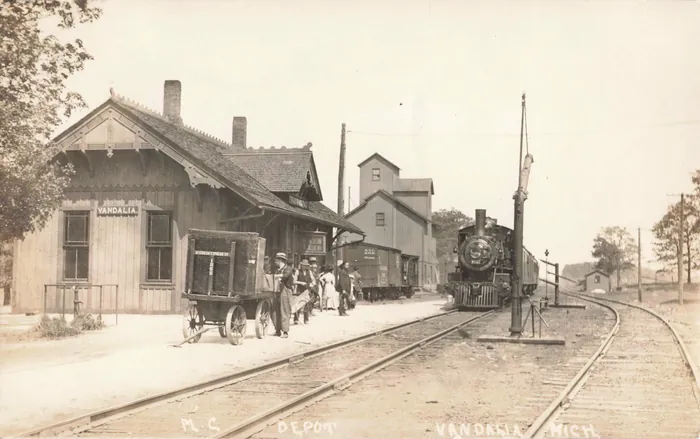
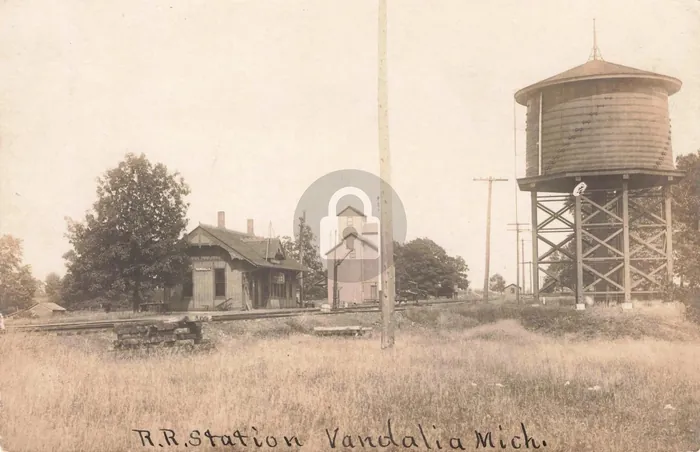
The railroad, a real one this time, made Vandalia a town. The Air Line division of the Michigan Central reached it in 1871, and the village was incorporated in 1875. Rogers, writing that year, counted about 500 people, two hotels, a foundry, a handle factory, a broom factory, a cooper shop employing five men and 'one of the finest school buildings, for a town of the size, in the State.' That school was the brick building of District No. 4, put up in 1873 for $6,500. By 1882 Mathews counted 439 residents.
Faith and fellowship filled the rest of the week. The Christian (Disciples) church organized in 1854 and built that year. The Methodists, who had met in houses and the schoolhouse since the 1830s, finished their own church in 1877. The Friends dedicated a brick meeting house, 34 by 57 feet with a belfry, on December 28, 1879. Vandalia Masonic Lodge No. 290 was chartered in 1871, and a temperance society called the Red Ribbon Society, Mathews reports, had driven the liquor trade out of town by 1882.
In 1957 the Michigan Historical Commission set up a marker in Milo Barnes Park telling how Vandalia sat at the junction of two Underground Railroad lines. The 2020 census counted 318 people in the village.