The story
Welcome to Cassopolis
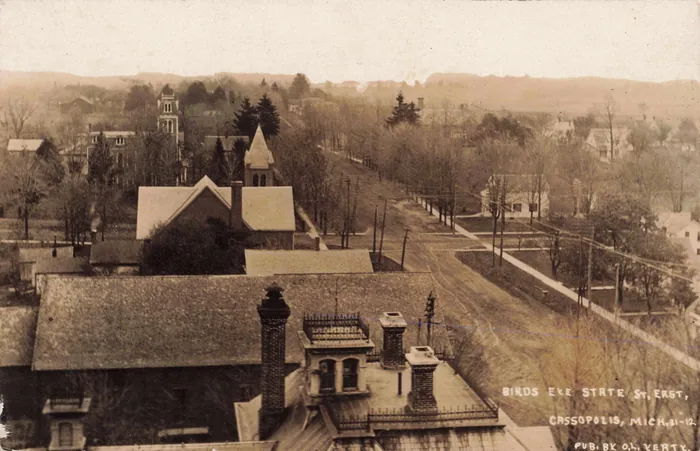
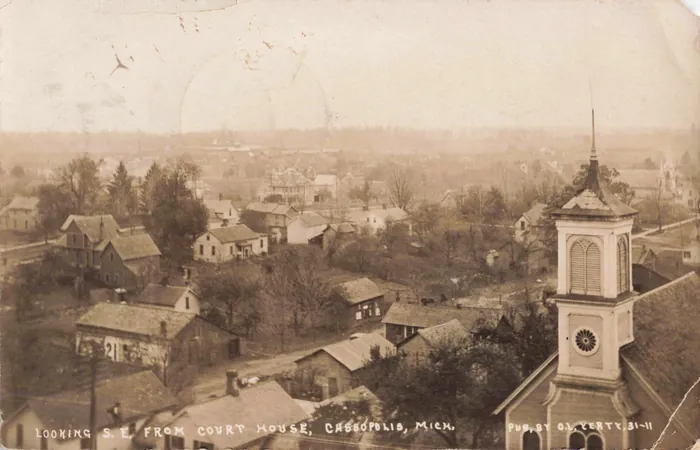
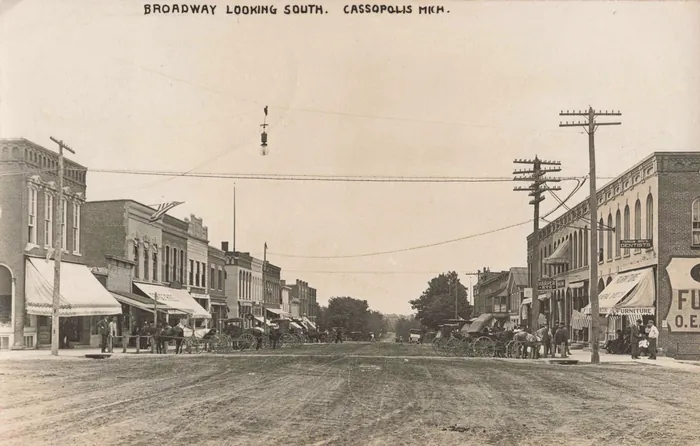
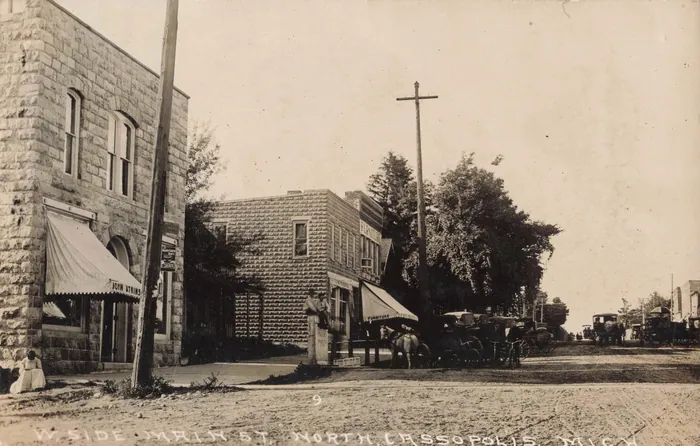
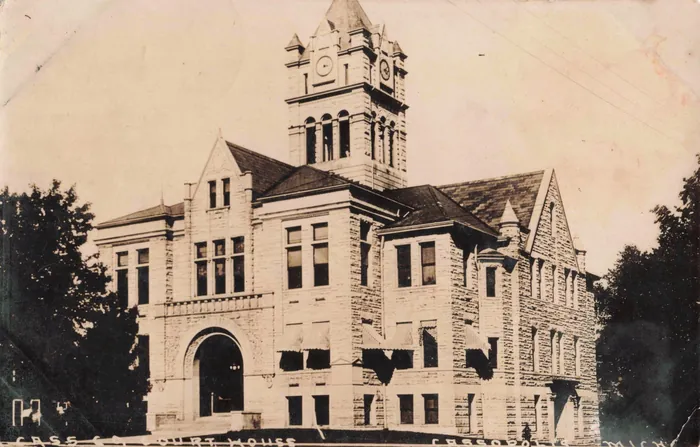
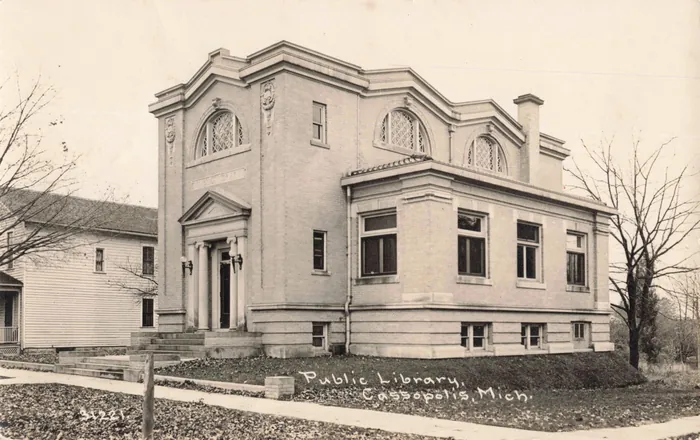
Cassopolis is the seat of Cass County, laid out in 1831 on the east shore of Stone Lake and named, like the county, for Lewis Cass, governor of Michigan Territory. It won the county seat away from another village after a young lawyer’s night ride to the land office, and it kept it. Its courthouse, its log cabin museum and its county library branch make it the first stop for anyone digging into Cass County’s past.
Abram Tietsort Jr. built the first cabin here, a small log house on the east bank of Stone Lake, in 1829 or 1830; his daughter Julia Ann, born July 3, 1830, was the first child born on the village site. Cass County had been set off in 1829, and in 1830 commissioners appointed by the territorial governor placed its seat of justice at Geneva, on Diamond Lake. Howard S. Rogers, the county’s first historian, says the choice “gave much dissatisfaction,” and the commissioners were openly accused of corruption. On March 4, 1831, the Legislative Council ordered a new commission to relocate the seats of Cass, St. Joseph and Branch counties.
Rogers tells how the new site was won. Elias B. Sherman, a young lawyer and surveyor, chose the southeast quarter of section 26 in LaGrange and then overheard three brothers named Jewell planning to enter the same eighty acres. He kept his counsel, walked to Edwardsburg to take Alexander H. Redfield into partnership, and set out “through the cold rain and dismal darkness in this race for a County seat,” borrowing a horse on the way and reaching the land office at White Pigeon ahead of his rivals; the land entry is dated September 22, 1831. With Tietsort, Oliver Johnson and Ephraim McCleary they platted a village “to be called Cassapolis,” promised half the lots to the county, and named three streets, O’Keefe, Rowland and Disbrow, for the new commissioners. The plat was recorded November 19, 1831, and Acting Governor Stevens T. Mason’s proclamation of December 19 fixed the county seat there.
Read the full story
When the plat was recorded there was not a building on it. Ira B. Henderson opened a tavern in a double log cabin; in 1832 Jacob Silver and Robert Painter began selling goods, Sherman and Redfield built a frame house on the square, and Eber Root put up a frame tavern. The first court sat in the fall of 1832 under an oak tree south of the square, and on January 1, 1833, Bishop Philander Chase married Sherman to Sarah Silver in the loft over the Silvers’ store and held the village’s first religious service. In 1833 the Silvers raised a distillery so heavy that, Rogers says, the raising took the men of the country for ten miles around three days. Redfield kept the post office in the Silvers’ store. A frame courthouse of 1839–41 stood on the public square for more than half a century.
Cassopolis lay on what Rogers called the “Quaker line” of the Underground Railroad, and in August 1847 it was the scene of the hearing that set free nine people whom raiders from Kentucky had tried to carry back from the Quaker farms of the county. A year earlier, in the spring of 1846, the village had a lodge of the “Ancient and Honorable Order of the Eclampsus Vitus,” a burlesque of secret societies, with Dr. E. J. Bonine, Laban Harter, J. P. Osborn and Dr. L. Osborn as charter members; Rogers says its ball at the Union Hotel in the winter of 1846–47 showed “over two hundred badges.” The Odd Fellows organized in 1847, the Masons in 1852, and the Presbyterians built their church in 1846.
The railroads at first passed Cassopolis by. When the Michigan Central was finished through the north of the county about 1848, many business and professional men moved to the line and helped found Dowagiac, and Rogers says the county seat stood “almost at a stand still” for twenty years. The village was incorporated by the board of supervisors in 1863, when a census counted 475 people, and received a special charter in 1875. Then two railroads came at once: the Michigan Air Line laid track to the village on November 28, 1870, and the Peninsular (later the Grand Trunk) in February 1871. By 1875 about a thousand people lived here, and Glover counted 1,477 by the state census of 1904. The spelling settled as Cassopolis; Rogers says the National Democrat made the change in 1865, and postal listings give Cassapolis until 1870.
A stone courthouse replaced the old frame one in 1898–99, and the old courthouse was moved off the square to become the Colonial Opera House. In 1906 the Kellogg Switchboard and Supply Company bought a new drill works by the Grand Trunk depot, and for years its telephone cabinets were made here. In 1923 the people of the county hauled in logs from their own woods to raise the two-story Pioneer Log Cabin on the shore of Stone Lake, opened as a museum the next year. The 2020 census counted 1,712 people in the village.