The story
Welcome to Adamsville
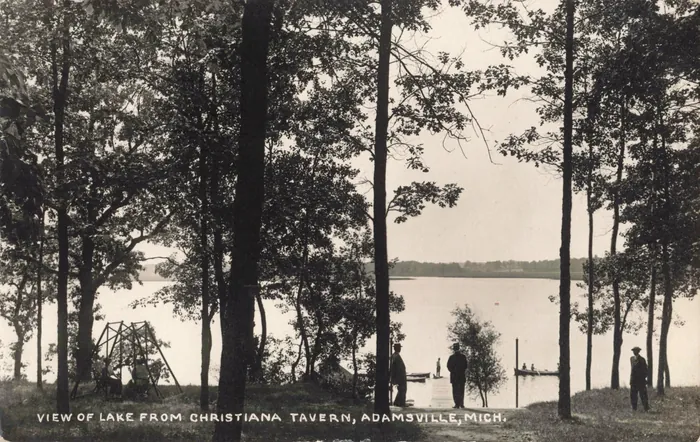
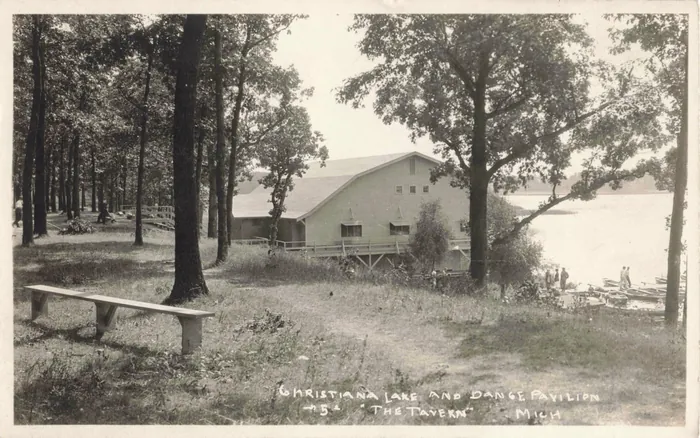
Adamsville began as two rival paper villages facing each other across Christiana Creek on the old Chicago Road. One was Sterling Adams's Adamsport, the other Moses Sage's Christiana. The Sages' gristmill, running night and day, made the place, and the railroads later passed it by.
The country around Adamsville was Potawatomi land, given up by the Treaty of Chicago of 1821. The community lies near the eastern edge of Ontwa Township, about five miles east of Edwardsburg, where the old Chicago Road crossed Christiana Creek. Rogers tells how the creek got its name: the missionary Isaac McCoy named it for his wife, Christiana, when their party crossed it on December 18, during the mission's move to the Carey Mission near Niles in December 1822. 'If no other monument shall bear her name,' Rogers wrote, 'this placid stream will in all future time remind the beholder of its namesake.'
The Chicago Road was the great highway from Detroit to Chicago until about 1850, and Mathews traces it through Adamsville to Edwardsburg. Sterling Adams, a justice of the peace in early Ontwa, laid out the village of Adamsport on the east side of the creek, with seventy-nine lots, bisected by the road. On the opposite bank Moses Sage platted a rival village called Christiana, with forty-eight lots and a public square, and additions by George Stevens and L. Johnson followed in 1836. In time both sides came to be known by one name, Adamsville. Adams was the first postmaster, and in 1833 the Legislative Council named him one of the commissioners to lay out a road from Adamsville to the Paw Paw River.
Read the full story
'The Sages made the town,' an old resident told Glover. Moses Sage built the first gristmill in 1835, and it ran night and day for several years, paying 44 to 50 cents a bushel for wheat while flour sold for $2.50 a barrel. In the winter of 1843-44 speculators drove flour up to $6 a barrel, and Sage sold 6,000 barrels he had stored at Niles, which got him out of debt. The Sage family, Moses and his sons Martin G. and Norman, stayed prominent in milling and business for three-quarters of a century, later from Elkhart. Horace Thompson, a carpenter who came in 1831, worked on the first flouring mill, and young men like William Nutting of Vermont found their first jobs with the Sages. A man named Halsted built a hotel about 1835 that Rogers found still taking in 'the weary traveler' forty years later.
Dr. Henry Follett, an assistant surgeon in the War of 1812, brought his wife and six children from New York to Adamsville in August 1836 and practiced there and on a farm nearby until his death in 1849. Baptists built a church at Adamsville for $2,300, but it burned in about a year, and the congregation later rebuilt in Mason Township. In 1849 Adamsville was named as a possible route for a plank road from Niles to Mottville, though only the Niles to Edwardsburg stretch was ever built.
Adamsville never became the manufacturing rival to Edwardsburg its founders hoped for. Rogers in 1875 counted 126 people, a general store, a flour mill with four run of stone, a sawmill and heading factory, and wagon, blacksmith and cooper shops. Mathews gave 133 people in 1882, with a hotel, store, blacksmith shop and gristmill. Once the railroads set up new trade routes, Glover wrote in 1906, Adamsville began to decline, though the census still found 207 people living there, with two groceries and a United Brethren church. The post office closed when rural free delivery made it unnecessary, and the water power had passed from the Sage estate to H. E. Bucklen.
Adamsville Cemetery, on Adamsville Road at May Street, holds early Sage graves and that of Sterling Adams, who died in 1846, according to the volunteers who read its stones.