The story
Welcome to Marcellus
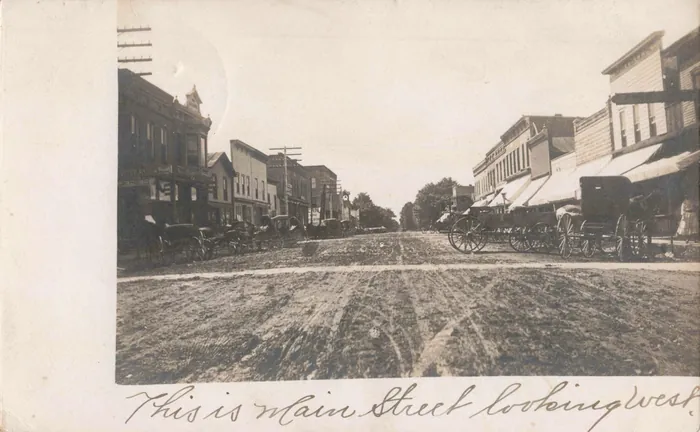
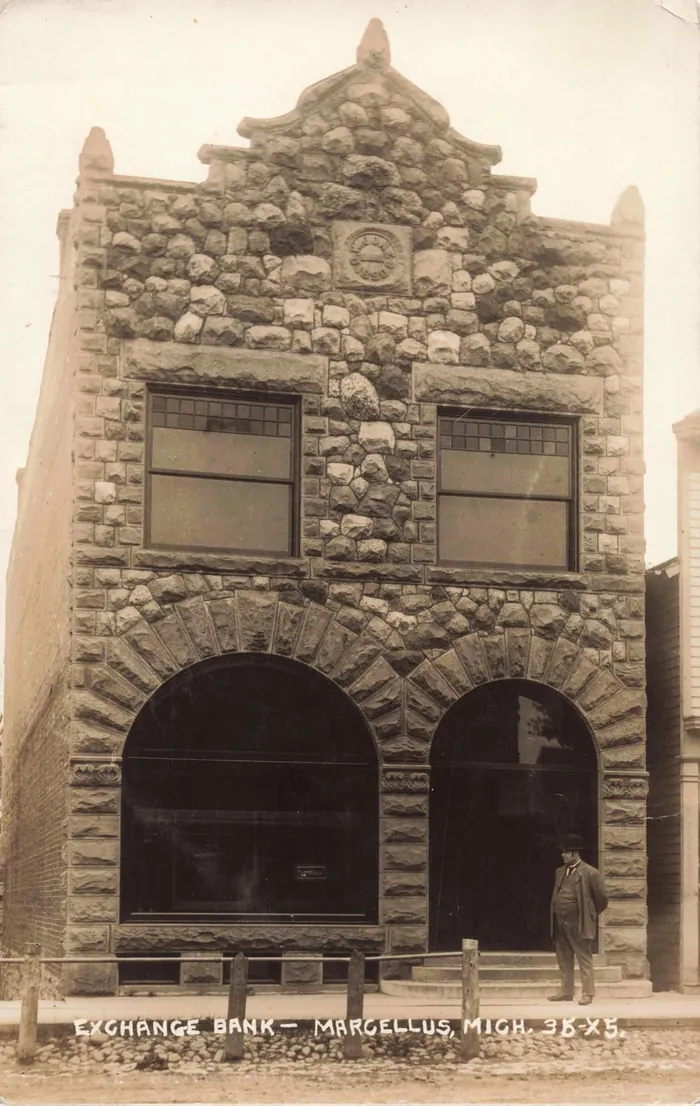
Marcellus is a railroad town that was planned before the trains arrived. In 1868 the spot held two farmhouses in the timber of Cass County's last-settled township; within a dozen years it had a bank, a newspaper, three hotels and a brick school. Later it became the town that told Michigan, every spring, that you can catch fish in Marcellus.
For most of the 1830s, settlers passed this corner of Cass County by. Alfred Mathews, writing in 1882, says the heavy timber, the marshes and the 'malaria,' and big tracts held by speculators kept Marcellus Township empty while the prairies to the south and west filled up. When Thomas Burney came back to the township in 1868 and set up on the site of the present village, there were, Mathews says, only two farmhouses inside what became the village limits. Burney put up the first business building that year and sold goods with his son Levi.
What changed everything was the Peninsular Railroad, later part of the Grand Trunk, which Rogers says came through in the winter of 1870 and 1871, angling across the middle of the township. In 1868 George W. Jones, a Young's Prairie landowner, bought 211 acres at the center of the township, on the line of the coming road, sure it would make a village site. The plat, drawn with Leander Bridge, M. Snyder and George R. Roach, was completed April 9, 1870, and recorded April 23 of that year. Glover says the village was first called Marcellus Center, and that its blocks copied the plan of Cassopolis.
Read the full story
The firsts came fast. Mathews lists them: Thomas Burney the first merchant, John Manning the first grocery, Daniel Morrison the first blacksmith shop, G. Doolittle the first wagon shop, Herman Chapman the first hardware store and Lewis Arnold the first hotel. Railroad booster Warren O. Matthews became the first station agent and later the postmaster. Burney paid a price for the boom: he sold goods to the railroad laborers on company orders that were never paid, and Mathews says he never recovered from the loss.
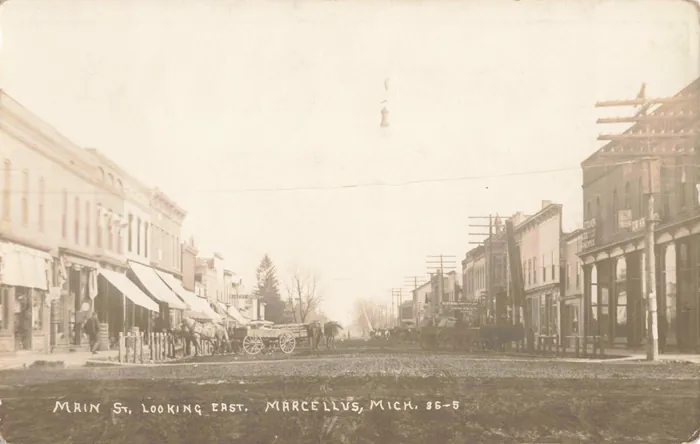
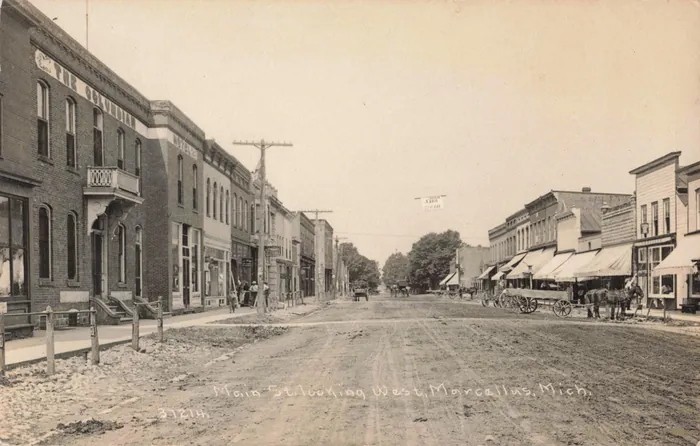
Marcellus was incorporated as a village in 1879, with David Snyder as its first president. By 1882 Mathews counted 635 people, three churches, four dry goods stores, three hotels, two saloons, a stave factory, a planing mill, a private bank and a weekly paper, the Marcellus News. In one 'wheat year' 180,000 bushels of wheat were bought at Marcellus, and two elevators stood by the tracks. Rogers, seven years earlier, had counted about 500 people and a paper called the Messenger.
Schooling grew right along with the town. The village school district, No. 9, built a one-story brick schoolhouse 24 by 36 feet for $1,000, added a second story in 1876 and then overflowed into rented halls, including Centennial Hall. In the fall of 1881 a two-story brick school costing $8,000, with a tower, four classrooms and seats for 350 pupils, opened on three wooded acres on the south side of the village. Mathews dates the district to 1873 and Glover to 1874.
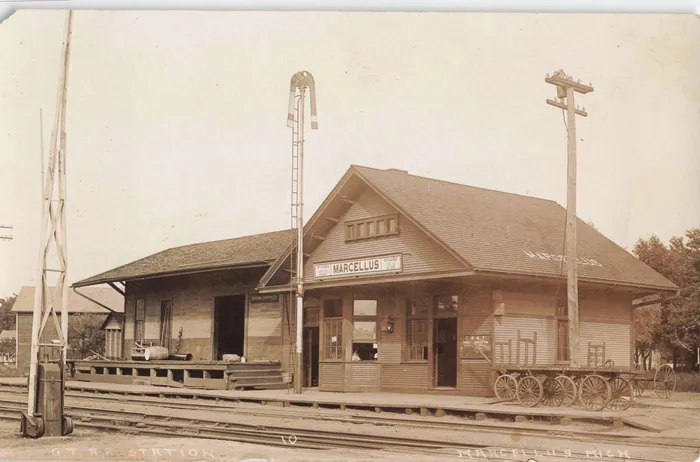
The railroad kept shaping the town. According to the village's own history, the first depot stood on the east side, too far from the business district, so it was moved in 1898, and by 1911 ten passenger trains stopped each day. At its height the village had two theaters, a bowling alley and a pool hall. A young soldier, Russell A. Wood, who died of influenza in an army camp during the First World War, left $7,000 in his will for a library. The village and township added the rest, and the Wood Memorial Library opened on East Main Street in 1925.
Then there is the fish. In 1939 Marcellus held its first Bluegill Frolic to open the fishing season, and about 4,000 people came for a parade, a water fight and the crowning of a Frolic Queen, according to the Marcellus News. After the war the Frolic became a two-day affair with a fishing contest, and by the 1950s crowds reached about 20,000. The early slogan said it plainly: 'You can catch fish in Marcellus.' The 2020 census counted 1,074 people in the village.