Made in the Valley
What the valley made
Stoves and seed drills, fishing lures and band horns, wagons, plows, guitars, rubber boots, washing machines, celery and peaches. For a century the towns of the St. Joseph River valley made things the whole country knew by name. Here are 23 of the makers: who started them, what they made, how they ended, and where you can still see their work.
Jump to: Cass County Berrien and St. Joseph counties Kalamazoo South Bend and Mishawaka Elkhart The map The timeline
The makers on the map
The map opens here.
A century and a half of making
When each maker worked in the valley, from the dates on its entry below. A bar running to the right edge is still going; a fading bar is one whose end we have not pinned down.
- Studebaker1852–1963
- M. Rumely Company1853–1983
- Oliver Chilled Plow Works1855–1985
- Kalamazoo celery growing1856–2000
- Benton Harbor Fruit Market and the Michigan Fruit Belt1860–today
- Mishawaka Woolen Manufacturing Co.1867–1997
- Singer Manufacturing Company cabinet works1868–1955
- Round Oak Stove Company1871–1947
- C. G. Conn1875–1972
- Coppes Bros. & Zook1876–today
- Sheffield Car Company1879–1918
- Dowagiac Drill Company / Dowagiac Manufacturing Co.1881–?
- Dr. Miles Medical Company / Miles Laboratories1885–?
- The Upjohn Company1886–1995
- Shakespeare Company1897–1970
- James Heddon's Sons1902–1984
- Gibson Mandolin-Guitar Manufacturing Company1902–1984
- Kalamazoo Stove Company1902–1952
- Clark Equipment Company1904–?
- Kawneer Company1907–?
- Upton Machine Company1911–today
- Checker Cab Manufacturing / Checker Motors1923–1982
- Bendix Corporation1924–?
Cass County, Michigan
Dowagiac, MI
Round Oak Stove Company
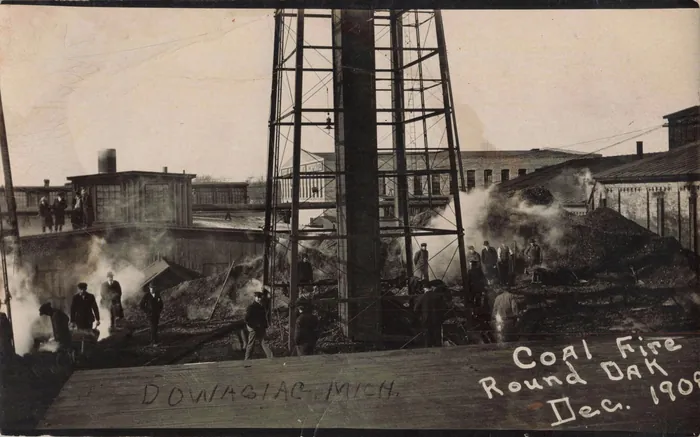
Coal Fire, Round Oak, Dec. 1909 · 1908 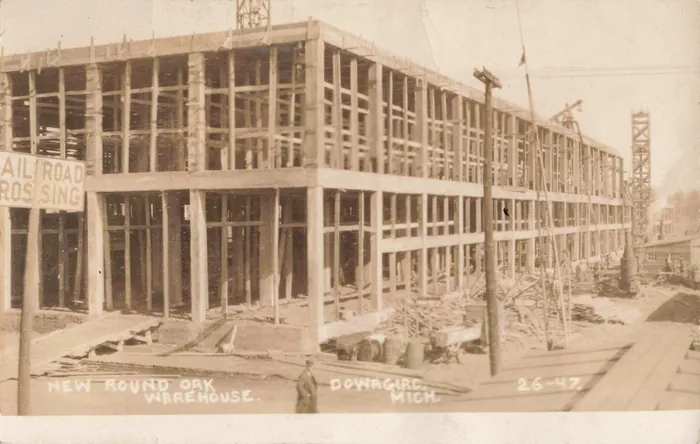
New Round Oak Warehouse, Dowagiac, Mich. · about 1910–1918 Philo D. Beckwith opened a foundry in Dowagiac in the 1850s and cast his first stove around 1867 to heat the struggling shop. The Michigan Central Railroad then ordered heaters for its depots between Detroit and Chicago, and by 1871 stoves were his main product. By 1900 Round Oak was one of the largest stove factories in the United States. Its 1890s advertising claimed more than a million Round Oak stoves were in use.
- Begun
- 1871
- By
- Philo D. Beckwith
- Made
- Heating stoves, later furnaces and cooking stoves
- At its height
- About 1,200 workers in the 1910s, in a town of five or six thousand people.
- How it ended
- Decline began in 1914 after the deaths of salesman O. G. Beach and Arthur Beckwith; stove production ended in 1946-47. In 1947 the buildings were sold to Kaiser-Frazer and the Round Oak name went to Peerless (repair parts). A revival under new owners in 1948 ended in the 1950s.
- Today
- The 1910s Round Oak foundry complex on Spaulding Street is still in use by Ameriwood Furniture. The Beckwith Memorial Theatre (1893) is gone.
See it: Dowagiac Area History Museum
Have something Round Oak Stove Company made? Add it to the heirloom cabinet ›
Dowagiac, MI
Dowagiac Drill Company / Dowagiac Manufacturing Co. (grain drills)
Before stoves, Beckwith’s Dowagiac foundry was built around a roller grain drill; an 1863 patented Beckwith design used heavy cast-iron wheels to smooth the soil as it planted, and in 1869 Michigan awarded him a silver medallion for his two-horse drill. The Dowagiac Drill Company followed in 1881. Dowagiac drills were sold across the United States and in Europe, South America and Asia, and 1899 advertising called the works the “largest drill factory in existence.”
- Begun
- 1881 (Dowagiac Drill Company); Beckwith’s drill business earlier
- By
- Grew out of P. D. Beckwith’s grain-drill trade
- Made
- Grain drills (seed-sowing machines)
- Today
- The Dowagiac Area History Museum keeps grain-drill artifacts with its Round Oak collection. A Beckwith & Lee drill of about 1890 is in the collection of The Henry Ford.
See it: Dowagiac Area History Museum · The Henry Ford
Have something Dowagiac Drill Company made? Add it to the heirloom cabinet ›
Dowagiac, MI
James Heddon's Sons
The story goes that James Heddon, a former beekeeper, was whittling by Dowagiac’s Mill Pond in the late 1890s when a bass struck a piece of wood he tossed into the water. He went on to build a top-water lure he called the “Dowagiac.” The company was founded in 1902, first making lures by hand in the family kitchen and in a new Dowagiac factory by 1904. By the 1920s it was called the world’s largest producer of quality fishing tackle; most of its workers were women.
- Begun
- 1902
- By
- James Heddon (with his sons)
- Made
- Artificial fishing lures, rods and reels
- How it ended
- Lures were made in Dowagiac until 1984. The brand lives on under later owners.
- Today
- The Heddon Museum in downtown Dowagiac holds more than 1,000 lures, 140 reels and 150 rods, including an original James Heddon frog.
See it: Heddon Museum
Have something James Heddon's Sons made? Add it to the heirloom cabinet ›


Berrien and St. Joseph counties, Michigan
Benton Harbor, MI
Benton Harbor Fruit Market and the Michigan Fruit Belt
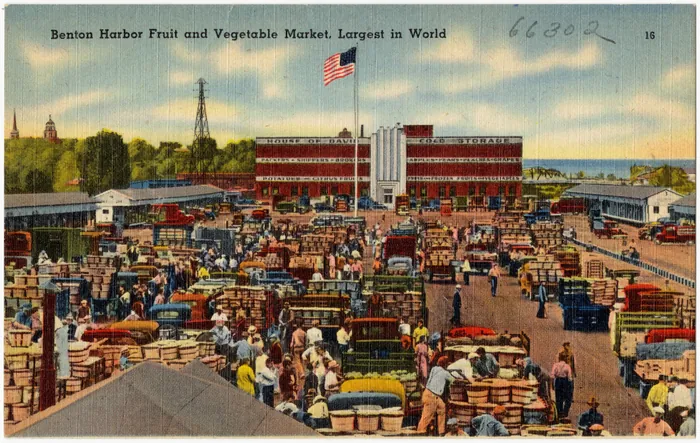
Benton Harbor Fruit and Vegetable Market, largest in the world · about 1930–45 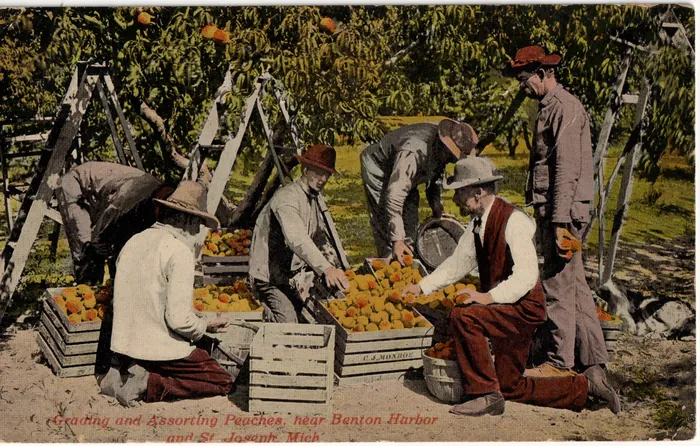
Grading and assorting peaches near Benton Harbor and St. Joseph, Michigan · 1913 Lake Michigan tempers the weather along a narrow coastal strip, and by the 1840s Berrien County was already shipping peaches to Chicago. The Benton Harbor market was established in 1860 as an outlet for the region’s fruit. A 1914 motorists” guide declared that “No tour through Michigan is complete without a ride through the famous Fruit Belt.”
- Begun
- 1860
- Made
- Peaches, apples, cherries, berries, grapes, pears, plums
- At its height
- In the 1940s it was called “the largest cash-to-growers outlet in the world.”
- How it ended
- Still operating seasonally; it moved from downtown Benton Harbor to Territorial Road (in Benton Township, 1967) with urban-renewal funds.
- Today
- The market still trades each summer, with nearly 100 commodities passing through. A State of Michigan “The Fruit Belt” historical marker tells the region’s story.
See it: Benton Harbor Fruit Market
Have something Benton Harbor Fruit Market and the Michigan Fruit Belt made? Add it to the heirloom cabinet ›
St. Joseph / Benton Harbor, MI
Upton Machine Company (Whirlpool)
Lou Upton received the patent for a hand-cranked clothes washer from a failed appliance dealer, his uncle Emory added an electric motor, and with $5,000 from L. C. Bassford the Upton Machine Company began building electric wringer washers in St. Joseph in 1911. A 1916 contract to build two washers for Sears, Roebuck saved the young firm. It merged with the Nineteen Hundred Washer Company in 1929 and took the name Whirlpool Corporation in 1950.
- Begun
- 1911
- By
- Lou Upton and his uncle Emory Upton
- Made
- Electric wringer washing machines, later home appliances
- How it ended
- Still in business.
- Today
- Whirlpool Corporation is headquartered in Benton Harbor.
Have something Upton Machine Company made? Add it to the heirloom cabinet ›
Niles, MI
Kawneer Company
Francis J. Plym, a Swedish-born architect, patented a way of framing plate-glass shop windows in heavy rolled copper, which would neither rot like wood nor rust like iron; the patent was granted May 15, 1906. The company name came from Kansas City’s Kaw River. Local promoter Carmi R. Smith is said to have met Plym while he was changing trains at Niles, and in early 1907 the company moved there with help from the local Business Men’s Association. Kawneer grew from window frames to door frames and complete shop fronts.
- Begun
- 1906 (Kansas City); moved to Niles early 1907
- By
- Francis J. Plym, architect
- Made
- Metal storefront framing and complete storefronts
- How it ended
- Kawneer left Niles for the Atlanta area sometime in the 1970s or early 1980s (sources differ). The company continues today.
- Today
- Plym donated Plym Park to Niles, and it is still in use. Kawneer aluminum panels that covered downtown Niles storefronts in the 1970s were removed in the 2003-04 revitalization.
Have something Kawneer Company made? Add it to the heirloom cabinet ›
Buchanan, MI
Clark Equipment Company
The company began in Chicago making a tougher drill for boring holes in steel rails, and moved to Buchanan in 1904 when the chamber of commerce offered free rent and cheap power. Eugene B. Clark, a 33-year-old Illinois Steel engineer, took over management, and the firm became Celfor Tool (1906) and then Clark Equipment (1916). Buchanan made steel truck wheels and an internal-gear drive axle that became an industry standard. Foundry workers built a gas-powered shop buggy to move material around the plant; as the Trucktractor it was sold to others, and its features went into Clark’s lift truck in 1927.
- Begun
- 1903 in Chicago as George R. Rich Manufacturing; moved to Buchanan 1904; Clark Equipment formed 1916
- By
- Eugene B. Clark (with George R. Rich’s drill company)
- Made
- Rail drills, then truck axles and wheels, and industrial trucks (the Trucktractor, ancestor of the forklift)
- How it ended
- Ingersoll-Rand bought Clark in 1995 and sold it to Doosan in 2007.
Have something Clark Equipment Company made? Add it to the heirloom cabinet ›
Three Rivers, MI
Sheffield Car Company (Sheffield Velocipede Car Co.)
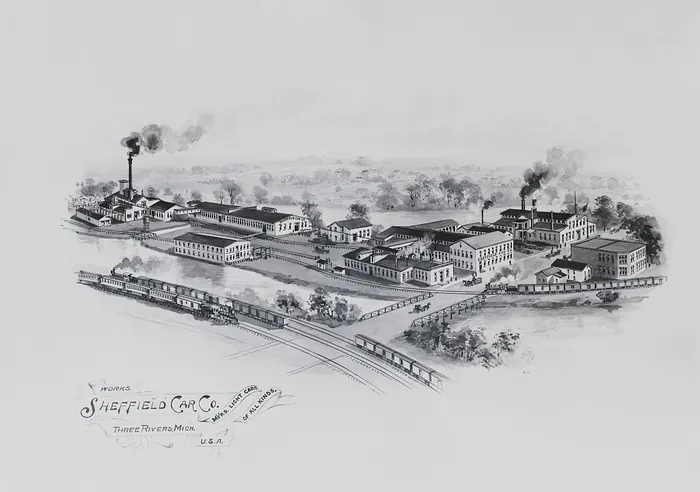
Sheffield Car Co. works, Three Rivers, Mich., U.S.A · between 1890 and 1910 George S. Sheffield, a Michigan farmer, patented a three-wheeled railroad hand car (Patent No. 213,254, 11 March 1879) and built the business in Three Rivers. In 1888 Charles H. Morse of Fairbanks, Morse & Co. bought Willits’s interest, and Fairbanks-Morse became the sales agent for Sheffield products; the company was reorganized as Sheffield Car Co. in 1892. By 1896 it offered velocipedes with small gasoline engines, and one estimate puts velocipede output at about 4,000. A Sheffield velocipede survives at the Buckinghamshire Railway Centre in England.
- Begun
- 1879 (George S. Sheffield & Co.); incorporated 15 June 1882
- By
- George S. Sheffield, with Warren Willits and E. B. Linsley
- Made
- Railroad velocipedes and handcars, motor section cars, street-car trucks
- At its height
- By 1910 the works occupied 40 acres and built light motor cars up to street-car size, dump cars, mining cars and marine engines.
- How it ended
- Absorbed into Fairbanks, Morse & Co. in 1918 and later run as its Sheffield Works on Fourth Street. When the plant closed is not settled.
See it: Buckinghamshire Railway Centre
Have something Sheffield Car Company made? Add it to the heirloom cabinet ›


Kalamazoo
Kalamazoo, MI
Kalamazoo celery growing
A Scotsman, George Taylor, is credited with planting celery in Kalamazoo in 1856. Cornelius De Bruin, who came from the Netherlands in 1866, developed the stalk type, and Dutch farmers turned the muck lands into celery fields. Celery was shipped by rail from 1871, and vendors, often young boys, sold stalks to passengers at the Michigan Central depot. Growers wore wooden shoes, and their horses wore wide wooden shoes to keep from sinking in the muck.
- Begun
- 1856 (George Taylor’s first planting, by tradition); Dutch growers from 1866
- By
- George Taylor; Cornelius De Bruin and other Dutch growers
- Made
- Celery (blanched, “Kalamazoo celery”)
- At its height
- More than 1,000 acres were still in celery in 1939; the 1910 city directory ran six and a half pages of growers.
- How it ended
- Paper-mill wells lowered the water table, blight struck in the 1930s and outside competition grew. By 1985 one grower remained, and he was gone by about 2000.
- Today
- Former celery growers turned to flowers, and Kalamazoo became one of the leading U.S. producers of bedding plants. A historical marker stands at Park Street and Crosstown Parkway.
Have something Kalamazoo celery growing made? Add it to the heirloom cabinet ›
Kalamazoo, MI
Gibson Mandolin-Guitar Manufacturing Company
Orville Gibson, a New Yorker who came to Kalamazoo in the 1880s, worked as a clerk and carved mandolins in his spare time. He was making them full-time by 1896, and five local men then offered to fund a factory for his instruments. The company moved to Parsons Street in 1917 and stayed nearly seven decades, growing to about 120,000 square feet over a whole city block. The Super 400 (1934) and the Les Paul (1952) were made there.
- Begun
- 1902 (financing agreement); incorporated 1904 per Kalamazoo Public Library
- By
- Orville Gibson (with five Kalamazoo backers)
- Made
- Mandolins and guitars
- At its height
- In the 1960s, over 1,000 guitars a day and nearly 1,000 workers.
- How it ended
- Headquarters moved to Nashville in 1981 and the Kalamazoo plant closed in 1984.
- Today
- Four former Gibson workers formed Heritage Guitar, Inc., which still builds guitars in part of the old Parsons Street plant.
See it: Kalamazoo Valley Museum
Have something Gibson Mandolin-Guitar Manufacturing Company made? Add it to the heirloom cabinet ›
Kalamazoo, MI
The Upjohn Company
Dr. W. E. Upjohn patented a “friable” pill in 1885, one that crumbled easily to powder, when most hard pills passed through the body undissolved. To prove it he mailed pine boards to thousands of physicians with his pills and rivals”, inviting them to hammer each pill into the wood and compare. A thumb crushing a pill became the company trademark for about 60 years. In the 1950s Upjohn’s chemistry made steroids such as cortisone affordable, and later products included Motrin and Rogaine.
- Begun
- 1886 (in Hastings, as Upjohn Pill and Granule Co.; moved to Kalamazoo)
- By
- Dr. William E. Upjohn, with his brothers Henry and James
- Made
- Pills and pharmaceuticals
- How it ended
- Merged with Pharmacia in 1995; the Portage works later passed to Pfizer.
- Today
- The Portage plant, opened in 1951, still makes medicines. W. E. Upjohn was named the Kalamazoo Gazette’s “Person of the Century” in 2000.
Have something The Upjohn Company made? Add it to the heirloom cabinet ›
Kalamazoo, MI
Kalamazoo Stove Company
The Kalamazoo Stove Company made stoves and furnaces from 1902 to 1952 and was one of the first manufacturers to sell directly to customers by mail rather than through stores, under the slogan “A Kalamazoo Direct to You.” In 1937, its peak year, it made 100,000 stoves.
- Begun
- 1902
- Made
- Stoves, ranges and furnaces sold by mail
- At its height
- 100,000 stoves in 1937; over 2,700 employees and two Kalamazoo plants at its height.
- How it ended
- Stove and furnace production stopped in 1952 as buyers moved to gas and electric; parts were supplied for years afterward.
See it: Kalamazoo Valley Museum
Have something Kalamazoo Stove Company made? Add it to the heirloom cabinet ›
Kalamazoo, MI
Shakespeare Company
William Shakespeare Jr. patented a level-winding fishing reel in 1896, which laid line evenly on the spool so anglers no longer had to guide it with a thumb, and founded his company in Kalamazoo in 1897. The firm grew from Water Street to Pitcher Street (1913) and to 241 E. Kalamazoo Ave. (1939). From 1945 it made the first fiberglass fishing rods. A 1948 strike of about 700 workers led to a riot and a record-length conspiracy trial.
- Begun
- 1897 (incorporated 1905)
- By
- William Shakespeare Jr.
- Made
- Fishing reels, rods and lines
- At its height
- No peak figure found; about 700 employees were involved in the 1948 strike.
- How it ended
- Headquarters moved to Columbia, South Carolina, in 1970; a Kalamazoo division stayed on, and successor Speareflex abandoned the site in 1989.
- Today
- The Shakespeare Pub occupies one of the Art Deco company buildings and keeps the name alive.
Have something Shakespeare Company made? Add it to the heirloom cabinet ›
Kalamazoo, MI
Checker Cab Manufacturing / Checker Motors
Morris Markin, a Russian-born tailor who had taken over a Chicago cab fleet, formed the Checker Cab Manufacturing Corporation in May 1922 and moved production to two empty auto plants on Pitcher Street in Kalamazoo in 1923. Albert Kahn designed new buildings in 1929. By 1965 more than a quarter of the nation’s cabs were Checkers, and they became a New York City icon. Detroit automakers refused filming access for the 1978 film Blue Collar, so it was shot at the Checker plant.
- Begun
- 1922 (Chicago); in Kalamazoo from 1923
- By
- Morris Markin
- Made
- Taxicabs
- At its height
- Over 100 vehicles a day and about 5,000 a year at peak.
- How it ended
- The last Checker cab came off the line on 12 July 1982. The company then made stampings, went bankrupt and closed at the end of June 2009, after 87 years in Kalamazoo; much of the plant was demolished in 2010.
- Today
- The 1929 Kahn building, machine shop and test track remain. The last cab, apple green, is at the Gilmore Car Museum.
See it: Gilmore Car Museum · Kalamazoo Valley Museum
Have something Checker Cab Manufacturing made? Add it to the heirloom cabinet ›
South Bend and Mishawaka, Indiana
South Bend, IN
Studebaker
Henry and Clement Studebaker opened a blacksmith shop in South Bend on 16 February 1852 with $68 in capital, and built two wagons in their first year. The firm supplied wagons to the U.S. Army, made 6,000 vehicles in 1867 and over 75,000 by 1885, and became one of the world’s largest makers of horse-drawn vehicles. It built an electric car in 1902 and a gasoline car in 1904, and made its last wagons in 1920.
- Begun
- 16 February 1852
- By
- Henry and Clement Studebaker (H & C Studebaker)
- Made
- Wagons and carriages, then automobiles
- At its height
- Over 75,000 vehicles a year by 1885; sales over $2 million by 1887 (Smithsonian Libraries).
- How it ended
- South Bend production ended in December 1963; the Hamilton, Ontario plant closed in March 1966, ending 114 years.
- Today
- Studebaker National Museum, South Bend. On the former Studebaker proving ground (now Bendix Woods County Park, New Carlisle) about 8,000 pines planted in the late 1930s spell STUDEBAKER, about half a mile long in all; the sign is on the National Register.
See it: Studebaker National Museum · Studebaker-Bendix Heritage Trail · Studebaker Tree Sign, Bendix Woods County Park
Have something Studebaker made? Add it to the heirloom cabinet ›
South Bend, IN
Oliver Chilled Plow Works (South Bend Iron Works)
James Oliver, a Scottish immigrant, received the first of 45 plow patents on June 30, 1857. He chilled molten iron so a plow bottom had a glass-hard face that polished like steel and scoured clean in sticky prairie soil. The South Bend Iron Works had 100 workers in 1868; in 1874 Oliver bought 32 acres of farmland for a new factory. Daily shipments sometimes reached 30 to 40 railcars, each carrying 150 to 200 plows, and by 1901 the firm was called the world’s largest plow maker, styling itself “Plowmakers to the World.”
- Begun
- 1855 (bought into South Bend Foundry); South Bend Iron Works 1868; Oliver Chilled Plow Works 1901
- By
- James Oliver
- Made
- Chilled cast-iron plows
- At its height
- World’s largest plow manufacturer by 1901; up to 30-40 railcars of plows shipped a day.
- How it ended
- Later part of Oliver Farm Equipment / Oliver Corporation; sold to White Motor Corporation in 1960; White tractors were built in South Bend from 1976 until the plant closed in 1985. Most buildings were demolished in 2002.
- Today
- The powerhouse and smokestack, still bearing the Oliver name, are the only surviving factory structures (Oliver Industrial Park, Rose Brick & Materials). The family mansion Copshaholm (38 rooms, completed 1896-97) is open at The History Museum.
See it: The History Museum · The Henry Ford
Have something Oliver Chilled Plow Works made? Add it to the heirloom cabinet ›
South Bend, IN
Singer Manufacturing Company cabinet works
Singer set up its South Bend cabinet works in 1868 on the East Race and moved around 1900 to a larger site on Division Street (now Western Avenue). The plant made the wooden cabinets and cast-iron stands and treadles for Singer sewing machines. It covered about 60 acres, including 20 acres of lumber yards and about five miles of railroad track inside the factory.
- Begun
- 1868 (South Bend works)
- By
- The Singer Manufacturing Company
- Made
- Sewing-machine cabinets and stands (with a foundry for stands and treadles)
- At its height
- About 3,000 workers in 1914, its busiest year.
- How it ended
- Singer announced the closing in April 1954; the shutdown began in January 1955.
- Today
- One building survives on the Western Avenue site, the Mary Crest Building.
Have something Singer Manufacturing Company cabinet works made? Add it to the heirloom cabinet ›
Mishawaka, IN
Mishawaka Woolen Manufacturing Co. (Ball-Band)
Martin V. Beiger and Adolphus Eberhart invented an all-knit boot in 1886. A red ball was added to the boots” black band in 1891, and “Ball-Band” was registered as a trademark in 1901; the first Ball-Band rubber shoes were made in February 1898. The company motto was “Good enough will do; Ball-Band must be the best.” In 1951 it launched the Red Ball Jets sports shoe.
- Begun
- Woolen mill c. 1838; bought by the Beigers 1867; incorporated 1874
- By
- Jacob Beiger and Martin V. Beiger (owners from 1867)
- Made
- Rubber and knit footwear (Ball-Band boots and shoes, Red Ball Jets)
- At its height
- About 5,000 workers on more than 40 acres.
- How it ended
- Renamed Mishawaka Rubber and Woolen Mfg. Co. (1924) and Mishawaka Rubber Co. (1958); sold to Uniroyal in 1961, later Michelin. The Mishawaka plant ceased operations in 1997 and the buildings were demolished in June 2000.
- Today
- Robert Buetter Riverfront Park (2005) occupies the site. In July 2026 Mishawaka unveiled “Shoe City”, giant Red Ball Jet sculptures around the city, one at Ironworks Plaza. IU South Bend Archives hold 17 company films.
See it: Shoe City Red Ball Jet sculptures · The Henry Ford
Have something Mishawaka Woolen Manufacturing Co. made? Add it to the heirloom cabinet ›
South Bend, IN
Bendix Corporation (Bendix Aviation)
Vincent Bendix of Moline, Illinois, invented the starter drive that made the automobile self-starter practical. In 1924 he founded the Bendix Corporation in South Bend to make automobile brake systems. It became Bendix Aviation in 1929 and made automotive, aviation, marine, radio and radar equipment; he or his company held more than 5,500 patents. Bendix also founded the Bendix Transcontinental Air Race in 1931.
- Begun
- 1924
- By
- Vincent Bendix
- Made
- Automobile brakes and starter drives, later aviation and radio equipment
- How it ended
- Renamed Bendix Corporation in 1960. Bosch later occupied the South Bend main office until December 2012; Curtis Products moved in in 2013.
- Today
- The 1920s-30s Art Deco plant buildings in western South Bend survive, including the administration building on Bendix Drive with copper zigzag door spandrels.
See it: Studebaker-Bendix Heritage Trail
Have something Bendix Corporation made? Add it to the heirloom cabinet ›
Elkhart, Nappanee and La Porte, Indiana
Elkhart, IN
C. G. Conn
Charles G. Conn was making a rubber-rimmed cornet mouthpiece by 1874, patented it in 1875, and began making instruments that year, his first cornet designed with the French maker Eugene Dupont. The mouthpiece idea, the story goes, came after he split his lip in a saloon fight. By 1905 Conn claimed “the world’s largest musical instrument factory”, and other makers followed him to Elkhart. By the 1970s about 40% of the world’s band instruments were made in Elkhart, the “Band Industry Capital of the World.”
- Begun
- 1875 (mouthpiece patent and first instruments); incorporated 1904
- By
- Charles Gerard Conn
- Made
- Band instruments (cornets, horns, saxophones and more)
- At its height
- World’s largest musical-instrument factory by 1905 (company claim); Elkhart made about 40% of the world’s band instruments by the 1970s.
- How it ended
- Conn sold to Carl D. Greenleaf in 1915; the company was sold in 1969, and manufacturing moved out of Elkhart in 1972 (organ work stayed until 1978). The Conn-Selmer name continues in Elkhart.
- Today
- An Indiana state historical marker stands at Jackson Blvd. and Elkhart Ave., the site of the Conn factory until 1910.
Have something C. G. Conn made? Add it to the heirloom cabinet ›
Elkhart, IN
Dr. Miles Medical Company / Miles Laboratories
Dr. Franklin L. Miles moved his practice from Chicago to Elkhart in 1875 and in 1885 began the Dr. Miles Medical Company to sell Dr. Miles” Nervine and Restorative Nerve and Liver pills. The firm published Dr. Miles New U.S. Weather Almanac from 1902 and won a place in law books with a 1911 U.S. Supreme Court price-fixing case. Its best-known product, Alka-Seltzer, was first used on December 20, 1930, and trademarked June 9, 1931.
- Begun
- 1885 (incorporated 28 October 1885)
- By
- Dr. Franklin L. Miles
- Made
- Patent medicines, then Alka-Seltzer
- How it ended
- Bayer AG acquired Miles Laboratories in 1977-79, and the Miles name was dropped in 1995.
- Today
- An Indiana state historical marker stands at 403 W. Franklin St., Elkhart.
Have something Dr. Miles Medical Company made? Add it to the heirloom cabinet ›
Nappanee, IN
Coppes Bros. & Zook (Coppes Napanee)
John and Frank Coppes began with a sawmill partnership in Nappanee in 1876, and attorney Daniel Zook joined in 1890. In 1898 Coppes was called the largest maker of the kitchen cabinets known as “Hoosiers”, and in 1914 it introduced the streamlined “Nappanee Dutch Kitchenet.” A 1920 time-and-motion study claimed a housewife could save 75% of her kitchen time and effort with one.
- Begun
- 1876
- By
- John and Frank Coppes (Daniel Zook joined in 1890)
- Made
- Kitchen cabinets (“Hoosier’-type and the Dutch Kitchenet)
- How it ended
- Renamed Coppes, Inc. in 1936; sold to an outside corporation (Monarch Co.) in 1969. Thomas Mast bought the old factory complex in 2007.
- Today
- Coppes Napanee still makes custom cabinets in Nappanee and calls itself the longest continuously operating cabinet maker in the U.S. The old factory is Coppes Commons (shops since 2008), and in August 2026 a 30-foot Hoosier cabinet, billed as the world’s largest, was unveiled there.
See it: Coppes Commons and Coppes History Museum · Coppes Napanee / Coppes Commons
Have something Coppes Bros. & Zook made? Add it to the heirloom cabinet ›
La Porte, IN
M. Rumely Company (Advance-Rumely)
German immigrant Meinrad Rumely and his brother John opened a small La Porte shop in 1853 making corn shellers, horse-powered machines and railroad castings; by 1869 it had 35 workers and $50,000 a year in sales. In 1909 the company tested “Kerosene Annie”, a tractor that burned cheap kerosene and needed no boiler, water or coal. The resulting OilPull was an immediate success, and nearly 60,000 were built and sold worldwide between 1910 and 1930.
- Begun
- 1853
- By
- Meinrad Rumely (with brother John)
- Made
- Threshers and the OilPull kerosene tractor
- At its height
- Nearly 60,000 OilPull tractors built (1910-1930); 300 employees in 1904.
- How it ended
- Reorganized as Advance-Rumely in 1915 and bought by Allis-Chalmers in 1931, which closed the La Porte plant in 1982 or 1983.
- Today
- An Indiana state historical marker and an ASME landmark plaque (#225, 2003) stand at La Porte Hospital, the site of the first shop. Some original Rumely buildings stand in the 112-acre former plant on Pine Lake Avenue. The La Porte County Historical Society Museum holds Rumely collections.
See it: La Porte County History Museum · La Porte County Historical Society Museum
Have something M. Rumely Company made? Add it to the heirloom cabinet ›
Have something one of them made? Add it to the heirloom cabinet
Each maker was checked against the sources linked under it in October 2026: museum and library pages, state historical markers, local newspapers and company histories. Where sources disagree on a date, we say so or give the range. The big claims (“largest in the world”) are the makers’ own boasts, as printed at the time. Corrections are welcome at research@projectscroll.com.