The story
Welcome to St. Joseph
St. Joseph stands on a high bluff where the St. Joseph River empties into Lake Michigan, the spot where La Salle’s men landed in 1679. Founded in 1829 as Newburyport, it was a busy river and lake port, then the shipping point for the peaches of the Fruit Belt, and since 1894 the seat of Berrien County. Its pier lights, its bluff-top park and its beach still draw people to the water.
Ellis (1880) writes that until 1829 the bluff was unbroken forest except for about half an acre at its point, cleared by La Salle’s followers in 1679 and the winter of 1680–81 and later used by the Indians as a camp and burial ground; Coolidge (1906) names the French post at the river mouth Fort Miami. The name came from the mission established at the mouth of the river about 1700, ‘the Mission of St. Joseph of Lake Michigan,’ after the patron saint of New France. William Burnett and his son James kept a trading post a mile or so up the river from about 1785 until after 1825, beside an apple orchard Burnett planted, and lake sailors called the harbor Saranac.
Calvin Britain, a former teacher at the Carey Mission, and Augustus B. Newell took up land at the river mouth in 1829 and bought it from the government on September 30, 1830. Newell built the first house, a log cabin under the hill, and in 1831 the Mansion House, the first hotel. In 1831 Britain laid out a village south of the river that he called Newberryport, which Ellis says honored Oliver Newberry of Detroit; it was incorporated as the village of St. Joseph by an act approved March 7, 1834, with Thomas Fitzgerald, the lighthouse keeper, as first president. The county seat was placed here in 1832, and courts sat in a log schoolhouse until the seat went to Berrien Springs in 1837. Village taxes were so hard to pay in 1836 that the council let people work them off by digging stumps out of the streets at 25 cents a stump.
Read the full story
The port grew fast. A lighthouse was begun in 1831, the government started the piers in 1836, and the steamer Newburyport tried the river in 1832, followed by the Matilda Barney, built here in 1833, and the Davy Crockett. Hiram Brown shipped the first cargo of wheat in 1834, and in 1842, Ellis says, more wheat left St. Joseph than Chicago. The panic of 1837 and the railroads ended the river trade; after 1850 lumber went out by the million feet, and then fruit. Peaches from B. C. Hoyt’s garden were shipped to Chicago in 1839, Captain Curtis Boughton set out one of the first budded orchards in 1849, and by 1868 the township shipped 507,134 packages of peaches. That fall the steamer Hippocampus, overloaded with about 8,000 baskets of peaches, sank with heavy loss of life.
The Chicago and Michigan Lake Shore Railroad reached St. Joseph from New Buffalo with a grand jubilee on February 2, 1870. A new lighthouse, a combined tower and keeper’s house, had gone up in 1859, and the pier lights now standing date from 1906–07. Benton Harbor, across the river, grew into a rival, and about 1891 St. Joseph’s leaders began working to win the county seat back. St. Joseph became a city on June 5, 1891. A county vote of 5,610 to 5,368, upheld by the supreme court, moved the seat here in December 1894; the courts met in Martin’s Academy of Music until a new courthouse and jail were finished in February 1896. The Carnegie library opened on November 11, 1894.
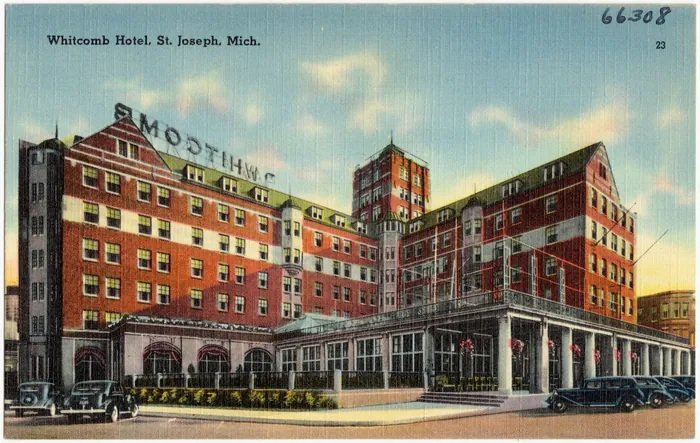
The bluff hotels made St. Joseph a resort. The Whitcomb, on the site of Newell’s Mansion House, piped water from a sulfur spring found in 1905 into its mineral baths, and was rebuilt as a tall hotel that opened in 1928. Silver Beach Amusement Park opened between the lake and the river mouth in 1891. In 1911 the Upton brothers began making electric washing machines here, the start of the Whirlpool Corporation. The pier lights, decommissioned in 2005, passed to the city in 2013 and were restored in 2016. The 2020 census counted 7,856 people.