Lore and legend
The True Story of the Dewey Lake Monster: The Week the Valley Went Wild
Everyone around Sister Lakes knows the story of the 1964 monster. The record tells it differently. It did not begin with berry pickers, and it did not begin in 1964: more than a hundred and twenty-five years earlier, someone peeled the bark from a tree at a fork in the road to Dewey’s Lake and wrote a warning on it in red chalk. This is the real story, and it is stranger than the legend.
By Michael Urbanski · Project Scroll · First published · Updated · 79 min read

New finding 15 new findings in this story. See what’s new ›
Sister Lakes, Mich. Foshen Tecumseh Clinton was “a towering 260-pounder” in striped bib overalls, a man who spent his days “banging out fender dents in a South Bend, Indiana, body shop.” “But not tonight— tonight Foshen was stalking a monster,” the National Observer reported in June 1964. At dusk by Magician Lake he lowered the butt of his double-barreled shotgun to the ground. A few feet away his brother Len slapped at a mosquito and fidgeted with his four-pronged fishing spear. Then came a muffled thumping, and it grew louder. Foshen was one of thousands who came that week to hunt the lake country west of Dowagiac. This is the story of what they were hunting.
You have probably heard the story. In 1964 some berry pickers near Dowagiac saw a hairy monster, ten feet tall. The papers had a laugh, the sheriff found nothing, and that was the end of it.
Almost none of that is true.
It was not one sighting. People had been seeing the thing, and keeping quiet about it, for two years before anyone called the police. It was not ten feet tall, not at first: the first accounts on the wire said nine, and a girl who saw it in broad daylight said seven, and it grew with every newspaper that printed it. It did not begin with pickers in a strawberry field. It began after dark at a farmhouse south of Dewey Lake, between a barn and a shed, where a woman said the thing had been coming around for summers, and had once chased her into her own house. And nobody in 1964 called it Bigfoot. That word was only six years old, coined by a California newspaper in 1958. In Sister Lakes they called it the monster, or the creature, or the thing.
The papers decided within a week that there was nothing there. But the story did not begin in 1964, and the strangest parts of it were never in the papers. They are in the county’s own oldest books. More than a hundred and twenty-five years before the berry pickers, someone peeled the bark from a tree on the road to “Dewey’s Lake” and wrote a warning on it in red chalk. An 1882 history called a thing in these woods “the monster” and said it drank a colt’s blood. In 1898 the lake next door had a serpent of its own. And the reports kept coming, from the swamps and creeks and woods of this valley, long after everyone agreed there was nothing out there.
This is the real story, as the record tells it. Every statement on this page says where it comes from. Some of it is stranger than the legend.
The case in brief
What the record shows
- It was front-page news in Detroit. The Detroit News of 11 June 1964 ran “Frankenstein Snarl of Traffic Loosed by ‘Monster’ Hunt” on page one.
- The berry pickers stayed out of the fields. The next day’s front page: “‘Monster’ Scare Idles Pickers.”
- The sheriff’s men led the hunt. Sheriff Robert Dool sent his undersheriff, Ernest Kraus, and deputies with deer rifles into the lakes country (United Press, 11 June 1964).
- Searches found nothing. By 12 June the South Bend Tribune called the monster “nonexistent.”
- The road had a warning on it long before. The county history of 1882 tells of a tree by the road to Dewey’s Lake, marked in red chalk: “Turn to the left and go to the Devil.”
- It was not the first thing in the dark. The same old books tell of a blood-drinking “monster” cat in Volinia Township, and papers of 1898 told of a serpent in Indian Lake, next door to Dewey.
What it has never shown
- A body, a bone, a clear photograph, or a cast that held up. The one plaster cast of the first night came out of the sand soft and uncertain.
- The Browns’ full account as first printed. The wire gives the nine feet and 500 pounds to Mrs. Utrup, and the National Observer gives the nine feet to her husband. Of the Browns’ own words, the Associated Press kept one line of Gordon’s: “It’s no bear.”
- Any agreement on who stood with Gordon Brown that first night.
Prologue: a warning on the road, the 1830s
DocumentedPicture the country before the farms. Oak and hickory to the horizon, tamarack swamps in the low ground, and one narrow track winding north-east from Indian Lake “around fallen trees and swamps,” as the county history of 1882 describes it. At the corner of Section 16 the track divided. One branch led to what would become the Treat family’s farm. The other ran toward a small lake that a pioneer named Dewey would give his name to.
DocumentedSomeone had gone that way before the settlers. At the fork he stopped, stripped the bark from a tree, and on the bare wood he wrote in red chalk: “Turn to the left and go to the Devil.” The 1882 book says only that he was a “disconsolate emigrant,” and that he was gone by the time the Treat family came through, sometime between 1837 and 1839. (The sources disagree on the year; we set them side by side below.)
New findingThose were the same years a hairy wild thing was reported in the papers on the other side of the lake country. The earliest printing we have found is in the Farmers’ Gazette, and Cheraw Advertiser of South Carolina, 27 December 1839, under the heading “A Wild Child” and a Michigan City date line of 4 December A “wild child, or lad,” it said, was “running at large among the sand hills” near Fish Lake, some forty-five miles south-west of here: about four feet high, covered in a light coat of chestnut-coloured hair, very fast on its feet, and fond of the water, plunging into Fish Lake and swimming “all the time whining most piteously.” When chased, it set up “the most frightful and hideous yells,” and seemed “to make efforts at speaking.” The writer guessed it was a child strayed from some emigrant party, grown up wild among the animals of the forest. And the line usually quoted from the Gettysburg reprint of 30 December, as the Indiana History Blog quoted it in 2017, was the Michigan City paper’s own, credited at the foot to the Gazette: “It would be nothing but an act of humanity on the part of our young men to turn out and help to capture it.”
ReadingNobody wrote down which road the warning meant, or why. But read against the old township map, the left-hand road seems to have gone to Dewey’s Lake. A hundred and twenty-five years later, at the end of that road, something stood between a barn and a shed and let two brothers with a flashlight walk right past it. This is how it happened, and how far back it goes.
Older things in the dark: the 1800s
The monster of 1964 was not the first thing the people of this country saw at the edge of the trees. The old county books keep a few others.
DocumentedThe cat on the leaning tree. In Volinia Township, north-east of Dowagiac, in the early days, families who let their fire go out sent a child to a neighbor’s to borrow coals. The 1882 history tells what one boy saw: “Reuben F. Gard was sent on such an errand one frosty morning to the house of George Newton, and when there remarked that he saw an immense cat, crouched on a tree that leaned over the path he passed along.”

DocumentedThe book goes on: “A panther at once suggested itself, and a search showed where the monster had killed a colt belonging to D. C. Squires, and sucked its blood. It was a narrow escape.” (History of Cass County, 1882, p. 285.)
DocumentedThe cries on the road home. In Porter Township, the same book says, Mr. and Mrs. Rinehart, coming home from church in Newberg, “were followed for several miles by a panther, who encircled them while emitting his blood-curdling cries,” until it left them near Birch Lake (p. 303).
DocumentedNext door, the panthers were public business. When Van Buren County’s supervisors met for their first annual meeting, in the schoolhouse at Paw Paw on 13 October 1837, the only business besides the bills and the taxes was a bounty: five dollars a head “on each wolf and each panther killed in the county.” The meeting’s minutes were reprinted in the Paw Paw Courier-Northerner ninety years later.
ReadingThose were real animals: the cougar was native to Michigan until it was wiped out in the early 1900s. But notice the word the old historian reached for. In 1882, in plain print, it was already “the monster.”

DocumentedThe serpent next door. In October 1898 the state-news columns carried a short item: “Residents of the vicinity of Indian lake, near Dowagiac, have been terrorized of late by a huge sea serpent in the lake” (Isabella County Enterprise, 14 October). Another paper added that “parties are out gunning for the monster.” Two weeks later it “proved to be an otter and a muskalonge” (Evart Review, 28 October). In July 1899, under the heading “Cass County’s Sea Serpent,” it was back.
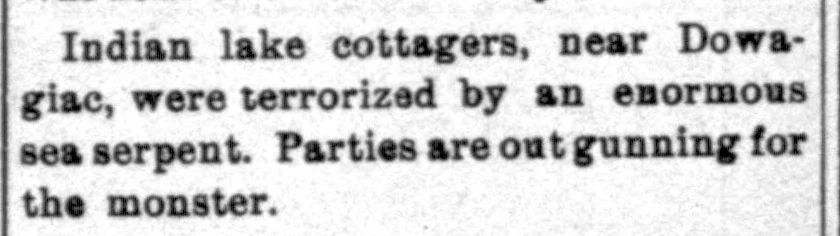

DocumentedWhich Indian Lake? Michigan has more than one. But every one of the papers says “near Dowagiac,” and that is Cass County’s Indian Lake, in Silver Creek Township: the lake where the Treats picked up the track toward the fork, a few miles from Dewey. We have now read the 1898 and 1899 items on the page ourselves. The serpent has a story of its own: read the Indian Lake sea serpent ›
Before the headlines

DocumentedThe thing at Dewey Lake did not arrive in June 1964. According to Robert Atkinson’s survey of the 1964 papers, people had been reporting a large, hairy creature on two legs since 1962, among the cherry orchards, the berry patches and the swampland south of the lake. Most of them kept quiet. In June the sheriff’s deputies told the press the sightings had come on and off for nearly two years.
DocumentedErnest Kraus, the undersheriff, explained the silence to the wire on 12 June: “People have been reluctant to call because it’s a fantastic story and they’re afraid of ridicule.”
“People have been reluctant to call because it’s a fantastic story and they’re afraid of ridicule.”
ReadingTwo summers of silence, then. Two summers of people coming in from the fields and not saying what they had seen at the tree line.
The people in this story (17)
- Mrs. Evelyn Utrup Farm wife south of Dewey Lake, “Mrs. John Utrup” on the wire; said the thing had chased her into her house.
- John Utrup Her husband, the farmer. Told the sheriff he had seen it “several times”; by the National Observer’s account, the man who set its height at nine feet.
- Gordon Brown, 25, and Mary Brown, 17 Seasonal farm workers; with Gordon’s brother Randall, the first witnesses, on 9 June.
- Harold Utrup Mrs. Utrup’s brother-in-law, whose farm next door Gordon Brown worked.
- Robert Dool Sheriff of Cass County; had the reward withdrawn to stop “3,000 strangers prowling about at night with guns.”
- Ernest “Ernie” Kraus Undersheriff; led the deputies the first night, and explained why people had kept quiet.
- Andy Chavous Deputy: “I’d feel safer if it was just me and the monster.”
- Joyce Smith, Gail and Patsy Clayton Three girls who saw it cross the road at 9:15 in the morning, 11 June. Joyce fainted.
- Robert Walker Of Dowagiac; brought in “big ape tracks” and said he had seen it the summer before.
- Jack Hadley Beer distributor who offered $1,000 for the monster taken alive.
- Michael McGovern Reporter for Chicago’s American, who had Mary Brown draw it in his notebook.
- William H. Burt and Frank E. Eggleton University of Michigan zoologists: probably a bear; certainly not a gorilla.
- Dick and Dorothy Grabemeyer Farmers by the swamp, who had seen bears there before.
- Wayne and Lloyd Ritter Brothers from Clare who saw a ten-foot creature cross I-96 on 17 June.
- Cpl. Richard Abbott and Jocko State Police officer and his tracking dog, who chased a figure in fur at the Saranac overpass.
- Henry Dewey The pioneer who gave the lake its name; from Union County, Indiana, and in Pokagon by 1830.
- Timothy and Sullivan Treat The family who came to the fork in the road between 1837 and 1839, and took the other branch.
Tuesday night, 9 June
DocumentedThe call came from the farm of Mrs. Evelyn Utrup, south of Dewey Lake in Silver Creek Township. Seasonal workers had driven onto the farm after dark: Gordon Brown, who was twenty-five, his wife Mary, who was seventeen, his brother Randall, and a girl from a neighboring place. Gordon Brown worked on the farm next door, which belonged to Mrs. Utrup’s brother-in-law, Harold Utrup, as the National Observer told it that month. Between the barn and a shed, they said, they saw something large. Not every account agrees on who stood beside Gordon Brown in the dark. The National Observer said that he “and two companions had chased it into the woods”; John Keel, in 1970, has Brown telling “how he and his brother had seen the creature”; and a 2022 book names a fellow farmhand, Joseph Smith. The papers could count the monster’s pounds more easily than the people who saw it.
DocumentedNor do the early books agree on where Gordon Brown came from, or whether he was on foot. FATE magazine, in October 1964, put him on the Utrup land: “Gordon Brown said he saw the thing on the Harold Utrup farm.” Brad Steiger’s The Abominable Snowmen (1969) calls him “Gordon Brown, from nearby Dowagiac,” and has the thing cross “the road in front of his car as he passed the Utrup farm.” Janet Bord’s Bigfoot Casebook (1982) makes him “a fruit picker from Georgia,” who “was driving with his brother when they” saw it. Robert Atkinson, reading the 1964 papers, has the brothers on foot with a flashlight.
ReadingPut together, the one point every early telling shares is the brother. Randall Brown was there; the third person in the Observer’s “two companions” is still unnamed. And the car and the flashlight need not contradict each other: the Browns had driven onto the farm, and the chase began on foot.
DocumentedThe Brown brothers went after it with a flashlight, about three hundred yards, as Robert Atkinson reconstructs it from the 1964 papers. Then they understood that the tree they had just passed was not a tree. It was the thing, standing still, letting them go by. They ran.
New findingThe Associated Press, writing on Thursday, 11 June, joins the two tellings into one. Gordon Brown, it said, “of nearby Dowagiac,” saw the creature on the Harold Utrup farm, where he worked: the headlights of his car lit the thing standing between Utrup’s barn and a shed. Then he got a flashlight and followed it into a field near some woods. “It’s no bear,” he said. “I’ve seen bear before and it’s not one.” Car first, then on foot: the books that disagree are each telling half of the same night. (The AP story, front page of the Escanaba Daily Press, 11 June 196469.)
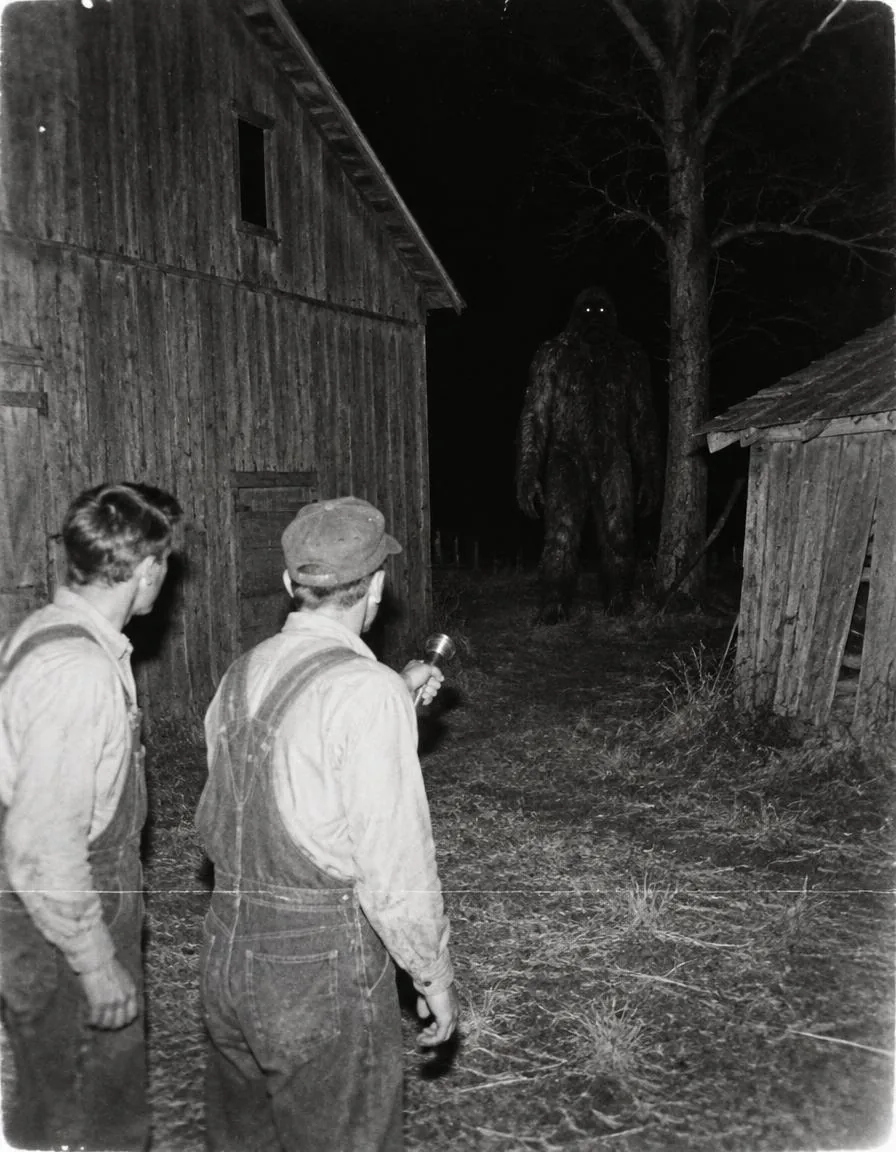
Tuesday night, 9 June 1964. No moon. Take the flashlight and look between the barn and the shed.
DocumentedWhat they told the deputies, as Atkinson gathers it, matched the description the whole country would repeat: about nine feet tall, some five hundred pounds, a black, leathery face, and eyes that glowed red. It made a sound, they said, like a baby crying, or a goose honking.
DocumentedMrs. Utrup said she had never actually seen it. But she had heard it, often, outside, in the summers. Once, she said, it had chased her into the house, and its stamping had shaken the ground and the house with it. To the sheriff, as the National Observer told it, she spoke of “great thumping feet” rushing at her when she went into the back yard to see what a noise was; she ran back in without seeing what made them. (The wire and the Observer both call her Mrs. John Utrup; Robert Atkinson names her Evelyn. Janet Bord’s Bigfoot Casebook of 1982 joins the two: the land was “part of a farm owned by Evelyn Utrup and her husband John.”)
DocumentedHer husband had. John Keel, in Strange Creatures from Time and Space (1970), writes that “John Utrup told the Cass County sheriff that he had seen the monster several times,” and quotes him: “It had big, bright shining eyes.” Janet Bord tells it the same way: “Utrup had seen it standing in his yard with its ‘big, shining eyes’ reflecting his headlights.”
New findingAnd the nine feet may be his. The National Observer, in its report from the lakes that month, says the “accepted set of dimensions was established by farmer Utrup, who said the day after he saw it standing behind the bush in his yard he measured the bush, found it was five feet high, and estimated that whatever he had seen stood four feet above that.” Five feet of bush, and four feet of something above it. “This was his only look at the monster,” the Observer adds, where Keel has him seeing it “several times.” No telling of the monster that we have read traces the famous nine feet to a farmer with a tape measure.
New findingBy the time the Associated Press wrote it up on Thursday, 11 June, the figure had lost its owner. “For anyone contemplating monster hunting,” the AP offered “a description of ‘the thing,’ as pieced together by police from residents’ complaints: ‘About nine feet tall. About 500 pounds.’” The nine feet began at the Utrup farm, by the Observer’s account, and became everybody’s. When farmer Utrup first saw it is not certain: a 1980 survey of Michigan reports lists an unnamed sighting of 1962 at Sister Lakes in the same words the Observer gives him: “Nine feet tall; black face; ‘big, bright, shining eyes.’”
ReadingRead that line again: often, in the summers. Whatever was out there, by her account, had been coming around for a long time before anyone picked up a telephone.
“Definitely not human.”
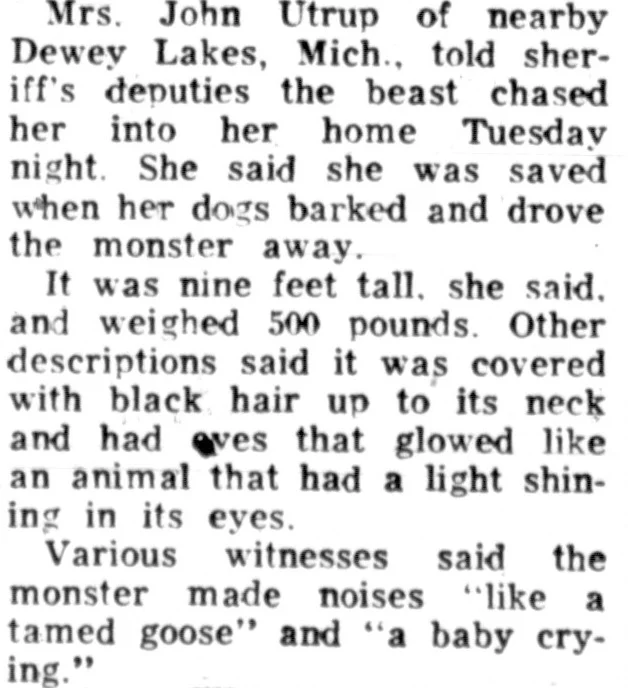
New findingIn the earliest wire story we have read on the page, the United Press report printed in Mount Pleasant’s Isabella County Daily Times-News on 11 June, the nine feet and five hundred pounds are hers, as Leader Publications of Dowagiac also gave them in 2017. “Mrs. John Utrup of nearby Dewey Lakes, Mich., told sheriff’s deputies the beast chased her into her home Tuesday night. She said she was saved when her dogs barked and drove the monster away. It was nine feet tall, she said, and weighed 500 pounds.” The next day’s wire added the face: it was “covered with hair except for a black leathery human-like face.”
ReadingThe two accounts do not quite agree. The wire has the chase on Tuesday night and gives her a height and a weight; the Observer has her never seeing it at all, only hearing it. Both cannot be her exact words. What both agree on is the sound: something big, outside, in the dark, close enough to drive her indoors.
ReadingSo the woman in the St. Joseph Herald-Press headline of 10 June, “Monster Chases Woman!,” was almost certainly Mrs. Utrup. And the description the country repeated seems to have come out of the Utrup farmhouse, not only from the Browns: the United Press put the nine feet in her mouth, and the Observer in her husband’s, measured against a bush in their yard.
DocumentedShe telephoned the sheriff, Robert Dool. He sent his undersheriff, Ernest “Ernie” Kraus, with a posse of deputies into the lakes country that night. They carried deer rifles, the United Press wire reported, and they meant to stake out the fields.
DocumentedThe deputies found a track: three and three-quarter inches across the heel, six inches wide across the middle. They poured plaster into it. The soil was sand, and the cast came out soft and uncertain. The Associated Press measured the same track as “nearly four inches at the heel and more than six inches across the ball of the foot,” found by Deputies Howard Sheline and Daniel Behrman. (A 1980 survey has “18-inch footprints”; no paper of that week we have read says so.)
Wednesday, 10 June
DocumentedBy morning someone had put up a sign, MONSTER, with an arrow pointing the curious toward the Utrup farm. The deputies took it down. It did not matter. A radio newscaster in Benton Harbor told his listeners, wrongly, that the Cass County authorities wanted help hunting the creature, and the St. Joseph Herald-Press ran the story under “Monster Chases Woman!”
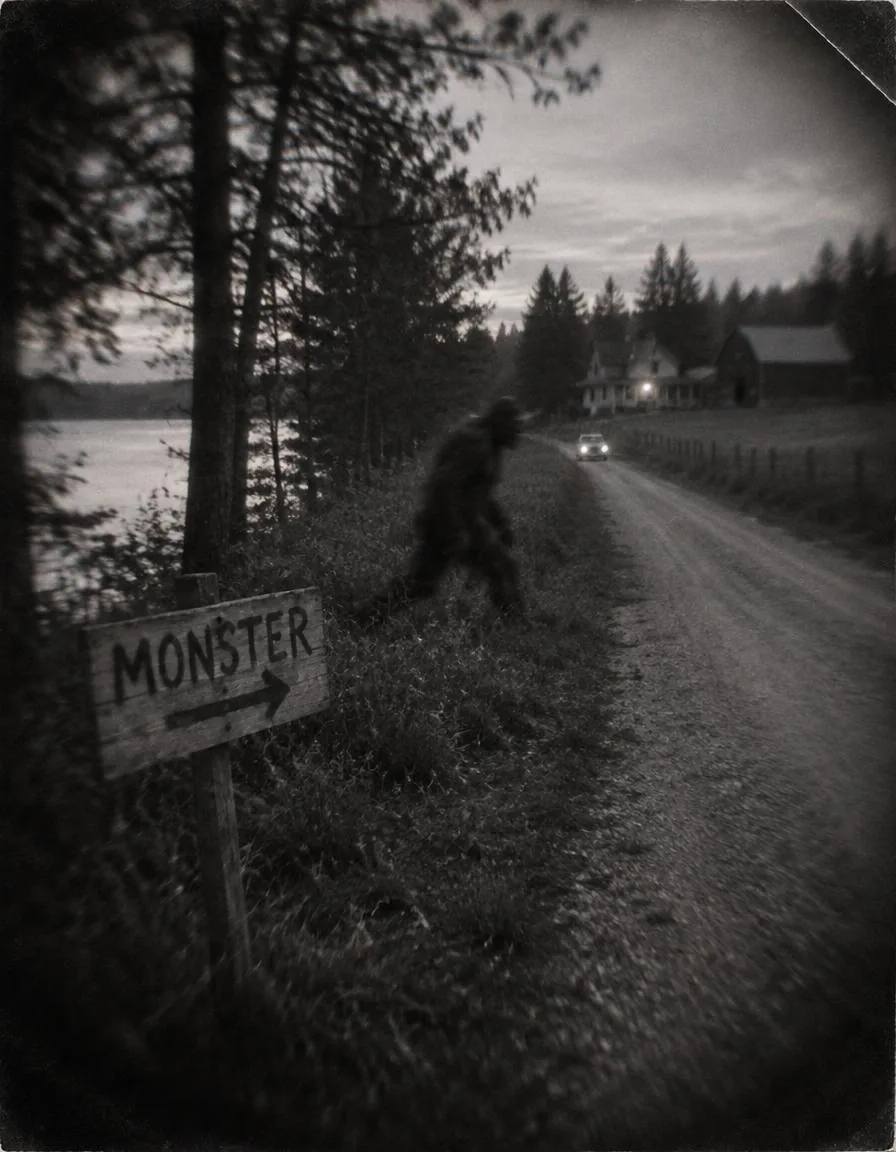
DocumentedThat night they came. Men drove the back roads with shotguns, rifles, tire irons and knives, with license plates from Indiana, Illinois and as far away as Ohio. The deputies spent the night directing traffic and sending would-be posses home. Officers came over from Van Buren County to help. At one stop they took a loaded magnum revolver from three boys from the Detroit area; at another, baseball bats from seven more; at another, tire irons and clubs from a caravan of eight carloads of teenagers. “I’d feel safer if it was just me and the monster,” one deputy, Andy Chavous, said. The crowd did not thin until about three in the morning. (A United Press story printed on Saturday the 13th tells of the same eight carloads, and the same line.)
“I’d feel safer if it was just me and the monster.”
Thursday morning, 11 June
“It was nine feet tall, she said, and weighed 500 pounds.”
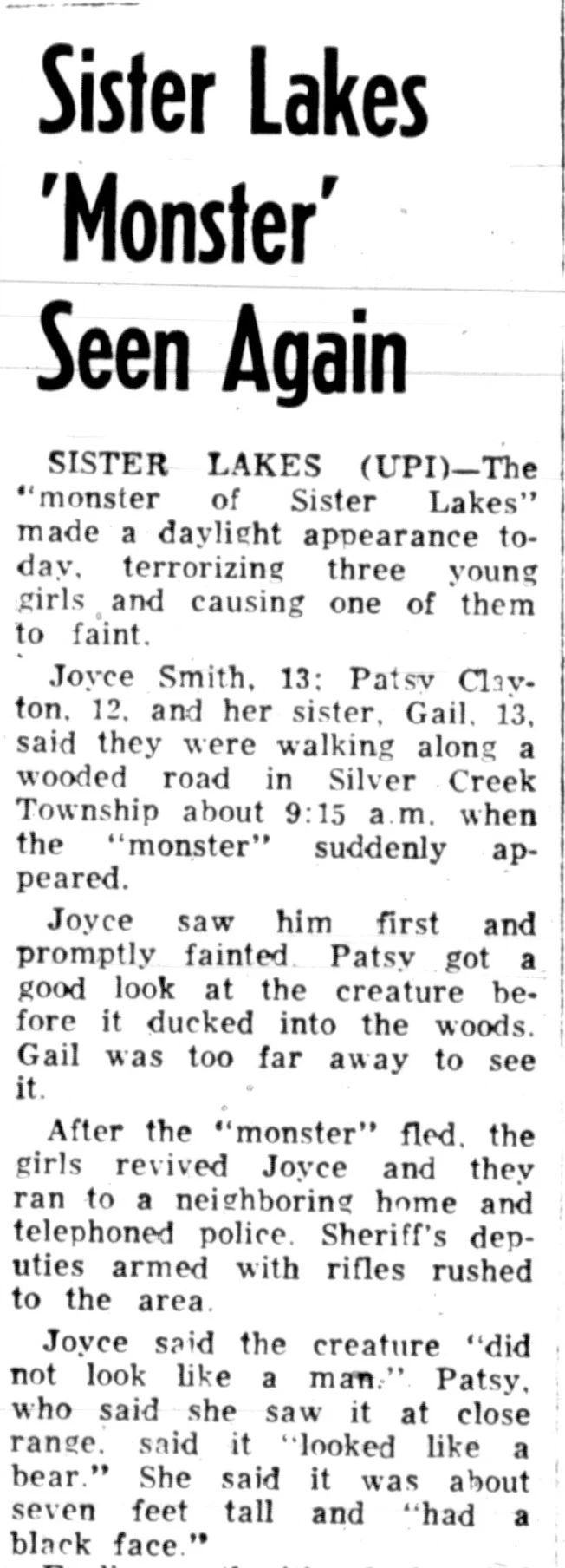
DocumentedAt a quarter past nine in broad daylight, three girls were walking near Swisher Street and Town Hall Road: Joyce Smith, thirteen, and two sisters, Gail Clayton, thirteen, and Patsy Clayton, twelve. Something crossed the road in front of them. It walked on two legs. The next day’s wire put it more starkly: the “Monster” “suddenly reared up alongside the road.”
DocumentedJoyce Smith fainted. The Clayton sisters brought her round, and the three of them ran to the nearest house to call the police. Dowagiac’s police chief, Richard Wild, passed the call to the sheriff. Two sheriff’s cars came, and a conservation officer, and a State Police plane was called for. They found nothing.
New findingWho was the conservation officer? Wikipedia’s article on the monster names him William Rowe. The Associated Press, writing from Dowagiac on Saturday, 13 June 1964, calls him “Conservation Officer Bill Roe,” and gives his verdict: the monster was “nothing more than a bear far from its regular haunts, but brought to the area by the lure of swamp huckleberries.” “Odds-on,” he said, “that’s what it probably is.” Whether he was the officer who came to the road that Thursday morning, the wire does not say. (The AP story, in the Escanaba Daily Press, 13 June 196471.)
DocumentedPatsy Clayton had the best look. It was seven feet tall, she said, with a black face, and it was “definitely not human.” Joyce Smith said it looked like a bear, but it walked on its hind legs. Patsy, the wire said, “got a good look at the creature before it ducked into the woods.”
“Definitely not human.”
DocumentedAnd they were not the only ones that Thursday. “Three more persons Thursday reported seeing the creature,” the wire said the next morning. It did not give their names. The Associated Press said only that deputies armed with rifles searched a nearby woods that night “after three girls reported seeing the beast.” “We think it’s a bear,” said Dave Lyons of the sheriff’s staff. Then he hesitated: “Other people …”
DocumentedKraus, the undersheriff, told the wire that day that a gorilla had not been ruled out: “We have had no reports of any circus gorillas.” By the next day the deputies thought it most likely a bear that had wandered in.
DocumentedThat day’s Detroit News put it across the top of page one: “Frankenstein Snarl of Traffic Loosed by ‘Monster’ Hunt.”
The Detroit News
Thursday, June 11, 1964Detroit, Michigan
Frankenstein Snarl of Traffic Loosed by ‘Monster’ Hunt
Friday, June 12, 1964
‘Monster’ Scare Idles Pickers
Workers Afraid To Go Into Fields
DocumentedBy Sunday the 14th, a wire story printed as far away as Muncie, Indiana, had the creature at about ten feet and more than five hundred pounds (the Muncie Star Press of that day, as the Notebook of Ghosts gives it).
ReadingNine feet on the wire, seven from the girl who saw it best, then ten. The monster grew in print, a long way from the farm.
Tap or click any bar to see who gave that height, and when.
ReadingThe road names are older than the monster. On the Silver Creek Township plat of about 1928, “S. Swisher” holds 160 acres in Section 8, one of the two sections Dewey Lake lies across. Swisher Street very likely carries that family’s name.
Friday, 12 June
DocumentedRobert Walker of Dowagiac came forward with what he called “big ape tracks” in the woods near Dewey Lake. He said he had seen the creature himself the summer before, and had not wanted to say so. He knew its nightly rounds, he said, and the commotion had driven it off: “It hasn’t showed up for two nights: it shows he is scared.” The deputies who looked at his tracks thought they looked more like a dog’s.
DocumentedIn Chicago, Chicago’s American put the monster on its front page. Its reporter, Michael McGovern, had asked Mary Brown to draw what she saw, in a small notebook balanced on an oilcan. The paper ran her drawing under the words “Have YOU Seen THIS Monster?” and quoted her husband: “It was an extreee giant looking thing, a whale of a joker.”
New findingHer drawing was not lost with the paper. Sixteen years later Michigan Anomaly Research, a small newsletter edited by David Fideler, reprinted it on page 4 of its Winter 1980 report, captioned “witness drawing, Sister Lakes, Michigan: 1964.” A copy survives among the Marcello Truzzi papers at Eastern Michigan University, and you can see it on the Internet Archive76. We link to it rather than show it here, because the rights to the drawing are not clear.
“A black leathery human-like face.”
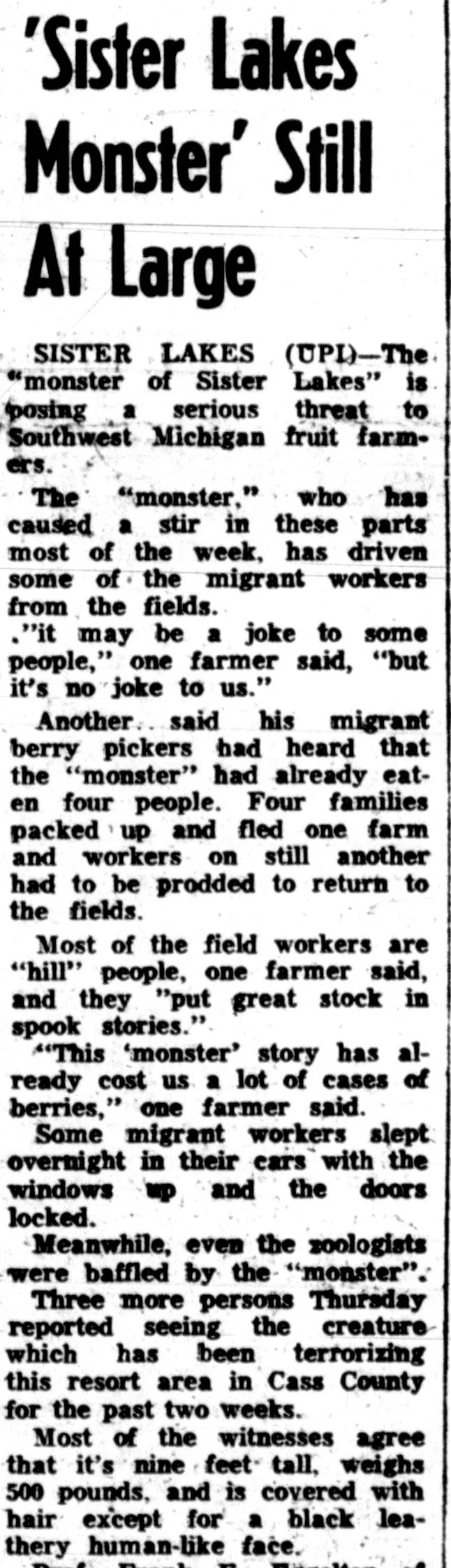
DocumentedThe Detroit News had a different worry: “‘Monster’ Scare Idles Pickers,” with “Workers Afraid To Go Into Fields.” Among the migrant families who had come north for the berry harvest, a rumor had spread that the monster had eaten four people. Some families packed up and left. Some of those who stayed, the wire reported on 12 June, “slept overnight in their cars with the windows up and the doors locked.”
“It may be a joke to some people, but it’s no joke to us.”
ReadingIt is easy to laugh at the monster. It is harder to laugh at a family sleeping in a car with the doors locked, a long way from home, in a country where something was said to walk the fields at night.
Monster Town, U.S.A.

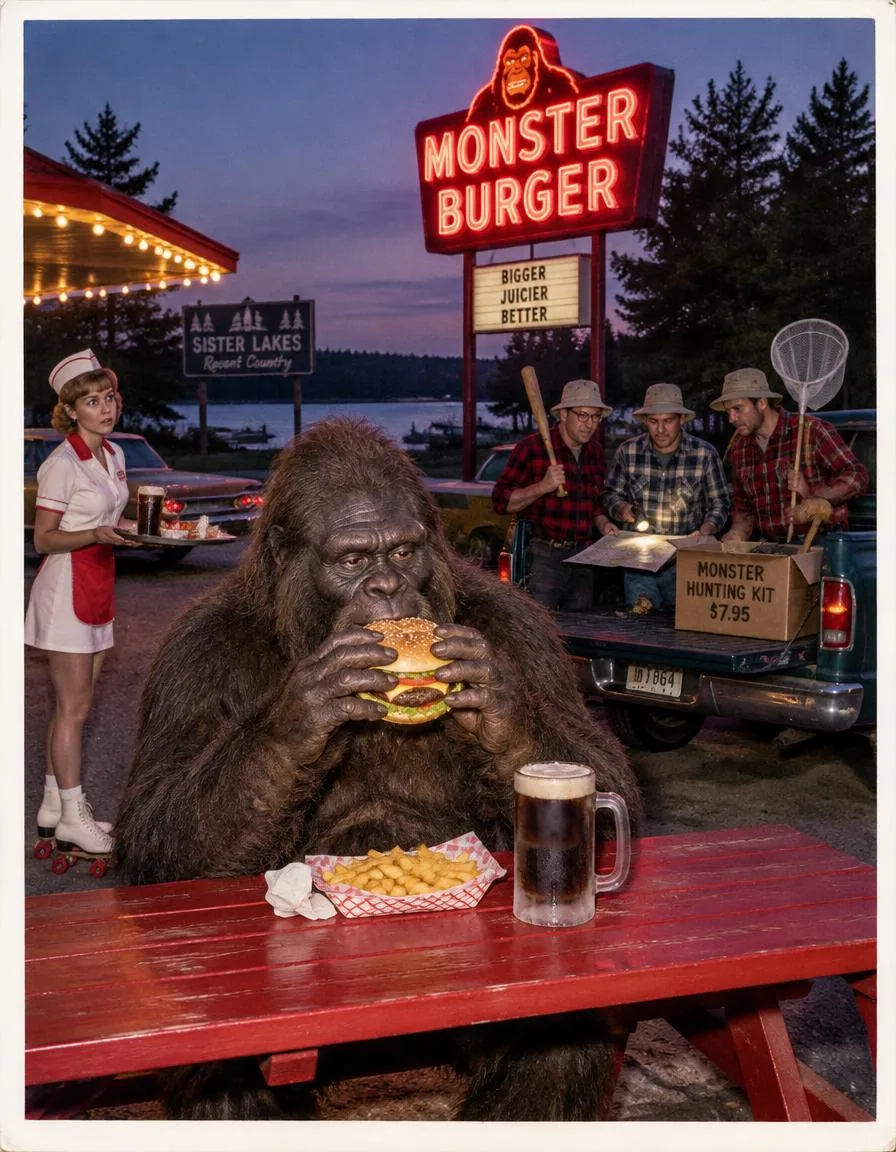
DocumentedSister Lakes did what a resort town does with a crowd. The taverns poured “Monster Brew.” Reid’s Drive-In put a stuffed monster out front to sell its “Monster Burger.” Harvey’s East variety store sold a “Monster Hunting Kit” for $7.95: a baseball bat, a wooden mallet, an arrow, a net and a flashlight (other papers add a squirt gun and a stake). Gas stations sold “getaway gas.” The radio station at St. Joseph, WSJM, played monster songs between its live reports, and a Dowagiac theater booked The Horror of Party Beach and The Curse of the Living Corpse. A group calling itself the Monster Boosters promoted the whole thing; the Sister Lakes Chamber of Commerce said it had nothing to do with it.
Monster kits at $7.95, Monster Burgers, and a $1,000 bounty.
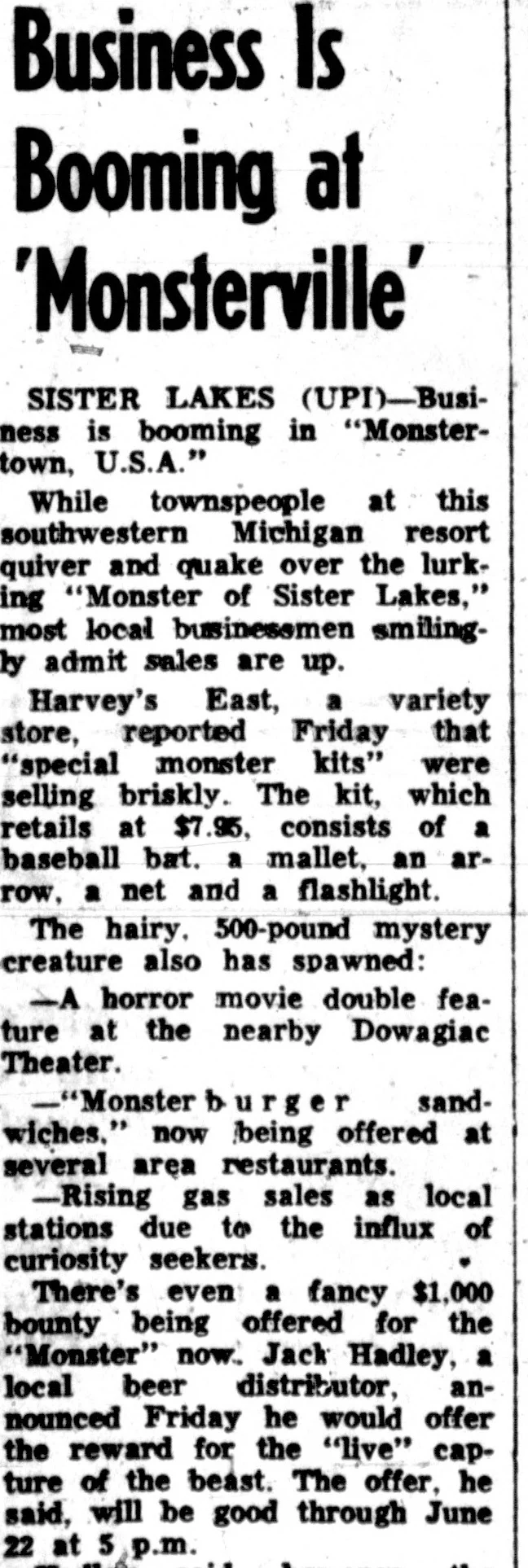
DocumentedThen came the money. Jack Hadley, a beer distributor, offered $1,000 for the monster taken alive by five o’clock on 22 June. (Every printing of the wire we have read spells him Hadley: Mount Pleasant and Traverse City on 13 June, and, as far away as British Columbia, the Victoria Daily Colonist of 14 June, which says “Jack Hadley, a local beer distributor, has announced he would offer the reward.” Only one later account has Handly.) The sheriff, Robert Dool, was already swamped with calls from around the world, and he had seen the crowds. “It’s getting mighty dangerous,” he said, “with 3,000 strangers prowling about at night with guns.” He persuaded Hadley to withdraw the offer, and by Monday the 15th it was gone.
ReadingWho was he? The National Observer called him “a Cassopolis beer distributor.” In 1977 the Benton Harbor Herald-Palladium names a Jack Hadley as president of Dixon Beverage. That is likely the same man, though we have not yet proven it.
DocumentedThere was gunfire only once. A hunter saw a black shape in the dark, fired twice and missed. It was a Shetland pony. Chicago’s American had the headline: “Itchy Gun Fingers Blast Away at Pony.”
DocumentedNot everyone was amused. “They call us ‘Beast Town’ now in Detroit,” a Dowagiac Daily News columnist wrote. “Gives us a rather uncouth image doesn’t it.” The Chicago papers, by then, were calling the place “Monster Town, U.S.A.”
DocumentedThe name stuck where it was given. On Saturday, 13 June, the Detroit Free Press ran it across a banner: “‘Beast Town’ Booms: Get Your Monster Kit (7.95).”
DocumentedOn Saturday and Sunday, 13 and 14 June, there were no more sightings. The hunters went back to work. The summer people went back to the water.
DocumentedOther towns noticed what a monster could do for business. Two months later the Saline Reporter, a weekly south of Ann Arbor, confessed to envy: Dowagiac, it wrote on 19 August, had “capitalized on a monster before we could get around to installing a Loch Ness … type in the mill pond, thus drawing scads of tourists.”
The week by night
The whole week on one map: where each report was made, and the older places it passed by.
- 1962 to 1964. Reports of a large, hairy thing on two legs among the orchards, berry patches and swamp south of Dewey Lake; most witnesses kept quiet.
- Tuesday 9 June, night. The farm south of the lake: the Browns between the barn and a shed; Mrs. Utrup chased into her home, saved by her dogs.
- Wednesday 10 June. A MONSTER sign pointing down the road to the farm, a false radio report, and a night of armed hunters on every back road.
- Thursday 11 June, 9:15 a.m. Three girls on a wooded road near Swisher Street and Town Hall Road; one faints. Three more people report it that day.
- Friday 12 June. Robert Walker’s “big ape tracks” in the woods near Dewey Lake.
- Saturday 13 June. Deputies stop eight carloads of teenagers with tire irons and clubs. No new sightings.
- Wednesday 17 June, 4 a.m. Two brothers on Interstate 96 near Ionia report a ten-foot creature with long brown hair.
What the experts said
DocumentedTwo University of Michigan zoologists were asked what it could be. As Atkinson quotes the 1964 press, Dr. William H. Burt thought of a bear: “When they get up on their hind legs … they might be five or six feet.” Professor Frank E. Eggleton doubted it, “Bears don’t stand on their hind feet too often,” and suspected an escaped circus gorilla. No zoo or circus reported an animal missing.
DocumentedEggleton had his own doubt. If it was true the thing had been roaming the area for two years, he told the wire, it could not be a gorilla, since “they couldn’t survive that long in this climate out-of-doors.”
ReadingSo the experts had a bear that would not stand up and a gorilla that could not have lived through two Michigan winters. Neither answer fit.
DocumentedThe county officials liked the bear. Dick and Dorothy Grabemeyer, who farmed by the swampland near Dewey Lake, said they had seen bears there before. But the Brown brothers were hunters, and they insisted it was no bear; and the witnesses who saw it said it walked on two legs.
DocumentedThere was a catch in the bear. Michigan’s black bears live mostly in the north. The Department of Natural Resources says their range in the Lower Peninsula has only spread south toward Grand Rapids since about 2000, and when a black bear wandered into rural Cass County in May 2022, it made the news.
ReadingSo a bear in the Sister Lakes country in 1964 was not impossible. But it would have been almost as unusual as the monster, and a bear that walked upright across a road in front of three girls, in broad daylight, more unusual still.
DocumentedThe Grabemeyers’ name is on the old map too. The township plat of about 1928 shows “F. W. Grabemeyer” on 119 acres in Section 6, in the north-west corner of the township, a mile or so west of Dewey Lake. The family left its name on the water as well: the federal Geographic Names Information System lists a Grabemeyer Lake about a mile and a half west of Dewey Lake.
ReadingAnd the red eyes? Many animals have a mirror at the back of the eye that throws a flashlight beam straight back: deer, raccoons, dogs, bears. Human eyes do not. The first night’s witnesses spoke of red eyes. Whatever was out there, it was looking back at them.
DocumentedBy 12 June the South Bend Tribune’s headline read “Dewey Lake ‘Monster Is Nonexistent.’” By 14 June it was “‘Hairy Monster’ Scare Lessens”; nobody, the paper said, “seems frightened anymore.” On 18 June the Dowagiac Daily News ran “Policeman Says ‘No Monster.’”
DocumentedIn 1983 the Tribune’s “Action Line” column looked back and suggested the monster had been dreamed up by strawberry pickers who had been drinking.
ReadingNonexistent, said the paper. Nobody frightened anymore. It is the kind of thing people say in daylight.
The copycats
DocumentedWithin a week the monster had imitators. Early on Wednesday, 17 June, some eighty miles north-east, near Ionia, two brothers, Wayne Ritter, nineteen, and Lloyd Ritter, seventeen, of Clare, driving from Lansing to Grand Haven at four in the morning, reported a ten-foot creature “with long brown hair” crossing Interstate 96. If it was the same monster, the wire noted, it had “grown a foot” since Thursday. The Associated Press put it drily: “Sister Lakes of Cass County may have lost its ‘monster’ to more northerly climes, if a report made here today by two brothers from Clare checks out.”
DocumentedThey had stopped and called the Kent County sheriff’s department; Sergeant Sid Frazer took the call, and the State Police post at Ionia took the case. Two troopers, Charles Bush and Bob Tubbs, drove the brothers back to the spot. They found no tracks. “It was foggy,” Bush said, “and could have been an impression enhanced by an illuminated road sign. It could have been a deer.”
DocumentedThe next night, something came out onto the same road. Corporal Richard Abbott of the State Police was driving home to East Lansing with his tracking dog, Jocko, when a figure, “apparently a youth clad in” fur, jumped onto I-96 near the Saranac overpass, in front of the car ahead of him. Abbott slowed, thinking it was a deer; then he jumped out and grabbed for it, and missed. He and Jocko went after it until a downpour washed out the tracks. Nobody ever learned who was inside the fur. It left behind a piece of fur, “apparently from a coat or wrap,” and a rubber glove. “This kid could have gotten run over,” a trooper at the Ionia post said. Before dawn the same post arrested eight would-be monsters on M-21, two miles west of town: boys under big ponchos, one standing on another’s shoulders. They were brought in, “sternly lectured,” and handed over to their parents.
DocumentedTheir home paper gave them the front page. Under “Did They See The Monster?” the Clare Sentinel of 18 June described the thing as the Ritters told it: “about ten feet tall and covered with long brown hair, ‘like a gorilla,’” upright, running on muscular hind legs. By daylight there was nothing. “The outer limits of the twilight zone,” the paper wrote, “had again become a modern, paved expressway and not a foot track or sign of the Monster could be found.”
DocumentedWhen the Sentinel looked back over 1964 on the last day of the year, the Ritters made the list, between a forest fire and the Jaycees’ Young Man of the Year: “June came and with it a little bit of madness.”
DocumentedNor did Dewey Lake go quiet. On 13 July 1964, by a 1980 survey of Michigan reports, a married couple near Dowagiac watched something with reddish-brown hair from their car for several minutes, in the vicinity of the Dowagiac Swamp. It made no attempt to approach them, “acting in a shy manner,” and at last climbed a tree. Fire department men sent to the scene found scratches and broken limbs on the tree.
New findingBy August the scare had found a new animal. “Now Sheridan Has Its Own ‘Monster,’” the United Press reported on 10 August, from Montcalm County: a lion, “like the type you see in a circus.” Mr. and Mrs. Lyle North, south of Sheridan on M-66, said they saw it standing on a limb in a tree; their dogs chased it, and it roared and fled into the swamps. A ten-year-old boy in Bushnell Township was in trouble for telling his family he had seen a lion, until it walked into the yard and his mother saw it too. Conservation officers said lions were not native to Montcalm County. The sheriff was not excited. No paper we have found ever reported the lion caught.
ReadingAnd then one line in that Sheridan story that could have come straight from Dewey Lake two months before: other rural residents said they had seen the animal too, “but don’t talk about it for fear of ridicule.” It was Ernie Kraus’s explanation, almost word for word, from the other end of the state. Whatever people see in the dark, the fear of being laughed at keeps more of it quiet than the dark does.
DocumentedThe next summer the Benton Harbor News-Palladium reported, on 17 August 1965, that the monster which “caused a flurry in this area last summer” had “apparently packed his bags” for Monroe, on Lake Erie. There, on the night of Friday the 13th, Mrs. George Owens, thirty-eight, and her daughter Christine Van Acker, seventeen, said that a thing seven feet tall and some four hundred pounds, with hair “like quills,” came at their car, reached in at the open window and struck the girl’s head against the door. She was left with a black eye, and the Detroit Free Press put her picture on its front page under “‘The Thing’ Haunts Monroe: Monster Days Are Here Again.” Sixteen more sightings followed that summer, and search parties went out. The two women passed a lie-detector test given for a radio show and failed one given by the police, who called it a hoax. They kept to their story.
DocumentedBy 1968 the lawmen had learned their lesson. That summer Van Buren County deputies spent two weeks quietly trying to capture a loose ocelot alive in the Sister Lakes area, until a lake resident shot it; the St. Joseph Herald-Press told the story on 5 August. “We didn’t want to say anything about it before,” said Sgt. Donald Hogmire. “We wanted to capture it alive if at all possible. Besides, I have been through two monster scares in Sister Lakes, and I wasn’t about to start another one.”
ReadingEvery hoax made the next report easier to dismiss. That is the trouble with a hoax: it does not only fool people. It teaches them to stop listening.
Back to the fork in the road
DocumentedDewey Lake takes its name from a pioneer. The county history of 1882 says Henry Dewey moved to Silver Creek because “the land in the vicinity of the lake which bears his name possessed many attractions, among others its proximity to the lake, which at the time was alive with fish.”
New findingWho was he? The same book answers in pieces. Its Pokagon chapter has him there almost at the start: “Dewey entered 160 acres on Section 13 in October, 1830,” and its table of first land entries lists “Henry Dewey, Union County, Ind., Oct. 16, 1830.” Then: “In 1832, Mr. Dewey went to La Grange.” In Silver Creek, the book says, “Henry Dewey, one of the early settlers of Pokagon, entered land on Sec. 8 in 1835. The date of his settlement is not known. Daniel Blish is positive that it was not until 1841.” A man from Union County, Indiana, then, who bought land by the lake in 1835 and may not have lived there for six years after.
ReadingThat matters for the warning. If Daniel Blish was right, Henry Dewey was not yet living by his lake when the Treats came to the fork. “Dewey’s Lake” may be the name the historian of 1882 gave the road, not the name the disconsolate emigrant knew it by. The land was Dewey’s from 1835; the name may have come later.
New findingBut Blish was probably wrong, and the same book shows it. It prints the poll list of Silver Creek’s first election after its first town meeting, and that election came the year before November 1839: 1838. Henry Dewey voted in it. He is also on the township’s roll of resident taxpayers for 1838, with land valued at $1,571, the third largest in the township, behind only Neapon Pokagon’s $2,602 and Patrick Hamilton’s $1,690. Timothy Treat ($396) and his son Sullivan ($240) are on the same roll. So by 1838 Dewey was voting in Silver Creek and paying taxes on his land there. The name on the road may be younger than the road, but not by much.
DocumentedOn the same page is an older fright. Timothy Treat brought his family from Aurora, New York, in the autumn of 1837, lived two years at Ontwa, and then moved on to Silver Creek. They came in from the south. At Indian Lake they found a track running north-east, “winding around fallen trees and swamps.” And “at the southeast corner of Section 16 the road forked, one branch leading to Dewey’s Lake, the other to their future home.”
DocumentedSomeone had been there before them. “Some disconsolate emigrant had preceded them,” the book says, “and evidently was not favorably impressed with the country to which they were going.” He had stripped the bark from a tree, and on the bare wood he had written in red chalk:
“Turn to the left and go to the Devil.”
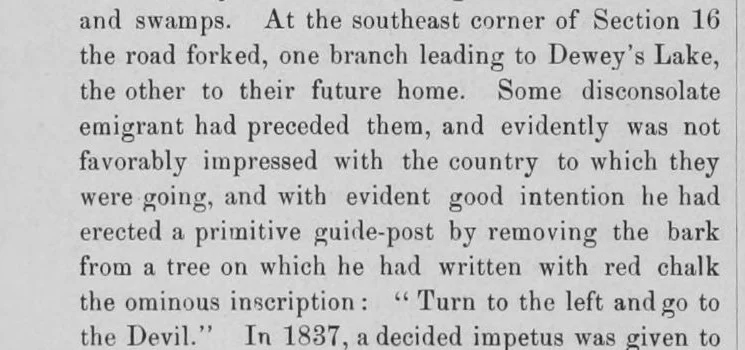
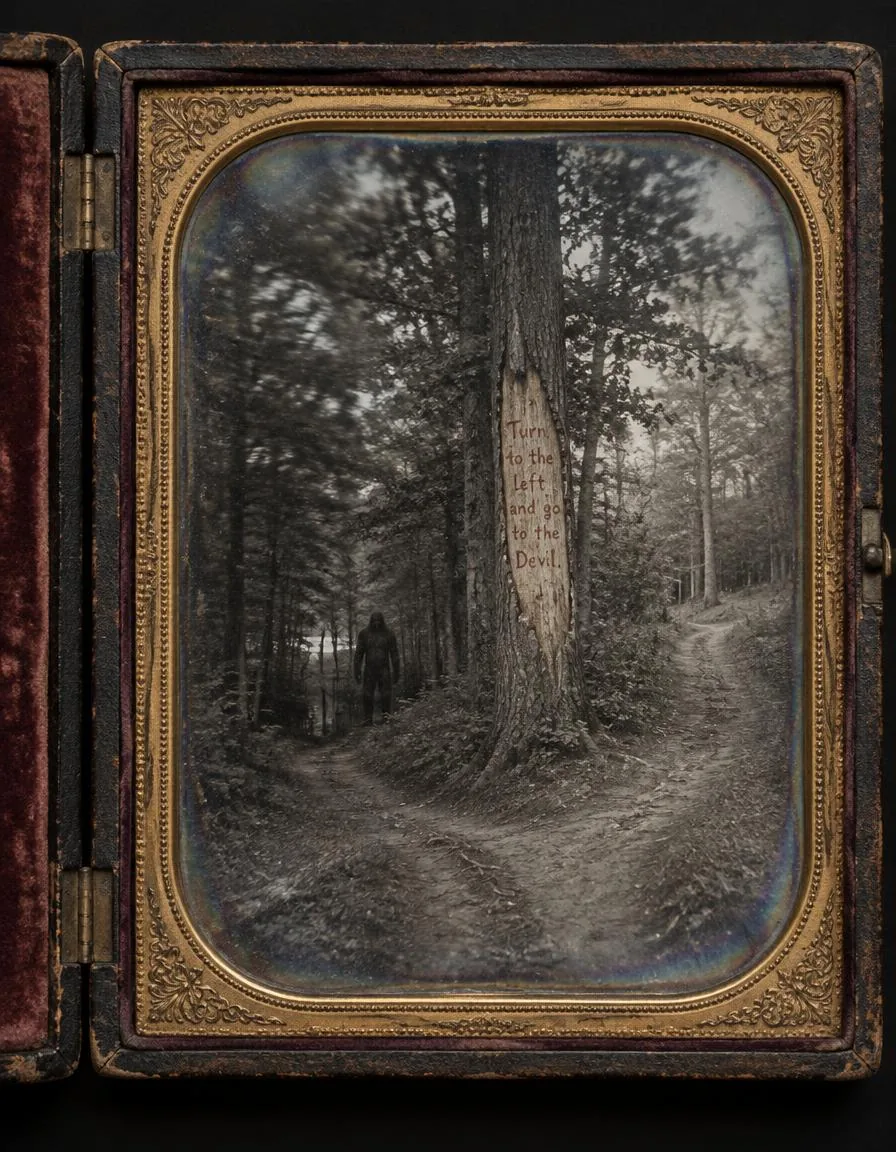
ReadingThe book never says which branch was the left one. But the map can. Dewey Lake lies across Sections 4, 5, 8 and 9 of Silver Creek Township, north-west of Section 16. Indian Lake lies in Sections 30 and 31, in the south-west corner. A traveler coming up the track from Indian Lake toward the north-east, and reaching the south-east corner of Section 16, would have to bear left, to the north-west, to reach Dewey’s Lake.
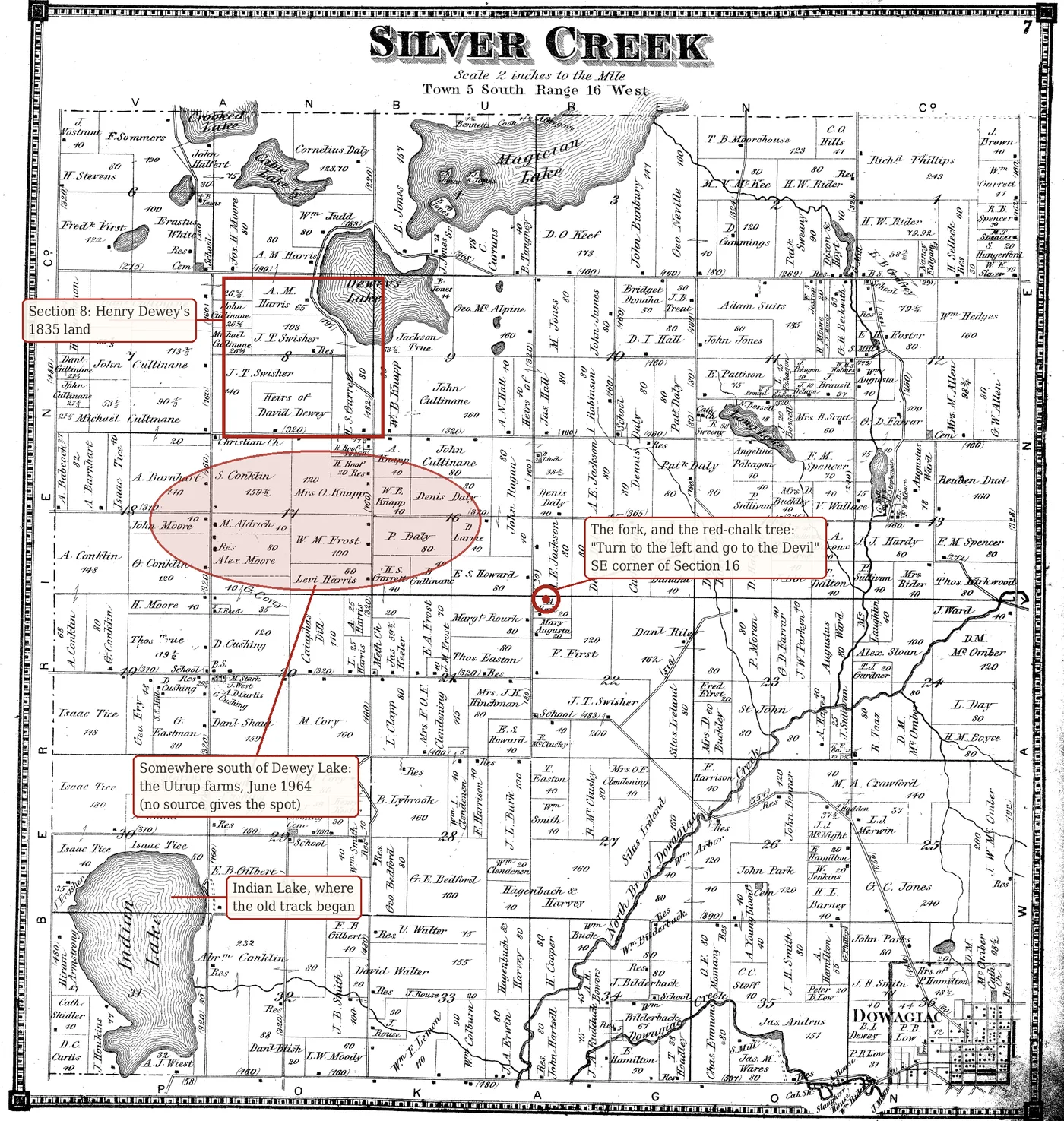
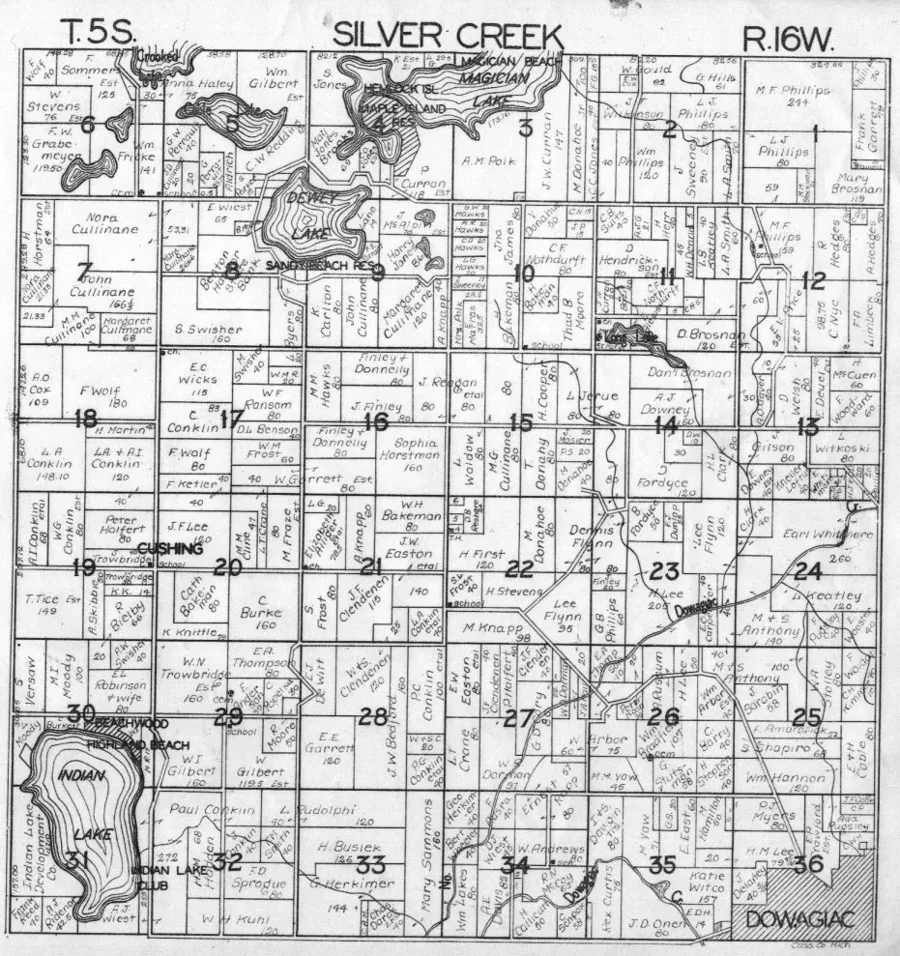 1928Today
New findingRead that way, the warning was not a joke about the whole country. It pointed one way. Turn to the left, it said, and go to the Devil. The 1882 history says one branch led to Dewey’s Lake and the other to the Treats’ “future home,” and on the plat the left-hand branch seems to be the one to Dewey’s Lake.
ReadingThe Treats came to the fork by 1837 at the latest, and perhaps years earlier, so the warning was already there, and its writer gone. The family took the other branch, and the book moves on.
DocumentedSo where did the other branch go? The family’s own genealogy answers it. The Treat Family (1893) says Timothy Treat, born in Vermont in 1786, a veteran of the War of 1812, “remained in Aurora till the fall of 1834, when he removed to Michigan and settled near Niles,” and that “in the fall of 1837 he moved some twenty-five miles and settled in Silver Creek township,” where he lived until 1863. His eldest son was Sullivan Treat, born in Aurora in 1811, who “settled in Silver Creek, Cass Co., Mich., on a heavily timbered farm, which he cleared, enduring all the privations incident to pioneer life.” Father and son both ended their days at Elk Grove, California; Sullivan went west across the Plains in 1859.
ReadingSullivan Treat’s land patent, issued in May 1839, is for the south-east quarter of the north-east quarter of Section 12, on the township’s east side. From the fork at the corner of Section 16, Section 12 lies to the north-east, and Dewey’s Lake to the north-west. The Treats took the right-hand road, and the warning pointed the other way.
DocumentedThe family’s “future home,” the 1882 book says, was on “lands purchased of John Barney,” and Barney’s land lay the same way: “October 19, 1835, John Barney, afterward familiarly known as Judge Barney, entered 160 acres of land on Section 2.” Section 2, like Section 12, is north-east of the fork.
New findingBut a patent is the government’s deed, and it came years after the purchase. The 1882 book’s own table of Silver Creek’s first land entries lists “Sullivan Treat, Cass County, Mich., May 17, 1836,” for 40 acres: the size of that quarter of a quarter. Sullivan had chosen his land, and was already living in Cass County, more than a year before his father’s family is said to have left New York.
OpenSo when did the Treats come to the fork? The 1882 book tells it two ways on one page. Its story has Timothy leave Aurora “In September, 1837,” reach Edwardsburg “about October 1,” and move to Silver Creek “After a residence of two years in the town of Ontwa”: about 1839. Its record of the township has him there already in April 1837: “the second Monday in April found them convened at the place appointed, for the purpose of electing township officials. Timothy Treat was elected Supervisor,” and its list of supervisors begins “Timothy Treat, 1837.” The family genealogy has him near Niles from 1834 and in Silver Creek in the fall of 1837. Sullivan’s land was entered in May 1836, and his daughter Lucy Ann was “born May 2, 1839, in Silver Creek township.” The warning on the tree is older than all of it, but how much older we cannot yet say. The land office’s own tract books and the township’s first minutes would settle the Treats’ year.
New findingMore of the record points the same way, and earlier. The 1882 book puts Timothy Treat on Silver Creek’s 1838 poll list, and Timothy and Sullivan on its 1838 tax roll. The Treat Family says that Sullivan, born in January 1811, left New York “at the age of twenty-one” and settled in Silver Creek on a heavily timbered farm: about 1832. Of Timothy’s children it says “the first nine born in Aurora, the last three in Silver Creek”; the tenth, Horace Jay, was born in March 1835, so the family had already left New York. His daughter Fidelia married Philander Dunning in July 1835, and a Philander B. Dunning is on the same Silver Creek tax roll. Next door in Van Buren County, Ira Foster, who began his cabin in Keeler Township on 7 April 1837, later named “Samuel Treat, at Silver Creek, in Cass County” as his neighbor on the south: probably Sullivan. The Treats were on that road years before 1839, and the red chalk was there before them.
New findingWe have found no modern telling of the Dewey Lake Monster that mentions the red-chalk sign on the road to “Dewey’s Lake,” or that names the lake’s pioneer from the 1882 history.
Something that learned to keep its distance
Drive the back roads of this valley at dusk and you will see how much of it is still dark. Between the towns lie river bottoms and tamarack swamps, wet woods along the creeks, woodlots no one has cut in a lifetime, and lakes whose far shores show no lights at all. A few miles from Dewey Lake, the Dowagiac Woods alone keeps 384 acres of forest, the Michigan Nature Association’s largest sanctuary in the Lower Peninsula.

ReadingCountry like that keeps its secrets. A deer can live a whole life a hundred yards from a road and never be seen. So can a fox, a bobcat, a mink. And the stories people tell about this country all share a shape: something seen at the edge of the light, at the edge of the trees, watching. Something that does not come closer. Something that, if it is there at all, has learned to stay away.
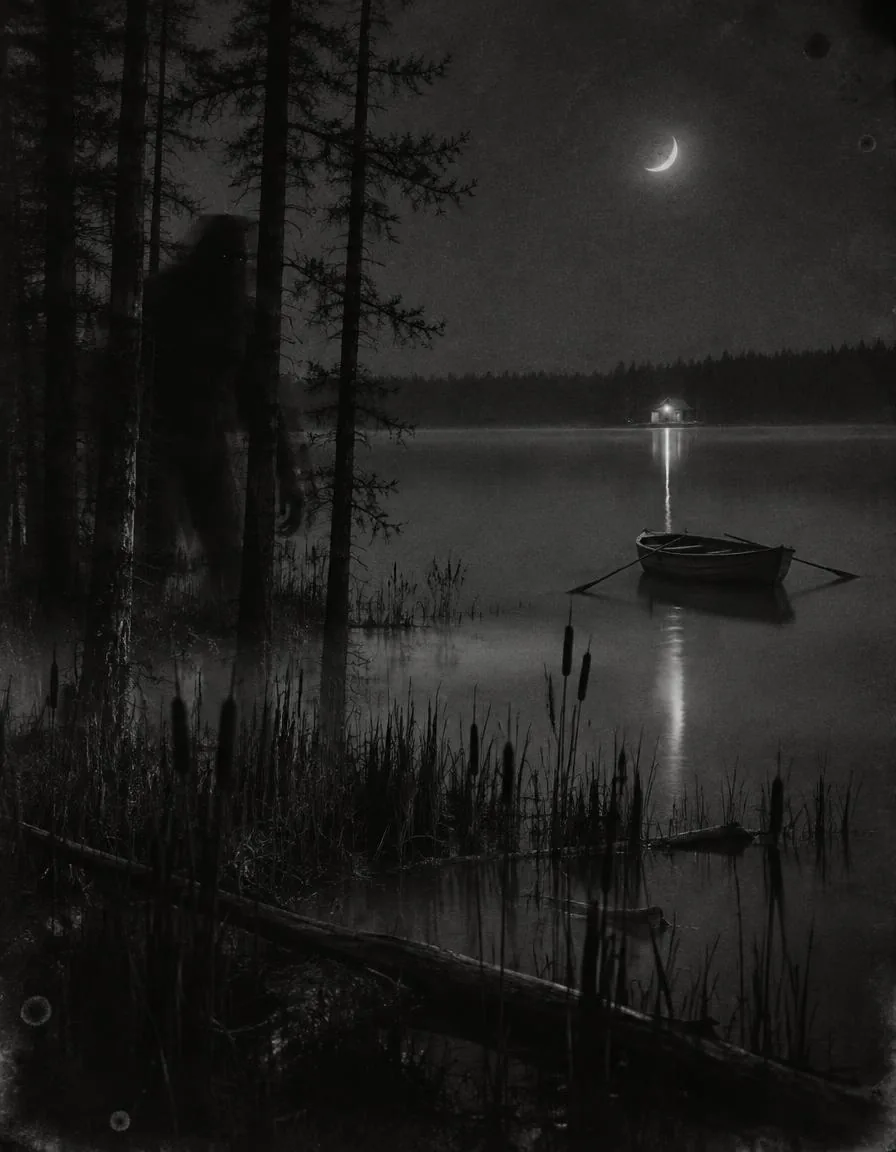
DocumentedPeople have another name for the Dewey Lake Monster now. The Wikipedia article on it calls it the “Sister Lakes Sasquatch.” Another word for Sasquatch is Bigfoot.
DocumentedAnd it has not been reported only once. In the database of the Bigfoot Field Researchers Organization, a group that collects such reports, Michigan has 227 listings, three of them in Cass County. One comes from near Dowagiac, on 27 July 2001, at about half past two in the morning. Two friends, roused by a frightened goose and the sound of snapping branches, took their flashlights outside and found, they said, a large, hairy, ape-like figure crouched in a ditch about thirty feet away. For some ten minutes it froze whenever the lights were on it and stirred when they went off. When the batteries began to fade, one of them ran in for the car keys, to use the headlights. When he came back, it was gone.
DocumentedWiden the circle and the count climbs. The same database lists 227 reports in Michigan, 82 in Indiana, 305 in Illinois and 335 in Ohio: 949 in the four Great Lakes states closest to this valley. Around this valley alone it lists three in Cass County, three in Berrien, three in Kalamazoo, one in St. Joseph County, Indiana, one in Elkhart County and two in La Porte.
DocumentedAcross the country, the same group says it has received nearly 75,000 reports since the 1990s, and counts some 5,500 of them as credible. The state-by-state counts in its database add up to more than 5,700.
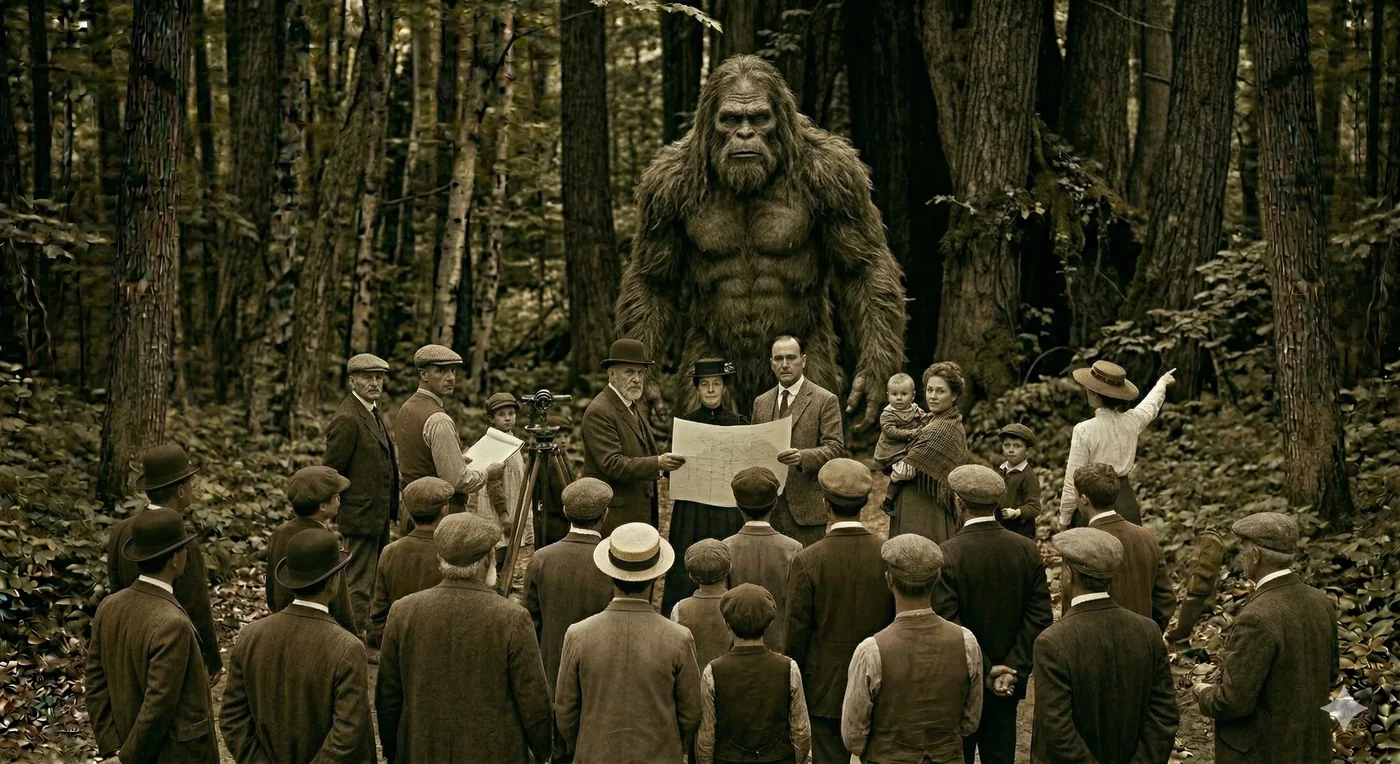
ReadingNone of that is proof of anything. A report is a story someone tells; it is not a body, or a bone, or a photograph that holds up. But it is worth knowing that the witnesses of 1964 were not the last people in this valley to come in from the dark with that look on their faces. Thirty-seven years later, a few miles away, two more did. And somewhere out past the last porch light, in the swamps and the river bottoms and the long dark woods, the valley is keeping its counsel.
Other footsteps in the valley
The Bigfoot Field Researchers Organization’s database is only one collection of stories, and nobody checks them all. But read the reports it holds for the counties around this valley one after another, as we did, and something begins to show: the same kind of night, the same kind of place, the same dog that will not go on.
DocumentedNear Union, Cass County, the late 1960s. A few years after Dewey Lake, a summer-camp riding instructor was out on a trail near the camp in the evening, in the hardwoods near U.S. 12, toward the St. Joseph River, when her horse spooked and bolted. Something large and pale kept pace with them through the trees, running alongside, about as tall as she was in the saddle. She let the horse run. The report, given years later by her nephew, says she was badly frightened and rarely spoke of it again.
DocumentedNear Kalamazoo, the 1970s. A girl of about seven was running across a school playground at the edge of the pines when she ran straight into something. It was very tall, holding a pine branch aside, with skin she remembered as “tawny reddish” and deep chocolate-brown hair. It let the branch go and walked away. Nine or ten years later, on a winter night at her family’s house, she heard growling and heavy steps outside and saw a large shape look around the corner. In the morning there were big footprints in the snow. “I physically ran into a Sasquatch,” she told the investigators.
DocumentedStevensville, Berrien County, a winter night about 1974. In a house near the wooded dunes and a cemetery, a twelve-year-old was babysitting four younger brothers when a sound came from right outside the living-room window: a “howling scream that sounded like something dying,” which turned, as it went on, into a gurgling, low, laugh-like chuckle. The child waited half an hour, then went out with a flashlight. There was fresh snow on the ground. There were no tracks. And the family dog was gone.
DocumentedNear Stillwell, La Porte County, Indiana, October 1987. A man camping alone at dusk, just outside the old Kingsbury ordnance plant, heard rustling and grunting close by. He shouted that he had a gun. A stump landed eight feet from him; then a log, three feet away. He ran. Behind him he heard footsteps on the railroad tracks, about a second apart, and at a dip in the trail he saw something eight or nine feet tall, which screamed: “the most God forsaking scream,” he wrote, “that it would make your blood curdle.” When he came back with two friends three hours later, the tent was torn down. The stump and the log were where they fell.
Read the other 9 reports
DocumentedNear Fulton, Kalamazoo County, spring 1989. Two friends camped by a creek in a swampy wood heard something come up a deer trail, stop about thirty yards off, and scream while it tore at a tree. One loaded a shotgun. The other walked toward it and talked to it, and after a few minutes it went away. The first man says his family had been hearing the thing in those woods since the 1960s. They called it the “Monkey Beast.”
DocumentedNear Buchanan, February 1993. On a cloudy Saturday morning a hunter went looking for his German shepherd at a beaver pond among the orchards. What he took at first for a clump of dark bushes resolved into a shoulder, an arm and a head. He put it at seven to eight feet, “very muscular.” It turned, took two steps and was gone into the brush. His dog would not go near the place afterward.
DocumentedSouth Bend, November 2000. At dawn on a foggy Saturday, two thirteen-year-olds hiking in the woods by a creek off Kern Road found pieces of wood scattered around a set of footprints. Then they heard a noise, and one of them saw a hairy, ape-like figure, about six foot eight, no more than twenty yards away. They ran. The boy said afterward that he had read about the Sister Lakes Monster in a library book.
DocumentedNear Dowagiac, July 2001. The goose, the snapping branches, the thing in the ditch that froze in the flashlight beam, told above.
DocumentedNear Plainwell, May 2002. North up the Kalamazoo, four people reported a sighting together, at night.
DocumentedNear Pullman, Allegan County, June 2007. At two in the morning a man and his girlfriend woke to two screams from the woods by a creek-fed swamp, eight or ten seconds apart, from two different places. Their dog went wild and afterward would not go outside. “It sounded like two ladies being killed,” he said. A few nights later, after he shouted into the dark, he heard something run off into the trees on two feet.
DocumentedOsceola, Indiana, May 2008. At half past three on a Sunday morning, by the swamps and marsh along Baugo Creek, a man heard a howl he had never heard before and could not name. His dog, which went after anything that moved outside, ran out the door, turned straight around and came back in without a sound. It “sent chills up my spine,” he wrote.
DocumentedMill Creek, La Porte County, Indiana, October 2008. A bowhunter twenty feet up a tree stand at last light watched two nervous does burst out of the brush behind him. Then came a smell like an open septic tank. A rotten log about two feet long struck the base of his tree; something at least the size of a man crashed off through the pawpaw. Forty-five seconds later a deep, rising scream came from the swamp at the far end of the woods. He stayed in the stand for an hour before he dared climb down.
DocumentedThe Paw Paw Lake country, June 2012. At dusk, in the woods between Lake Michigan and Paw Paw Lake, a man walking his dog heard what sounded like a large stick break. The dog stared into the trees, “the fur on the back of his neck … standing straight up.” In the morning there was a print in the soil, he said, five inches longer than his own shoe, sunk deep where his own weight left no mark. The investigator noted that the photograph was poorly defined, and could have been made by a person.
ReadingNow look at them together. Almost every one is at the edge of water: a lake, a river, a creek, a beaver pond, a swamp. Almost every one is at the edge of the dark: dusk, night, the early hours. Again and again the first witness is not a person but a dog, or a horse, or a goose. Three times, something threw wood, or left it scattered, as if to say it was there. And again and again, the thing does not come closer. It watches, or it paces, or it turns and takes two steps and is gone.
ReadingThere are plain explanations for every one of them, and they deserve to be said. A red fox’s scream can sound like a woman, or a child. A bear standing up is taller than a man, and a man in camouflage in a swamp can look like a bush. A goose and a dog will panic at a raccoon. People who have heard a story tend to see it. And a report is not a body, or a bone, or a photograph that holds up; none of these has been proved.
ReadingBut none of them has been ruled out, either. Each one is a story somebody told, from somewhere in this valley, about a night they never forgot.
The legend that would not die
DocumentedThe monster outlived the week that made it. The sellers of 1964 had their Monster Burgers and their getaway gas. Sister Lakes Brewing Company has since poured a “Dewey Lake Monster,” a double IPA.
DocumentedTwo years on, the story was still selling papers. A Dow Jones advertisement in Time of 30 December 1966 sold the National Observer on it: “Ichabod Crane would certainly have been terrified by this legend of the Hairy Monster of Sister Lakes in The National Observer.”
DocumentedIt never quite stopped being seen, either. In 2016 a Kalamazoo television station, WWMT, closed its “Michigan Monsters” series at Dewey Lake and counted nearly thirty sightings over the years, from Dowagiac as far as Decatur, some with cars said to have been smashed or turned over. Wendy Alexander, who grew up in Cass County hearing the stories and kept track of new ones, was open-minded but plain about what it would take to settle it: “an actual specimen.”
DocumentedIn July 2019, at the Dewey Lake boat parade, the Dowagiac Daily News met a family whose son dressed as a sasquatch every year, to keep up, as his mother put it, “the tradition of the Dewey Lake Monster.”
DocumentedIn October 2020 the Lost Cryptids Conservatory, a Michigan group founded in 2011 by Blake Duescher, held a Dewey Lake Monster Conference at the brewery. A few dozen people came, believers and skeptics both; there were plaster casts of footprints on the tables, and Duescher’s team had walked the woods the day before. What struck him most was how the creature was said to behave: “the level of aggression and harassment is kind of unparalleled.” That same month Southwestern Michigan College in Dowagiac released a radio play, Terror on Dewey Lake. The brewery has since hosted “Bigfoot and Brews,” a whole convention in the monster’s honor.
ReadingThat is how a legend works. The papers said it was nonexistent, and the sheriff called off the reward, and the pickers went back into the fields. But the name stayed. Sixty years on, people who never heard of the 1964 headlines still know there is something called the Dewey Lake Monster, and still, now and then, slow the car on the back roads at dusk and look into the trees.
A timeline of frights
- Early days Volinia Township: a boy sees “an immense cat” on a leaning tree; a colt is found killed, its blood drained.
- Pioneer days Porter Township: a panther follows a couple home from church for miles, “emitting his blood-curdling cries.”
- Before 1837–39 The fork at Section 16: “Turn to the left and go to the Devil,” in red chalk on a peeled tree.
- Dec 1839 Michigan City: “A Wild Child,” four feet high and covered in chestnut hair, runs the sand hills by Fish Lake and swims in it, “whining most piteously.”
- Oct 1898 Michigan papers report “a huge sea serpent” in Indian Lake, near Dowagiac; two weeks later, an otter and a muskie.
- July 1899 The Indian Lake beast is back, said to move “through the water like an arrow.”
- 1962–64 Reports of a large, hairy thing on two legs south of Dewey Lake; most witnesses keep quiet.
- 9 June 1964 The Utrup farm: Gordon Brown’s headlights pick it out between the barn and a shed; with a flashlight, the Browns follow it and walk past a “tree” that is not a tree.
- 10 June 1964 A MONSTER sign, a radio appeal, and a night of armed hunters on the back roads.
- 11 June 1964 9:15 a.m.: three girls see it cross the road on two legs. One faints.
- 11–12 June 1964 Front page of The Detroit News: the traffic, the hunt, the empty berry fields.
- 12–14 June 1964 South Bend Tribune: the monster is “nonexistent”; nobody “seems frightened anymore.”
- 12 June 1964 “Big ape tracks”; Mary Brown’s drawing on the front page in Chicago; berry pickers sleep in their cars.
- 13 June 1964 Detroit Free Press banner: “‘Beast Town’ Booms: Get Your Monster Kit (7.95).” Conservation Officer Bill Roe calls it a bear, drawn by “the lure of swamp huckleberries.”
- 17 June 1964 Near Ionia: the Ritter brothers’ ten-foot creature on I-96. The next night, a figure in fur at the Saranac overpass, and eight boys in ponchos.
- 18 June 1964 Dowagiac Daily News: “Policeman Says ‘No Monster.’”
- 13 July 1964 Near Dowagiac: a couple watches something with reddish-brown hair by the Dowagiac Swamp until it climbs a tree.
- Aug 1964 Sheridan, Montcalm County: a “lion” in a tree, and neighbors who will not talk “for fear of ridicule.”
- Aug 1965 Monroe: a seven-foot thing with hair “like quills” attacks a car on Friday the 13th. A hoax, say the police.
- Late 1960s Near Union: something pale runs alongside a bolting horse through the trees.
- Aug 1968 Near Sister Lakes: Van Buren deputies quietly hunt a loose ocelot, rather than start “another” monster scare.
- 1970s Near Kalamazoo: a girl runs into something tall and hairy at the edge of a playground.
- About 1974 Stevensville: a scream like something dying, then a low chuckle. Fresh snow, no tracks.
- 1983 The Tribune looks back and blames strawberry pickers who had been drinking.
- Oct 1987 Near Stillwell, Indiana: a stump and a log thrown at a lone camper; a scream; the tent torn down.
- Spring 1989 Near Fulton: something screams and tears at a tree beside a creek camp.
- Feb 1993 Near Buchanan: a dark, muscular figure at a beaver pond, seven or eight feet tall.
- Nov 2000 South Bend: two boys, scattered wood, footprints, and a figure six foot eight.
- 27 July 2001 Near Dowagiac, 2:30 in the morning: two friends with flashlights report a large, hairy figure crouched in a ditch. Then it is gone.
- May 2002 Near Plainwell: four witnesses, one night sighting.
- June 2007 Near Pullman: two screams from a swamp at 2 a.m.; a dog that will not go out.
- May 2008 Osceola, Indiana: a howl by Baugo Creek, and a dog that will not go out.
- Oct 2008 Mill Creek, Indiana: a log thrown at a hunter’s tree stand, and a scream from the swamp.
- June 2012 The Paw Paw Lake country: a snapping stick, a dog’s raised hackles, a print in the morning.
- 2016 WWMT counts nearly thirty sightings over the years, from Dowagiac to Decatur.
- Oct 2020 A Dewey Lake Monster Conference at Sister Lakes Brewing; a radio play, Terror on Dewey Lake.
Story or record? Play along
Now that you have read the record, try these. Here are ten things people say about the Dewey Lake Monster and the country around it. For each, make your call: true, false, or no record either way. Then see what the paper shows.
“The monster scare was front-page news in Detroit.”
True
The Detroit News put it on page one on 11 and 12 June 1964.
“Police caught, or photographed, the creature.”
False
The searches found nothing, and by 12 June the South Bend Tribune called the monster “nonexistent.”
“Berry pickers refused to go into the fields.”
True
“‘Monster’ Scare Idles Pickers,” said The Detroit News of 12 June 1964, with “Workers Afraid To Go Into Fields.” It was strawberry season.
“The first witnesses said it stood about nine feet tall.”
True, as reported
About nine feet and 500 pounds is what the first witnesses told the deputies, as Robert Atkinson gathers the 1964 reports. A twelve-year-old girl who saw it on 11 June said seven feet. On 14 June a wire story printed in Indiana had it at ten feet and more than 500 pounds; the monster grew in the telling.
“In 1964 people called it Bigfoot.”
Not in the papers
The 1964 headlines called it the monster, the creature or the thing. The word Bigfoot had been coined only six years before, by a California newspaper in 1958. The Sister Lakes Sasquatch is a later name.
“It was said to cry like a baby.”
True, as told
The story told in the Sister Lakes country today, as Visit Southwest Michigan tells it: a large, hairy creature with glowing red eyes, and “it cried, like a baby.”
“There was a $1,000 reward for it.”
True
A local beer distributor offered $1,000 for the monster taken alive by 22 June, then withdrew it at the sheriff’s request when the calls poured in (as Atkinson reports).
“Someone once warned travelers off the road to Dewey Lake.”
True
The county history of 1882 (p. 356): on a peeled tree at the fork, in red chalk, “Turn to the left and go to the Devil.”
“The Dewey Lake Monster has been called a Sasquatch.”
True
The Wikipedia article on it gives the name “Sister Lakes Sasquatch.” And in 2001, near Dowagiac, two friends reported a large, hairy, ape-like figure.
“An old county book calls a creature here a “monster.””
True
The 1882 history, telling of a great cat in Volinia Township: “the monster had killed a colt … and sucked its blood” (p. 285).
If you go out there
After dark at the Sister Lakes
Stay on the public roads, and leave the farms, the fields and the private shores alone. Turn the engine off. Wait. Listen for the frogs to stop, the way they do when something moves. And if, out past the last porch light, you hear what sounds like a baby crying in the trees, you will know, at least, that you are not the first.
The case file: what we asked, and what we found
6 questions answered
Mary Brown sketched what she had seen in a small notebook balanced on an oilcan, for a reporter from Chicago’s American, and on Friday, 12 June 1964, the paper ran it on the front page. The drawing survives in a 1980 reprint; the page itself we know only on the Chicago Public Library’s microfilm. Here is what else we asked, and what we found.
The week of the monster
- Answered Who was Mrs. Utrup? Evelyn, the wife of John Utrup. The wire and the National Observer both called her “Mrs. John Utrup”; Janet Bord’s Bigfoot Casebook (1982) names the land “a farm owned by Evelyn Utrup and her husband John.” And John turns out to be a witness himself, a farmer who told the sheriff he had seen the thing “several times.”
- Answered Where did the nine feet come from? From one man and one bush. The National Observer of 22 June 1964 says “the accepted set of dimensions was established by farmer Utrup.” He saw something with a black face and “big, bright, shining eyes” standing behind a bush in his yard. Next day he measured the bush, found it five feet high, and judged the thing four feet taller. When he first saw it is not certain: a 1980 survey lists an unnamed 1962 sighting described in the same words. By the time the Associated Press wrote it up on Thursday, 11 June 1964, the figure had become a description “pieced together by police from residents’ complaints”: “About nine feet tall. About 500 pounds.” The United Press gave it to Mrs. Utrup, and Atkinson to the Browns. But it started at the Utrup farm, where Mrs. John Utrup called the sheriff on the night of Tuesday, 9 June.
- Answered Who was the conservation officer on the road? Wikipedia calls him William Rowe. The Associated Press, writing from Dowagiac on Saturday, 13 June 1964, calls him “Conservation Officer Bill Roe.” He thought the monster was “nothing more than a bear far from its regular haunts,” “brought to the area by the lure of swamp huckleberries.” “Odds-on,” he said, “that’s what it probably is.”
- Answered Who were the three more witnesses of 11 June? “Three more persons Thursday reported seeing the creature,” said the United Press, and gave no names; the AP said only that deputies searched the woods “after three girls reported seeing the beast.” Atkinson found them in the local papers: three girls of twelve and thirteen, Joyce Smith and the sisters Gail and Patsy Clayton. They were walking a road at 9:15 that morning when it stepped out of the woods and crossed in front of them on two legs. Joyce fainted. Patsy, who saw it best, called it seven feet tall, with a black face, and “definitely not human.” That night deputies with rifles searched the woods and found nothing. “We think it’s a bear,” said Dave Lyons of the sheriff’s staff, and then he hesitated: “Other people…”
The country before it
- Answered Who was Henry Dewey? He entered land in Pokagon Township in October 1830 and came the next April with his wife and eleven children. The 1882 book gives his home as Union County, Indiana, in one place and Wayne County in another. In 1835 he entered land on Section 8, by the lake that “now bears his name.” When he came to live there, Daniel Blish was “positive that it was not until 1841,” but the book itself adds: “It may have been shortly before this time.” Its own records answer it. Henry Dewey is on the poll list of Silver Creek’s first election after its first town meeting, the one before November 1839, so 1838. He is also on the township’s 1838 roll of resident taxpayers, with land valued at $1,571, the third largest in the township. In 1872 the county atlas still showed “Heirs of David Dewey” on Section 8. The road to the Devil may be older than his name on the lake, but not by much.
- Answered What was the hairy thing at Michigan City in 1839? The papers called it “A Wild Child”: a boy of four feet in a coat of chestnut hair, living wild in the sand hills by Fish Lake. The earliest printing we have found is in the Farmers’ Gazette, and Cheraw Advertiser of South Carolina, 27 December 1839. It carries a Michigan City report dated 4 December. The Philadelphia Saturday Courier had it the next day. The plea to capture the boy, “an act of humanity,” was the Michigan City Gazette’s own.
The monster that kept coming back
- 17 June 1964: two brothers from Clare reported a ten-foot, gorilla-like creature crossing I-96 near the Saranac interchange at four in the morning. “Sister Lakes of Cass County may have lost its ‘monster’ to more northerly climes,” said the AP.
- 13 July 1964: near Dowagiac, a couple watched something reddish-brown in the Dowagiac Swamp until it climbed a tree.
- 13 August 1965: a Friday the 13th. A mother and her teenage daughter near Monroe said something reached through their car window and seized the girl. Four days later the Benton Harbor News-Palladium reported that the “Monster of Sister Lakes” had “apparently packed his bags (or whatever monsters pack) and headed to Monroe, Mich.”
- August 1968: Van Buren deputies spent two weeks quietly hunting a loose ocelot near Sister Lakes. “We didn’t want to say anything about it before,” said Sgt. Donald Hogmire. “I have been through two monster scares in Sister Lakes, and I wasn’t about to start another one.”
Read the papers yourself
The week, in the papers you can open today
You can read the Associated Press’s stories from that week, free, in the Escanaba Daily Press:
- Thursday, 11 June 196469: “‘Hairy Monster’ Of Cass County Eludes Hunters,” front page
- Friday, 12 June 196470: “Armed Officers Hunt ‘Monster’”
- Saturday, 13 June 196471: “Sister Lakes ‘Monster’ May Be Big Bear”
- Wednesday, 17 June 196472: “Clare Brothers See ‘Monster’”
And from the older record:
- The St. Joseph Herald-Press, 5 August 196873: the ocelot hunt
- Mary Brown’s drawing, reprinted in 198076: page 4
- The 1872 county atlas80: Silver Creek is page 7
- The 1882 History of Cass County: search inside for “go to the Devil”
- The Treat Family (1893): Timothy and Sullivan Treat
- The Observer’s World (1965)54: the National Observer’s Sister Lakes story, page 97, free to borrow
Find something we missed? Write to research@projectscroll.com. Credit goes to the finder.
Sources
- History of Cass County, Michigan (Chicago: Waterman, Watkins & Co., 1882): Silver Creek Township, Henry Dewey, Timothy Treat and the red-chalk sign, p. 356; Volinia Township, the panther and the colt, p. 285; Porter Township, the panther near Birch Lake, p. 303. Internet Archive.
- The Detroit News, 11 June 1964, front page (“Frankenstein Snarl of Traffic Loosed by ‘Monster’ Hunt”), as listed and pictured by RareNewspapers.com.
- The Detroit News, 12 June 1964, front page (“‘Monster’ Scare Idles Pickers”), as listed by RareNewspapers.com.
- South Bend Tribune, 12 June 1964, p. 21; 14 June 1964, p. 21 (Ray Gard); 18 August 1983, p. 2 (“Action Line”). As cited in Wikipedia, “Dewey Lake Monster,” which also names the conservation officer “William Rowe.”
- Robert Atkinson, “Monster Town USA: The 1964 Sister Lakes Monster Sightings” (July 2017), the fullest account of the week, from the Dowagiac Daily News (11, 13, 14 and 18 June 1964), Chicago’s American (12 and 15 June), the St. Joseph Herald-Press (10 June), the Chicago Tribune and Chicago Daily News (12–13 June) and the Kalamazoo Gazette (12 June). The names, ages and times in this story are as those papers gave them.
- Curator 135, “The Dewey Lake Monster” (2022): the Benton Harbor Herald-Palladium of 11 June 1964 on the three girls at Swisher Street and Town Hall Road, the police response and the checkpoints.
- Notebook of Ghosts, “From the Newspaper Archives: More Midwest Monsters” (2020): the Muncie Star Press of 14 June 1964; the Benton Harbor News-Palladium of 17 August 1965, p. 9, and the South Bend Tribune of 24 August 1965, p. 3, on Monroe.
- United Press International, 11, 12 and 15 June 1964 (Mrs. John Utrup, the chase, nine feet and 500 pounds; the “black leathery human-like face”; Undersheriff Ernest Kraus and the deer rifles; the sounds “like a tamed goose” and “a baby crying”; the circus gorillas; the bear; Sheriff Dool and the disarming), as printed in the Isabella County Daily Times-News of those days. Digital Michigan Newspapers.
- United Press International, 13 June 1964 (“Jack Hadley, a local beer distributor”; the reward to 5 p.m., 22 June), as printed in the Traverse City Record-Eagle, p. 1.
- The National Observer, June 1964, reprinted in Charles Preston, ed., The Observer’s World (Dow Jones, 1965), p. 98: Mrs. Utrup and Sheriff Robert Dool, Undersheriff Ernie Kraus and the posse, Gordon Brown at Harold Utrup’s farm. Read in search excerpts.
- John Eby, “Dear John,” Dowagiac Daily News, 31 May 2012: the Daily News hunt story of 11 June 1964 by Dave Schultz, and Sheriff Robert “Bud” Dool on “3,000 strangers prowling about at night with guns,” quoting Eby’s own “Horizons” feature in the Dowagiac Daily News of 23 February 2007.
- Leader Publications, “It came from Dewey Lake,” 23 February 2017 (Deputy Andy Chavous; the reward withdrawn).
- Amberrose Hammond, Mysterious Michigan (The History Press, 2022), pp. 128–133: a later account of the week, with its own list of the 1964 papers.
- Bureau of Land Management, General Land Office records: Sullivan Treat, patent of 1 May 1839, Section 12, Township 5 South, Range 16 West, and Section 7, Township 5 South, Range 15 West.
- Leader Publications, 30 March 2006, on the Cass County sheriffs since 1969 (Paul Parrish served after 1988, not in 1964).
- Robert Atkinson, “Monster Town USA” (July 2017), the archive listing, a survey of the Dowagiac, St. Joseph, Kalamazoo, Detroit and Chicago papers of 10–18 June 1964: the first descriptions, the reward and the sheriff.
- Plat map of Silver Creek Township, Cass County, Michigan, about 1928, on the Project Scroll map room.
- Wikipedia, “Indian Lake (Cass County, Michigan)” (spring-fed; about 506 acres).
- Bigfoot Field Researchers Organization, report 2914: Cass County, Michigan, near Dowagiac, 27 July 2001 (a witness report, not verified by us).
- Bigfoot Field Researchers Organization, reports 21916 (near Union, Cass County, late 1960s), 7386 (Stevensville, about 1974), 25768 (near Buchanan, 1993), 4414 (near Plainwell, 2002), 23734 (Osceola, Indiana, 2008) and 35753 (Paw Paw Lake country, 2012). Witness reports, not verified by us.
- Visit Southwest Michigan, “Haunted places & chilling ghost stories” (the creature that “cried, like a baby”; the ABC News crew from Chicago).
- Bigfoot Field Researchers Organization, Michigan listings (227 when we read it; Cass County, 3).
- Bigfoot Field Researchers Organization, the report database by state (Michigan 227, Indiana 82, Illinois 305, Ohio 335, when we read it on 23 October 2026), and the Indiana county listings.
- Nexstar Media, “These states have more ‘credible’ Bigfoot sightings than others, according to Bigfoot investigators,” 27 August 2022 (nearly 75,000 reports; some 5,500 counted credible).
- Pictures: Tichnor Brothers postcards of Dewey Lake and Crooked Lake (Boston Public Library); the Great Sea-Serpent (Illustrated London News, 1848); Sherman F. Denton’s muskellunge (1896); the Audubon cougar (1845–48); the Dowagiac Woods (Fergu186). All via Wikimedia Commons.
- Wikipedia, “Dowagiac Woods” (384 acres; the Michigan Nature Association’s largest sanctuary in the Lower Peninsula).
- Michigan Department of Natural Resources, on cougars in Michigan (native; wiped out around the early 1900s).
- Grand Traverse Herald, 13 October 1898, p. 4 (“Indian lake cottagers, near Dowagiac”). Digital Michigan Newspapers, Clarke Historical Library, Central Michigan University.
- Isabella County Enterprise, 14 October 1898, p. 4; Evart Review, 28 October 1898, p. 8; Gladwin County Record, 21 July 1899, p. 6 (“Cass County’s Sea Serpent”). Digital Michigan Newspapers.
- John Harvey Treat, The Treat Family: A Genealogy of Trott, Tratt, and Treat (1893), pp. 68 and 93 (Timothy Treat, no. 191; Sullivan Treat, no. 386). Internet Archive.
- Isabella County Daily Times-News (Mount Pleasant), 11, 12 and 13 June 1964, p. 1: “Sister Lakes ‘Monster’ Seen Again,” “‘Sister Lakes Monster’ Still At Large,” “Business Is Booming at ‘Monsterville’” (United Press). No copyright notice found in these issues. Digital Michigan Newspapers.
- United Press International, 17 June 1964 (Wayne and Lloyd Ritter of Clare on I-96), as printed in the Isabella County Daily Times-News, p. 1. Digital Michigan Newspapers.
- Clare Sentinel, 18 June 1964, p. 1 (“Did They See The Monster?”: Wayne and Lloyd Ritter on I-96), and 31 December 1964, p. 1 (the year in review). Digital Michigan Newspapers.
- Isabella County Daily Times-News, 10 August 1964, p. 2 (United Press, “Now Sheridan Has Its Own ‘Monster’”). Digital Michigan Newspapers.
- Saline Reporter, 19 August 1964, p. 2 (Dowagiac and the Loch Ness envy). Digital Michigan Newspapers.
- Detroit Free Press, 13 June 1964 (“‘Beast Town’ Booms: Get Your Monster Kit (7.95)”), as listed by RareNewspapers.com.
- Aaron Dimick, “Michigan Monsters: Dewey Lake Monster legend comes to the surface,” WWMT, 30 May 2016.
- Leader Publications, “Sister Lakes Brewing Company to host Dewey Lake Monster conference,” 3 October 2020, and “Sister Lakes Brewing Company hosts Dewey Lake Monster conference,” 19 October 2020.
- Leader Publications, “Boat parades, bragging rights up for grabs this weekend,” 3 July 2019.
- Leader Publications, “SMC to produce radio show featuring Dewey Lake monster” (2020).
- SW Michigan Dining, “Sister Lakes Brewing Company,” 16 August 2018 (the Dewey Lake Monster double IPA).
- WSBT, “Bigfoot and Brews, a convention for cryptid enthusiasts.”
- Isabella County Daily Times-News, 17 June 1964, p. 1 (United Press: the Ritter brothers, Sgt. Sid Frazer, Troopers Charles Bush and Bob Tubbs). Digital Michigan Newspapers.
- Isabella County Daily Times-News, 18 June 1964, p. 2 (United Press, “‘Monsters’ Get Lecture From Police”: Cpl. Richard Abbott and Jocko; the eight youths on M-21). Digital Michigan Newspapers.
- Lindsey Beckley, “Mermaids, Giant Turtles, and Wild Men…Oh My!,” The Indiana History Blog, Indiana Historical Bureau, 2017 (the Michigan City “wild” creature, as reprinted in the Adams Sentinel, Gettysburg, 30 December 1839).
- Moon phases for June 1964 (new moon, 10 June). Catalina Sky Survey, University of Arizona.
- Michigan Department of Natural Resources, on black bears expanding south since 2000, as reported by WDIV ClickOnDetroit, 10 April 2025; Leader Publications, “Cass County residents report black bear sighting, DNR confirms,” 9 May 2022.
- Bigfoot Field Researchers Organization, reports 37553 (near Kalamazoo, 1970s), 2076 (near Stillwell, La Porte County, Indiana, 1987), 2897 (near Fulton, Kalamazoo County, 1989), 1786 (South Bend, 2000), 19838 (near Pullman, Allegan County, 2007) and 26939 (Mill Creek, La Porte County, 2008). Witness reports, not verified by us.
- Courier-Northerner (Paw Paw), 15 July 1927, p. 10: the minutes of the Van Buren County Board of Supervisors, 13 October 1837 (the bounty on wolves and panthers). Digital Michigan Newspapers.
- Detroit Free Press, 17 August 1965 (“‘The Thing’ Haunts Monroe: Monster Days Are Here Again,” with the photograph of the girl’s black eye), as listed by RareNewspapers.com.
- Wikipedia, “Bigfoot” (the name first used in print by the Humboldt Times, California, in 1958).
- OpenStreetMap contributors, lakes and roads of Silver Creek Township (data © OpenStreetMap contributors, ODbL), drawn on the 1928 plat’s grid for the then-and-now map.
- Isabella County Daily Times-News (Mount Pleasant), 13 June 1964, p. 1 (United Press: “Business Is Booming at ‘Monsterville’”; the kits, the burgers and the bounty). Digital Michigan Newspapers.
- The Observer’s World: People, Places, and Events from the Pages of The National Observer (1965): Mrs. John Utrup, Gordon Brown and his “two companions,” and “farmer Utrup” and the bush; Foshen and Len Clinton by Magician Lake, and Harold Brown (“The Lakes ‘Monster’,” p. 97). The report’s date, 22 June 1964, is as J. W. Green gives it (1967). Read in Internet Archive full-text search.
- John A. Keel, Strange Creatures from Time and Space (1970): John Utrup and Gordon Brown. Read in Internet Archive full-text search.
- Janet and Colin Bord, The Bigfoot Casebook (1982): “Evelyn Utrup and her husband John”; Gordon Brown, “a fruit picker from Georgia.” Read in Internet Archive full-text search.
- “The Monster at Sister Lakes,” FATE, October 1964: Gordon Brown on the Harold Utrup farm. Read in Internet Archive full-text search.
- Eric Norman (Brad Steiger), The Abominable Snowmen (1969): Gordon Brown “from nearby Dowagiac” and the car. Read in Internet Archive full-text search.
- Daily Colonist (Victoria, B.C.), 14 June 1964, p. 59: “Monster Kits Selling Briskly But Berry-Pickers in Panic”; Jack Hadley and the reward. University of Victoria, via Internet Archive.
- “A Wild Child,” Farmers’ Gazette, and Cheraw Advertiser (Cheraw, S.C.), 27 December 1839, p. 7, from Michigan City, 4 December, credited to the Gazette. South Carolina Digital Newspaper Program, Chronicling America.
- History of Cass County, Michigan (1882): Silver Creek Township, the Treats, John Barney, Henry Dewey and Daniel Blish, the first town meeting and the supervisors, the poll list of the first election (1838) and of November 1839, the 1838 roll of resident taxpayers, and the table of first land entries (Sullivan Treat, 17 May 1836); Pokagon Township, Henry Dewey in 1830. Internet Archive, search inside.
- John Harvey Treat, The Treat Family (1893): Timothy Treat near Niles in 1834 and in Silver Creek in 1837; Sullivan Treat, who settled in Silver Creek “at the age of twenty-one,” and his daughter Lucy Ann; Timothy’s children (Horace Jay, March 1835) and Fidelia’s marriage to Philander Dunning, July 1835. Internet Archive, search inside.
- Geographic Names Information System, Grabemeyer Lake and Dewey Lake (feature 624618), as listed by MyTopo.
- Library of Michigan, newspapers on microfilm: Berrien County (the St. Joseph Herald-Press, 1928–1965).
- Library of Michigan, newspapers on microfilm: Cass County (the Dowagiac Daily News, 1964 on).
- Chicago Public Library, Chicago newspapers on microfilm (Chicago’s American, 1962–1969).
- Lindsey Beckley, “Mermaids, Giant Turtles, and Wild Men … Oh My!,” Indiana History Blog, Indiana Historical Bureau, 29 May 2017.
- “It came from Dewey Lake,” Leader Publications (Dowagiac), 23 February 2017.
- Escanaba Daily Press, 11 June 1964, p. 1: “‘Hairy Monster’ Of Cass County Eludes Hunters” (Associated Press): the description “pieced together by police,” Gordon Brown’s headlights and flashlight and “It’s no bear,” Deputy Jack Greene, and the track found by Deputies Howard Sheline and Daniel Behrman. Internet Archive.
- Escanaba Daily Press, 12 June 1964: “Armed Officers Hunt ‘Monster’” (Associated Press): the three girls, and Dave Lyons of the sheriff’s staff. Internet Archive.
- Escanaba Daily Press, 13 June 1964: “Sister Lakes ‘Monster’ May Be Big Bear” (Associated Press, Dowagiac): Conservation Officer Bill Roe, and Sheriff Robert Dool on the migrant families. Internet Archive.
- Escanaba Daily Press, 17 June 1964: “Clare Brothers See ‘Monster’” (Associated Press, Grand Rapids). Internet Archive.
- Bill Hamilton, “Sister Lakes Ocelot Killed After Big Hunt,” St. Joseph Herald-Press, 5 August 1968: Sgt. Donald Hogmire. Internet Archive.
- Time, 30 December 1966: a Dow Jones advertisement for the National Observer (“the Hairy Monster of Sister Lakes”). Internet Archive, in its one item for the 1966 issues.
- Benton Harbor Herald-Palladium, 2 September 1977: Jack Hadley, president of Dixon Beverage. Internet Archive.
- David Fideler, ed., Michigan Anomaly Research, Report on Current Research, vol. 1, no. 2 (Winter 1980): the 1962 and 13 July 1964 entries, the “18-inch footprints,” the Philadelphia Saturday Courier of 28 December 1839, and Mary Brown’s drawing (“witness drawing, Sister Lakes, Michigan: 1964”), p. 4. Marcello Truzzi papers, Eastern Michigan University, on the Internet Archive.
- Lon Strickler, “Monster of Sister Lakes: ‘It’s No Bear. It Had a Human Face!’,” Phantoms & Monsters (2024), reprinting the Holland Evening Sentinel of 11 June 1964 (the Harold Utrup farm; Mrs. John Utrup).
- J. W. Green, “Reports indicating the existence of giants, human-like creatures, in North America,” Genus 23, nos. 3–4 (1967): 221–245, which dates the National Observer’s report to 22 June 1964. Internet Archive.
- History of Berrien and Van Buren Counties, Michigan (Philadelphia: D. W. Ensign & Co., 1880), Keeler Township: Ira Foster, his cabin of 7 April 1837, and “Samuel Treat, at Silver Creek, in Cass County.” Internet Archive.
- D. J. Lake, Atlas of Cass County, Michigan (Philadelphia: C. O. Titus, 1872), Silver Creek Township, p. 7: the base of our map of the fork. University of Michigan Library, on the Internet Archive.
- Wayne State University Libraries, on The Detroit News strike of 22 July to 22 November 1964.
Numbers in the text point to this list; entries without a number are further sources we consulted. How we research › · The libraries behind all our stories ›
More lore and legends Write to us All the news
About this research
Research and reporting Michael Urbanski Project Scroll
- Sources
- Every fact on this page is drawn from the sources listed above, and each can be checked where it is held.
- Corrections
- Errors are corrected on the page, and each correction is noted there.
- Contact
- To report an error or share a record that adds to the story, write to research@projectscroll.com.
- Method
- How we research ›
© 2026 Michael Urbanski and Project Scroll. All rights reserved. The text, original maps, charts and illustrations may not be reproduced without permission; brief quotations with credit and a link back are welcome. Material from other sources belongs to its holders and is credited where it appears; public-domain material is marked as such.


