Project Scroll

    Tip: press / or Ctrl K anywhere to search.

    ← Every place in Berrien County

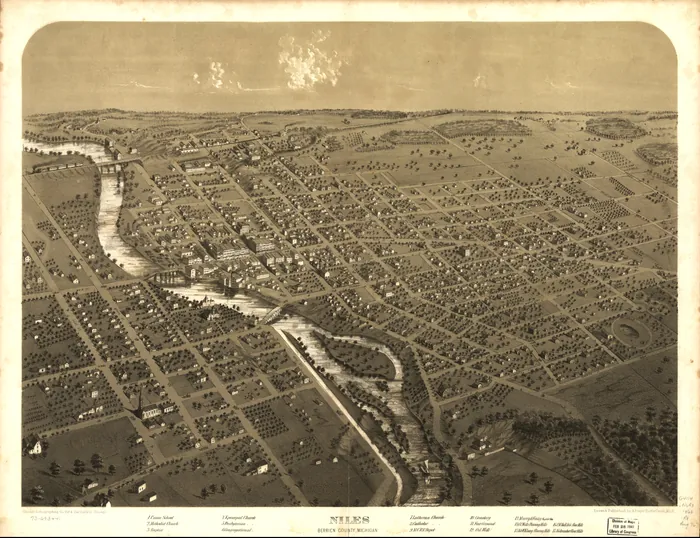
    Bird’s-eye drawing of Niles in 1868 with the St. Joseph River and its bridges

    Berrien County · Michigan · St. Joseph River Valley

    Niles

    The City of Four Flags, named for a Baltimore editor.

    Discover its storyThe full historyThings to seeDirectionsThe valley map

    Niles in 1868, the year the dam and the iron bridge were begun: A. Ruger’s bird’s-eye view. A. Ruger; Chicago Lithographing Co., Library of Congress, via Wikimedia Commons, Public domain.

    • Cityin Berrien County
    • 1828founded
    • 11,988people, 2020 census
    • 22 mifrom St. Joseph, the county seat

    Project Scroll is an independent local-history website. This is not an official page of the City of Niles or Berrien County, and it does not speak for them. For official business, contact the city office directly.

    The story

    Welcome to Niles

    Niles grew where Dowagiac Creek meets the St. Joseph River, a few miles from the French Fort St. Joseph and the Baptist Carey Mission. Traders opened a store here in 1828 and named their village in 1829 for Hezekiah Niles, the Baltimore newspaper editor. Today its museum, its fort site and its grand Michigan Central depot tell three centuries of river history.

    The river here was a crossroads long before the town. The French built Fort St. Joseph on the St. Joseph River south of the present city, and the state’s marker dates it to 1691; it passed to the British in 1761, was taken by Indians in Pontiac’s uprising of 1763, and in 1781 Spanish raiders from St. Louis flew their flag over it briefly, which is the root of Niles’s nickname, the City of Four Flags. The land east of the river was ceded by the Potawatomi at the Treaty of Chicago in 1821, but, Ellis notes, it was not surveyed and offered for sale until 1829. Settlers were first drawn by Isaac McCoy’s Carey Mission west of the river; Squire Thompson of Union County, Indiana, built a cabin on the riverbank in 1823.

    In 1827 Ephraim and Elijah Lacey, Samuel B. Walling, Isaac Gray, William Justus and A. Thornberry came down the river from Richmond, Indiana, looking for water power, passed by Elkhart, and chose the mouth of Dowagiac Creek. In October 1828 Obed P. Lacey, Walling and Justus brought their families and a stock of goods; the books of Walling & Lacey, the first store in the St. Joseph valley according to Coolidge, opened that month, and in January 1829 they were headed “Pog-wa-tigue,” which Ellis renders “running water.” Obed Lacey acted as postmaster, and Isaac Gray received the first regular commission in 1830. On August 1, 1829, Justus, Walling and the Laceys laid out a plat that was recorded in Lenawee County as “the plat of the village of Niles”; Coolidge says Obed Lacey named it for the editor of the Niles Register, a favorite paper of his.

    Read the full story

    The Laceys started a sawmill in January 1830 and a flour mill the same year, a raising that drew men from thirty miles around. Alamanson Huston opened the first tavern in a log house on Main Street in 1829, where the county’s first court was ordered to sit; Thomas K. Green’s house became the “Old Diggins” tavern, the headquarters of the officers during the Sauk (Black Hawk) war of 1832, when troops were quartered in the unfinished Pavilion hotel. A ferry licensed in 1831 carried teams across the river until the free Broadway bridge opened in December 1836. The First Presbyterian Church was organized in March 1834 and Trinity Episcopal Church that November, and Nathaniel Bacon’s American Hotel of 1835 was the first brick building in the village.

    Niles was incorporated as a village by an act approved February 12, 1835, and received its city charter on February 12, 1859, with Elijah Lacey as first mayor. The Michigan Central was rerouted through the town in 1847, and the first passenger train from Detroit arrived on October 7, 1848, with about 130 invited guests; for a while steamboats met the trains at a tall warehouse by the bridge. Coolidge calls 1865 to 1872 a time of “unexampled prosperity,” when the population nearly doubled: in 1868 work began on the dam, the gas works and the iron Main Street bridge, and the large Reading House hotel went up. The Michigan Air Line reached Niles in February 1871.

    The dam powered paper. J. W. French and J. B. Millard organized the Michigan Wood Pulp Company on the west bank in 1872, and as the French Paper Company it was, by 1906, the largest factory in the city; the Niles Board and Paper Company held the rest of the water power. After a quieter stretch, Coolidge credits the Business Men’s Association of 1901 with bringing new factories, among them the Garden City Fan Company from Chicago. The Michigan Central built its stone depot in 1892, famous for its landscaped grounds, and Henry A. Chapin’s mansion of 1882–84 became city hall in the 1930s and is now the home of the Niles History Center. The 2020 census counted 11,988 people.

    More on Niles: the full history, maps and pictures ›

    Plan a visit

    Things to see

    • Fort St. Joseph Museum and Chapin Mansion (Niles History Center)

      508 E. Main Street, Niles

      Free museum in the carriage house of Henry A. Chapin’s mansion of 1882–84, with finds from the Fort St. Joseph archaeological project, Underground Railroad and railroad exhibits and pictographs by Sitting Bull; the mansion, city hall from the 1930s to 2012, is also open.

      Directions

    • Fort St. Joseph site (Michigan historical marker S0004)

      South Bond Street, north of Fort Street, Niles

      The riverside site of the French fort of 1691, later British and briefly Spanish; marker registered 1956 and erected 1957; National Register of Historic Places, 1973.

      Directions

    • Niles Railroad Depot

      598 Dey Street, Niles

      The Michigan Central’s stone station of 1892, still an Amtrak stop; National Register of Historic Places, 1979.

      Directions

    • Silver Brook Cemetery

      Niles

      The city cemetery begun about 1836 on land bought from George N. Bond and named for the brook that runs through it; graves of many of the village’s founders and of Lieut. Col. William Hoffman and his son Satterlee, killed at Churubusco.

      Directions

    Then and now

    Pictures

    The brick Chapin Mansion in Niles with its tower and porch
    The Chapin Mansion of 1882–84, city hall for most of the twentieth century and now part of the Niles History Center. Photograph by Paul R. Burley, via Wikimedia Commons. CC BY-SA 4.0.
    The stone Michigan Central depot at Niles with its tower
    The Michigan Central depot of 1892, still a stop on the line that reached Niles in 1848. Photograph by rossograph, via Wikimedia Commons. CC BY-SA 4.0.
    Niles, Berrien County, Michigan (bird's-eye view)
    Niles, Berrien County, Michigan (bird's-eye view), 1868. Library of Congress, Geography and Map Division.
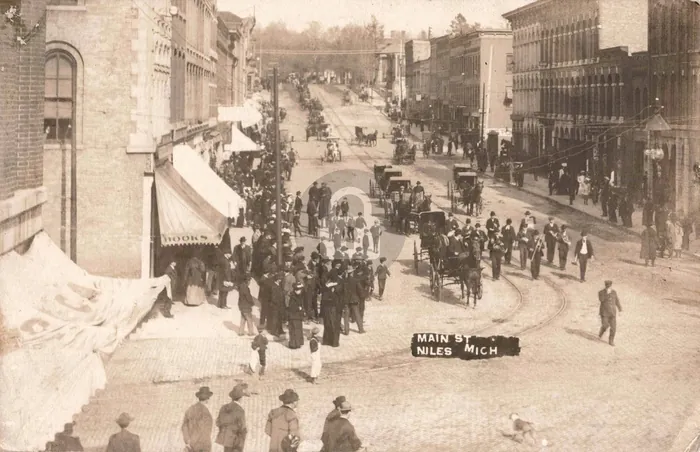
    Main St., Niles, Mich.
    Main St., Niles, Mich., about 1905–1915. Private collection; scan shared online.

    Come and see

    Through the year

    Read more

    Stories on Project Scroll

    Quick facts

    At a glance

    Founded
    Walling & Lacey’s store, October 1828; village plat August 1, 1829
    Named for
    Hezekiah Niles, editor of Niles’ Weekly Register of Baltimore; the settlement was first called Pog-wa-tigue
    Post office
    Obed P. Lacey acting postmaster, 1828; Isaac Gray commissioned 1830
    Incorporated
    Village by act approved February 12, 1835; city charter February 12, 1859
    Railroad
    Michigan Central, first train October 7, 1848; Michigan Air Line, 1871
    Nearby
    Fort St. Joseph site (French fort from about 1691) and the Carey Mission (1822)
    Township
    Niles Township surrounds most of the city
    Population
    2020 census: 11,988

    Know a story about Niles?

    Old photographs, letters, a school picture, a story your grandparents told: if it belongs to Niles, we would love to see it. A phone photo of the front and back is enough, and we credit you by name if you like.

    Send it to us Contact page

    Keep exploring

    Nearby in the valley

    For researchers: records and sources

    Where the records are

    Deeds, plats, probate files and vital records for Berrien County are kept by the county offices; the County Records Department at 2100 E. Empire Avenue, Benton Township, holds births and deaths from 1867 and marriages from 1831. The first village plat of 1829 was recorded in Lenawee County (liber A, folios 134–135). City records are with the Niles city clerk. The Niles History Center at 508 E. Main Street holds the city’s museum collections and the finds of the Fort St. Joseph Archaeological Project, and the Niles District Library keeps local newspapers. The Berrien County Historical Association’s research library is at the History Center at Courthouse Square in Berrien Springs. Niles is covered in Ellis, History of Berrien and Van Buren Counties (1880), ch. XXV, pp. 153–174, and Coolidge, A Twentieth Century History of Berrien County (1906), ch. VII, pp. 141–165.

    Sources

    • Franklin Ellis, History of Berrien and Van Buren Counties, Michigan (Philadelphia: D. W. Ensign & Co., 1880), ch. XXV, ‘City of Niles,’ pp. 153–174: early settlers, the Treaty of Chicago lands and Walling & Lacey’s books, pp. 153–155; the plat of August 1, 1829, p. 155; taverns and the Sauk war, pp. 155 and 158–159; the ferry and the Broadway bridge, p. 159; post office and Pog-wa-tigue, p. 160; plat and additions, p. 160; village incorporation and city charter, pp. 160–161; churches, pp. 162–165; Silver Brook Cemetery, pp. 165–166; Michigan Central and Air Line, pp. 168–169. link
    • Orville W. Coolidge, A Twentieth Century History of Berrien County, Michigan (Chicago: Lewis Publishing Co., 1906), ch. VII, ‘Niles City,’ pp. 141–165: the Laceys and the first store, p. 141; the name, p. 142; mills and taverns, p. 142; the railroad’s arrival, the prosperity of 1865–72 and the Business Men’s Association, pp. 156–157; paper mills and the Garden City Fan Company, pp. 161–162. The Spanish flag, p. 14. link
    • Michigan History Center, historical marker file S0004, ‘Fort St. Joseph’ (registered 1956, erected 1957; South Bond Street north of Fort Street). link
    • City of Niles, Niles History Center, ‘Fort St. Joseph Museum’ (508 E. Main Street; exhibits and hours). link
    • ‘Henry A. Chapin House,’ Wikipedia (built 1882–84; given to the city 1933; city hall to 2012; museum since 2013; NRHP 1981). link
    • ‘National Register of Historic Places listings in Berrien County, Michigan,’ Wikipedia (Fort St. Joseph Site, 1973; Niles Railroad Depot, 598 Dey St., 1979). link
    • Niles’ Weekly Register (Baltimore), vol. 37, no. 947, 7 November 1829, p. 1 (the editor thanks the founders of the new town). link
    • Project Scroll, ‘How Niles got its name’ (2026), with its sources. link
    • ‘Niles, Michigan,’ Wikipedia (coordinates; village 1835, city 1859; depot built 1892; parts in Berrien and Cass counties; 2020 census population 11,988). link
    • U.S. Census Bureau, 2020 Census Redistricting Data (P.L. 94-171), table P1, Niles city, Michigan: 11,988. link

    Dates and names are from the county histories and official sources listed here. Where they disagree, we say so. Know better? Send a correction.