The story
Welcome to Goshen
Goshen was laid out in 1831 for one purpose: to be the seat of Elkhart County. Its courthouse square still anchors the town, and the hydraulic canal dug in the 1860s turned it into a city of mills and factories.
Goshen was not the county’s first choice. Chapman’s History of Elkhart County (1881) prints the 1830 report of the commissioners who picked a site in section 34 of Township 37 North, Range 5 East, near the mouth of the Elkhart River. A second commission soon recommended moving it, and chose fractions of section 9 in Township 36 North, Range 6 East, the high ground on the Elkhart River where Goshen stands. Oliver Crane, the county’s agent for selling lots, came, Chapman says, “from the vicinity of Goshen, New York, [and] gave name to the town.” George Crawford surveyed the original plat of 301 lots, and Crane sold the first of them in July 1831.
The country around was already settling. Elias Riggs and William Simpson, who had sold their squatters’ claims on Elkhart Prairie to Col. John Jackson in 1829, moved across the line into what became Elkhart Township, and Chapman and Deahl both count them among its first settlers. Mrs. Susan Nickerson was there in June 1828 and John B. Cripe in March 1829. The first preachers were Methodists and German Baptists; Balser Hess preached for the Baptists, and the Dunkard church of the township was organized in 1834.
Read the full story
The village was run by trustees, the first elected on November 23, 1839, with John Cook presiding, until 1854, when it was incorporated as a town. On April 18, 1868, voters approved a city charter, 391 to 31, and the first city officers were chosen on May 5, with H. D. Wilson as mayor.
That same year water came to work. Chapman writes that the hydraulic canal was proposed in 1866 and completed in 1868, taking water from the Elkhart River about a mile and a half south of the city. J. H. Defrees built linseed-oil mills on it in 1868, and Cephas and Eleazer Hawks moved their flour mill there from Waterford the same year. Weaver’s 1916 history follows the Hawks interests, furniture makers, buggy-top and churn factories and rubber works that grew up along the canal.
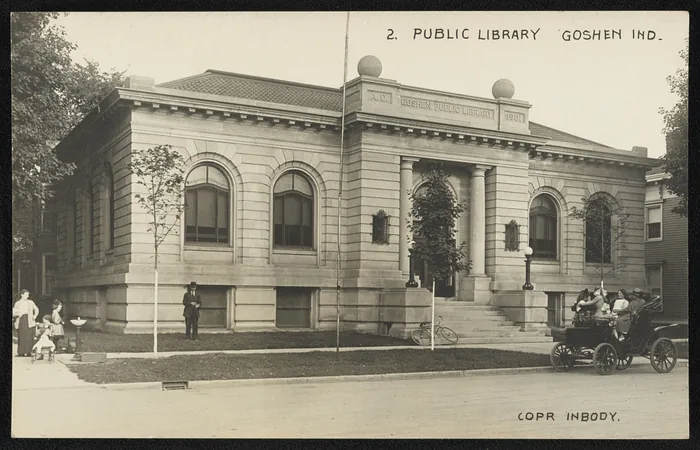
Goshen also became a college town. Weaver gives a chapter to Goshen College, the Mennonite school, and to the city’s Carnegie library and hospital. The courthouse that Deahl photographed in 1905 had been built in 1870 and was remodeled that year. The 2020 census counted 34,517 people in the city.