The story
Welcome to White Pigeon
White Pigeon was the first town in St. Joseph County and for a few years the busiest place in southwestern Michigan: the first county court met here, and from 1831 to 1834 the land office for the whole region sold farms from a building that still stands on Chicago Road. The village takes its name from Wahbememe, the Potawatomi leader remembered as White Pigeon.
Asahel Savery built the first house within the village, a log tavern, in the winter of 1827–28. Known as the ‘Old Diggins,’ it was the first public house in the county; settlers held the county’s first caucus there in 1829, its first town meeting in 1830, and its first court in August 1830. Savery also ran the first stagecoaches on the Chicago Road in 1831–32, driving them himself. The village plat was surveyed on May 6, 1830, by Robert Clark, Jr., Savery, Niles F. Smith and Neal McGaffey, and it was the first village plat recorded in the county.
In 1831 the government opened its land office for southwestern Michigan at White Pigeon, with Major Abraham Edwards as register and Thomas E. Sheldon as receiver. In three years it sold about 260,000 acres at $1.25 an acre before moving to Bronson, now Kalamazoo, in 1834. The White Pigeon Academy was chartered in 1831, and a branch of the University of Michigan opened in the village in 1837, at first in the old Savery tavern. The Presbyterian church was organized on August 8, 1830, by the Rev. William Jones, and Everts calls it the first church of that denomination in western Michigan; its first building went up in 1834.
Read the full story
Merchants came early: Smith opened a little store in 1830, and in 1831 Elias S. Swan, John S. Barry and I. W. Willard brought large stocks of goods. Fanning mills were made in the village by 1831–32. In 1838 McGaffey, Chapin and Kellogg dug a race on the Pigeon River and Levi Baxter built the first flour mill; after it burned in 1860 D. P. Hamilton rebuilt it in 1862. The village was first incorporated in March 1837, but the corporation lapsed after two or three years and was not renewed until April 4, 1865.
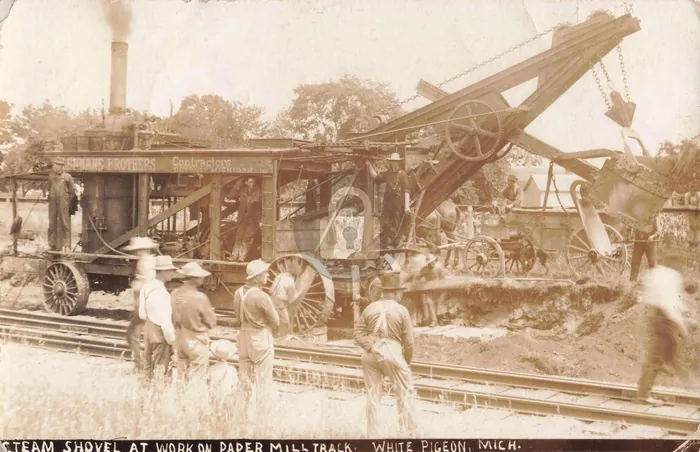
The people of White Pigeon worked hard to bring the Michigan Southern Railroad through the village, and it was completed to White Pigeon in 1851, with an eating house built by Dr. W. N. Elliott. In 1861 the 11th Michigan Infantry and Church’s Battery gathered at a training ground near the railyard; a monument to the regiment was placed in 1915 and rededicated in 2014 at Depot Park. A Baptist church of brick was built in 1867, and German Reformed and Lutheran congregations formed in 1865 and 1866.
In 1909 the Alba Columba Club of White Pigeon placed a large boulder at the grave of Wahbememe, just west of the village, and on August 11 a crowd estimated at seven thousand watched his descendant Willie White Pigeon unveil it. The St. Joseph County Historical Society restored the old land office, which it now keeps as a museum. The 2020 census counted 1,718 people in the village.