Project Scroll

    Tip: press / or Ctrl K anywhere to search.

    ← Every place in St. Joseph County

    Old photograph of a long road bridge leading to a large power-plant building on the far bank of a river.

    St. Joseph County · Michigan · St. Joseph River Valley

    Constantine

    Meek’s Mills at the mouth of the Fawn, once the county’s river port.

    Discover its storyThings to seeDirectionsThe valley map

    The bridge and the electric light and power plant at Constantine, photographed for the 1911 county history. Photograph from H. G. Cutler, ed., History of St. Joseph County, Michigan (Chicago: Lewis Publishing Co., 1911), vol. 1, via the Internet Archive, Public domain.

    • Villagein St. Joseph County
    • 1829founded
    • 1,947people, 2020 census
    • 9 mifrom Centreville, the county seat

    Project Scroll is an independent local-history website. This is not an official page of the Village of Constantine or St. Joseph County, and it does not speak for them. For official business, contact the village office directly.

    The story

    Welcome to Constantine

    Constantine grew around William Meek’s mills where the Fawn River runs into the St. Joseph, and for twenty years it was the busiest shipping point on the upper river. It was the home of Governor John S. Barry, and its brick main street is a National Register historic district.

    William Meek of Wayne County, Ohio, chose the land where the Fawn River, then called Crooked Creek, joins the St. Joseph, and brought his family in the spring of 1829. That winter he began a sawmill, and the next spring, before it was finished, he threw a rough dam across the creek and set up a wheel and stones to grind grain, with Hugh Woods as millwright. For years the hamlet was known as Meek’s Mills. Meek surveyed the village plat in August 1831, when only five families lived there, and the name Constantine, suggested by the merchant Niles F. Smith, was long ignored by settlers at rival White Pigeon, who would tell travelers they must mean Meek’s Mills.

    Smith opened the first store in 1830 in a little frame building on the riverbank. By 1835 the village had about three hundred people, and 1836 brought new stores, wagon and plow makers, a jeweler and a newspaper, the Republican, which advertised the town’s water power. A steamboat named Constantine was projected and a keelboat of the same name carried produce and goods, and the Bank of Constantine opened on March 3, 1837. The crash of that year ended many of the bigger plans. The village was first incorporated in the spring of 1837; that corporation lapsed in 1839, and Constantine was incorporated again on March 15, 1861.

    Read the full story

    The river kept the town busy. In 1831 Elias S. Swan unloaded a stock of goods for White Pigeon on the bank at Constantine and left it overnight in the woods, unwatched and untouched. Until the railroad came, Lima, Indiana, shipped all its produce and received its merchandise through Constantine, and the bridge over the St. Joseph was built on piles with a high arch to let steamboats pass. In 1869 the township voted thirteen thousand dollars for an iron suspension bridge. After the Michigan Southern Railroad came through, river navigation ended and the old warehouse was moved up onto the bank.

    John S. Barry came from White Pigeon to keep store in Constantine about 1834. He served three terms in the state senate and was three times elected governor, and he helped manage the Michigan Southern Railroad. The house he built in 1835 on North Washington Street is now the Governor John S. Barry Museum. By 1877 the village had flour mills, the George and Tweedale foundry and a union school, and in 1911 Cutler photographed its bridge and electric light and power plant on the river.

    The two-story business blocks along Washington and Water streets form the Constantine Historic Commercial District, listed on the National Register in 1985. General Harry Hill Bandholtz, who headed the American military mission to Hungary after the First World War, was a native of the village. The 2020 census counted 1,947 people in Constantine.

    Plan a visit

    Things to see

    • Governor John S. Barry Museum

      280 N. Washington St., Constantine

      The house John S. Barry built in 1835, saved by the Governor Barry Historical Society and opened as a museum; a 1947 state marker stands in front. Listed on the National Register in 1972.

      Directions

    • Constantine Historic Commercial District

      Washington St. between Second and Water streets, Constantine

      Late nineteenth-century commercial blocks on Washington and Water streets, listed on the National Register in 1985.

      Directions

    • Constantine Methodist Episcopal Church

      285 White Pigeon St., Constantine

      Michigan State Historic Site, listed in 1984.

      Directions

    Then and now

    Pictures

    Engraving of two ornate brick business blocks on a street corner, with pedestrians and a horse in the street.
    Wells & Calam’s block and the First National Bank, Constantine, engraved for the 1877 county history. Engraving from History of St. Joseph County, Michigan (Philadelphia: L. H. Everts & Co., 1877), via the Internet Archive. Public domain.
    Engraving printed sideways of a large frame flour mill beside a road and millrace, with wagons at the door.
    D. Frazier’s Commercial Mills at Constantine, a dealer in grain, flour and feed, from the 1877 county history. Engraving from History of St. Joseph County, Michigan (Philadelphia: L. H. Everts & Co., 1877), via the Internet Archive. Public domain.
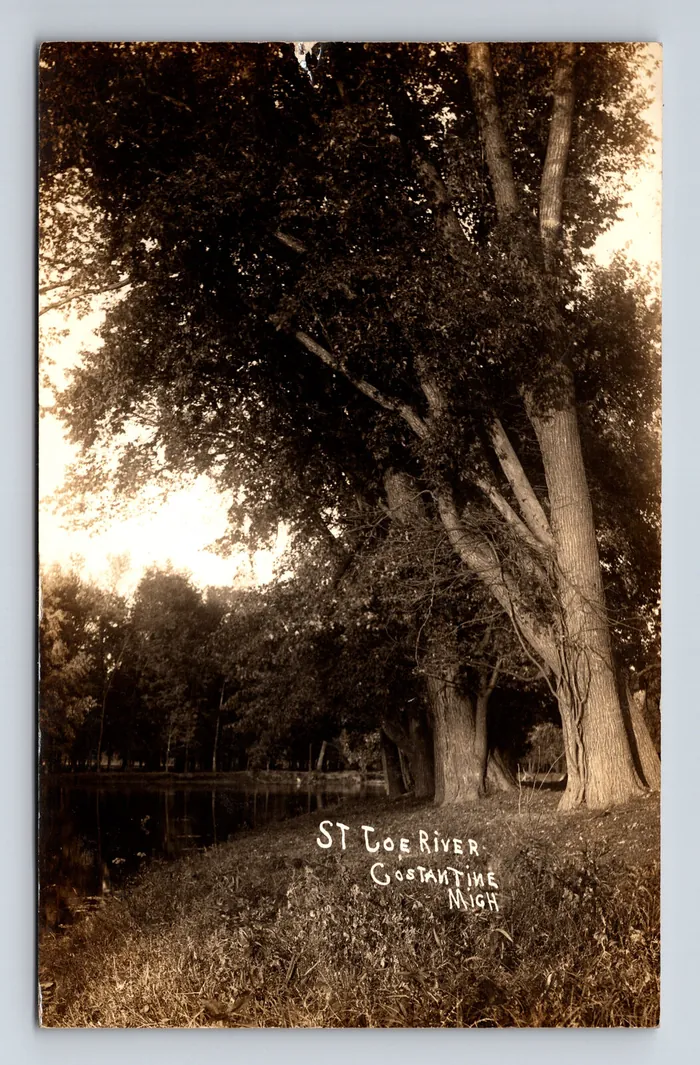
    St. Joe River, Constantine, Michigan
    St. Joe River, Constantine, Michigan, about 1914. none required.
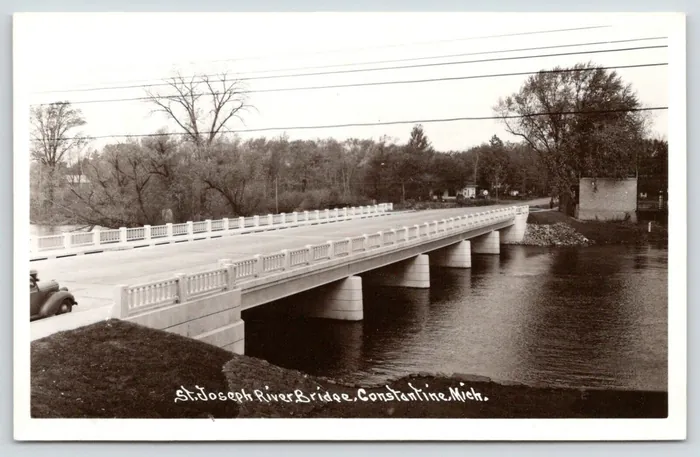
    St. Joseph River Bridge, Constantine, Mich
    St. Joseph River Bridge, Constantine, Mich, about 1944. none required.

    Quick facts

    At a glance

    Founded
    1829, by William Meek
    Earlier name
    Meek’s Mills
    Platted
    August 1831, by William Meek
    Named for
    The Roman emperor Constantine; the name was suggested by Niles F. Smith
    Incorporated
    Spring 1837 (lapsed 1839); again March 15, 1861
    Railroad
    Michigan Southern
    Township
    Constantine
    Population
    2020 census: 1,947

    Know a story about Constantine?

    Old photographs, letters, a school picture, a story your grandparents told: if it belongs to Constantine, we would love to see it. A phone photo of the front and back is enough, and we credit you by name if you like.

    Send it to us Contact page

    Keep exploring

    Nearby in the valley

    For researchers: records and sources

    Where the records are

    Deeds, probate files and vital records for St. Joseph County are at the county courthouse, 125 W. Main St., Centreville. The St. Joseph County Historical Society keeps research archives, land records and one-room school records at its headquarters, 34 N. Main St., Three Rivers. The village is covered in the 1877 Everts history under Constantine Township, pp. 113–130 (village, pp. 116–120), and in Cutler, History of St. Joseph County (1911), vol. 1, ch. VIII, pp. 167–171, and ch. XV, pp. 375–390.

    Sources

    • History of St. Joseph County, Michigan, with Illustrations Descriptive of Its Scenery, Palatial Residences, Public Buildings, Fine Blocks, and Important Manufactories (Philadelphia: L. H. Everts & Co., 1877), Constantine Township, pp. 113–115; village of Constantine, pp. 116–120 (Meek and the plat, p. 116; 1836–37 boom, bank and incorporation, pp. 116–117; river trade, p. 117; railroad, p. 119). link
    • History of St. Joseph County, Michigan, with Illustrations Descriptive of Its Scenery, Palatial Residences, Public Buildings, Fine Blocks, and Important Manufactories (Philadelphia: L. H. Everts & Co., 1877), White Pigeon Township, p. 65 (Swan’s goods unloaded at Constantine). link
    • H. G. Cutler, ed., History of St. Joseph County, Michigan, 2 vols. (Chicago and New York: Lewis Publishing Co., 1911), vol. 1, ch. IV, first grist mill, p. 44; ch. VIII, Constantine, pp. 167–171; ch. XV, Constantine, pp. 375–390. link
    • ‘Constantine, Michigan,’ Wikipedia (coordinates; name origin citing Gannett 1905; Bandholtz; 2020 census population 1,947). link
    • ‘Governor John S. Barry House,’ Wikipedia (built 1835; museum). link
    • Michigan Historical Commission, ‘John Stewart Barry’ marker (1947); transcription at the Historical Marker Database, entry 73001. link
    • ‘List of Michigan State Historic Sites in St. Joseph County,’ Wikipedia (state historic sites and addresses). link
    • ‘National Register of Historic Places listings in St. Joseph County, Michigan,’ Wikipedia (listings and dates). link
    • U.S. Census Bureau, 2020 Census Redistricting Data (P.L. 94-171), table P1, Constantine village, St. Joseph County, Michigan: 1,947. link

    Dates and names are from the county histories and official sources listed here. Where they disagree, we say so. Know better? Send a correction.