Project Scroll

    Tip: press / or Ctrl K anywhere to search.

    ← Every place in Berrien County

    Aerial view of Berrien Springs and the St. Joseph River

    Berrien County · Michigan · St. Joseph River Valley

    Berrien Springs

    Wolf’s Prairie on the St. Joseph, county seat for fifty-seven years.

    Discover its storyThe full historyThings to seeDirectionsThe valley map

    Berrien Springs from the air in 2006. Photograph by David Mack, via Wikimedia Commons, Public domain.

    • Villagein Berrien County
    • 1829founded
    • 1,910people, 2020 census
    • 13 mifrom St. Joseph, the county seat

    Project Scroll is an independent local-history website. This is not an official page of the Village of Berrien Springs or Berrien County, and it does not speak for them. For official business, contact the village office directly.

    The story

    Welcome to Berrien Springs

    Berrien Springs grew on Wolf’s Prairie, a thousand-acre plain in a bend of the St. Joseph River. Laid out in 1831 as Berrien, it was the county seat from 1837 to 1894, and its courthouse of 1839, the oldest in Michigan, still stands on the square. Today the square is the county’s history center, and the village is a center of the fruit and wine country.

    The village stands on Wolf’s Prairie, which Ellis (1880) describes as a tract of about a thousand acres and, apart from Bertrand, the only prairie in the county. John Pike, with his wife and eight children, came down the river in a pirogue from the Carey Mission in the summer of 1829 and built a log house on the river bottom; for a year his family were the only settlers in what became Oronoko Township. George Kimmel of Pennsylvania entered about three hundred acres that year and in 1832 built the first sawmill, on Lemon Creek, and his son-in-law Francis B. Murdock, the county’s first practicing lawyer, came by raft down the Dowagiac and the St. Joseph in 1830. Murdock’s daughter Eliza, born in October 1831, was the first child born in the township.

    Pitt Brown and his nephew Horace Godfrey, millers from Sandusky, Ohio, landed from a raft near the foot of the hill in July 1831, built a log shanty that became the first tavern, and put a scow ferry on the river. In August 1831 the deputy surveyor Samuel Marrs platted the village of Berrien for Brown, Godfrey and Murdock. A post office opened that year with Brown as postmaster, kept in the bar of his tavern. Robert E. Ward, who came from Albany in 1835, is said to have renamed the place Berrien Springs, for the sulphur and other mineral springs on the east bank of the river. Thomas Love and Edward Ballengee opened the first store about 1831, and in 1832 the steamer Newburyport was the first boat to reach the village from St. Joseph.

    Read the full story

    Niles held the first county court, and the county seat was placed at St. Joseph in 1832. Then an act approved February 25, 1837, moved it to “the village of Berrien” from May 1, provided the proprietors repaid St. Joseph for its public buildings and gave lots for the county’s use; the supervisors accepted lots 255, 256, 301 and 302 on April 18, 1837. A wooden jail was finished in June 1838, and the courthouse, built by James Lewis under a contract of August 1838 for $2,500 to plans by Gilbert B. Avery, was finished and occupied in 1839. The county agricultural society was organized at the courthouse in 1850 and resolved to hold its first fair here that September; the fair of 1851 was held here too, before the fairs moved to Niles.

    Berrien Springs was incorporated as a village on October 15, 1863, by the board of supervisors, with Philip Kephart as first president, and was reincorporated in 1867 and again in 1878. Ellis counted about a thousand people in 1880, a village that was busiest in court weeks and still waited for a railroad; the St. Joseph Valley line came from Buchanan in 1881. A long fight over the county seat ended in a county vote, upheld by the supreme court, that moved it to St. Joseph in December 1894. The old courthouse became a community hall and, in 1901–02, the first home of Emmanuel Missionary College, now Andrews University, which grew up just outside the village.

    Rose Hill Cemetery, laid out in 1837 on a rise above the river, holds a marble shaft of 1874 to the township’s Civil War dead. Charles A. Chapin’s Berrien Springs Power and Electric Company was preparing in 1906 to dam the St. Joseph here. In 1967 the county and the historical commission bought back the courthouse, restored it, and the whole courthouse square, with the sheriff’s residence of 1870 and the Murdock log cabin, is now the History Center at Courthouse Square, run by the Berrien County Historical Association. The village once called itself the Christmas pickle capital of the world, and revived its pickle festival in 2021. The 2020 census counted 1,910 people.

    More on Berrien Springs: the full history, maps and pictures ›

    Plan a visit

    Things to see

    • History Center at Courthouse Square (Berrien Springs Courthouse)

      313 N. Cass Street, Berrien Springs

      The Greek Revival courthouse of 1839, the oldest in Michigan, with its restored courtroom, the sheriff’s residence of 1870, the Murdock log cabin of about 1830 and Bennett’s Forge; run by the Berrien County Historical Association. National Register 1970; the whole complex 1982.

      Directions

    • Rose Hill Cemetery

      Berrien Springs

      The township’s oldest cemetery, laid out in 1837 on high ground in view of the St. Joseph, with a marble soldiers’ monument raised by subscription in 1874.

      Directions

    Then and now

    Pictures

    The white Greek Revival courthouse of 1839 at Berrien Springs
    The Berrien County courthouse of 1839, the oldest in Michigan, now part of the History Center at Courthouse Square. Photograph by rossograph, via Wikimedia Commons. CC BY-SA 4.0.
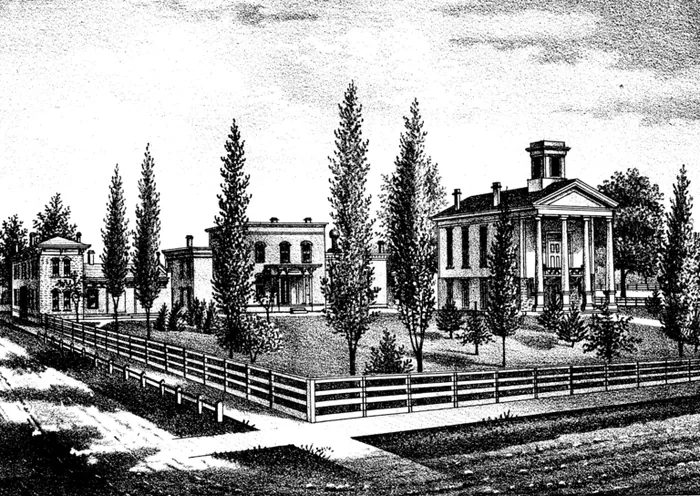
    Old Berrien County Courthouse (engraving)
    Old Berrien County Courthouse (engraving), 1880. none required.

    Come and see

    Through the year

    Quick facts

    At a glance

    Founded
    John Pike’s cabin on Wolf’s Prairie, 1829; village of Berrien platted August 1831
    Named for
    The county (named for John M. Berrien of Georgia, attorney general under Jackson), with ‘Springs’ for the mineral springs across the river
    Post office
    1831, Pitt Brown postmaster
    County seat
    1837 to 1894
    Incorporated
    Village, October 15, 1863; reincorporated 1867 and 1878
    Railroad
    St. Joseph Valley Railroad from Buchanan, 1881; later a Pere Marquette branch
    Township
    Oronoko Charter Township
    Population
    2020 census: 1,910

    Know a story about Berrien Springs?

    Old photographs, letters, a school picture, a story your grandparents told: if it belongs to Berrien Springs, we would love to see it. A phone photo of the front and back is enough, and we credit you by name if you like.

    Send it to us Contact page

    Keep exploring

    Nearby in the valley

    For researchers: records and sources

    Where the records are

    Berrien County’s older vital records are kept by the County Records Department at 2100 E. Empire Avenue, Benton Township: births and deaths from 1867 and marriages from 1831; deeds and plats are with the register of deeds. The first plat of the village of Berrien was recorded in Cass County, to which Berrien was then attached. Village records are with the Berrien Springs village clerk and township records with the Oronoko Charter Township clerk. The History Center at Courthouse Square, 313 N. Cass Street, run by the Berrien County Historical Association, keeps a research library for the whole county. Berrien Springs is covered in Ellis, History of Berrien and Van Buren Counties (1880), ch. XXXVIII, ‘Oronoko Township,’ pp. 278–292, with the courthouse at pp. 133–135; and in Coolidge, A Twentieth Century History of Berrien County (1906), ch. XI, pp. 198–205.

    Sources

    • Franklin Ellis, History of Berrien and Van Buren Counties, Michigan (Philadelphia: D. W. Ensign & Co., 1880), ch. XXXVIII, ‘Oronoko Township,’ pp. 278–292: Wolf’s Prairie, p. 278; Pike, Kimmel, Murdock, Brown and Godfrey, pp. 279–280; the plat of August 1831, the name and the county seat, p. 280; Love and Ballengee, p. 281; steamboats, p. 281; post office, p. 282; village incorporation, p. 283; Rose Hill Cemetery and the soldiers’ monument, p. 290. Courts and county buildings: the county seat at St. Joseph, 1832, p. 133; the act of February 25, 1837, and the lots of April 18, 1837, p. 134; the jail of 1838 and the courthouse of 1838–39, pp. 134–135; the Berrien County Agricultural Society, organized 1850, p. 150. link
    • Orville W. Coolidge, A Twentieth Century History of Berrien County, Michigan (Chicago: Lewis Publishing Co., 1906), ch. XI, ‘Oronoko Township,’ pp. 198–205: Wolf’s Prairie and the first settlers, p. 198; county seat 1837–1894, p. 198; the planned dam of the Berrien Springs Power & Electric Company, p. 202. The county-seat vote and removal of December 1894, pp. 185–186. link
    • ‘Berrien Springs Courthouse,’ Wikipedia (Gilbert B. Avery; contract with James Lewis, $2,500; Emmanuel Missionary College 1901–02; restoration from 1967; NRHP 1970). link
    • ‘Old Berrien County Courthouse Complex,’ Wikipedia (sheriff’s residence 1870; Murdoch log cabin; NRHP 1982; History Center at Courthouse Square). link
    • Southwest Michigan Tourist Council, ‘The History Center at Courthouse Square’ (313 N. Cass St.; Berrien County Historical Association, founded 1968). link
    • Michigan Railroads, ‘Station: Berrien Springs, MI’ (village 1863; St. Joseph Valley Railroad 1881; Pere Marquette branch 1903). link
    • ‘Berrien Springs, Michigan,’ Wikipedia (coordinates; Oronoko Charter Township; Christmas pickle festival revived 2021; 2020 census population 1,910). link
    • U.S. Census Bureau, 2020 Census Redistricting Data (P.L. 94-171), table P1, Berrien Springs village, Berrien County, Michigan: 1,910. link

    Dates and names are from the county histories and official sources listed here. Where they disagree, we say so. Know better? Send a correction.