The story
Welcome to Benton Harbor
Benton Harbor was dug into being. In 1859 three neighbors set out to cut a ship canal from the St. Joseph River across the marsh to the foot of their bluffs, and a village grew up beside it as the canal was finished. Within forty years it was the busiest fruit port on the lake and the largest city in the county, and its oldest house, the Morton homestead of 1849, is now its museum.
Benton Township was named on March 11, 1837, for Senator Thomas H. Benton of Missouri. Its northwest corner was marsh along the Paw Paw River, crossed only by a causeway to St. Joseph. Eleazer Morton moved his large family to St. Joseph in 1835, bought land on sections 18 and 20, and in 1836 settled on the Territorial Road, where Coolidge (1906) says he kept a tavern. In 1849 he and his son Henry C. Morton built the house that still stands on Territorial Road; the state marker says the family let Potawatomi travelers bound for St. Joseph to sell baskets sleep on its porch, which was nicknamed the ‘Indian Hotel.’
The canal was the making of the place. Edwin D. Cooke’s Centennial address of July 4, 1876, which Ellis (1880) reprints, says the idea was talked of as early as 1834 and revived in 1859, when Charles Hull, helping Albert James out of the mud on the St. Joseph road, prophesied that within five years a ship canal would reach the highland and a village would stand on the flats. Sterne Bronson, Henry C. Morton and Hull formed a committee, gave land to the Chicago contractor Martin Green to dig it, and kept his dredge supplied. The canal, 25 feet wide at first, was finished in 1862, and the schooner J. C. Shank was the first vessel to come up it. It was enlarged in 1868 and deepened in 1875.
Read the full story
The village was laid out in 1860 by Morton, Bronson, M. G. Lamport, B. C. Lewis, Martin Green, Charles Hull and others, and named Bronson’s Harbor for the canal’s chief promoter; Fred Spallinger’s grocery was its first building. In 1865 the name was changed to Benton Harbor. The village organized under the general law in 1866, electing Samuel McGuigan president at the white schoolhouse on July 7, and received a special charter approved April 3, 1869, which put half its ground in Benton Township and half in St. Joseph Township. The first good brick block, the Reynolds Block, went up in 1868–69. Ellis wrote that the growth was ‘unprecedented in the history of Berrien County’: a place assessed at $893 in 1850 had more than a thousand people by 1880.
Fruit and steamboats carried the town. Benton Harbor was made a port of entry in 1871, and the Graham & Morton line, in which Henry Morton’s son Stanley was a partner, ran steamers on the lake. In 1877 the harbor shipped 285,003 baskets of peaches, 55,407 crates of strawberries and more than 53,000 barrels of apples. The Chicago and West Michigan (later Pere Marquette) began running trains into Benton Harbor in 1870, and by 1906 four railroads met here; that year Coolidge counted more than a million baskets each of peaches and grapes shipped by boat from Benton Harbor and St. Joseph, and called Benton Harbor, a city since 1891, the wealthiest and most populous in the county.
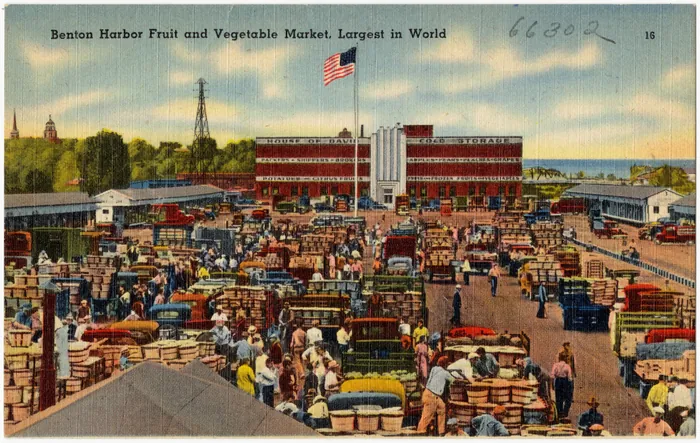
Just east of the city Benjamin and Mary Purnell founded the House of David, a communal religious colony whose brass bands, zoo and amusement park became famous. In 1917 John and Carrie Klock gave the city a stretch of Lake Michigan dunes and beach as Jean Klock Park, in memory of their daughter. The old fruit market on the flats was torn down in urban renewal in 1967, and the market moved to Benton Township. The Morton House, home to four generations of the family until 1936, has been the city’s history museum since the early 1960s. The 2020 census counted 9,103 people.
More on Benton Harbor: the full history, maps and pictures ›