Project Scroll

    Tip: press / or Ctrl K anywhere to search.

    ← Every place in St. Joseph County

    Old photograph of mill buildings along a wide millrace, with railroad tracks in the foreground.

    St. Joseph County · Michigan · St. Joseph River Valley

    Three Rivers

    Where the Rocky and the Portage meet the St. Joseph.

    Discover its storyThings to seeDirectionsThe valley map

    The ‘great manufacturing section’ of Three Rivers on its millrace, photographed for the 1911 county history. Photograph from H. G. Cutler, ed., History of St. Joseph County, Michigan (Chicago: Lewis Publishing Co., 1911), vol. 1, via the Internet Archive, Public domain.

    • Cityin St. Joseph County
    • 1829settled
    • 7,973people, 2020 census
    • 6 mifrom Centreville, the county seat

    Project Scroll is an independent local-history website. This is not an official page of the City of Three Rivers or St. Joseph County, and it does not speak for them. For official business, contact the city office directly.

    The story

    Welcome to Three Rivers

    Three Rivers grew up where the Rocky and Portage rivers flow into the St. Joseph, and the water power of the three made it the county’s leading manufacturing town. Four early plats were gathered into one corporation, which became a city in 1895.

    The first settler on the site was Jacob McInterfer, who came from Wayne County, Ohio, in the spring of 1829 and took a square mile on the west side of the Rocky River, where the city’s Third Ward now lies. George Buck followed in 1830 and built a double log house on what became the Second Ward; it served as the township’s first tavern, and the first political convention in the county met there, with Mrs. Buck cooking dinner for seventy-five guests. Mishael Beadle bought McInterfer’s mill site after his death in 1831, finished his sawmill, and built the first frame house in the city in 1832, in the neighborhood people called ‘Canada.’

    Several towns were laid out before one took hold. Christopher Shinnaman platted Moab on July 28, 1830, and the next June Buck and McInterfer laid out a village called St. Joseph, where the county seat was first located. When the seat went instead to Centreville, Moab went back to cornfields. On November 25, 1836, John H. Bowman platted Three Rivers between the Portage and the Rocky, and a month later George Buck, Jonathan Brown, Benjamin Sherman, Edward Pierson and L. B. Brown platted Lockport on the east side, with plans for a canal and a great water power.

    Read the full story

    Bowman, with partners from Prairie Ronde, started the Three Rivers flour mill in February 1837. The St. Joseph Canal and Lockport Manufacturing Company advertised in May 1837 for builders of a dam, bridge, canal and lock, but the panic of that year stopped the work. Until railroads came, flour went down the St. Joseph in flat-bottomed arks; one early cargo of a hundred barrels went all the way to Chicago and sold for nine hundred dollars. Arks ran to the mouth of the river until the railroad reached Niles in 1849, and then to Niles; when the Michigan Southern reached Constantine in 1853, flatboats carried freight only that far, and the same year the railroad built a branch line to Three Rivers.

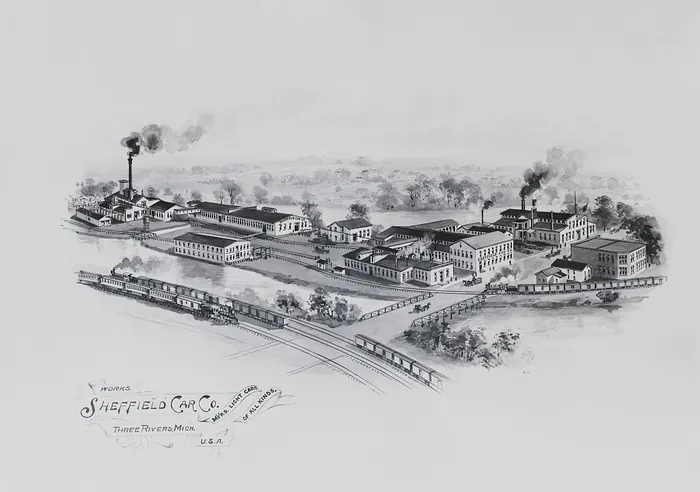
    The village was incorporated by the legislature on February 13, 1855, and in 1871 its limits took in Lockport as the Second Ward, ‘Canada’ as the Third and the land east of the Portage as the Fourth. The Michigan Central Air Line came through in 1871, and Three Rivers became a city in 1895. Paper making began with the Rosette mill of 1853–54 and continued with the Eddy Paper Company. By 1911 the Sheffield Car Company covered forty acres in the Second Ward, employed twelve hundred men, and built railway motor cars, velocipede cars and track tools, and the R. M. Kellogg Company claimed the largest strawberry-plant nursery in the world.

    The Riverside Cemetery Association, first called Oakdale, was organized in 1858 on the north bank of the St. Joseph; a granite boulder there was dedicated to the Civil War veterans on May 30, 1903. The public library began with a few hundred volumes collected in 1887. Today downtown Three Rivers is a National Register commercial historic district, and the St. Joseph County Historical Society keeps its headquarters and archives on North Main Street. The 2020 census counted 7,973 people in the city.

    Plan a visit

    Things to see

    • Downtown Three Rivers Commercial Historic District

      N. Main St., Michigan Ave. and Portage Ave., Three Rivers

      The nineteenth-century business blocks of North Main Street, listed on the National Register of Historic Places in 1982; a state marker stands at 66 N. Main St.

      Directions

    • Three Rivers Public Library

      107 N. Main St., Three Rivers

      Michigan State Historic Site; the library began with volumes collected by citizens in 1887.

      Directions

    • St. Joseph County Historical Society

      34 N. Main St., Three Rivers

      Headquarters and research archives for the county’s history, with land records, genealogy and one-room school collections.

      Directions

    • Riverside Cemetery

      North bank of the St. Joseph River, east of downtown Three Rivers

      Cemetery organized in 1858 on the north bank of the St. Joseph, with a Civil War memorial boulder dedicated in 1903 and a memorial chapel of the same year.

      Directions

    Then and now

    Pictures

    Old photograph of a three-story brick school with a flag on the roof, behind a lawn.
    The Three Rivers high school building about 1911. Photograph from H. G. Cutler, ed., History of St. Joseph County, Michigan (Chicago: Lewis Publishing Co., 1911), vol. 1, via the Internet Archive. Public domain.
    Engraving of a two-story bank building with tall arched windows and ‘First National Bank’ lettered on the glass.
    The First National Bank of Three Rivers, engraved for the 1877 county history. Engraving from History of St. Joseph County, Michigan (Philadelphia: L. H. Everts & Co., 1877), via the Internet Archive. Public domain.
    Sheffield Car Co. works, Three Rivers, Mich., U.S.A
    Sheffield Car Co. works, Three Rivers, Mich., U.S.A, between 1890 and 1910. Library of Congress, Prints & Photographs Division, Detroit Publishing Company Collection.
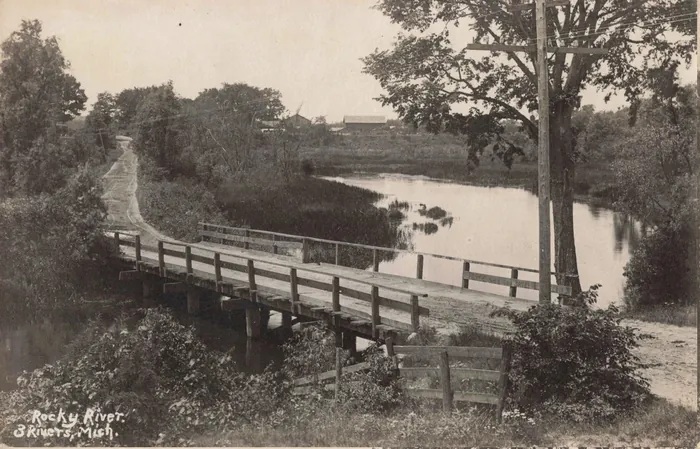
    Rocky River, 3 Rivers, Mich
    Rocky River, 3 Rivers, Mich, 1907. Tinder Collection, Clements Library, University of Michigan.
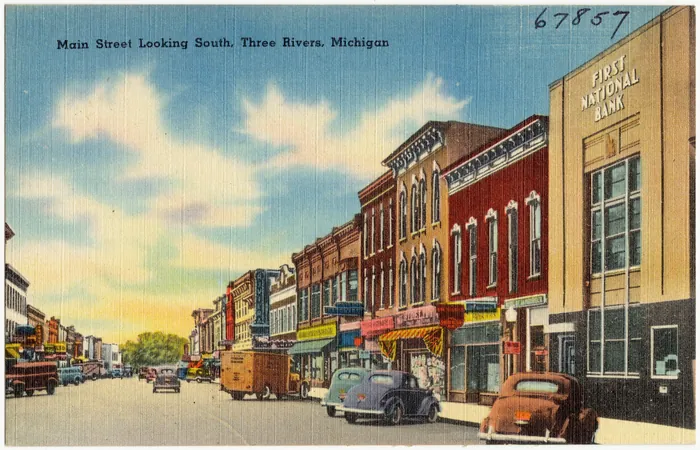
    Main Street looking south, Three Rivers, Michigan
    Main Street looking south, Three Rivers, Michigan, about 1930–45. Boston Public Library, Tichnor Brothers Collection.

    Come and see

    Through the year

    Read more

    Stories on Project Scroll

    Quick facts

    At a glance

    Settled
    1829, by Jacob McInterfer
    Platted
    Moab, 1830; St. Joseph, 1831; Three Rivers, November 25, 1836; Lockport, December 1836
    Named for
    The meeting of the St. Joseph, Rocky and Portage rivers
    Incorporated
    Village, February 13, 1855; city, 1895
    Railroad
    Michigan Southern branch, 1853; Michigan Central Air Line, 1871
    Township
    Lockport
    Population
    2020 census: 7,973

    Know a story about Three Rivers?

    Old photographs, letters, a school picture, a story your grandparents told: if it belongs to Three Rivers, we would love to see it. A phone photo of the front and back is enough, and we credit you by name if you like.

    Send it to us Contact page

    Keep exploring

    Nearby in the valley

    For researchers: records and sources

    Where the records are

    Deeds, probate files and vital records for St. Joseph County are at the county courthouse, 125 W. Main St., Centreville. The St. Joseph County Historical Society keeps research archives, land records and one-room school records at its headquarters, 34 N. Main St., Three Rivers. Three Rivers city hall is at 333 W. Michigan Ave. The city is covered in the 1877 Everts history under Lockport Township, pp. 137–155, and in Cutler, History of St. Joseph County (1911), vol. 1, ch. VIII, pp. 161–167, and ch. XIII, pp. 307–352.

    Sources

    • History of St. Joseph County, Michigan, with Illustrations Descriptive of Its Scenery, Palatial Residences, Public Buildings, Fine Blocks, and Important Manufactories (Philadelphia: L. H. Everts & Co., 1877), Lockport Township, pp. 137–140 (settlement, p. 137; Beadle, p. 138); city of Three Rivers, plats, p. 140; manufactures, p. 141; river shipping, p. 143; municipality, p. 147. link
    • H. G. Cutler, ed., History of St. Joseph County, Michigan, 2 vols. (Chicago and New York: Lewis Publishing Co., 1911), vol. 1, ch. VIII, Lockport Township, pp. 161–167; ch. XIII, Three Rivers, pp. 307–330 (city of 1895, p. 307; paper, p. 309; library, p. 324; Riverside Cemetery, pp. 325–327; Sheffield Car Company, pp. 327–328); ch. XIV, railroads, p. 354. link
    • ‘Three Rivers, Michigan,’ Wikipedia (name; coordinates; 2020 census population 7,973). link
    • ‘List of Michigan State Historic Sites in St. Joseph County,’ Wikipedia (state historic sites and addresses). link
    • ‘National Register of Historic Places listings in St. Joseph County, Michigan,’ Wikipedia (listings and dates). link
    • Pure Michigan, ‘St. Joseph Co. Historical Society of MI’ (headquarters at 34 N. Main St., Three Rivers; the White Pigeon land office; Chief Wahbememe Memorial Park). link
    • U.S. Census Bureau, 2020 Census Redistricting Data (P.L. 94-171), table P1, Three Rivers city, St. Joseph County, Michigan: 7,973. link

    Dates and names are from the county histories and official sources listed here. Where they disagree, we say so. Know better? Send a correction.