The story
Welcome to South Bend
South Bend grew up where the St. Joseph River swings in a broad curve toward Lake Michigan, beside two fur-trade posts of the 1820s. It became the county seat in 1831, a city in 1865 and, with the Studebaker and Oliver works, one of the great manufacturing towns of the Midwest.
The city takes its name from the river itself. Timothy Howard (1907) explains that the place was long called simply “The Bend,” for the great southern bend of the St. Joseph two miles above the old portage to the Kankakee, and that the word “South” was added later. Before it had that name it had others. Alexis Coquillard, agent of the American Fur Company, opened a trading post here that Howard dates to 1823 and Chapman (1880) to 1824; it was called the Big St. Joseph’s Station. In 1827 Lathrop M. Taylor opened a second post for Samuel Hanna & Co. of Fort Wayne, and his account books, which begin on October 29, 1827, are headed “St. Joseph’s, Indiana.”
A post office was set up in 1829, and on June 6 Taylor was commissioned postmaster at “Southold, Allen county, Indiana,” a name no one has ever explained. On October 18, 1830, the post office was renamed South Bend. The surveyors of the Michigan Road had already noted in 1828, “At this point is a beautiful site for a town.” Coquillard and Taylor laid out the town on March 28, 1831, with William Brookfield as surveyor, giving lots for a courthouse and jail, two schools and the Methodist and Catholic churches. When the first county seat, Brookfield’s paper town of St. Joseph near the portage, failed to grow, the legislature’s commissioners moved the seat of justice to South Bend on May 12, 1831, after the proprietors added more lots, four acres for a cemetery and a $3,000 bond.
Read the full story
The new town lived on the river trade. A writer quoted by Chapman remembered Peter Johnson launching the first keel boat for general freight in 1831, with Madore Crate as captain, and Horatio Chapin opening the first dry-goods store not tied to the Indian trade, his goods brought by lake and river from Detroit. Steamboats worked the river from 1835 to 1852. South Bend was first incorporated as a town on October 3, 1835, with Chapin as president of the trustees, but in the panic of 1837 the organization lapsed. The South Bend Manufacturing Company, chartered in 1842, finished a dam across the St. Joseph in 1844 with a mill race on each bank, and a new town charter followed on January 15, 1844.
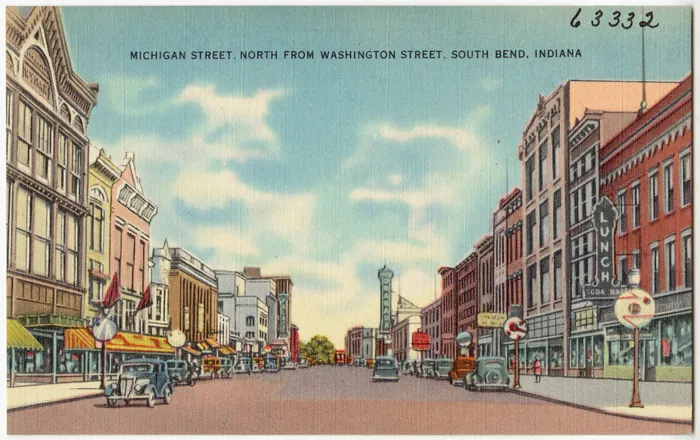
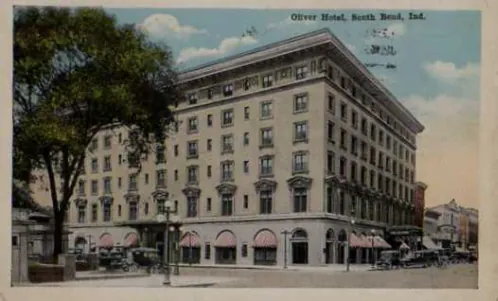
On May 22, 1865, the voters chose to make South Bend a city, 286 to 194, and on June 5 they elected William G. George the first mayor. Industry made its name. In 1852, Howard writes, Henry and Clem Studebaker opened a blacksmith shop here with sixty-eight dollars in cash and stock, building two wagons in their first year; their firm grew into a great wagon works and, later, a maker of automobiles. The Oliver Chilled Plow Works and the Singer works also made South Bend a factory town. Howard counted 128 people in 1831, 1,652 in 1850, 13,392 in 1880 and 35,999 in 1900.
In the twentieth century Vincent Bendix chose South Bend for his automotive parts plant in 1923, and Studebaker built cars here until its South Bend plants closed in December 1963. Notre Dame and Saint Mary’s lie just north of the city. Studebaker’s collection of wagons and cars, given to the city in 1966, is now shown at the Studebaker National Museum, beside The History Museum and the Oliver family’s 1895 mansion, Copshaholm. The 2020 census counted 103,453 people in South Bend.