Food, recipes & lodging
Recipes from the Valley Kitchen
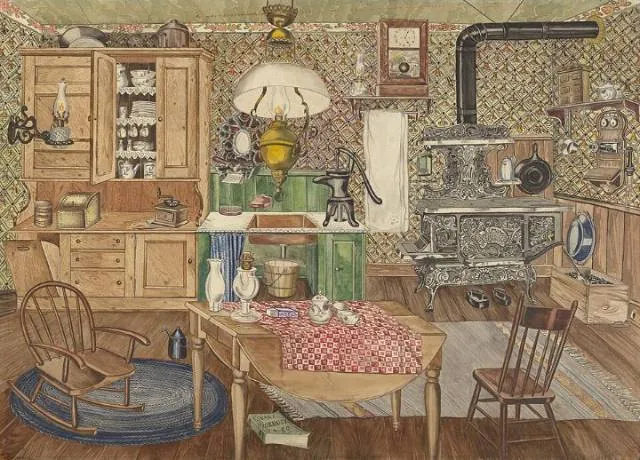
What the valley cooked, in the cooks’ own words: recipes and household hints as they were printed, from the valley’s own cookbooks and newspapers, and from the club and church cookbooks where valley cooks signed their recipes with their home towns, from Cassopolis and Dowagiac to Goshen and South Bend.
 Places to eat34 places with a story: old banks, depots, family tables
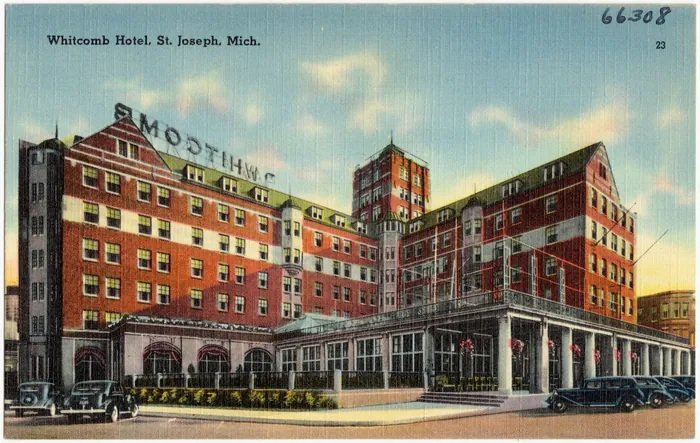 Places to stay14 inns and bed & breakfasts in old houses
- Recipes from the Valley Kitchen36 old recipes, with the pages they were printed on
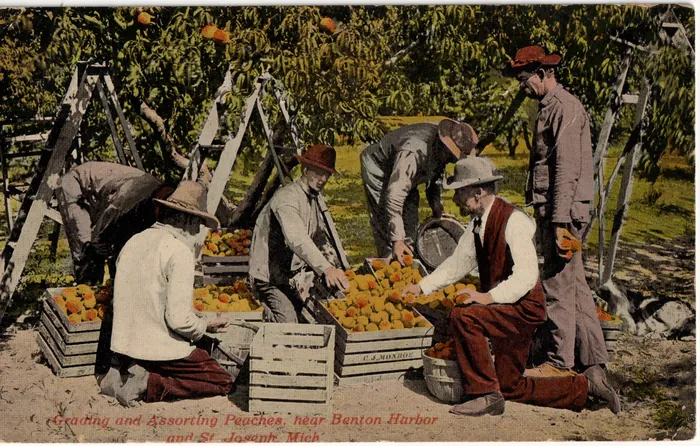 Where the food came fromOrchards, mills, celery and the stove town
The recipe box
Each card shows the dish as it was printed, word for word, the page it came from, and a note on making it today. Tick the ones you have cooked: one earns a badge for your field book. To cook away from the screen, take the whole box as a little booklet (PDF).
Breads 3
-

As printed, 1909 printing (first published 1901). Tap to enlarge. Breads Any time of year
Corn Bread
South Bend, Indiana (St. Joseph County), 1909 printing (first published 1901)
Take 1 pint bolted corn meal, 1 pint wheat flour, 1 pint thick sour milk, 2 eggs, ½ cup sugar, butter the size of an egg. Stir all together, then add 1 teaspoonful soda stirred in a little milk. Bake in a moderate oven.
From The Inglenook Cook Book (Brethren Publishing House; recipes from Sisters of the Brethren Church) · Sister Mell E. Wenger, South Bend, Ind.
Making it today
Mix 2 cups fine cornmeal, 2 cups flour, 2 cups buttermilk, 2 eggs, ½ cup sugar and ¼ cup melted butter. Stir 1 tsp baking soda into 2 Tbsp milk and add it last. Pour into a greased 9×13 pan and bake at 375°F for 25–30 minutes. 'Bolted' meal is sifted, finer corn meal; 'thick sour milk' is closest to buttermilk.
-
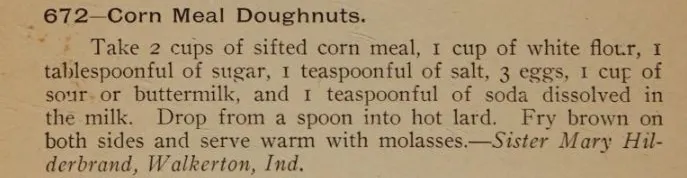
As printed, 1909 printing (first published 1901). Tap to enlarge. Breads Any time of year
Corn Meal Doughnuts
Walkerton, Indiana (St. Joseph County), 1909 printing (first published 1901)
Take 2 cups of sifted corn meal, 1 cup of white flour, 1 tablespoonful of sugar, 1 teaspoonful of salt, 3 eggs, 1 cup of sour or buttermilk, and 1 teaspoonful of soda dissolved in the milk. Drop from a spoon into hot lard. Fry brown on both sides and serve warm with molasses.
From The Inglenook Cook Book (Brethren Publishing House; recipes from Sisters of the Brethren Church) · Sister Mary Hilderbrand, Walkerton, Ind.
Making it today
Whisk 2 cups cornmeal, 1 cup flour, 1 Tbsp sugar and 1 tsp salt. Beat 3 eggs with 1 cup buttermilk and 1 tsp baking soda, and stir into the dry mix. Drop by tablespoons into oil or lard heated to 350°F and fry 2–3 minutes, turning, until brown. Drain and serve warm with molasses or sorghum. These are more like fritters than ring doughnuts.
-
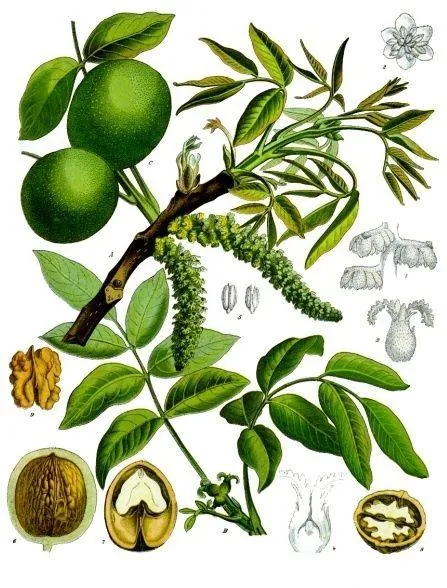
Köhler's Medizinal-Pflanzen, 1897 (public domain) Breads Any time of year
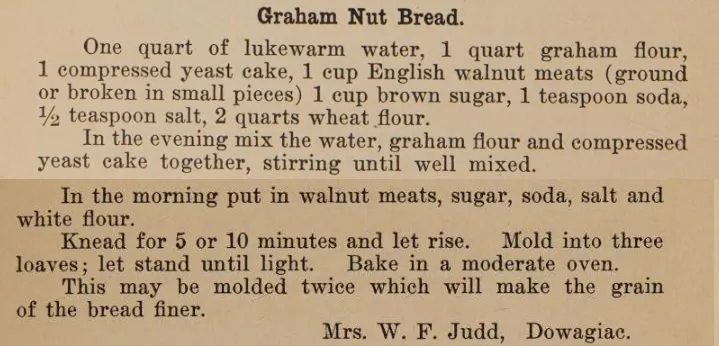
Graham Nut Bread
Dowagiac, Michigan (Cass County), 1909
One quart of lukewarm water, 1 quart graham flour, 1 compressed yeast cake, 1 cup English walnut meats (ground or broken in small pieces) 1 cup brown sugar, 1 teaspoon soda, ½ teaspoon salt, 2 quarts wheat flour. In the evening mix the water, graham flour and compressed yeast cake together, stirring until well mixed. In the morning put in walnut meats, sugar, soda, salt and white flour. Knead for 5 or 10 minutes and let rise. Mold into three loaves; let stand until light. Bake in a moderate oven. This may be molded twice which will make the grain of the bread finer.
From Michigan State Federation Cook Book (Michigan State Federation of Women's Clubs) · Mrs. W. F. Judd, Dowagiac
Making it today
An overnight sponge bread. Evening: stir together 4 cups lukewarm water, 4 cups whole-wheat (graham) flour and one 0.6-oz cake of fresh yeast (or 2¼ tsp active dry). Cover and leave overnight. Morning: stir in 1 cup chopped walnuts, 1 cup brown sugar, 1 tsp baking soda, ½ tsp salt and about 8 cups all-purpose flour (add it gradually; you may not need it all). Knead 5–10 minutes, let rise until doubled (about 1 hour), shape into three loaves in greased 8×4 pans, let rise again until light, and bake at 350°F about 40–45 minutes. Halve everything for a more manageable batch. A 'compressed yeast cake' is the old fresh-yeast cake; 'soda' is baking soda.
Soups 3
-
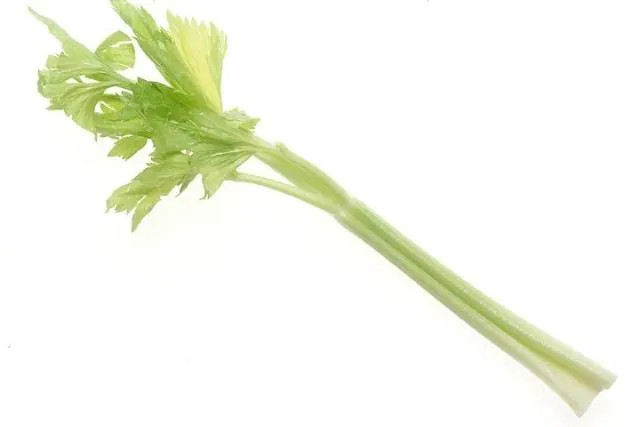
Renee Comet, National Cancer Institute (public domain) Soups Best in fall
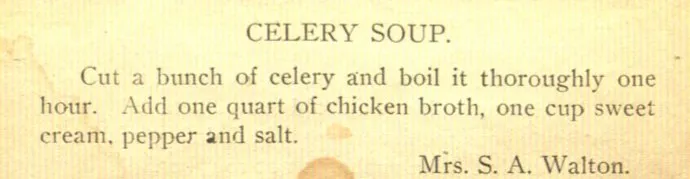
Celery Soup
Three Rivers, Michigan (St. Joseph County), about 1896
Cut a bunch of celery and boil it thoroughly one hour. Add one quart of chicken broth, one cup sweet cream, pepper and salt.
From The Three Rivers Cook Book (reprint, with supplement), King's Daughters Society · Mrs. S. A. Walton
Its story today: Kalamazoo grew celery for a century
Making it today
Chop one head of celery and simmer it in a little salted water about an hour, until very soft (blend it smooth if you like). Add 4 cups chicken broth and 1 cup heavy or light cream, heat through without boiling, and season with salt and pepper.
-

Gerda Arendt, via Wikimedia Commons (CC0) Soups Best in winter
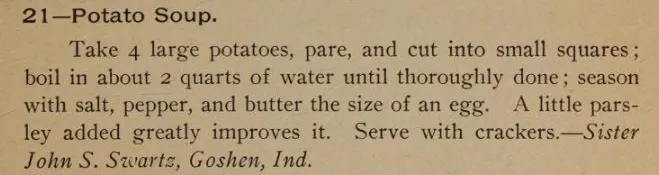
Potato Soup
Goshen, Indiana (Elkhart County), 1909 printing (first published 1901)
Take 4 large potatoes, pare, and cut into small squares; boil in about 2 quarts of water until thoroughly done; season with salt, pepper, and butter the size of an egg. A little parsley added greatly improves it. Serve with crackers.
From The Inglenook Cook Book (Brethren Publishing House; recipes from Sisters of the Brethren Church) · Sister John S. Swartz, Goshen, Ind.
Making it today
Peel and dice 4 large potatoes and simmer in 8 cups water (or use half broth) until very soft, about 25 minutes; mash some against the pot to thicken. Season with salt and pepper, stir in ¼ cup butter and a handful of chopped parsley, and serve with crackers.
-
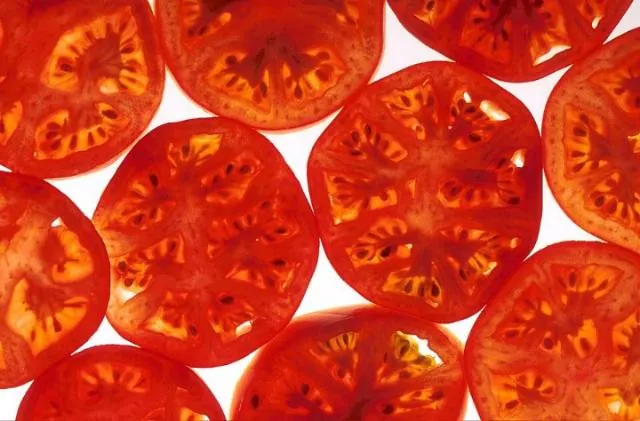
Scott Bauer, USDA Agricultural Research Service (public domain) Soups Best in summer
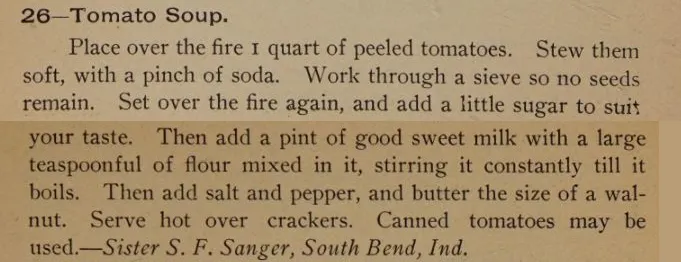
Tomato Soup
South Bend, Indiana (St. Joseph County), 1909 printing (first published 1901)
Place over the fire 1 quart of peeled tomatoes. Stew them soft, with a pinch of soda. Work through a sieve so no seeds remain. Set over the fire again, and add a little sugar to suit your taste. Then add a pint of good sweet milk with a large teaspoonful of flour mixed in it, stirring it constantly till it boils. Then add salt and pepper, and butter the size of a walnut. Serve hot over crackers. Canned tomatoes may be used.
From The Inglenook Cook Book (Brethren Publishing House; recipes from Sisters of the Brethren Church) · Sister S. F. Sanger, South Bend, Ind.
Making it today
Simmer 4 cups peeled tomatoes (or a 28-oz can plus a little water) with a pinch of baking soda (it tames the acid so the milk will not curdle) until soft, about 15 minutes; press through a sieve or blend. Return to the pot, add sugar to taste, then whisk 1 heaping tsp flour into 2 cups milk and stir it in; bring just to a boil, stirring. Season with salt and pepper, add 1–2 Tbsp butter ('size of a walnut'), and serve over crackers.
Main dishes 4
-
As printed, 1909. Tap to enlarge. Main dishes Any time of year
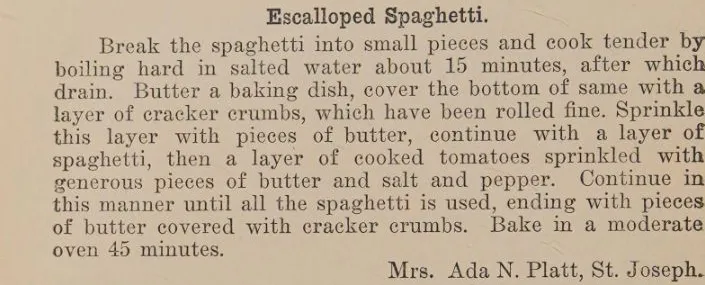
Escalloped Spaghetti
St. Joseph, Michigan (Berrien County), 1909
Break the spaghetti into small pieces and cook tender by boiling hard in salted water about 15 minutes, after which drain. Butter a baking dish, cover the bottom of same with a layer of cracker crumbs, which have been rolled fine. Sprinkle this layer with pieces of butter, continue with a layer of spaghetti, then a layer of cooked tomatoes sprinkled with generous pieces of butter and salt and pepper. Continue in this manner until all the spaghetti is used, ending with pieces of butter covered with cracker crumbs. Bake in a moderate oven 45 minutes.
From Michigan State Federation Cook Book (Michigan State Federation of Women's Clubs) · Mrs. Ada N. Platt, St. Joseph
Making it today
Break ½ lb spaghetti into short pieces and boil in salted water until just tender (about 10 minutes for modern pasta); drain. Butter a 2-quart dish and cover the bottom with fine cracker crumbs dotted with butter. Layer spaghetti, then stewed or canned tomatoes (about a 28-oz can in all), dotting each tomato layer with butter, salt and pepper; repeat, and finish with butter and crumbs. Bake at 350°F for 45 minutes.
-
As printed, 1909. Tap to enlarge. Main dishes Any time of year
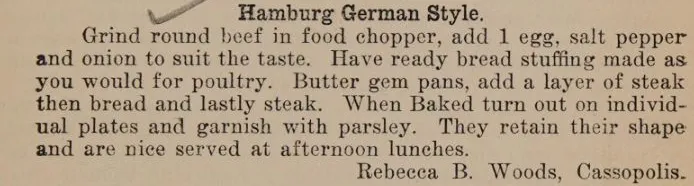
Hamburg German Style
Cassopolis, Michigan (Cass County), 1909
Grind round beef in food chopper, add 1 egg, salt pepper and onion to suit the taste. Have ready bread stuffing made as you would for poultry. Butter gem pans, add a layer of steak then bread and lastly steak. When Baked turn out on individual plates and garnish with parsley. They retain their shape and are nice served at afternoon lunches.
From Michigan State Federation Cook Book (Michigan State Federation of Women's Clubs) · Rebecca B. Woods, Cassopolis
Making it today
Mix 1 lb ground beef with 1 egg, salt, pepper and a little minced onion. Make about 2 cups of your usual bread stuffing (bread cubes, butter, onion, celery, sage, moistened with broth). Butter a 12-cup muffin tin; press a thin layer of beef in each cup, then a spoonful of stuffing, then another layer of beef. Bake at 375°F about 25 minutes, until the meat reaches 160°F. Turn out and garnish with parsley. 'Gem pans' are muffin tins.
-
Hugh M. Smith, U.S. Fish Commission, 1896 (public domain) Main dishes Any time of year
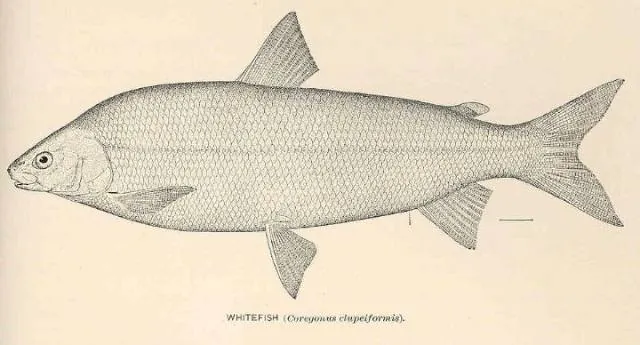
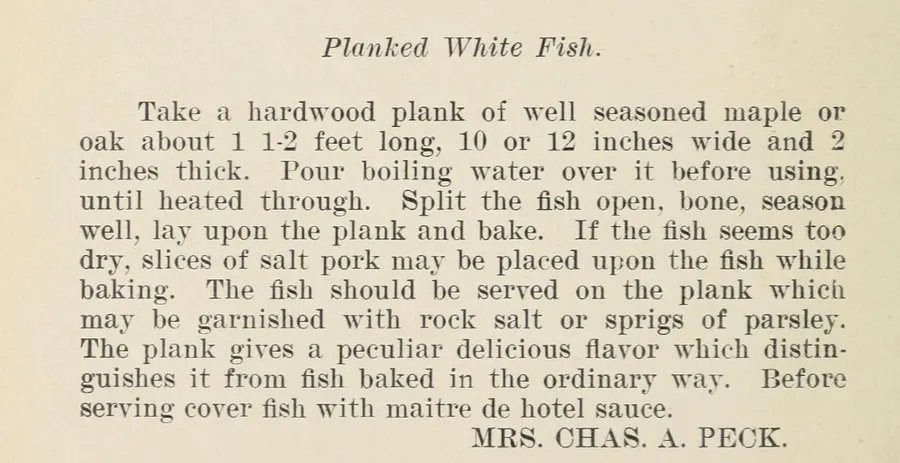
Planked White Fish
Kalamazoo, Michigan, 1906
Take a hardwood plank of well seasoned maple or oak about 1 1-2 feet long, 10 or 12 inches wide and 2 inches thick. Pour boiling water over it before using, until heated through. Split the fish open, bone, season well, lay upon the plank and bake. If the fish seems too dry, slices of salt pork may be placed upon the fish while baking. The fish should be served on the plank which may be garnished with rock salt or sprigs of parsley. The plank gives a peculiar delicious flavor which distinguishes it from fish baked in the ordinary way. Before serving cover fish with maitre de hotel sauce.
From New Crumbs of Comfort: A Cook Book, compiled by the Ladies of St. Luke's Church · Mrs. Chas. A. Peck
Making it today
Soak an untreated oak, maple or cedar cooking plank, then heat it in a 400°F oven. Lay a boned, butterflied whitefish skin-side down on the hot plank, season, top with a few strips of bacon if you like, and bake at 400°F for 15 to 20 minutes, until it flakes. Serve on the plank with lemon-parsley butter (maître d'hôtel butter).
-

From J. E. Harting, The Rabbit, 1898, Biodiversity Heritage Library (public domain) Main dishes Best in fall
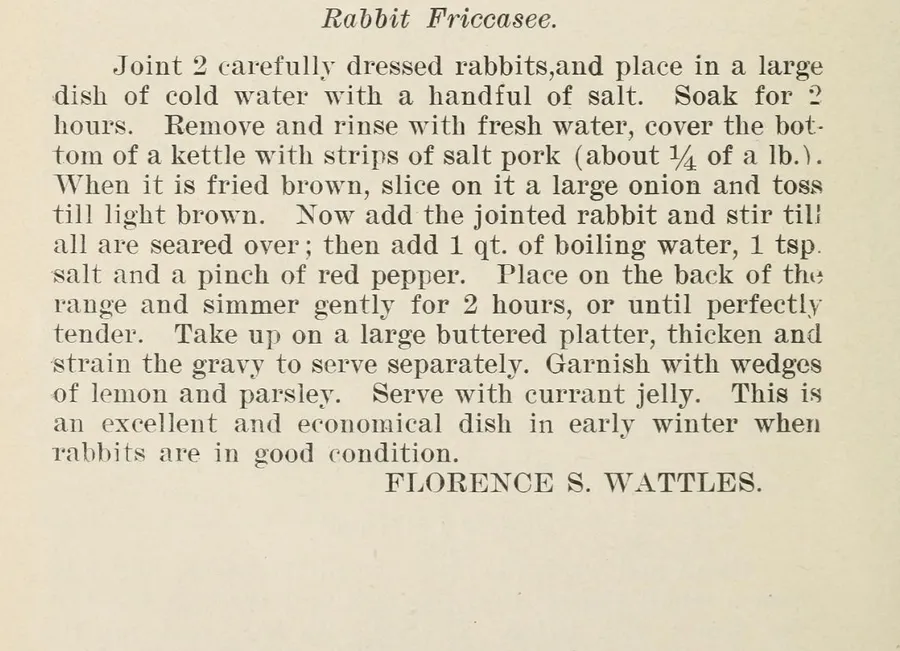
Rabbit Fricassee
Kalamazoo, Michigan, 1906
Joint 2 carefully dressed rabbits, and place in a large dish of cold water with a handful of salt. Soak for 2 hours. Remove and rinse with fresh water, cover the bottom of a kettle with strips of salt pork (about ¼ of a lb.). When it is fried brown, slice on it a large onion and toss till light brown. Now add the jointed rabbit and stir till all are seared over; then add 1 qt. of boiling water, 1 tsp. salt and a pinch of red pepper. Place on the back of the range and simmer gently for 2 hours, or until perfectly tender. ... This is an excellent and economical dish in early winter when rabbits are in good condition.
From New Crumbs of Comfort: A Cook Book, compiled by the Ladies of St. Luke's Church · Florence S. Wattles
Making it today
Brine two cut-up rabbits in salted water for 2 hours, then rinse. Brown 1/4 lb diced salt pork or bacon in a Dutch oven, add a sliced onion until golden, then sear the rabbit. Add 4 cups boiling water, 1 teaspoon salt and a pinch of cayenne, cover and simmer on low heat 1 1/2 to 2 hours until tender; thicken the broth for gravy and serve with currant jelly.
Vegetables 4
-
Daderot, via Wikimedia Commons (CC0) Small photos: U.S. Department of Agriculture (public domain).
Vegetables Best in summer
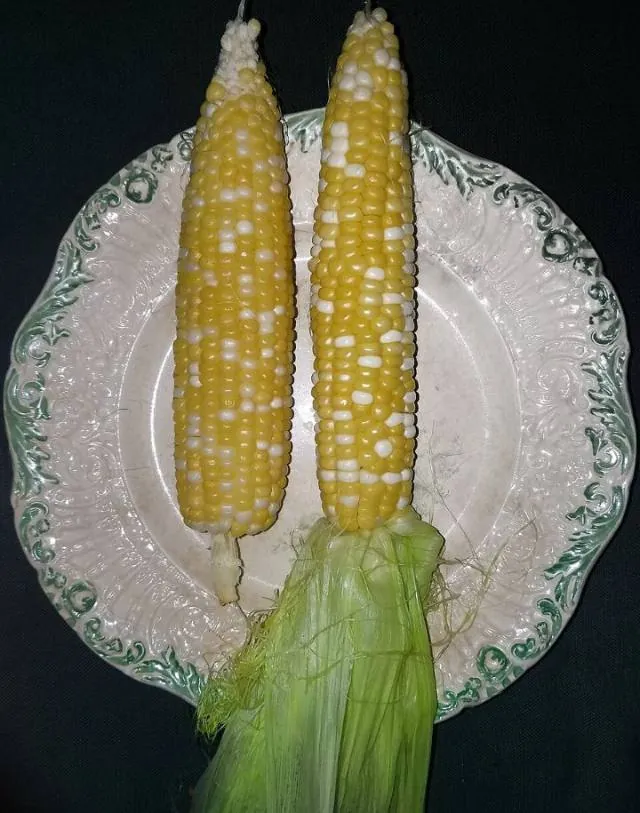
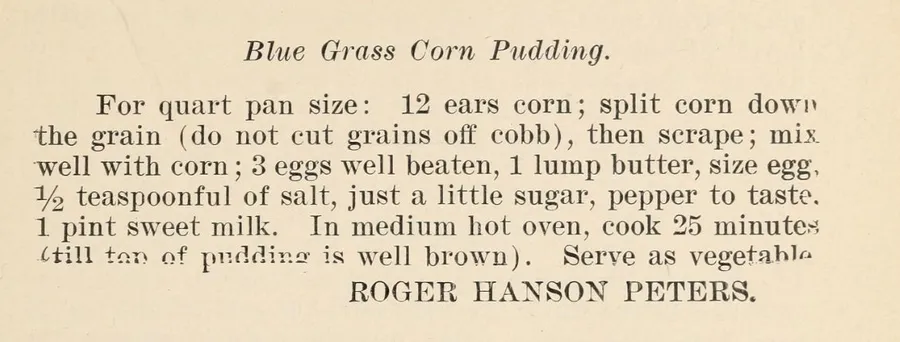
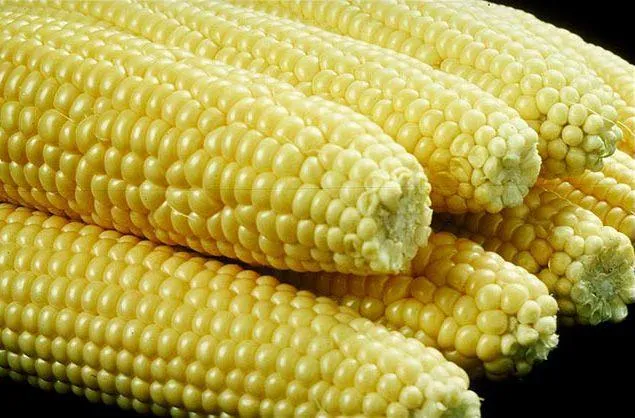
Blue Grass Corn Pudding
Kalamazoo, Michigan, 1906
For quart pan size: 12 ears corn; split corn down the grain (do not cut grains off cobb), then scrape; mix well with corn; 3 eggs well beaten, 1 lump butter, size egg, ½ teaspoonful of salt, just a little sugar, pepper to taste. 1 pint sweet milk. In medium hot oven, cook 25 minutes (till top of pudding is well brown). Serve as vegetable.
From New Crumbs of Comfort: A Cook Book, compiled by the Ladies of St. Luke's Church · Roger Hanson Peters
Making it today
Score down each row of kernels on 12 ears of fresh sweet corn and scrape the pulp and milk into a bowl (about 4 cups). Stir in 3 beaten eggs, 4 tablespoons melted butter ('size of an egg' is about 1/4 cup), 1/2 teaspoon salt, a pinch of sugar, pepper and 2 cups whole milk. Bake in a buttered 1 1/2- to 2-quart dish at 375°F for 25 to 35 minutes, until set and well browned on top.
-
Jeffery Martin, via Wikimedia Commons (CC0) Vegetables Best in winter
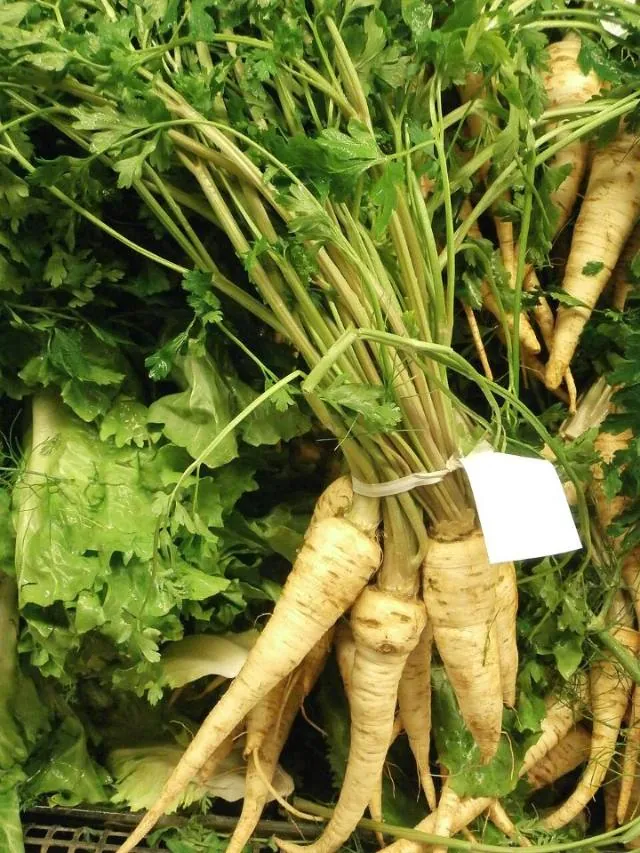
Escalloped Parsnips
Marcellus, Michigan (Cass County), 1909
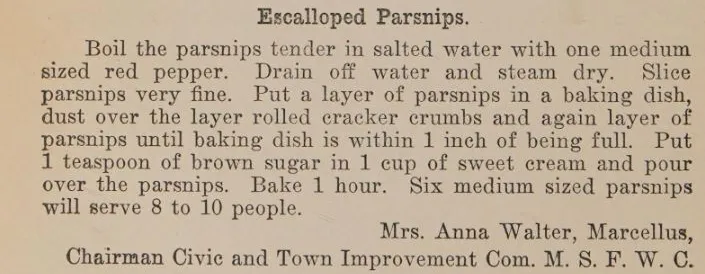
Boil the parsnips tender in salted water with one medium sized red pepper. Drain off water and steam dry. Slice parsnips very fine. Put a layer of parsnips in a baking dish, dust over the layer rolled cracker crumbs and again layer of parsnips until baking dish is within 1 inch of being full. Put 1 teaspoon of brown sugar in 1 cup of sweet cream and pour over the parsnips. Bake 1 hour. Six medium sized parsnips will serve 8 to 10 people.
From Michigan State Federation Cook Book (Michigan State Federation of Women's Clubs) · Mrs. Anna Walter, Marcellus, Chairman Civic and Town Improvement Com. M. S. F. W. C.
Making it today
Peel 6 medium parsnips and simmer them in salted water with one small dried or fresh red chili until tender, 15–20 minutes. Drain, let steam dry, and slice thin. Layer in a buttered 2-quart baking dish with crushed saltine crumbs between the layers, stopping an inch from the top. Stir 1 tsp brown sugar into 1 cup heavy cream and pour over. Bake at 350°F for about 1 hour, until bubbling and browned. Serves 8.
-
As printed, 1909. Tap to enlarge. Vegetables Any time of year
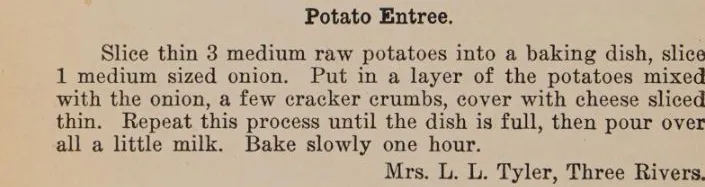
Potato Entree
Three Rivers, Michigan (St. Joseph County), 1909
Slice thin 3 medium raw potatoes into a baking dish, slice 1 medium sized onion. Put in a layer of the potatoes mixed with the onion, a few cracker crumbs, cover with cheese sliced thin. Repeat this process until the dish is full, then pour over all a little milk. Bake slowly one hour.
From Michigan State Federation Cook Book (Michigan State Federation of Women's Clubs) · Mrs. L. L. Tyler, Three Rivers
Making it today
Thinly slice 3 medium potatoes and 1 onion. In a buttered 1½-quart dish, layer potatoes and onion, a sprinkle of cracker crumbs, salt and pepper, and thin slices of cheese (mild cheddar or Colby); repeat until full. Pour about ¾ cup milk over the top, cover, and bake at 325–350°F for 1 hour, uncovering for the last 15 minutes to brown.
-
Roundhere44, via Wikimedia Commons (CC0) Vegetables Best in summer
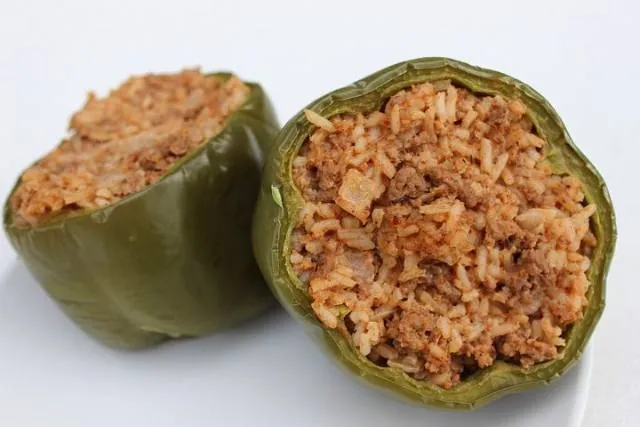
Stuffed Peppers
Dowagiac, Michigan (Cass County), 1909
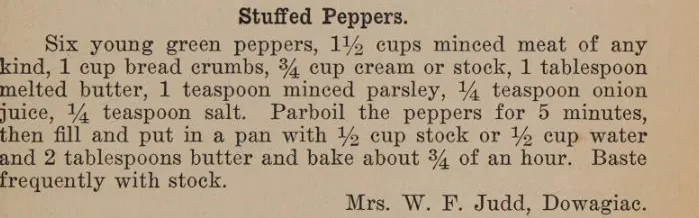
Six young green peppers, 1½ cups minced meat of any kind, 1 cup bread crumbs, ¾ cup cream or stock, 1 tablespoon melted butter, 1 teaspoon minced parsley, ¼ teaspoon onion juice, ¼ teaspoon salt. Parboil the peppers for 5 minutes, then fill and put in a pan with ½ cup stock or ½ cup water and 2 tablespoons butter and bake about ¾ of an hour. Baste frequently with stock.
From Michigan State Federation Cook Book (Michigan State Federation of Women's Clubs) · Mrs. W. F. Judd, Dowagiac
Making it today
Cut the tops from 6 green peppers and seed them; boil 5 minutes and drain. Mix 1½ cups finely chopped cooked meat (leftover roast, ham or chicken), 1 cup fresh bread crumbs, ¾ cup cream or broth, 1 Tbsp melted butter, 1 tsp chopped parsley, ¼ tsp grated onion with its juice and ¼ tsp salt. Fill the peppers, stand them in a baking dish with ½ cup broth and 2 Tbsp butter, and bake at 350°F about 45 minutes, basting now and then.
Pies & cakes 5
-
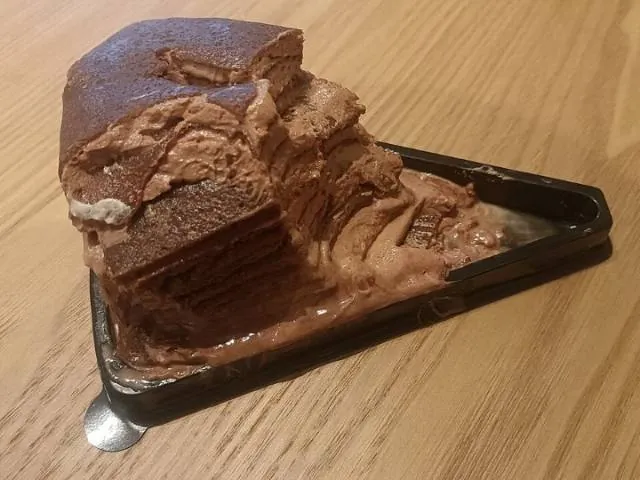
Fumikas Sagisavas, via Wikimedia Commons (CC0) Pies & cakes Any time of year
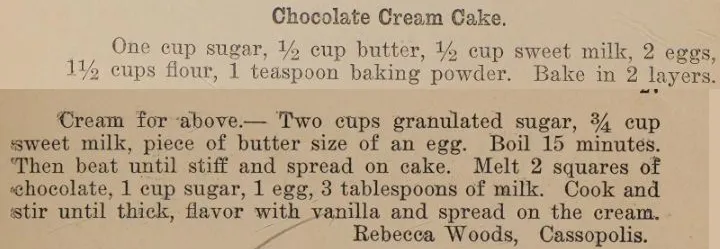
Chocolate Cream Cake
Cassopolis, Michigan (Cass County), 1909
One cup sugar, ½ cup butter, ½ cup sweet milk, 2 eggs, 1½ cups flour, 1 teaspoon baking powder. Bake in 2 layers. Cream for above.— Two cups granulated sugar, ¾ cup sweet milk, piece of butter size of an egg. Boil 15 minutes. Then beat until stiff and spread on cake. Melt 2 squares of chocolate, 1 cup sugar, 1 egg, 3 tablespoons of milk. Cook and stir until thick, flavor with vanilla and spread on the cream.
From Michigan State Federation Cook Book (Michigan State Federation of Women's Clubs) · Rebecca Woods, Cassopolis
Making it today
Cake: cream 1 cup sugar with ½ cup butter, beat in 2 eggs, then add 1½ cups flour sifted with 1 tsp baking powder alternately with ½ cup milk. Bake in two greased 8-inch round pans at 350°F for 20–25 minutes. White 'cream' filling: boil 2 cups sugar, ¾ cup milk and ¼ cup butter ('size of an egg') to the soft-ball stage (about 236°F), cool slightly, beat until thick and spread between and over the layers. Chocolate topping: cook 2 oz unsweetened chocolate, 1 cup sugar, 1 egg and 3 Tbsp milk over low heat, stirring, until thick (do not boil hard), add 1 tsp vanilla and spread over the white layer. A 'square' of chocolate is 1 oz.
-
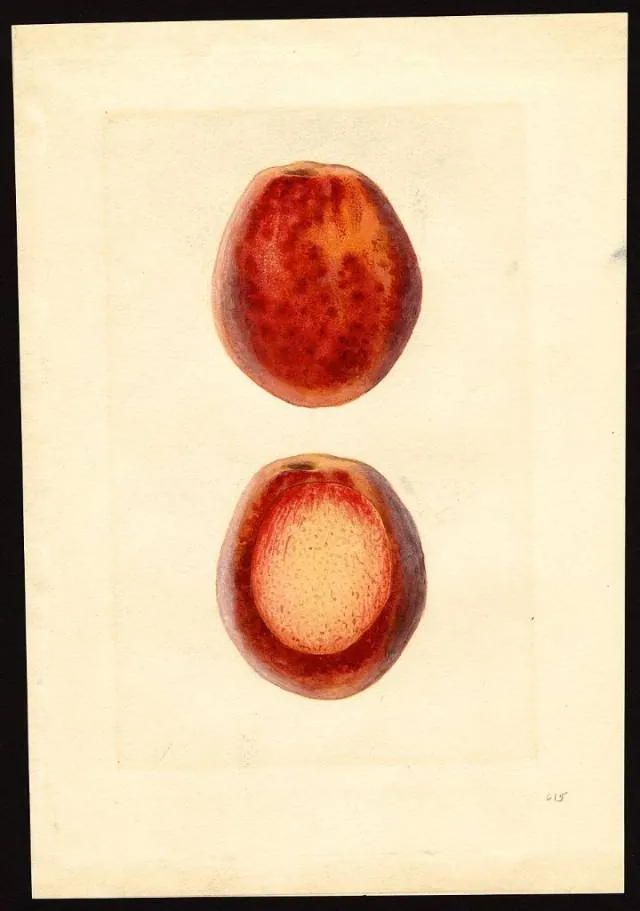
J. Marion Shull, USDA Pomological Watercolor Collection, National Agricultural Library (public domain) Pies & cakes Best in summer
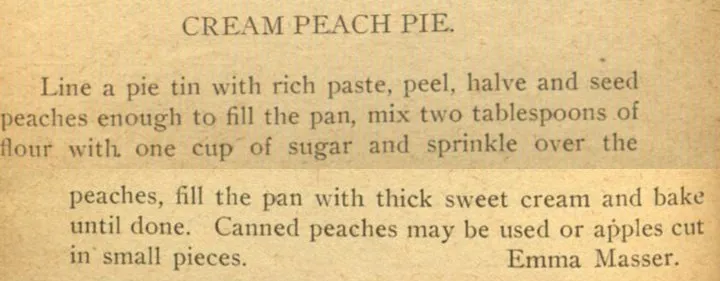
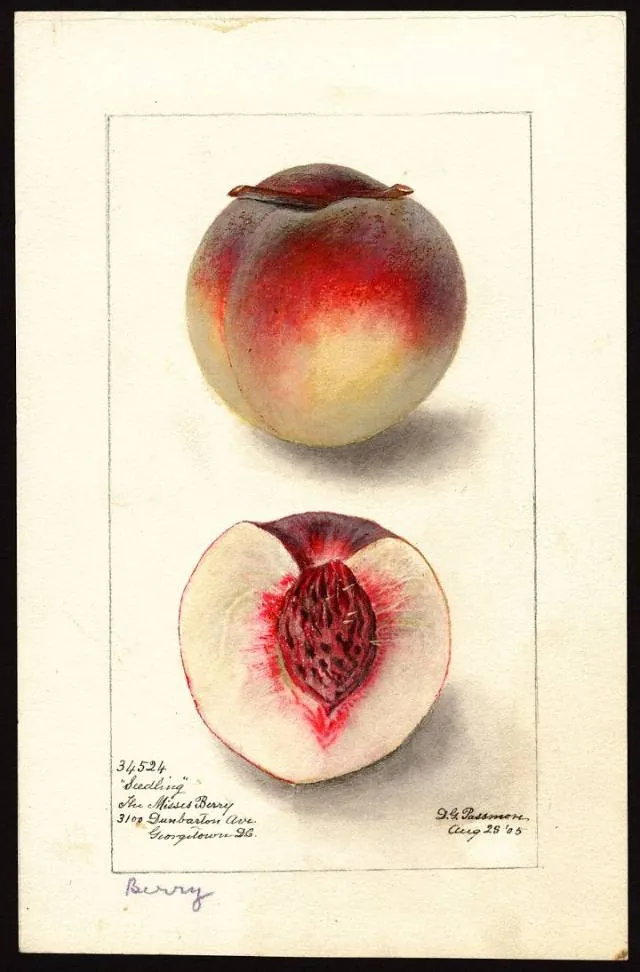
Cream Peach Pie
Three Rivers, Michigan (St. Joseph County), about 1896
Line a pie tin with rich paste, peel, halve and seed peaches enough to fill the pan, mix two tablespoons of flour with one cup of sugar and sprinkle over the peaches, fill the pan with thick sweet cream and bake until done. Canned peaches may be used or apples cut in small pieces.
From The Three Rivers Cook Book (reprint, with supplement), King's Daughters Society · Emma Masser
Its story today: The fruit belt and its great market
Making it today
Fit a 9-inch pie plate with pastry and fill it with peeled peach halves, cut side up. Mix 1 cup sugar with 2 tablespoons flour, sprinkle over the fruit, and pour in about 1 cup heavy cream. Bake at 425°F for 15 minutes, then 350°F for 30–40 minutes, until the cream is set and lightly browned; cool before slicing.
-
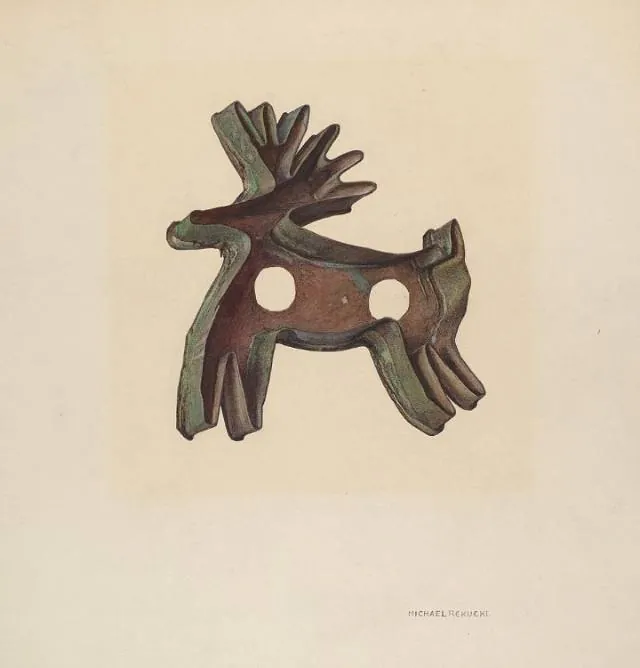
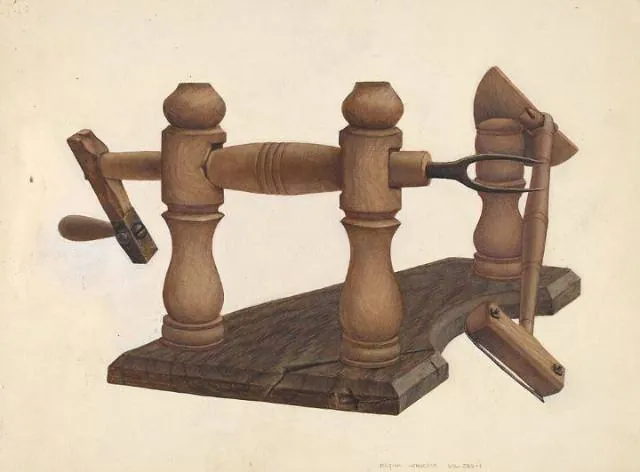
Michael Rekucki, Index of American Design, National Gallery of Art (CC0) Pies & cakes Any time of year
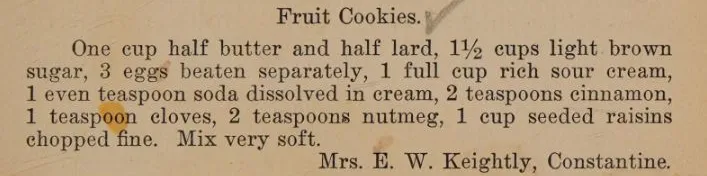
Fruit Cookies
Constantine, Michigan (St. Joseph County), 1909
One cup half butter and half lard, 1½ cups light brown sugar, 3 eggs beaten separately, 1 full cup rich sour cream, 1 even teaspoon soda dissolved in cream, 2 teaspoons cinnamon, 1 teaspoon cloves, 2 teaspoons nutmeg, 1 cup seeded raisins chopped fine. Mix very soft.
From Michigan State Federation Cook Book (Michigan State Federation of Women's Clubs) · Mrs. E. W. Keightly, Constantine
Making it today
Cream ½ cup butter and ½ cup lard (or all butter) with 1½ cups light brown sugar. Beat in 3 egg yolks, then 1 cup sour cream mixed with 1 tsp baking soda, the spices (2 tsp cinnamon, 1 tsp cloves, 2 tsp nutmeg) and 1 cup chopped raisins. Fold in the 3 whites, beaten stiff. Stir in flour (about 3 to 3½ cups) only until a soft dough forms. Drop by spoonfuls on greased sheets and bake at 375°F for 10–12 minutes. The book gives no flour amount; 'mix very soft' means just enough to hold a shape.
-
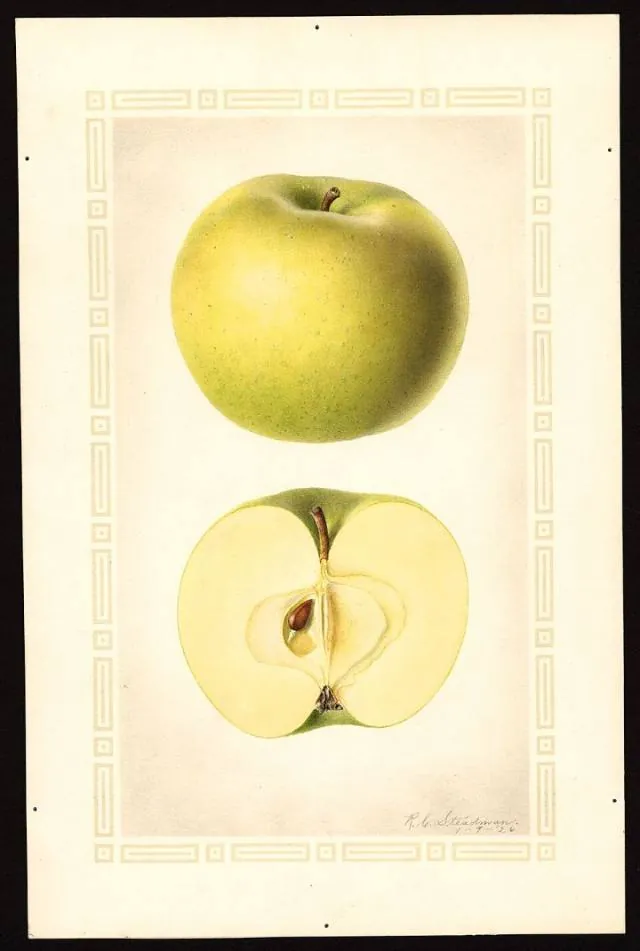
Royal Charles Steadman, USDA Pomological Watercolor Collection, National Agricultural Library (public domain) Pies & cakes Best in fall
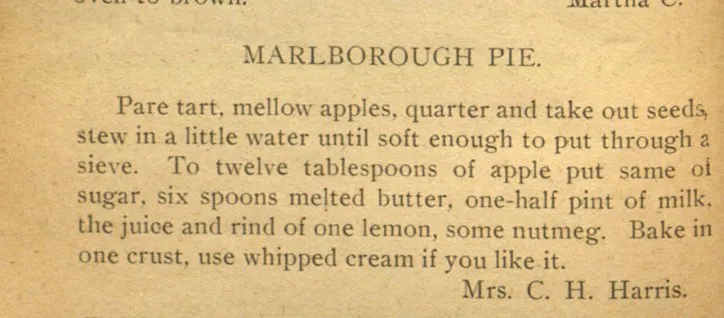
Marlborough Pie
Three Rivers, Michigan (St. Joseph County), about 1896
Pare tart, mellow apples, quarter and take out seeds, stew in a little water until soft enough to put through a sieve. To twelve tablespoons of apple put same of sugar, six spoons melted butter, one-half pint of milk, the juice and rind of one lemon, some nutmeg. Bake in one crust, use whipped cream if you like it.
From The Three Rivers Cook Book (reprint, with supplement), King's Daughters Society · Mrs. C. H. Harris
Making it today
Cook tart apples into a smooth sauce; measure 3/4 cup and mix with 3/4 cup sugar, 6 tablespoons melted butter, 1 cup milk, the zest and juice of a lemon and a grating of nutmeg (most cooks today also add 2–3 beaten eggs so the custard sets). Pour into an unbaked 9-inch crust and bake at 425°F for 10 minutes, then 350°F for 35–45 minutes until set. Top with whipped cream.
-
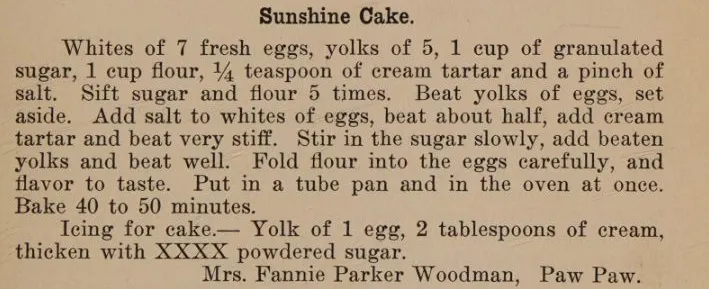
As printed, 1909. Tap to enlarge. Pies & cakes Any time of year
Sunshine Cake
Paw Paw, Michigan (Van Buren County), 1909
Whites of 7 fresh eggs, yolks of 5, 1 cup of granulated sugar, 1 cup flour, ¼ teaspoon of cream tartar and a pinch of salt. Sift sugar and flour 5 times. Beat yolks of eggs, set aside. Add salt to whites of eggs, beat about half, add cream tartar and beat very stiff. Stir in the sugar slowly, add beaten yolks and beat well. Fold flour into the eggs carefully, and flavor to taste. Put in a tube pan and in the oven at once. Bake 40 to 50 minutes. Icing for cake.— Yolk of 1 egg, 2 tablespoons of cream, thicken with XXXX powdered sugar.
From Michigan State Federation Cook Book (Michigan State Federation of Women's Clubs) · Mrs. Fannie Parker Woodman, Paw Paw
Making it today
A golden sponge cake. Sift 1 cup sugar and 1 cup cake flour separately, several times each. Beat 5 yolks until thick and set aside. Beat 7 whites with a pinch of salt until foamy, add ¼ tsp cream of tartar and beat to stiff peaks. Beat in the sugar a spoonful at a time, then the yolks; gently fold in the flour and 1 tsp vanilla or lemon. Turn into an ungreased 10-inch tube pan and bake at once at 325°F for 40–50 minutes. Cool upside down. Icing: beat 1 yolk with 2 Tbsp cream and enough powdered sugar to spread (or skip the raw yolk and use a little more cream). 'XXXX' was the grade name for fine powdered sugar.
Puddings & desserts 8
-

Sarah Stierch, via Wikimedia Commons (CC0) Small photos: Man vyi, via Wikimedia Commons (public domain).
Puddings & desserts Best in fall
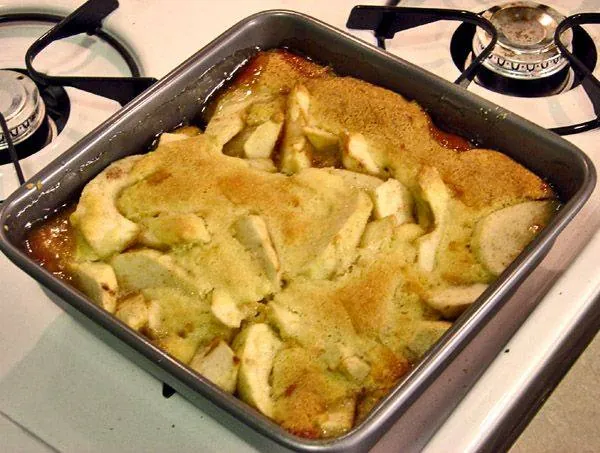
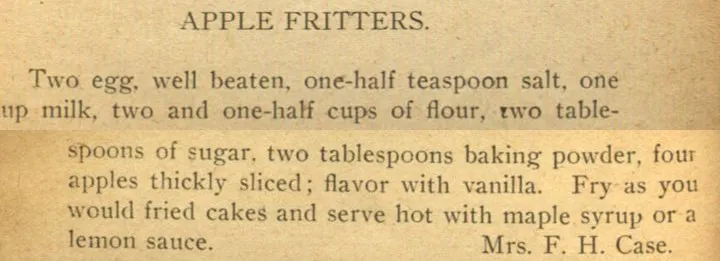
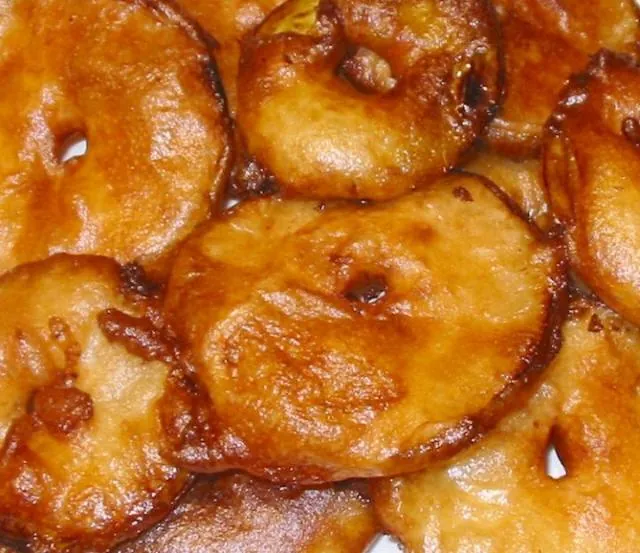
Apple Fritters
Three Rivers, Michigan (St. Joseph County), about 1896
Two egg, well beaten, one-half teaspoon salt, one cup milk, two and one-half cups of flour, two tablespoons of sugar, two tablespoons baking powder, four apples thickly sliced; flavor with vanilla. Fry as you would fried cakes and serve hot with maple syrup or a lemon sauce.
From The Three Rivers Cook Book (reprint, with supplement), King's Daughters Society · Mrs. F. H. Case
Its story today: Apples and cider today: the fall orchards
Making it today
Whisk 2 eggs, 1 cup milk, 2 tablespoons sugar, 1/2 teaspoon salt and a little vanilla; stir in 2 1/2 cups flour and 1 tablespoon baking powder (the original's 2 tablespoons is a lot for modern double-acting powder). Fold in 4 sliced apples, drop by spoonfuls into oil heated to 350–365°F, and fry until golden, 3–4 minutes. Serve hot with real maple syrup.
-
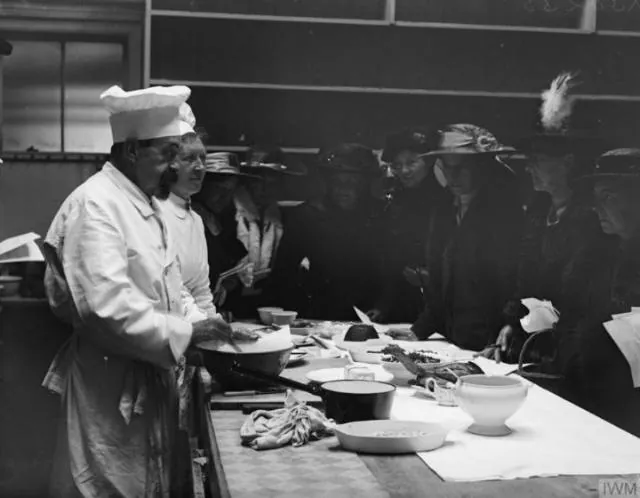
Horace Nicholls, Imperial War Museum (public domain) Puddings & desserts Best in winter
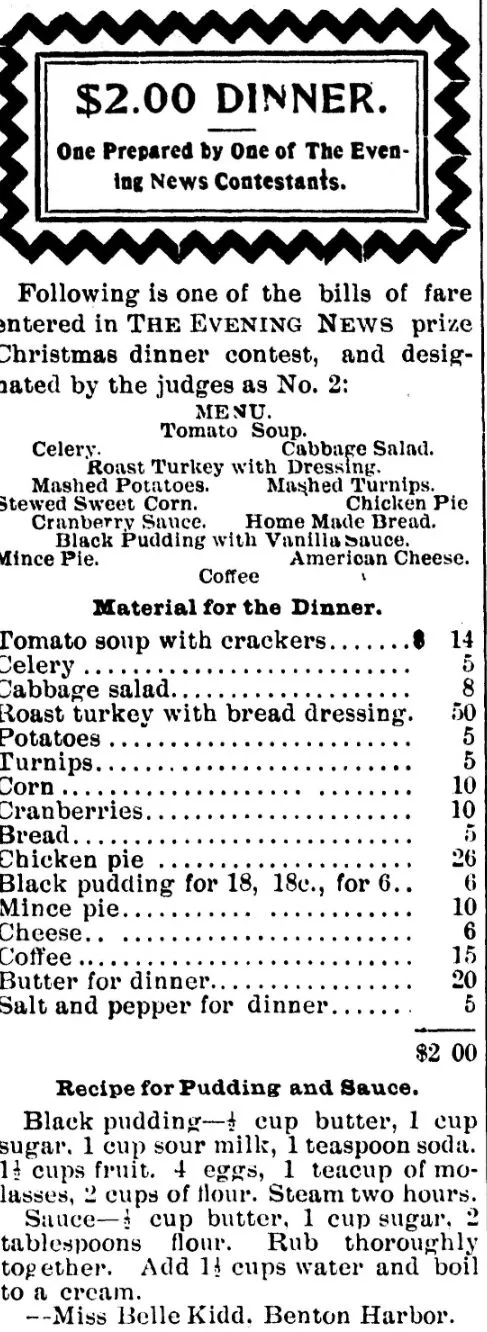
Black Pudding and Sauce
Benton Harbor, Michigan (Berrien County), 1897
Black pudding—½ cup butter, 1 cup sugar, 1 cup sour milk, 1 teaspoon soda, 1½ cups fruit, 4 eggs, 1 teacup of molasses, 2 cups of flour. Steam two hours. Sauce—½ cup butter, 1 cup sugar, 2 tablespoons flour. Rub thoroughly together. Add 1½ cups water and boil to a cream.
From The Evening News (Benton Harbor), December 22, 1897 · Miss Belle Kidd, Benton Harbor
Making it today
A steamed molasses fruit pudding (no blood; 'black' is from the molasses). Cream ½ cup butter and 1 cup sugar, beat in 4 eggs and ¾ cup molasses, then 1 cup buttermilk mixed with 1 tsp baking soda. Stir in 2 cups flour and 1½ cups raisins or chopped dried fruit. Pour into a greased 2-quart pudding basin, cover with foil and steam on a rack over simmering water for 2 hours. Sauce: rub ½ cup butter, 1 cup sugar and 2 Tbsp flour together, whisk in 1½ cups water and simmer, stirring, until creamy. A 'teacup' is about ¾ cup.
-
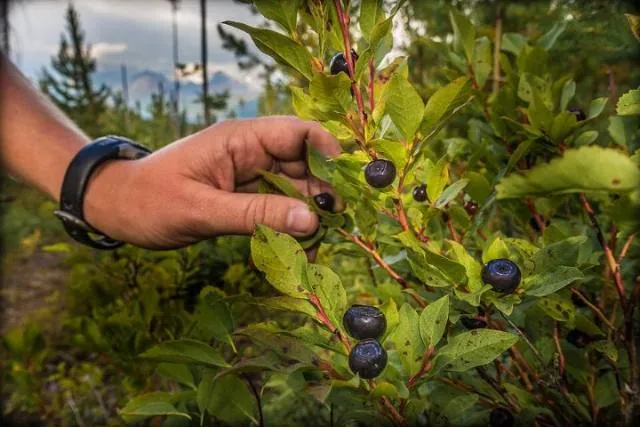
National Park Service, Glacier National Park (public domain) Small photos: Artemas Ward, The Encyclopedia of Food, 1923 (public domain).
Puddings & desserts Best in summer
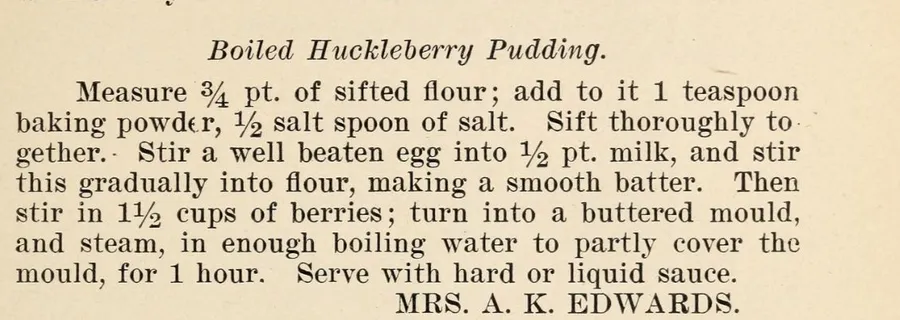
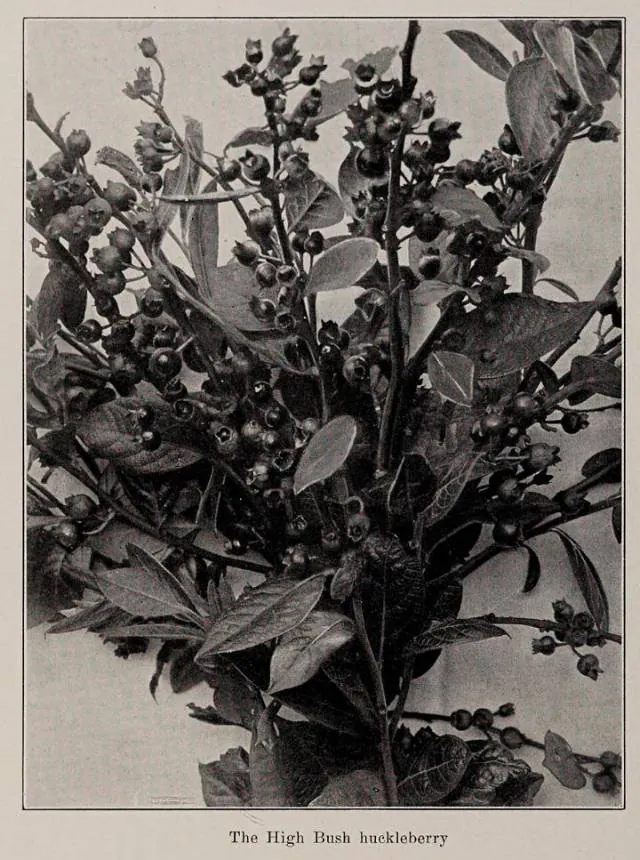
Boiled Huckleberry Pudding
Kalamazoo, Michigan, 1906
Measure ¾ pt. of sifted flour; add to it 1 teaspoon baking powder, ½ salt spoon of salt. Sift thoroughly together. Stir a well beaten egg into ½ pt. milk, and stir this gradually into flour, making a smooth batter. Then stir in 1½ cups of berries; turn into a buttered mould, and steam, in enough boiling water to partly cover the mould, for 1 hour. Serve with hard or liquid sauce.
From New Crumbs of Comfort: A Cook Book, compiled by the Ladies of St. Luke's Church · Mrs. A. K. Edwards
Its story today: Blueberry season on the calendar
Making it today
Sift 1 1/2 cups flour with 1 teaspoon baking powder and 1/8 teaspoon salt; beat 1 egg into 1 cup milk and stir in to make a smooth batter, then fold in 1 1/2 cups huckleberries or wild blueberries. Pour into a buttered 1 1/2-quart pudding mold or heatproof bowl, cover tightly with foil, and steam on a rack in a covered pot of simmering water (halfway up the mold) for 1 hour. Serve warm with hard sauce or a sweet sauce.
-
Artemas Ward, The Encyclopedia of Food, 1923 (public domain) Puddings & desserts Any time of year
Buttermilk Delda
Nappanee, Indiana (Elkhart County), 1909 printing (first published 1901)
Let 2 quarts of buttermilk come to a boil, sweeten, add 4 tablespoonfuls of flour moistened with sweet milk, and stir till thick. To be eaten warm or cold.
From The Inglenook Cook Book (Brethren Publishing House; recipes from Sisters of the Brethren Church) · Sister Sarah A. Crowl, Nappanee, Ind.
Making it today
A Pennsylvania-Dutch buttermilk pudding. Heat 8 cups buttermilk slowly, stirring, until it just simmers (it will separate a little; that is expected). Sweeten to taste (about ½ cup sugar). Whisk 4 Tbsp flour into ½ cup milk, stir it in and cook, stirring, until thickened, 3–5 minutes. Eat warm or chilled, with a dusting of cinnamon if you like.
-

Royal Charles Steadman, USDA Pomological Watercolor Collection, National Agricultural Library (public domain) Puddings & desserts Best in summer
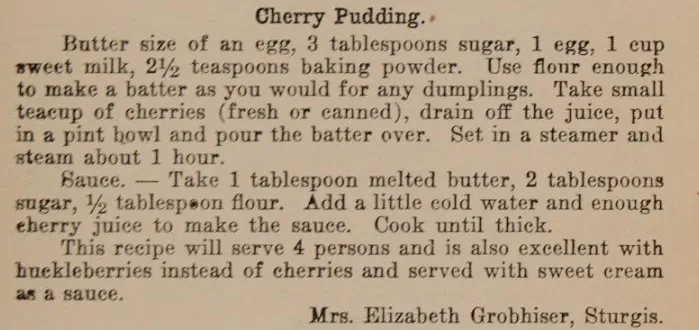
Cherry Pudding
Sturgis, Michigan (St. Joseph County), 1909
Butter size of an egg, 3 tablespoons sugar, 1 egg, 1 cup sweet milk, 2½ teaspoons baking powder. Use flour enough to make a batter as you would for any dumplings. Take small teacup of cherries (fresh or canned), drain off the juice, put in a pint bowl and pour the batter over. Set in a steamer and steam about 1 hour. Sauce. — Take 1 tablespoon melted butter, 2 tablespoons sugar, ½ tablespoon flour. Add a little cold water and enough cherry juice to make the sauce. Cook until thick. This recipe will serve 4 persons and is also excellent with huckleberries instead of cherries and served with sweet cream as a sauce.
From Michigan State Federation Cook Book (Michigan State Federation of Women's Clubs) · Mrs. Elizabeth Grobhiser, Sturgis
Making it today
Cream ¼ cup butter with 3 Tbsp sugar, beat in 1 egg and 1 cup milk, then about 2 cups flour sifted with 2½ tsp baking powder — a thick dumpling batter. Put ¾ cup drained pitted cherries (or blueberries) in a buttered 1-quart heatproof bowl, pour the batter over, cover with foil and steam on a rack over simmering water about 1 hour. Sauce: cook 1 Tbsp melted butter, 2 Tbsp sugar and 1½ tsp flour with a splash of water and about ½ cup cherry juice, stirring, until thick. Serves 4. 'Butter size of an egg' is about ¼ cup; a 'teacup' is roughly ¾ cup. The book's 'pint bowl' is small for this much batter — use a quart bowl.
-
Miguel Andrade, via Wikimedia Commons (public domain) Small photos: Deborah Griscom Passmore, USDA Pomological Watercolor Collection, National Agricultural Library (public domain).
Puddings & desserts Best in spring
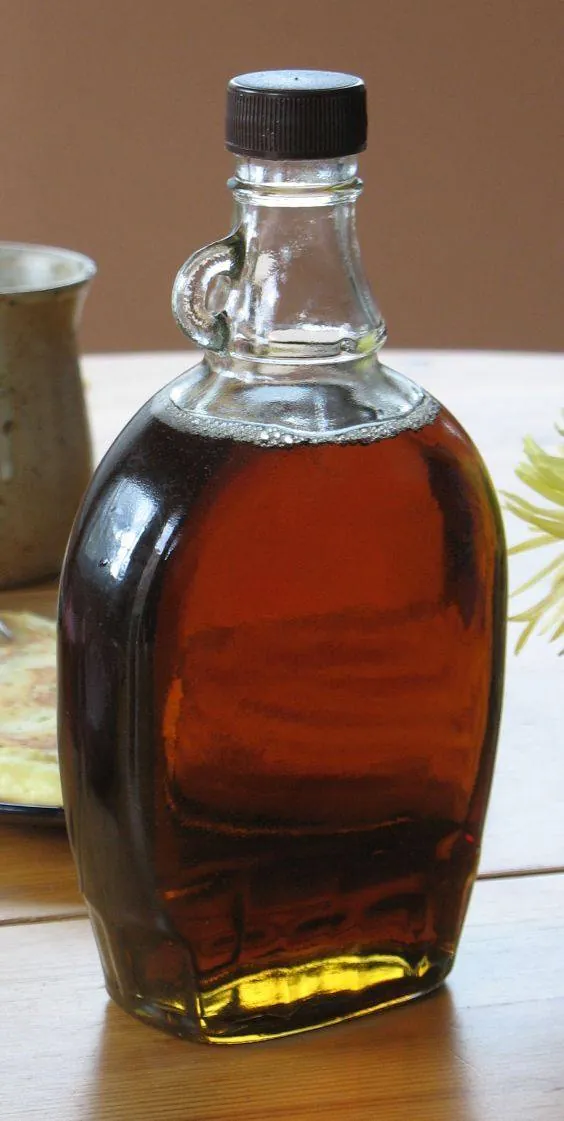
Dessert (fruit with maple jelly)
Bangor, Michigan (Van Buren County), 1909
Put in sherbet glasses enough fruit (any kind or kinds desired, fresh or canned) with nuts to half fill glasses. Make a jelly by taking 1 cup maple syrup and 1 cup water. Thicken with cornstarch and pour over fruit, filling glasses about ¾ full. Cover with whipped cream and serve.
From Michigan State Federation Cook Book (Michigan State Federation of Women's Clubs) · Mrs. Jas. P. Ryan, Bangor
Making it today
A maple-syrup fruit cup for 6. Half-fill 6 dessert glasses with mixed fruit and chopped nuts. In a saucepan whisk 1 cup pure maple syrup, 1 cup water and 2½ Tbsp cornstarch; bring to a boil, stirring, and boil 1 minute until clear and thick. Cool a little, pour over the fruit to fill the glasses about three-quarters, chill until set, and top with whipped cream.
-
Via Wikimedia Commons (public domain) Puddings & desserts Best in summer
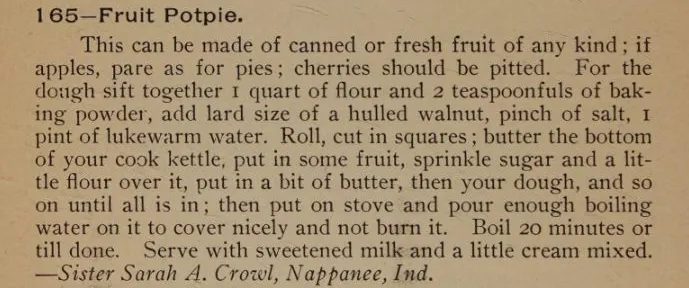
Fruit Potpie
Nappanee, Indiana (Elkhart County), 1909 printing (first published 1901)
This can be made of canned or fresh fruit of any kind; if apples, pare as for pies; cherries should be pitted. For the dough sift together 1 quart of flour and 2 teaspoonfuls of baking powder, add lard size of a hulled walnut, pinch of salt, 1 pint of lukewarm water. Roll, cut in squares; butter the bottom of your cook kettle, put in some fruit, sprinkle sugar and a little flour over it, put in a bit of butter, then your dough, and so on until all is in; then put on stove and pour enough boiling water on it to cover nicely and not burn it. Boil 20 minutes or till done. Serve with sweetened milk and a little cream mixed.
From The Inglenook Cook Book (Brethren Publishing House; recipes from Sisters of the Brethren Church) · Sister Sarah A. Crowl, Nappanee, Ind.
Making it today
Mix 4 cups flour, 2 tsp baking powder, a pinch of salt and 2 Tbsp lard or shortening; stir in about 1½ cups warm water to make a firm dough (add it gradually). Roll ⅛ inch thick and cut in 2-inch squares. Butter a Dutch oven and layer about 4 cups sliced apples or pitted cherries, sprinkling each layer with sugar, a little flour and dots of butter, then a layer of dough squares; repeat. Pour in boiling water just to cover, cover the pot and simmer about 20 minutes, until the dough is cooked through. Serve in bowls with sweetened milk and cream. In this Pennsylvania-Dutch style, potpie means boiled dough squares, not a pie with a crust.
-
Horace Nicholls, Imperial War Museum (public domain) Puddings & desserts Any time of year
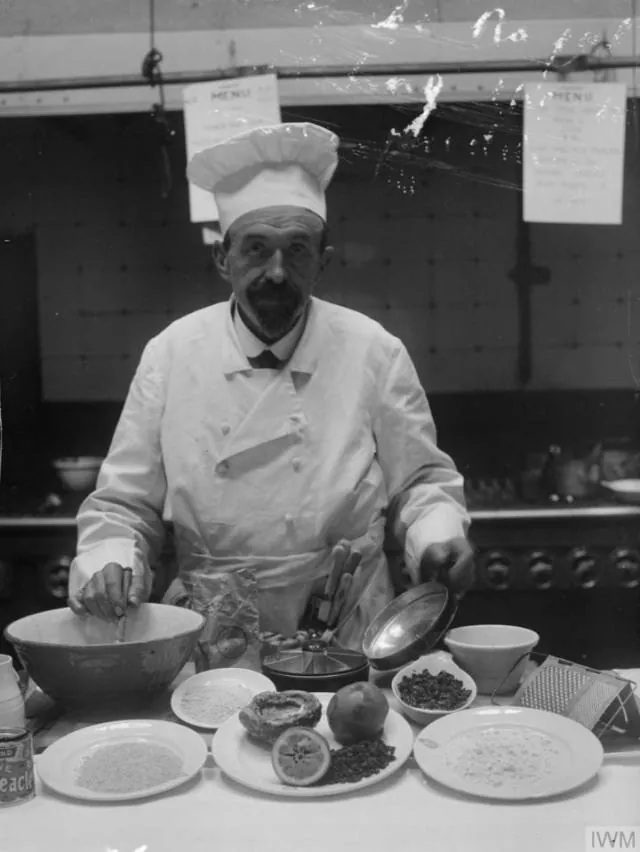
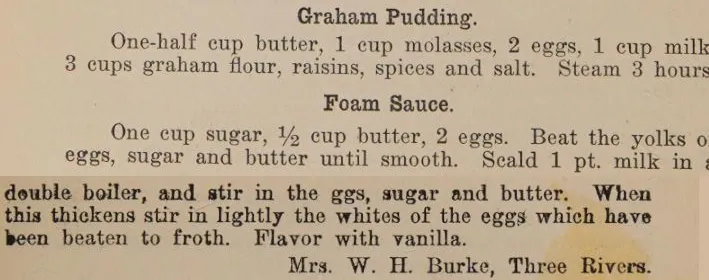
Graham Pudding with Foam Sauce
Three Rivers, Michigan (St. Joseph County), 1909
Graham Pudding. One-half cup butter, 1 cup molasses, 2 eggs, 1 cup milk, 3 cups graham flour, raisins, spices and salt. Steam 3 hours. Foam Sauce. One cup sugar, ½ cup butter, 2 eggs. Beat the yolks of eggs, sugar and butter until smooth. Scald 1 pt. milk in a double boiler, and stir in the ggs, sugar and butter. When this thickens stir in lightly the whites of the eggs which have been beaten to froth. Flavor with vanilla.
From Michigan State Federation Cook Book (Michigan State Federation of Women's Clubs) · Mrs. W. H. Burke, Three Rivers
Making it today
Pudding: melt ½ cup butter and mix with 1 cup molasses, 2 eggs and 1 cup milk. Stir in 3 cups whole-wheat flour, 1 tsp baking soda (the book names none; without it the pudding is very dense), ½ tsp salt, 1 tsp cinnamon, ½ tsp each cloves and nutmeg and 1 cup raisins. Pour into a greased 2-quart pudding basin, cover tightly with foil and steam on a rack in a covered pot of simmering water for 3 hours, topping up the water. Sauce: beat 2 yolks with 1 cup sugar and ½ cup butter. Heat 2 cups milk in a double boiler, stir in the yolk mixture and cook, stirring, until it coats a spoon (160°F). Fold in the 2 whites beaten to soft peaks and 1 tsp vanilla. Serve warm over the pudding.


Preserves & pickles 4
-
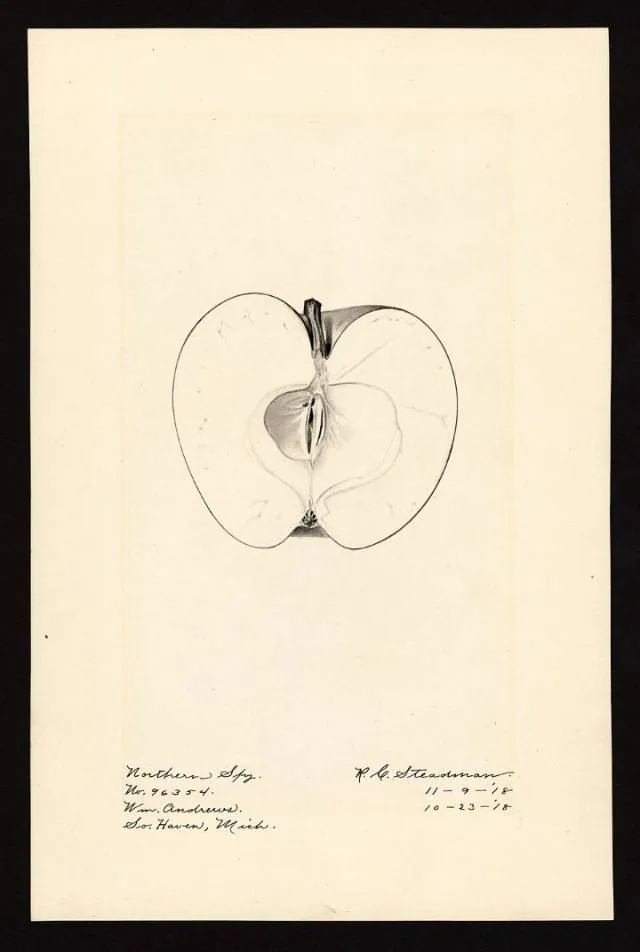
Royal Charles Steadman, USDA Pomological Watercolor Collection, National Agricultural Library (public domain) Preserves & pickles Best in fall
Apple Butter With Cider
South Bend, Indiana, 1917
It usually takes about equal quantities of sweet cider and peeled and sliced apples to make butter the right consistency. In other words, two gallons of sweet cider should be boiled down to one gallon, and two gallons of peeled and sliced apples should be added to it either uncooked or as apple sauce. Two of the essentials of making good apple butter are long, slow cooking (four to six hours) and constant stirring. If sugar is used, it should be added after the cooking of cider and apples is about two-thirds done. ... Apple butter is spiced according to taste, about a half teaspoonful each of ground cinnamon, cloves and allspice being used for each gallon.
From South Bend News-Times ("Canning Lesson" column)
Its story today: Apples and cider today: the fall orchards
Making it today
Boil 2 quarts fresh sweet cider down to 1 quart, add 2 quarts peeled, sliced apples, and cook low and slow, stirring often, for several hours (a slow cooker or a 300°F oven with the lid ajar works well) until thick enough that it doesn't separate. Add about 1/2 to 1 cup sugar two-thirds of the way through if you like, and a pinch each of cinnamon, cloves and allspice at the end. Refrigerate, or can following current USDA guidance.
-
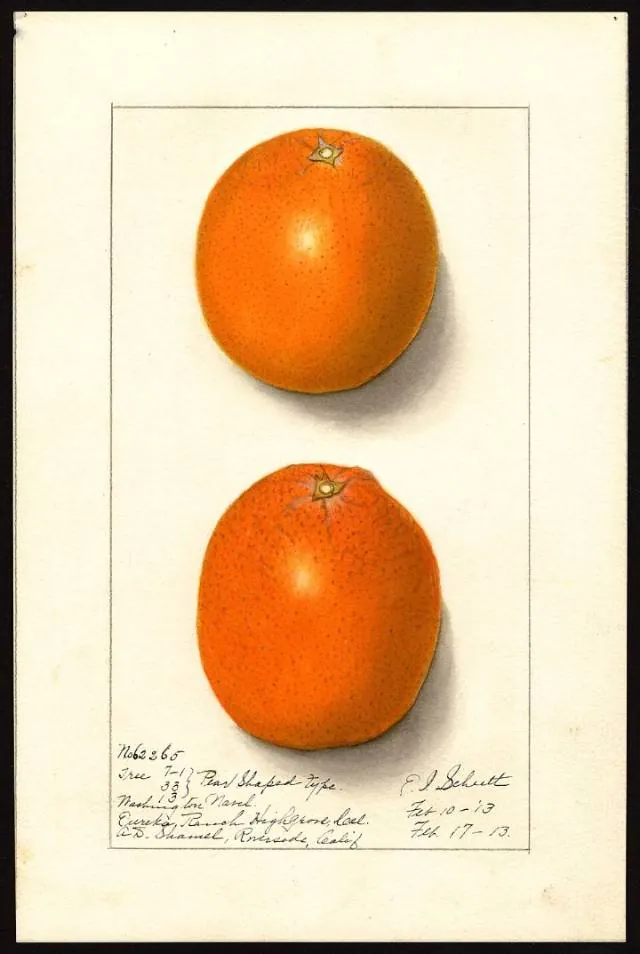
Ellen Isham Schutt, USDA Pomological Watercolor Collection, National Agricultural Library (public domain) Preserves & pickles Best in winter
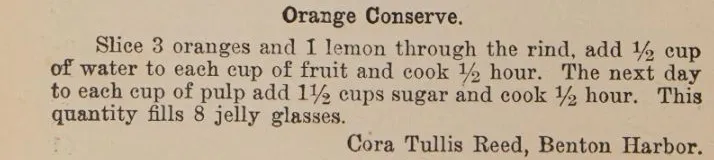
Orange Conserve
Benton Harbor, Michigan (Berrien County), 1909
Slice 3 oranges and 1 lemon through the rind, add ½ cup of water to each cup of fruit and cook ½ hour. The next day to each cup of pulp add 1½ cups sugar and cook ½ hour. This quantity fills 8 jelly glasses.
From Michigan State Federation Cook Book (Michigan State Federation of Women's Clubs) · Cora Tullis Reed, Benton Harbor
Making it today
Slice 3 oranges and 1 lemon very thin, peel and all (remove seeds). Measure, add ½ cup water per cup of fruit, and simmer 30 minutes; let stand overnight. Next day measure again, add 1½ cups sugar per cup, and simmer, stirring often, about 30 minutes, until it reaches 220°F and sets on a cold plate. Ladle into hot sterilized half-pint jars and process 10 minutes in a boiling-water bath (the old 'jelly glasses' were sealed with wax). Makes about 8 small jars.
-
Via Wikimedia Commons (CC0) Small photos: Royal Charles Steadman, USDA Pomological Watercolor Collection, National Agricultural Library (public domain).
Preserves & pickles Best in summer
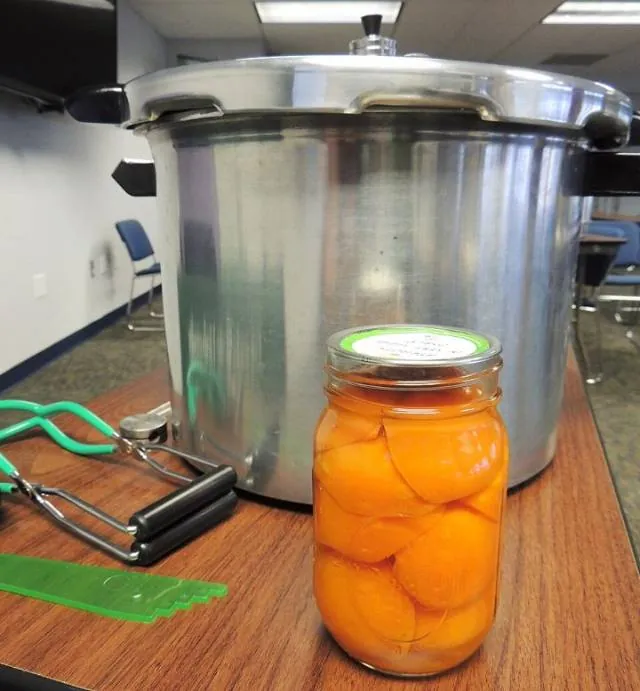
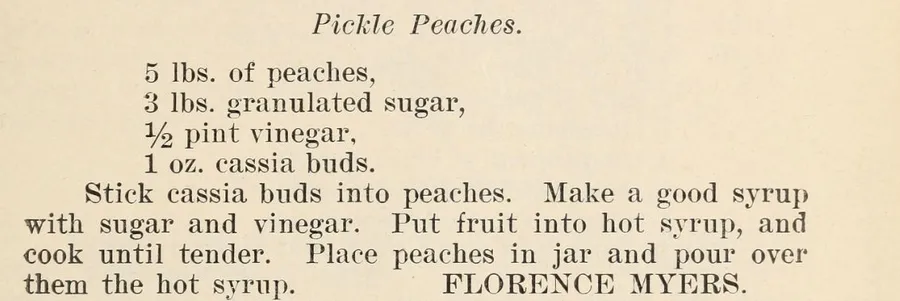
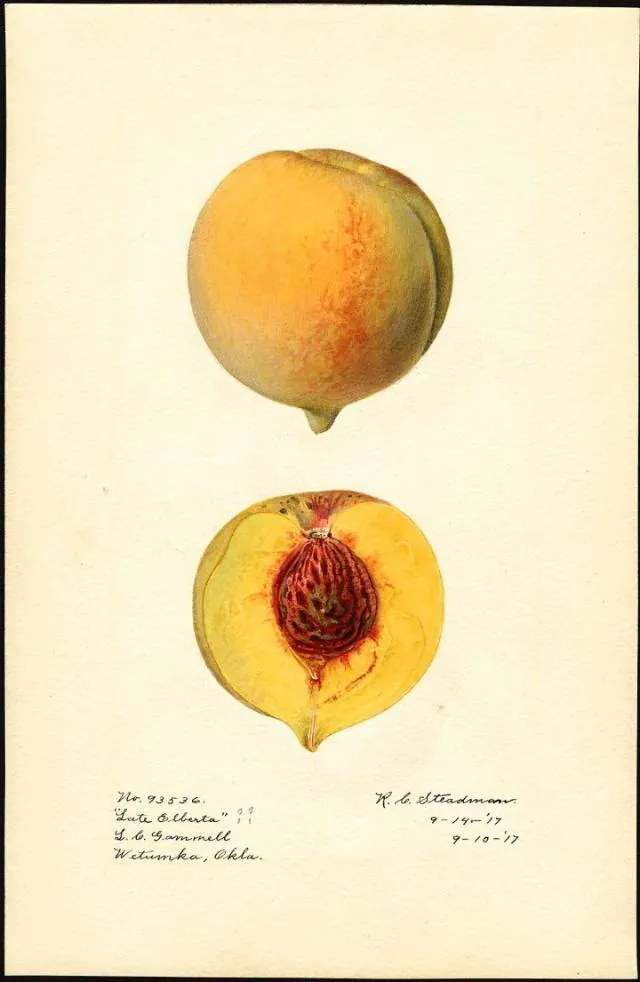
Pickle Peaches
Kalamazoo, Michigan, 1906
5 lbs. of peaches, 3 lbs. granulated sugar, ½ pint vinegar, 1 oz. cassia buds. Stick cassia buds into peaches. Make a good syrup with sugar and vinegar. Put fruit into hot syrup, and cook until tender. Place peaches in jar and pour over them the hot syrup.
From New Crumbs of Comfort: A Cook Book, compiled by the Ladies of St. Luke's Church · Florence Myers
Its story today: The fruit belt and its great market
Making it today
Peel 5 lb small, firm peaches and stud each with a few cassia buds (or whole cloves, or add cinnamon sticks to the syrup). Boil 6 cups sugar with 1 cup vinegar to a syrup, simmer the peaches in it until just tender, pack into hot jars and cover with the boiling syrup. Store in the refrigerator, or follow current USDA home-canning guidance and process in a water bath.
-
Nutrition, Food Safety & Health (Flickr), via Wikimedia Commons (CC0) Small photos: Frank Schulenburg, via Wikimedia Commons (CC0).
Preserves & pickles Best in fall
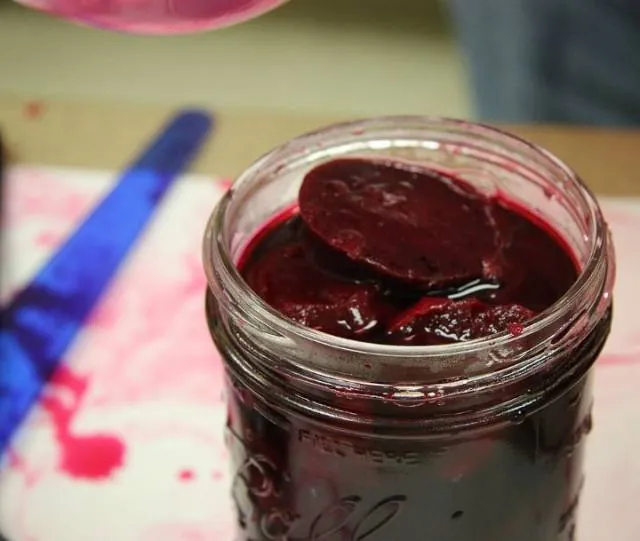
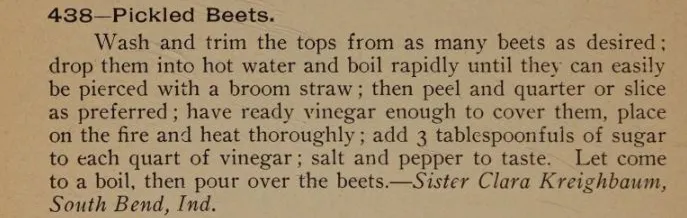
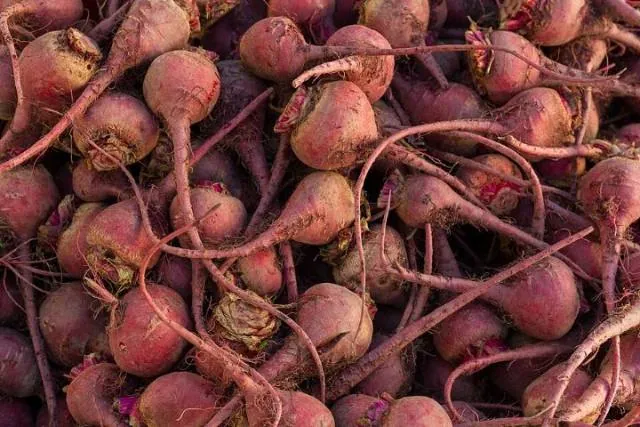
Pickled Beets
South Bend, Indiana (St. Joseph County), 1909 printing (first published 1901)
Wash and trim the tops from as many beets as desired; drop them into hot water and boil rapidly until they can easily be pierced with a broom straw; then peel and quarter or slice as preferred; have ready vinegar enough to cover them, place on the fire and heat thoroughly; add 3 tablespoonfuls of sugar to each quart of vinegar; salt and pepper to taste. Let come to a boil, then pour over the beets.
From The Inglenook Cook Book (Brethren Publishing House; recipes from Sisters of the Brethren Church) · Sister Clara Kreighbaum, South Bend, Ind.
Making it today
Trim beets, leaving an inch of stem, and boil until a skewer slides in easily (30–45 minutes). Cool, slip off the skins, and slice or quarter. For each 4 cups cider vinegar add 3 Tbsp sugar plus salt and pepper; bring to a boil and pour over the beets in clean jars. Refrigerate and use within a few weeks (for shelf storage, follow a tested canning recipe). A 'broom straw' was the cook's cake tester.
Drinks 2
-

Via Wikimedia Commons (CC0) Small photos: Jean-Étienne Liotard, The Chocolate Girl, c. 1744, Gemäldegalerie Dresden (public domain).
Drinks Best in winter
Chocolate
Benton Harbor, Michigan (Berrien County), 1909
Dissolve two squares of Baker's Chocolate in a pint of hot water. Add 1 cup of brown sugar and 1 pint of milk, stirring constantly until it boils. Dissolve 1 heaping teaspoon of corn starch in ½ cup of cold milk, and stir into the chocolate. Serve with whipped cream.
From Michigan State Federation Cook Book (Michigan State Federation of Women's Clubs) · Mrs. E. W. Moore, Benton Harbor
Making it today
Hot chocolate for 4–6: melt 2 oz unsweetened baking chocolate in 2 cups hot water over low heat. Add 1 cup brown sugar and 2 cups milk and bring just to a boil, stirring. Mix 1 heaping tsp cornstarch into ½ cup cold milk, stir it in and simmer a minute until slightly thickened. Serve topped with whipped cream.
-
Deborah Griscom Passmore, USDA Pomological Watercolor Collection, National Agricultural Library (public domain) Small photos: U. P. Hedrick, The Grapes of New York, 1908 (public domain).
Drinks Best in fall
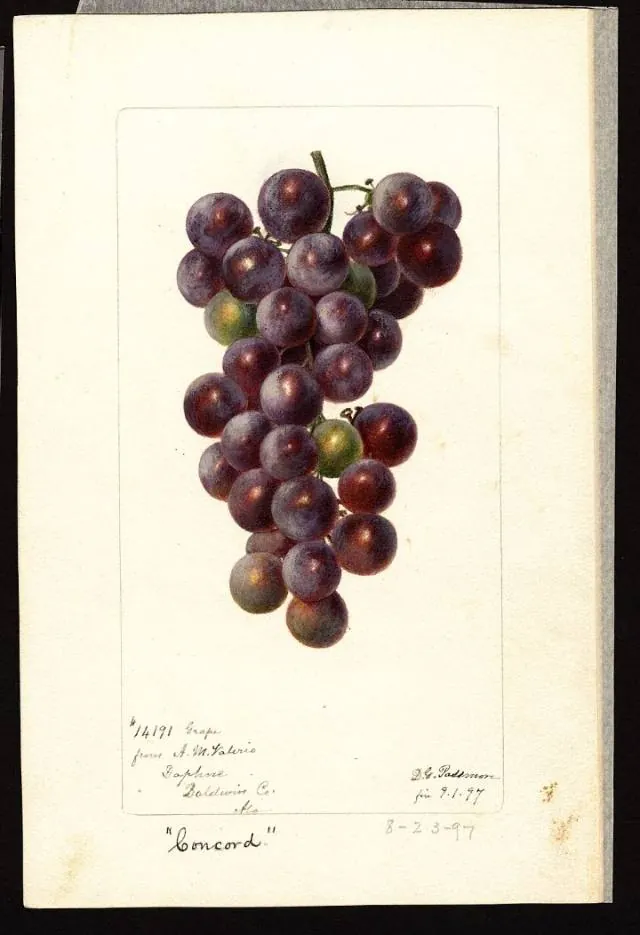
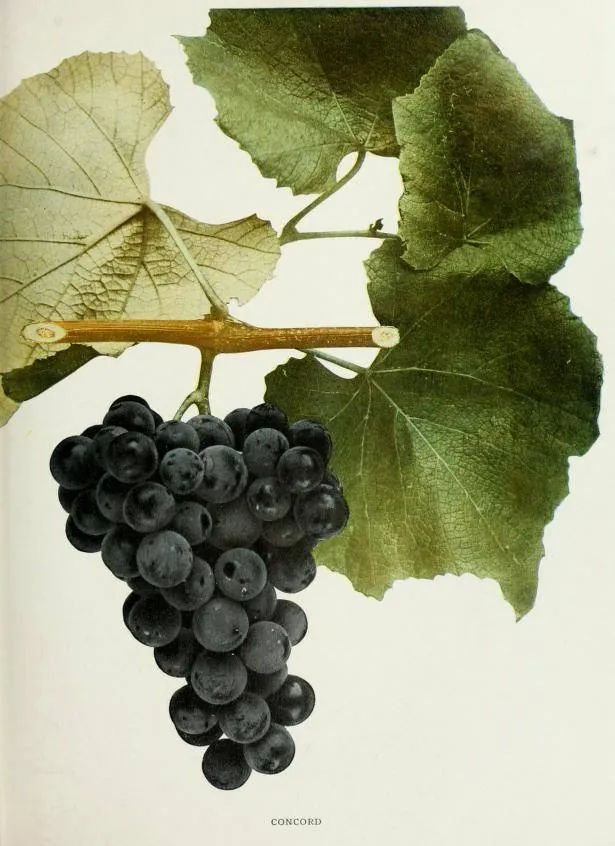
Grape Juice
Kalamazoo, Michigan, 1906
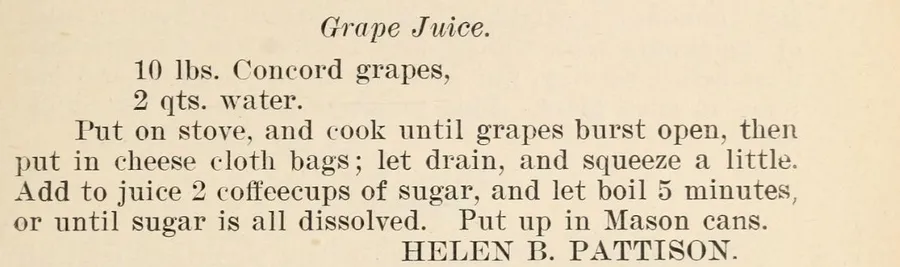
10 lbs. Concord grapes, 2 qts. water. Put on stove, and cook until grapes burst open, then put in cheese cloth bags; let drain, and squeeze a little. Add to juice 2 coffeecups of sugar, and let boil 5 minutes; or until sugar is all dissolved. Put up in Mason cans.
From New Crumbs of Comfort: A Cook Book, compiled by the Ladies of St. Luke's Church · Helen B. Pattison
Making it today
Simmer 10 lb stemmed Concord grapes with 8 cups water until the skins burst, about 10 minutes, then strain through a cheesecloth-lined colander or jelly bag, pressing lightly. Stir in about 2 cups sugar, boil 5 minutes, and pour into clean jars; refrigerate, freeze, or water-bath can following current USDA guidance.


Candy 3
-

As printed, 1909 printing (first published 1901). Tap to enlarge. Candy Best in winter
Candy Fudge
Goshen, Indiana (Elkhart County), 1909 printing (first published 1901)
Take 2 cups of granulated sugar, ½ cup of milk, butter the size of a walnut, and Baker's chocolate to suit the taste. Boil until it hardens in water. Beat and put in buttered tins. Cut in squares.
From The Inglenook Cook Book (Brethren Publishing House; recipes from Sisters of the Brethren Church) · Sister Gladie Swartz, Goshen, Ind.
Making it today
Combine 2 cups sugar, ½ cup milk, 1–2 Tbsp butter and 2 oz unsweetened chocolate in a heavy pan. Stir over medium heat until the sugar dissolves, then boil without stirring to the soft-ball stage (234–238°F, when a drop forms a soft ball in cold water). Cool for 10 minutes, beat until it thickens and loses its gloss, spread in a buttered 8×4 pan and cut in squares.
-

Eastman Johnson, Sugaring Off, RISD Museum (public domain) Candy Best in spring
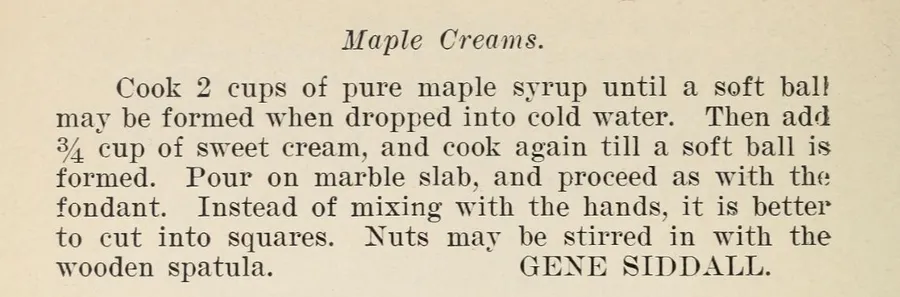
Maple Creams
Kalamazoo, Michigan, 1906
Cook 2 cups of pure maple syrup until a soft ball may be formed when dropped into cold water. Then add ¾ cup of sweet cream, and cook again till a soft ball is formed. Pour on marble slab, and proceed as with the fondant. Instead of mixing with the hands, it is better to cut into squares. Nuts may be stirred in with the wooden spatula.
From New Crumbs of Comfort: A Cook Book, compiled by the Ladies of St. Luke's Church · Gene Siddall
Its story today: Maple sugar festivals on the calendar
Making it today
Boil 2 cups pure maple syrup to the soft-ball stage (235–240°F), stir in 3/4 cup heavy cream, and boil again to 235–240°F. Pour onto a buttered marble slab or baking sheet, let cool slightly, then work it with a wooden spatula until creamy and thick; stir in chopped nuts and cut into squares.
-

ViajeroExtraviado, via Wikimedia Commons (CC0) Candy Best in winter
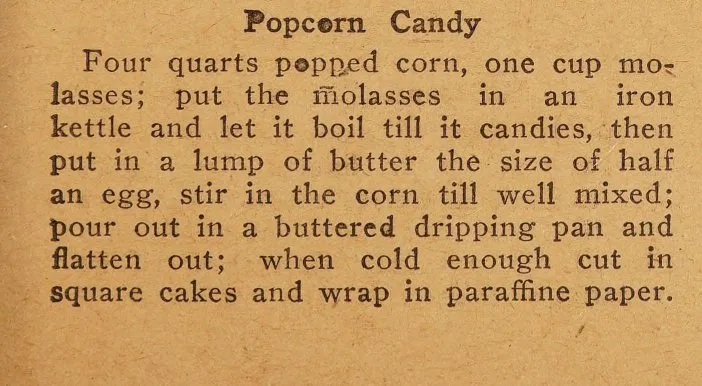
Popcorn Candy
Elkhart, Indiana, about 1900
Four quarts popped corn, one cup molasses; put the molasses in an iron kettle and let it boil till it candies, then put in a lump of butter the size of half an egg, stir in the corn till well mixed; pour out in a buttered dripping pan and flatten out; when cold enough cut in square cakes and wrap in paraffine paper.
From Dr. Miles' Candy Book (Dr. Miles Medical Co. advertising booklet)
Making it today
Boil 1 cup molasses in a heavy pot to the hard-ball/soft-crack stage (about 260–270°F), stir in 2 tablespoons butter, then quickly toss in 4 quarts (16 cups) popped corn until coated. Press into a buttered sheet pan, let cool until firm, cut into squares and wrap in waxed paper.
Household hints 4
-
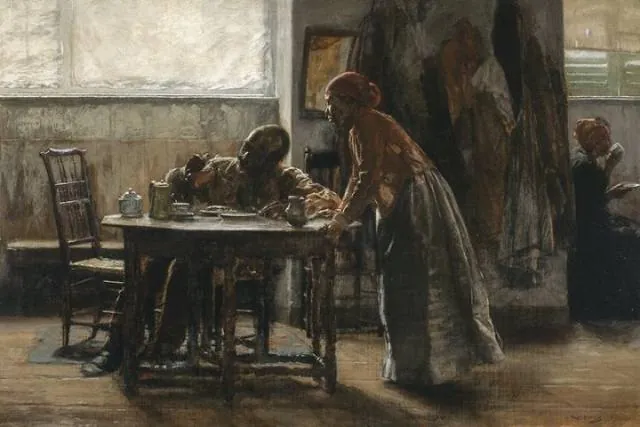
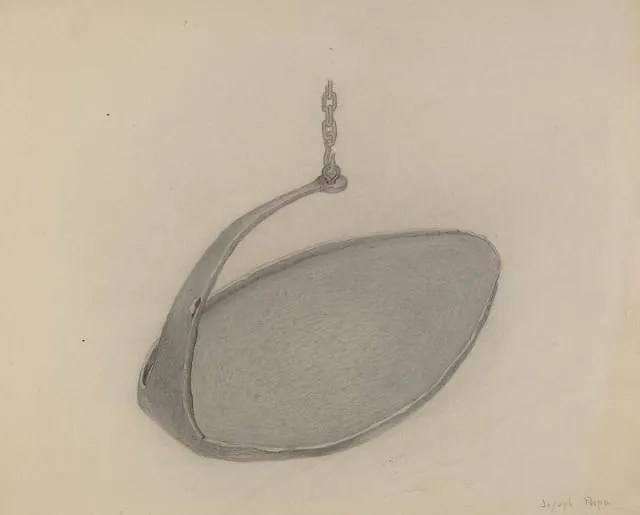
Alfred Kappes, Buckwheat Cakes, 1887 (public domain) Small photos: Joseph Papa, Index of American Design, National Gallery of Art (CC0).
Household hints Any time of year
A pancake hint
Marcellus, Michigan (Cass County), 1909
Make your pancake batter in a circle top or mouth pitcher and pour from pitcher onto griddle.
From Michigan State Federation Cook Book (Michigan State Federation of Women's Clubs) · Anna Walter, Marcellus
Making it today
Still good advice: mix pancake batter in a large spouted pitcher or 8-cup measuring jug and pour it straight onto the hot griddle — no ladle, fewer drips.
-
As printed, 1906. Tap to enlarge. Household hints Any time of year
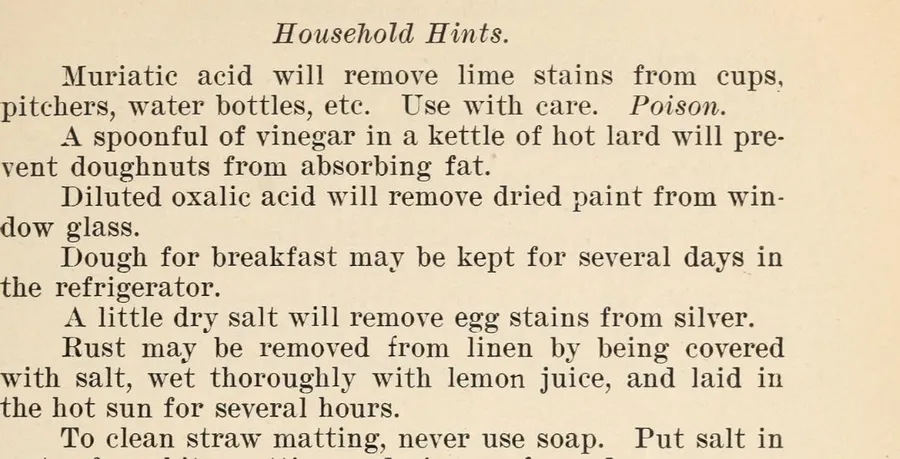
Doughnuts and silver: two kitchen hints
Kalamazoo, Michigan, 1906
A spoonful of vinegar in a kettle of hot lard will prevent doughnuts from absorbing fat. ... A little dry salt will remove egg stains from silver.
From New Crumbs of Comfort: A Cook Book, compiled by the Ladies of St. Luke's Church ("Household Hints")
Making it today
The vinegar trick is still passed around by doughnut makers. Keep the frying fat at 350–375°F; that matters most for doughnuts that aren't greasy. For silver, rub egg-tarnish spots with a pinch of salt on a damp cloth, then wash and dry.
-
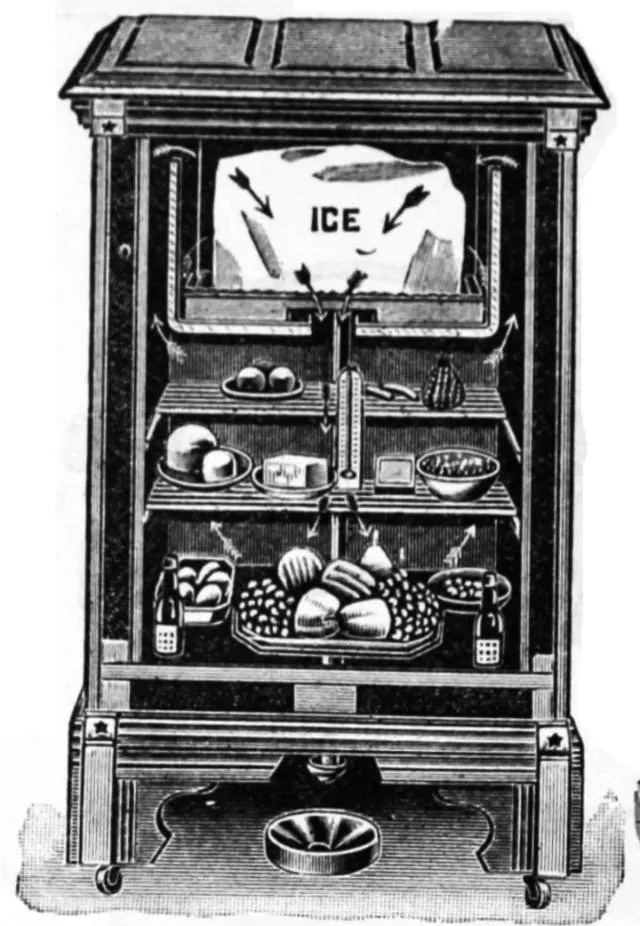
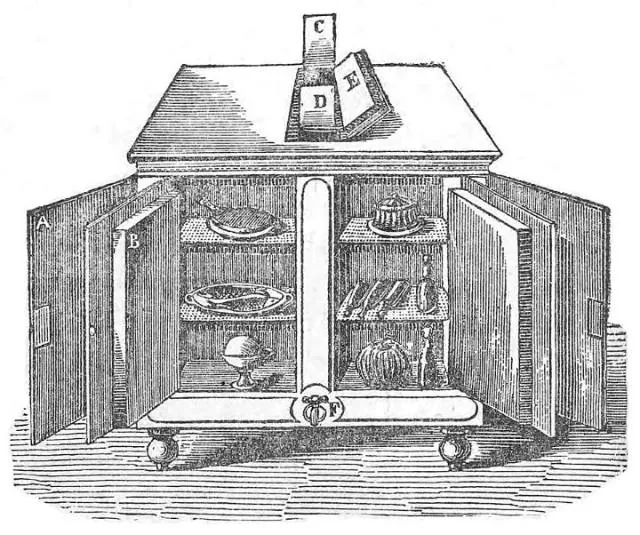
North Star Refrigerator advertisement, 1905 (public domain) Small photos: Via Wikimedia Commons (public domain).
Household hints Any time of year
Taking care of the ice chest
Nappanee, Indiana (Elkhart County), 1921
Keep the ice chest clean; wipe up anything spilled in it and, when necessary, wash it out with hot water, using two tablespoonfuls of washing soda to each gallon of water; rinse and dry thoroughly. ... Keep the ice compartment well filled. This is economy in the long run. Do not cover the ice with ice blankets, newspapers, or cloth. These prevent the ice melting, but make the ice chest less cool.
Making it today
The same idea works for a modern refrigerator or a camp cooler: keep it clean and full, and open the door as little as you can. A few tablespoons of baking soda in warm water is a gentler way to wash it out than washing soda.
-
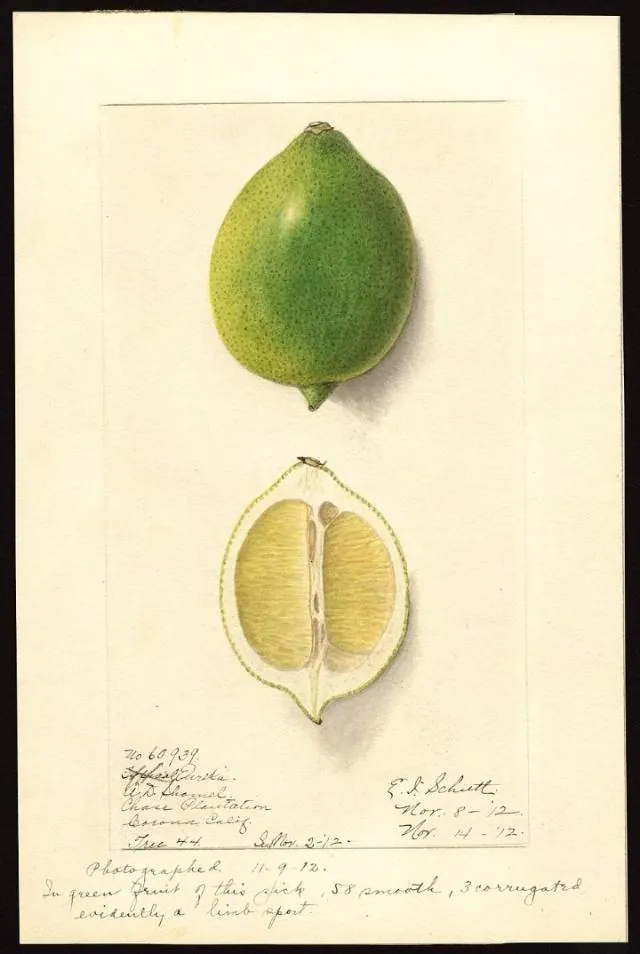
Ellen Isham Schutt, USDA Pomological Watercolor Collection, National Agricultural Library (public domain) Household hints Any time of year
To take rust out of linen
Kalamazoo, Michigan, 1906
Rust may be removed from linen by being covered with salt, wet thoroughly with lemon juice, and laid in the hot sun for several hours.
From New Crumbs of Comfort: A Cook Book, compiled by the Ladies of St. Luke's Church ("Household Hints")
Making it today
This still works on white cotton and linen: sprinkle the spot with salt, soak it with fresh lemon juice, and leave it in strong sunlight for a few hours, then launder. Test colored fabric first, because lemon and sun can bleach it.



No card in the box matches all of those. Try another word, or start again.
The cookbooks on the shelf
Every recipe here comes from one of these books and papers, made by the church societies, clubs and newspapers of the valley and its neighbors. Each one is free to read online.
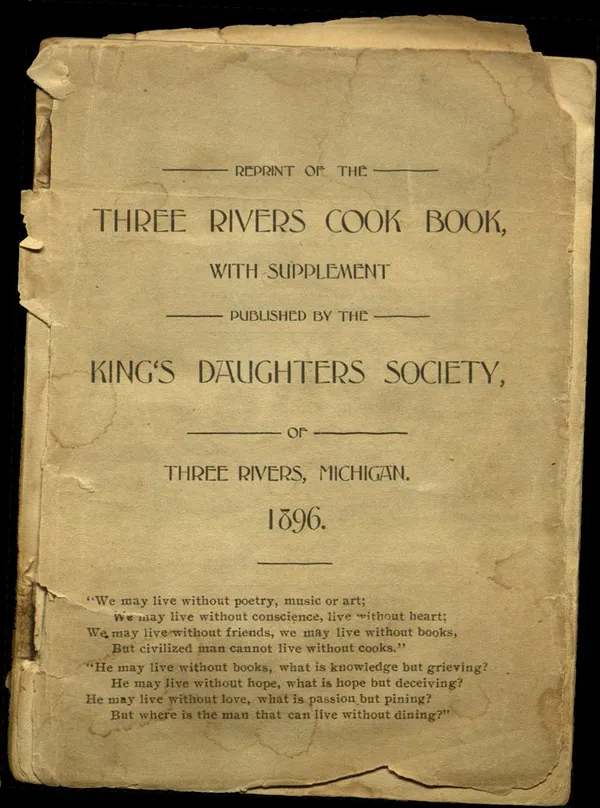
Three Rivers, Michigan · 1896
Three Rivers Cook Book, with Supplement
A reprint published by the King’s Daughters Society of Three Rivers, a church women’s service circle, with recipes signed by the women of the town and advertisements from its shops. Digitized by Michigan State University Libraries.
4 items on this page · Read the whole book ›

Kalamazoo, Michigan · 1906
New Crumbs of Comfort
Compiled by the ladies of St. Luke’s Church, Kalamazoo, with nearly two hundred pages of signed recipes, household hints and local advertising. Library of Congress copy, on the Internet Archive.
9 items on this page · Read the whole book ›
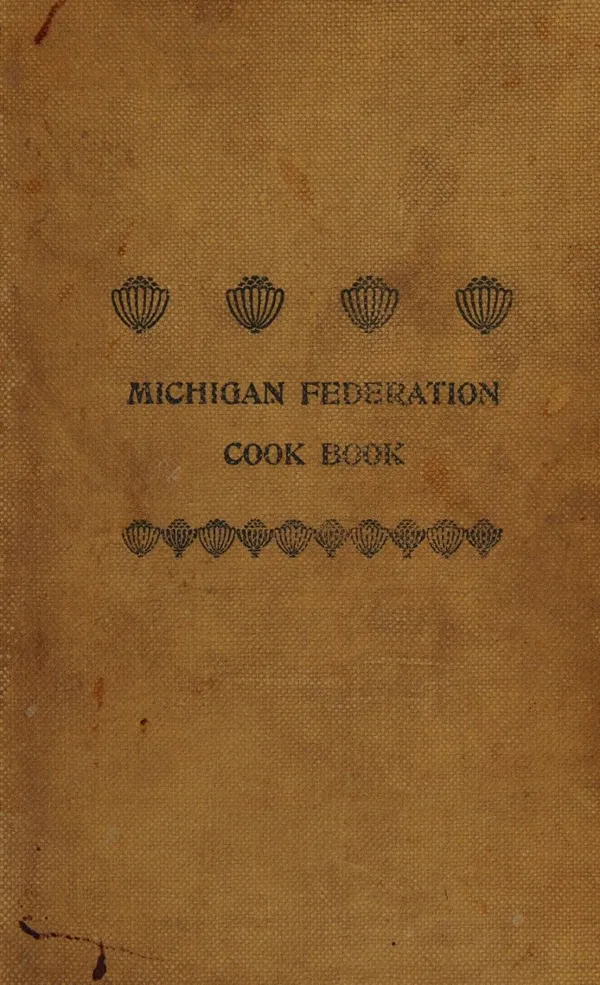
Michigan (printed at Charlotte) · 1909
Michigan State Federation Cook Book
Gathered from members of women’s clubs across Michigan and edited by Sarah Marshall Weaver. Every recipe is signed with the cook’s name and town, which is how cooks from Dowagiac, Cassopolis, Marcellus, Three Rivers, Constantine, Sturgis, St. Joseph, Benton Harbor, Paw Paw and Bangor appear in it.
15 items on this page · Read the whole book ›

Elgin, Illinois · 1901 (this printing 1909)
The Inglenook Cook Book
About a thousand numbered recipes sent in by women of the Church of the Brethren. The strong Brethren congregations of northern Indiana put cooks from Goshen, Nappanee, South Bend and Walkerton in its pages, with Pennsylvania Dutch dishes such as buttermilk delda and boiled potpie.
8 items on this page · Read the whole book ›
- The Evening News, Benton HarborBenton Harbor, Michigan1897
Benton Harbor, Michigan · 1897
The Evening News, Benton Harbor
Benton Harbor’s daily paper. For Christmas 1897 it ran a contest for a holiday dinner costing $2.00, printing readers’ menus with every item priced and the cook’s own recipes.
1 item on this page · Read the paper ›

Elkhart, Indiana · about 1900
Dr. Miles’ Candy Book
A giveaway booklet from the Dr. Miles Medical Company of Elkhart, makers of Dr. Miles’ Nervine: home candy recipes on one page, patent-medicine advertising on the next.
1 item on this page · Read the whole book ›
- South Bend News-TimesSouth Bend, Indiana1917
South Bend, Indiana · 1917
South Bend News-Times
South Bend’s daily paper, which ran a “Canning Lesson” column in the wartime fall of 1917. Read on Hoosier State Chronicles, the Indiana State Library’s newspaper archive.
1 item on this page · Read the paper ›
- Nappanee Advance-NewsNappanee, Indiana1921
Nappanee, Indiana · 1921
Nappanee Advance-News
The weekly paper of Nappanee, in Elkhart County, with household advice for farm kitchens. Read on Hoosier State Chronicles.
1 item on this page · Read the paper ›
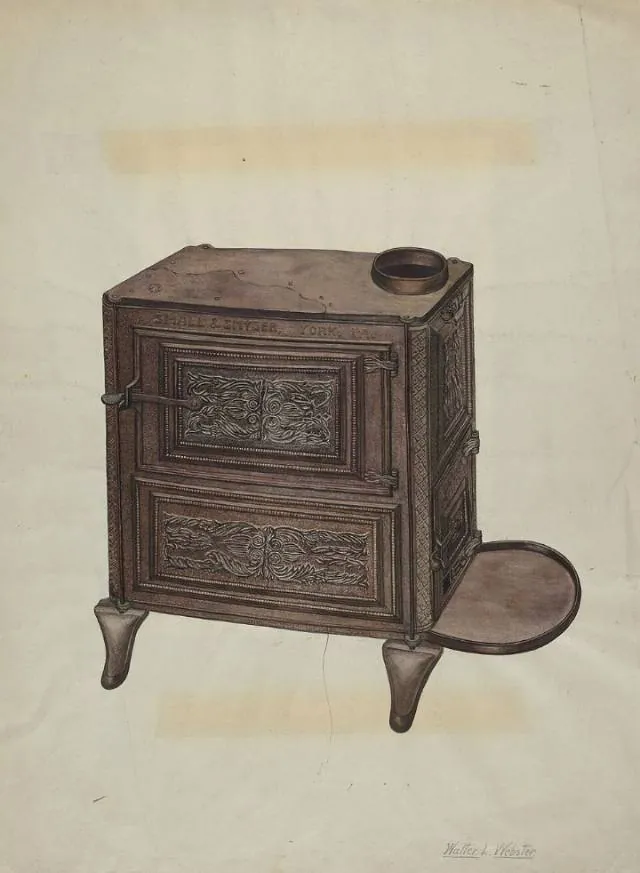
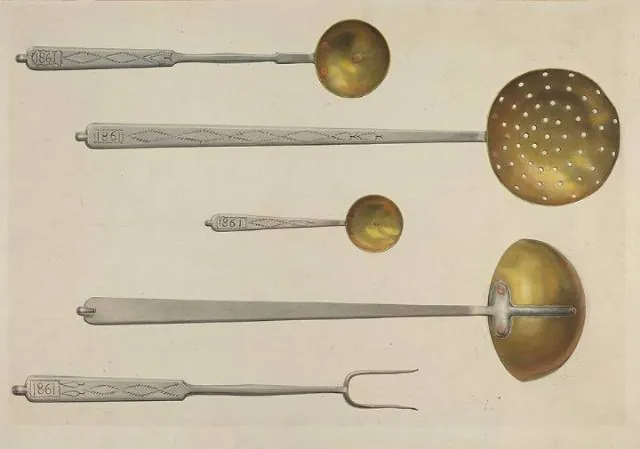
Old kitchen words
The old cooks wrote for readers who already knew how. Here is what their words mean in a kitchen today.
- Saleratus
- An early baking soda (bicarbonate of potash or soda). Use baking soda.
- Butter the size of an egg
- About 1/4 cup (4 tablespoons). “The size of a walnut” is about 2 tablespoons.
- A gill
- Half a cup (4 fluid ounces).
- A coffeecup, a teacup
- A coffeecup is about 1 cup; a teacup a little less, about 3/4 cup.
- A salt spoon
- About 1/4 teaspoon.
- Rich paste
- Pie pastry made with plenty of butter or lard.
- A soft ball
- Sugar syrup cooked until a drop forms a soft ball in cold water: 235–240°F on a candy thermometer.
- A quick, moderate or slow oven
- Before oven dials: quick or hot is about 400–450°F, moderate about 350–375°F, slow about 300–325°F.
- Cassia buds
- The dried flower buds of the cassia (Chinese cinnamon) tree. Whole cloves or a cinnamon stick will do.
- Paraffine paper
- Waxed paper.
- Dripping pan
- A shallow roasting or baking pan.
- Maître d’hôtel sauce
- Melted butter with chopped parsley, lemon juice, salt and pepper.
- Sweet milk, sour milk
- Sweet milk is fresh milk. Sour milk was soured naturally; buttermilk is the nearest today.
- A peck, a bushel
- A peck is about 8 quarts (around 12 lb of apples or peaches); a bushel is four pecks.
The recipes are from cookbooks and newspapers published before 1929, now in the public domain, quoted as printed; the notes on making them today and the seasons are ours. Photographs of the dishes are credited on each one.