Project Scroll

    Tip: press / or Ctrl K anywhere to search.

    ← Every place in Hillsdale County

    Engraving of a two-story farmhouse among tall evergreens behind a long white fence, with a horse and buggy on the road in front.

    Hillsdale County · Michigan · St. Joseph River Valley

    Litchfield

    Hervey Smith’s mill town on the upper St. Joseph, named by a turbulent pioneer.

    Discover its storyThings to seeDirectionsThe valley map

    The farm of Warner Bundy at Litchfield, engraved for the 1879 county history. Engraving from Crisfield Johnson, History of Hillsdale County, Michigan, with Illustrations and Biographical Sketches of Some of Its Prominent Men and Pioneers (Philadelphia: Everts & Abbott, 1879), via the Internet Archive, Public domain.

    • Cityin Hillsdale County
    • 1836founded
    • 1,399people, 2020 census
    • 11 mifrom Hillsdale, the county seat

    Project Scroll is an independent local-history website. This is not an official page of the City of Litchfield or Hillsdale County, and it does not speak for them. For official business, contact the city office directly.

    The story

    Welcome to Litchfield

    Litchfield grew around the sawmill Hervey Smith built on the St. Joseph River in 1836, on the village plat he laid out beside it. Its name was carried to the legislature by the settler Henry Stevens against the wishes of a township meeting. The railroad of 1872 doubled its trade, and it became a village in 1877 and a city in 1970.

    Until the spring of 1834, the 1879 county history says, the St. Joseph flowed here ‘without any mill-dams to obstruct it.’ That spring Henry Stevens settled on section 13 and Samuel Riblet on section 15, and on May 20, 1834, the first furrow was turned on Stevens’s farm with every inhabitant of the township present: Stevens and his two hired men and Samuel and Solomon Riblet, who all took turns at the plow. Riblet built his cabin of logs small enough for him and his wife to raise alone, while A. K. Bushnell brought men from Homer, some over ten miles, to raise his. There was no school or church nearer than Marshall, and the settlers went there to mill.

    The township lay in the hunting grounds of what the history calls the Leathernose family, a branch of Baw Beese’s band of Potawatomi, some forty or fifty people who wintered in the forests of Butler and Girard in Branch County and camped on the openings in summer. Their chief camping ground and corn field was on section 9; when Bushnell plowed up the planting ground and sowed it to wheat, they stopped planting and bought what they needed with berries, peltry and baskets until they were removed west of the Mississippi. The first sermon was preached by the missionary Stephen Wilcox in Riblet’s log house in June 1835, to seven hearers.

    Read the full story

    In the summer of 1836 Hervey Smith bought sixty-five acres on sections 10 and 15, built a sawmill and platted the village. A mail route between Jonesville and Marshall opened that May, and in the fall a post office was set up with Smith as postmaster; the mail came on an Indian pony ridden by Henry Dorsey of Homer, a boy of about thirteen, mostly along an Indian trail. Smith sold the mill and water power to George C. Munro of Jonesville, who built a flouring mill in 1841. When a meeting in the winter of 1836 chose the name Columbus for the new township, Henry Stevens, ‘a turbulent man,’ sent up a rival petition for Litchfield and went to Detroit, where he won the legislature over ‘by the free use of liquid and other arguments.’ The township was organized in April 1837.

    Malarial fevers raged from the summer of 1839 for about ten years, and in September 1840 more than sixty people were sick at once in a population of fewer than four hundred. The Baptist church was organized on March 16, 1839, and the Presbyterian church on July 14, 1839; the latter became Congregational, and its red-brick Gothic church of 1870 still stands on North Chicago Street. A union school was organized in 1853, and the Litchfield Gazette began in October 1874.

    The village grew slowly, the 1879 history says, until the Lansing branch of the Lake Shore and Michigan Southern Railroad was finished in the spring of 1872; after that its business more than doubled. Litchfield was incorporated as a village in the spring of 1877, with its first election in Millsom’s Hall on March 12 and L. A. Howard as president, and by 1879 it had about a thousand people, two flouring mills, a foundry and a bank. Rose Hartwick Thorpe wrote her curfew poem there in 1865, a 1934 marker records. Litchfield became a city in 1970; the 2020 census counted 1,399 people.

    Plan a visit

    Things to see

    • Congregational Church of Litchfield

      203 N. Chicago St., Litchfield

      Red-brick Gothic church completed in 1870, the congregation’s second and the oldest church standing in Litchfield; a Michigan State Historic Site (1980) with a marker of 1984.

      Directions

    • Litchfield Township School District No. 6 School

      153 Mill St., Litchfield

      Michigan State Historic Site, listed February 15, 1990.

      Directions

    • Rose Hartwick Thorpe marker

      Jonesville St., Litchfield

      Marker erected in 1934 recording that the poet composed her curfew poem in Litchfield in 1865.

      Directions

    • Wayside Memorial Park

      9596 Homer Rd. (M-99), Litchfield Township

      Park made in 1945–46 by the Litchfield Garden Club, with a stone memorial to ten local men who died in the Second World War, dedicated September 8, 1946; state marker of 2016.

      Directions

    Then and now

    Pictures

    Engraving of a white two-story house beside a lower wing, half hidden by tall trees, behind a picket fence, with a buggy on the road.
    The residence of Mrs. E. Mann, Litchfield, from the 1879 county history. Engraving from Crisfield Johnson, History of Hillsdale County, Michigan, with Illustrations and Biographical Sketches of Some of Its Prominent Men and Pioneers (Philadelphia: Everts & Abbott, 1879), via the Internet Archive. Public domain.
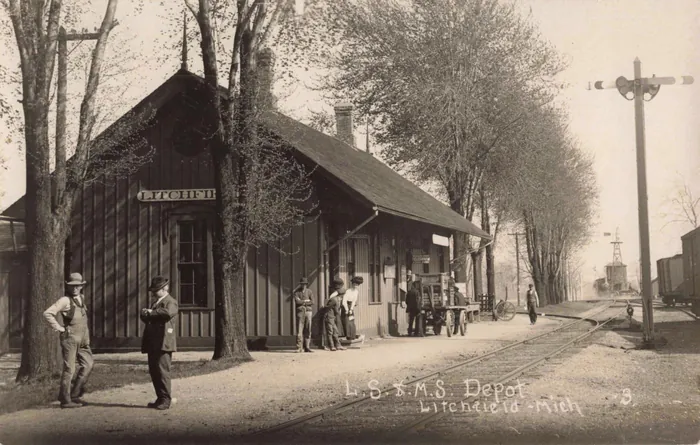
    L.S. & M.S. Depot, Litchfield, Mich.
    L.S. & M.S. Depot, Litchfield, Mich., 1914. Tinder Collection, Clements Library, University of Michigan.
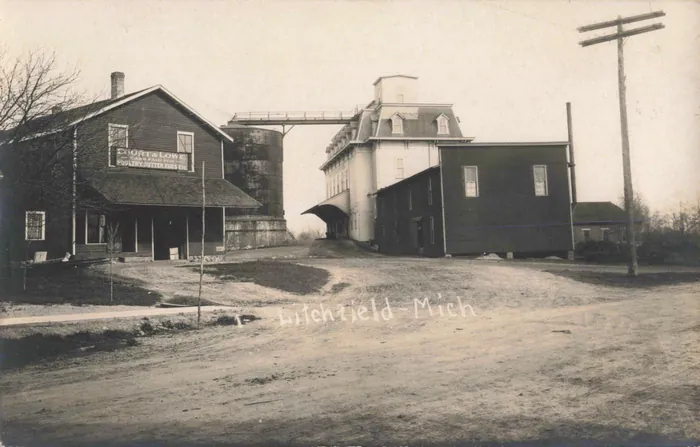
    Litchfield, Mich.
    Litchfield, Mich., 1913. Tinder Collection, Clements Library, University of Michigan.

    Read more

    Stories on Project Scroll

    • Where the River Begins The source of the St. Joseph, the lake named for Baw Beese, and what the records say of both.

    Quick facts

    At a glance

    First settlers
    Henry Stevens and Samuel Riblet, spring 1834
    Platted
    Summer 1836, by Hervey Smith
    Named for
    Litchfield, Connecticut, the name pressed by Henry Stevens
    Railroad
    Lansing branch of the Lake Shore and Michigan Southern, spring 1872
    Incorporated
    Village, spring 1877; city, 1970
    Township
    Litchfield
    Population
    2020 census: 1,399

    Know a story about Litchfield?

    Old photographs, letters, a school picture, a story your grandparents told: if it belongs to Litchfield, we would love to see it. A phone photo of the front and back is enough, and we credit you by name if you like.

    Send it to us Contact page

    Keep exploring

    Nearby in the valley

    For researchers: records and sources

    Where the records are

    Hillsdale is the county seat, and the county’s deeds, probate files and court records are kept by the county offices there; the Hillsdale County Courthouse stands at 29 N. Howell St., Hillsdale. Litchfield is covered in Johnson, History of Hillsdale County (1879), ‘Litchfield,’ pp. 157–164, and in Reynolds, Compendium of History and Biography of Hillsdale County (1903), ch. VII, pp. 60–61.

    Sources

    • Crisfield Johnson, History of Hillsdale County, Michigan, with Illustrations and Biographical Sketches of Some of Its Prominent Men and Pioneers (Philadelphia: Everts & Abbott, 1879), ‘Litchfield,’ pp. 157–164 (first settlers, mail route, Smith’s mill and plat, p. 157; first sermon, first furrow, organization, the name, and the railroad and incorporation, p. 158; newspapers, schools, malaria and churches, pp. 158–160; the Leathernose family, pp. 160–161; village election of 1877 and business, p. 164). link
    • Elon G. Reynolds, ed., Compendium of History and Biography of Hillsdale County, Michigan (Chicago: A. W. Bowen & Co., 1903), ch. VII, pp. 60–61 (Litchfield township and village; 1900 population). link
    • Michigan Historical Commission, ‘Congregational Church of Litchfield’ marker (L814A; registered 1980, erected 1984); Michigan History Center marker record. link
    • Michigan Historical Commission, ‘Wayside Memorial Park’ marker (L2282, 2016); Michigan History Center marker record. link
    • ‘Rose Hartwick Thorpe’ marker (1934), Litchfield; transcription at the Historical Marker Database, entry 165561. link
    • ‘List of Michigan State Historic Sites in Hillsdale County,’ Wikipedia (state historic sites, addresses and listing dates). link
    • ‘Litchfield, Michigan,’ Wikipedia (coordinates; Smithsville and the Columbus post office; named for Litchfield, Connecticut; city 1970; 2020 census population 1,399). link

    Dates and names are from the county histories and official sources listed here. Where they disagree, we say so. Know better? Send a correction.