The story
Welcome to Orland
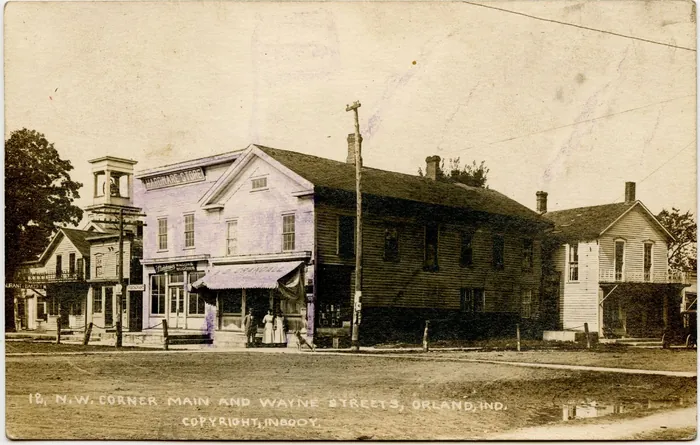
Orland was settled in 1834 by families from Windham County, Vermont, and was long called the Vermont settlement. Its name came from a hymn tune, it was a station on the Underground Railroad, and from 1850 to 1878 it kept the Orland Academy.
In the spring of 1834 John Stocker of Windham County, Vermont, looked over the burr-oak openings near what Michigan calls the Fawn River and Indiana settlers called Crooked Creek, and that summer and fall the Stocker, Pierce, Blanchard and Palmenter families settled there. G. D. Palmenter built the first house in the township, of logs. The first white child born there was Sarah L. Pierce, on November 10, 1834. More families came from Vermont in 1835 and 1836, and the place became known as the Vermont settlement.
When the post office was established in 1836, with Colonel Alexander Chapin as postmaster, the name Mill Grove was already taken in Indiana. At one of their singing meetings the settlers agreed that Chapin should open his tune book at random and that they would name the office after the first tune: it was ‘Orland,’ and the 1885 county history says this was the first post office of that name in the United States. Deacon Timothy Kimball built the first grist-mill on the river north of the settlement, and Captain Samuel Barry brought in the first stock of goods in the winter of 1836. The village was platted on March 19, 1838, by Barry, Cyrus Choate, Alexander Chapin and Chester Stocker.
Read the full story
Orland, the 1885 history says, was ‘a station of importance’ on the Underground Railroad. Captain Barry helped many people escaping slavery on their way to freedom beyond the Detroit River and was once arrested under the Fugitive Slave Law and taken to Indianapolis. Freedom seekers often stopped with S. U. Clark, who kept the hotel; Dr. Madison Marsh, the deputy United States marshal, was burned in effigy after an anti-slavery meeting at which the speaker Foster and his wife lectured.
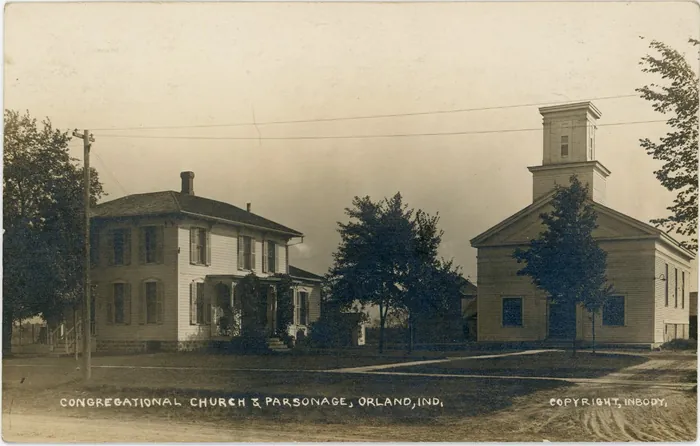
The Baptist church was organized on August 7, 1835. The Northeastern Indiana Literary Institute, better known as the Orland Academy, began in 1850 under the Baptist church and its association, with Barry as its chief backer, and lasted until 1878, when it was merged with the township schools. Orland was incorporated as a town on April 16, 1915. The St. Joseph Valley Railroad, built in 1907 from Elkhart through Orland, was taken up in 1918 except for a link between LaGrange and Orland. The 2020 census counted 389 people in Orland.