Front Street Virtual Walk

Walk old Front Street
Dowagiac, Michigan, the stove town: 13 stops through the downtown that the Round Oak works, the lure makers and the railroad built, each with what stood there and what is there now. Walk it from your chair, or bring this page to Front Street and stamp each stop on the spot.
Every stop
-
Stop 1 of 13
Dowagiac Area History Museum
Then. The town's history museum began at Southwestern Michigan College and moved downtown in 2013, taking over a building that had held retail shops. Its biggest story is the Round Oak Stove Company, which Philo D. Beckwith incorporated in 1871 after casting his first stove around 1867 to heat his own foundry; the company stopped making stoves in 1946 and its buildings were sold in 1947.
Now. A free museum (Tuesday-Friday 10-5, Saturday 10-2) with about 4,000 square feet of exhibits, including what is described as the largest public collection of Round Oak heating stoves in the world.
201 E. Division St., Dowagiac, MI 49047
source 1 source 2 source 3 source 4 source 5 source 6 · Open the Sanborn sheets of Dowagiac
-
Stop 2 of 13
The Heddon Museum
Then. The museum tells the story of James Heddon, who in the late 1890s whittled a piece of wood while waiting by the Mill Pond, saw a bass strike it when he tossed it in, and went on to make a top-water lure he named the Dowagiac. James Heddon's Sons ran from 1902 to 1984 and by the 1920s was the world's biggest maker of quality fishing tackle, also turning out golf shafts, ski poles, violin bows, box kites and, in World War II, radio antennae.
Now. A volunteer-run museum of the Dowagiac Area History Museum (open Tuesday and Friday, 10-5; call ahead) with more than 1,000 lures, 140 reels and 150 rods.
115 S. Front St., Dowagiac, MI 49047
source 1 source 2 source 3 · Open the Sanborn sheets of Dowagiac
-
Stop 3 of 13 · by 1899
The Fair Store block
Then. A store called The Fair was here by 1899, when the city directory listed Emanuel Tobias as its owner. The block then held a run of other businesses until 1941, when The Fair came back as a large department store that kept its doors open into the 1970s.
Now. Present occupant not confirmed.
117-123 S. Front St., Dowagiac, MI 49047
-
Stop 4 of 13 · built 1892 (theatre opened 19 January 1893; razed 1966)
Beckwith Park and the Beckwith Memorial Theatre site
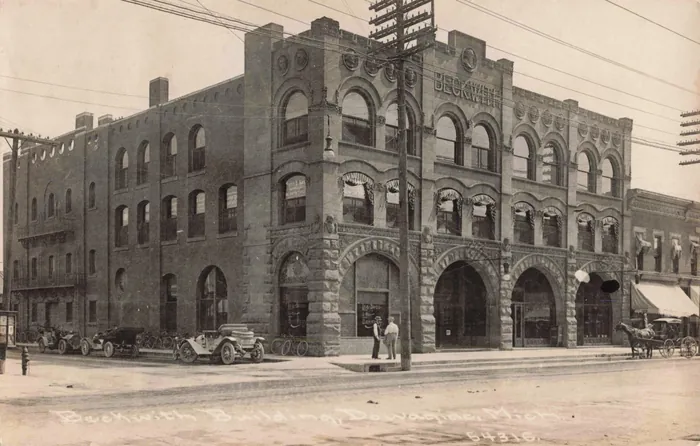
The Beckwith Building, Dowagiac, on a postcard of about 1912 Tinder Collection, Clements Library, University of Michigan · source 📷 Photo spot. Stand where the photographer stood: line up the rooflines and corners with the postcard, take the same picture, and send it to us. The best go up beside the old view, with your name.
Then. Open park ground from 1848, this corner became the site of the Beckwith Memorial in 1892, built in memory of Round Oak founder P. D. Beckwith by his daughter and son-in-law, in Lake Superior red sandstone, and dedicated in January 1893. Besides a 600-seat theatre counted among the finest between New York and Chicago, the building held a bank, city hall and the Round Oak company offices; films were shown from 1914. It was torn down in 1966, and a bank building later stood on part of the lot; the city bought that in 2019, took it down in 2020 and added the ground to the park.
Now. Beckwith Park, renovated and reopened in July 2021. A piece of the theatre's red sandstone wall still shows on the building next door.
Southeast corner of S. Front St. and Beeson St., Dowagiac, MI 49047
source 1 source 2 source 3 source 4 source 5 source 6 source 7 source 8 source 9 source 10 source 11 · Open the Sanborn sheets of Dowagiac
-
Stop 5 of 13 · by 1874 (rebuilt after an 1864 fire)
Caruso's Candy & Soda Shop
Then. The building that went up after an 1864 fire held a grocery, a barber shop, a department store and, in 1908-09, the State Savings Bank. In 1910 the Chicago Candy Kitchen opened here, making candy and ice cream and adding a soda fountain in 1914. Antonio (Anthony) Caruso and his wife Emilia took over the business in September 1922.
Now. Still run by the Caruso family, now in its third generation, making chocolates and caramels and serving sundaes and lunch at the soda fountain.
130 S. Front St., Dowagiac, MI 49047
source 1 source 2 source 3 · Open the Sanborn sheets of Dowagiac
-
Stop 6 of 13 · late 1860s-1880s
Front and Commercial: the brick downtown
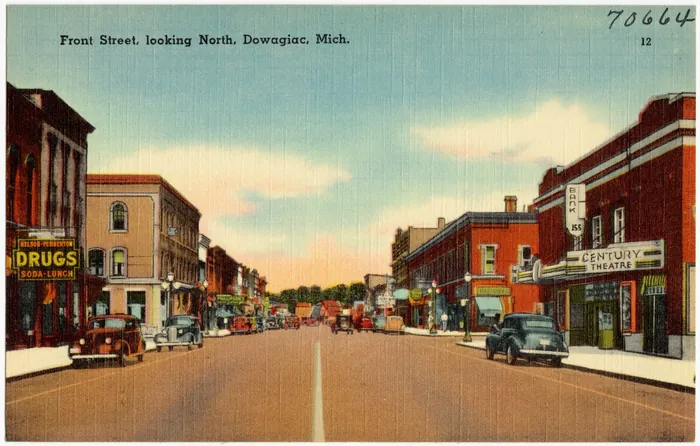
Front Street looking north, Dowagiac, on a postcard of about 1930–45 Boston Public Library, Tichnor Brothers Collection · source 📷 Photo spot. Stand where the photographer stood: line up the rooflines and corners with the postcard, take the same picture, and send it to us. The best go up beside the old view, with your name.
Then. Fires in the 1860s destroyed most of the first wooden stores on Front and Commercial streets, and brick blocks took their place, mostly between the late 1860s and the 1880s. A 1910 newspaper item quoted in the museum booklet reported that the State Savings Bank would move from 130 S. Front to this corner.
Now. The heart of the downtown commercial district, revitalized in the 1990s when M-51 was rerouted and Depot Drive was laid out.
S. Front St. at Commercial St., Dowagiac, MI 49047
source 1 source 2 source 3 · Open the Sanborn sheets of Dowagiac
-
Stop 7 of 13 · built 1913
1913 Elks Temple (Wounded Minnow Saloon)
Then. Raised in 1913 as a three-story downtown temple, it had shops at street level and club rooms, a pool hall and a small theatre above. Over the decades the ground floor held grocery stores, a state liquor store and taverns.
Now. The Wounded Minnow Saloon fills the ground floor, and a 2025 plan adds apartments upstairs as part of a $9 million state grant for downtown.
234–236 S. Front St., Dowagiac, MI 49047
source 1 source 2 source 3 source 4 · Open the Sanborn sheets of Dowagiac
-
Stop 8 of 13 · built c. 1900
Moore grocery building
Then. George Moore built this as a grocery and meat market around 1900 and had retired by 1908. Merwin and Bonnell traded here into the 1920s, and by 1938 W. F. Lyon and Son ran a funeral, undertaking and furniture business in it, followed by a string of other shops.
Now. Present occupant not confirmed.
238 S. Front St., Dowagiac, MI 49047
-
Stop 9 of 13 · built 1902-1903
Michigan Central Railroad Depot
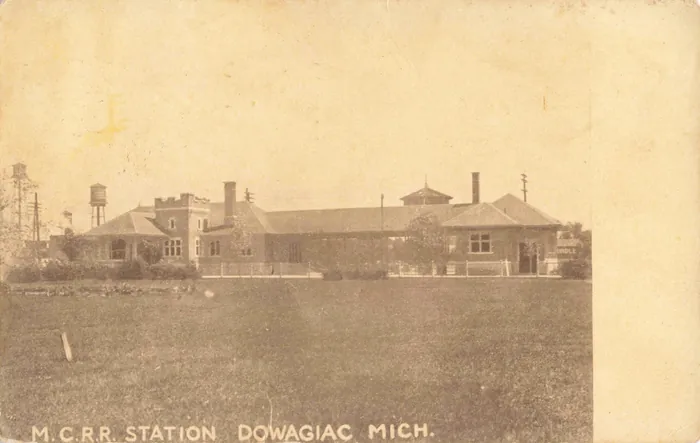
The Michigan Central station, Dowagiac, on a postcard of about 1910 Tinder Collection, Clements Library, University of Michigan · source 📷 Photo spot. Stand where the photographer stood: line up the rooflines and corners with the postcard, take the same picture, and send it to us. The best go up beside the old view, with your name.
Then. The Michigan Central built this brick Tudor Revival station for about $13,000 in 1902-03, replacing an earlier wooden depot; it is credited to the architects Spier and Rohns, who also designed the Niles station. It went on the National Register in 1993, and in 1995 the city restored it as part of the $1.8 million Depot Drive project, keeping the original floor mosaic with the railroad's initials.
Now. A working Amtrak stop (Blue Water and Wolverine), owned by the city, with the Greater Dowagiac Chamber of Commerce and a gift shop inside.
200 Depot Dr., Dowagiac, MI 49047
source 1 source 2 source 3 source 4 · Open the Sanborn sheets of Dowagiac
-
Stop 10 of 13 · built 1859 (sawmill); 1889 (lumber yard)
Judd Lumber Company
Then. Mark Judd put up a sawmill here in 1859, and he and William Judd added a lumber yard in 1889. The sawmill ran into the 1950s, and the Judd family kept the business until 2019.
Now. Still a working lumber yard, now run as US Lumber Company, and billed as Michigan's oldest.
101 Robinson St., Dowagiac, MI 49047
source 1 source 2 source 3 source 4 source 5 source 6 source 7 · Open the Sanborn sheets of Dowagiac
-
Stop 11 of 13
Commercial and Pennsylvania: where the first Round Oak stove stood
Then. A small early business district grew up at this corner, and its first buildings burned in a fire in the 1860s. Beckwith's very first stove heated his own foundry, but the first Round Oak stove offered for sale was set up in a barber shop here, where the townsmen would see it, and it stayed there until 1895.
Now. The exact lot is not known; the stop marks the corner. Present buildings and occupants not confirmed.
Commercial St. at Pennsylvania Ave., Dowagiac, MI 49047
source 1 source 2 source 3 source 4 · Open the Sanborn sheets of Dowagiac
-
Stop 12 of 13 · carnegie grant 13 January 1903; library founded 1904
Dowagiac District Library (Carnegie library)
Then. Dowagiac won a $12,500 Carnegie grant in January 1903, and the library dates its founding to 1904. In 2004 it became a district library serving the city and the townships of Silver Creek, Keeler, Wayne and Bainbridge.
Now. The working public library, with a genealogy and local history service.
211 Commercial St., Dowagiac, MI 49047
-
Stop 13 of 13 · church of 1859, remodelled 1906
Beckwith Theatre Company (former Methodist church)
Then. This was the site of the town's first church open to all denominations; in 1854 the children from the first Orphan Train were placed with local families here. The Methodists built a church on the spot in 1859, faced it in brick and took off its steeple in a 1906 remodeling, and worshipped here until 1974.
Now. Home of the Beckwith Theatre Company, a volunteer community theatre named for the lost Beckwith Memorial Theatre; its first season, in 1990, was staged on the third floor of the Elks Temple on Front Street. The city's website dates the building to 1925, but a museum photograph of about 1865 shows this same church, so its core is the 1859 church as refaced in 1906.
100 New York Ave., Dowagiac, MI 49047
source 1 source 2 source 3 source 4 source 5 source 6 source 7 · Open the Sanborn sheets of Dowagiac


Walking it for real
- Start at the history museum on Division Street and follow the stops in order; the whole walk is about a mile.
- Let the page follow you. “Follow me on foot” opens each stop as you reach it, and “Play the tour aloud” reads it to you, so you can keep your eyes on the street.
- Stamp as you go. “I’m here” checks your location once, on your phone, and stamps that stop. Nothing leaves your device.
- Stay on the sidewalk and on public ground, and be kind to the businesses: many of these buildings are still working shops and offices.
- Take the same picture. Where a stop has an old postcard, stand where the photographer stood and send us your photo.
Plan your visit: ready-made days out, food, lodging and festivals
The stops come from the Dowagiac Area History Museum’s walking tour, the museum and city websites, the National Register file for the depot and the county histories, each linked under its stop. The base map and aerial photographs are from the USGS National Map, a public-domain service of the US Geological Survey; “Plain” shows only today’s streets drawn on this page from OpenStreetMap data. Where a date or name could not be confirmed, the stop says so. Corrections are welcome at research@projectscroll.com.