Project Scroll

    Tip: press / or Ctrl K anywhere to search.

    ← Every place in Hillsdale County

    Engraving of a large Italianate house with a cupola-like roof deck and a two-story porch behind a picket fence, a horse and buggy at the gate.

    Hillsdale County · Michigan · St. Joseph River Valley

    Reading

    Basswood Corners on the high ridge where the waters part.

    Discover its storyThings to seeDirectionsThe valley map

    The residence of H. B. Chapman, who built many of Reading’s stores and dwellings after 1865, from the 1879 county history. Engraving from Crisfield Johnson, History of Hillsdale County, Michigan, with Illustrations and Biographical Sketches of Some of Its Prominent Men and Pioneers (Philadelphia: Everts & Abbott, 1879), via the Internet Archive, Public domain.

    • Cityin Hillsdale County
    • 1873founded
    • 1,095people, 2020 census
    • 8 mifrom Hillsdale, the county seat

    Project Scroll is an independent local-history website. This is not an official page of the City of Reading or Hillsdale County, and it does not speak for them. For official business, contact the city office directly.

    The story

    Welcome to Reading

    Reading stands on the ridge that divides the waters of Lake Erie from those of the St. Joseph, at a crossroads once called Basswood Corners. A farming township without a store until 1850, it grew into a busy village after a plank road and then the railroad of 1869, was incorporated in 1873 and became a city in 1934.

    Reading was set off from Allen by the legislature of 1837. The settlers had asked for the names Columbus for the northern town and Troy or Utica for the southern, but those were already taken, and the legislature named them Litchfield and Reading, ‘supposed to have been taken’ from towns in Connecticut and Pennsylvania. The whole tract then held 227 people. The 1879 county history describes a high ridge in the east of the township culminating at Reading village, from which the streams run south and east to Lake Erie by the Little St. Joseph and the Maumee, and west and north to Lake Michigan by Hog Creek and the St. Joseph. The water flowing north runs into a chain of lakes once marked on the survey maps as the Hog Lakes, the largest of them now Long Lake.

    The first settler was John Mickle, who came from Oswego, New York, by way of Maumee, Ohio, and reached his land on October 5, 1835, opening the first road south from Jonesville by way of Sand Creek. His cabin of unhewn logs, 19 by 23 feet, sheltered the families of thirteen settlers while they chose their land, and three years later he replaced it with a house of squared black-walnut logs. The first town meeting was held at his house on April 3, 1837. The settlers traded with the Indians for meat and maple sugar, and the history notes that the Indians would take only silver in exchange.

    Read the full story

    About 1840, with 331 people in the town, a mail route from Hillsdale was won by a group that slipped a petition signed in Adrian into the department’s hands, so that Ralph Bailey, not Mickle, became postmaster, with Daniel Kinne as deputy; George Fitzsimmons carried the mail once a week for $26 a year. Up to 1850 there was not a store, grocery or hotel in the town. The site chosen for a village was Basswood Corners, named for a clump of seven basswood trees growing from one stump near the corner of sections 22, 23, 26 and 27, where the State road and the Jonesville road met.

    Horace Billings opened a blacksmith shop at the corner in 1846, and Morris Inglesby a shop for grain cradles; Dr. William Hullinger built the first frame house and in 1853 a hotel that became the Reading House. Looking ahead to the Hillsdale and Reading plank road, David D. Prouty and Thomas Fuller platted a village on their land at the corner; the plank road was finished in 1855 and given up after a couple of years. William F. Turner and George Young built a steam sawmill in 1852, Nelson M. Turner opened the first store at Main and Michigan streets, and in 1856 a steam grist mill was built.

    The township bonded itself for $15,000 to bring the railroad from Jackson toward Fort Wayne through the village, and the first regular train from Jackson arrived on November 9, 1869. Business was believed to have quadrupled. Reading was incorporated as a village by a special act of April 12, 1873, one mile square, and Asahel B. Strong was elected the first president on April 14; a three-story brick school opened on November 4, 1873. A fire that started at a livery stable on August 25, 1899, destroyed ten business blocks, four homes and eight barns, and in 1900 the village had 1,096 people. Reading became a city in 1934, and the 2020 census counted 1,095.

    Plan a visit

    Things to see

    • Reading Civil War Memorial

      416 N. Main St. (M-49), Reading

      Monument headed ‘Remember The Soldier Dead,’ listing the battles of the war, erected in 1884 by Lt. Col. Frederick Fowler of the 2nd Michigan Cavalry.

      Directions

    • Main and Michigan streets

      Main St. at Michigan St., Reading

      The business corner where Nelson M. Turner opened Reading’s first store about 1853 and the brick blocks went up after the railroad came in 1869.

      Directions

    • Long Lake

      West part of Reading Township

      The largest of the lakes once called the Hog Lakes, which carry the township’s northward-flowing water toward the St. Joseph.

      Directions

    Then and now

    Pictures

    Engraving of a farmstead with a white house, barns and fenced yards beside a road, a horse and buggy passing.
    The residence of A. D. Southworth, Reading, from the 1879 county history. Engraving from Crisfield Johnson, History of Hillsdale County, Michigan, with Illustrations and Biographical Sketches of Some of Its Prominent Men and Pioneers (Philadelphia: Everts & Abbott, 1879), via the Internet Archive. Public domain.
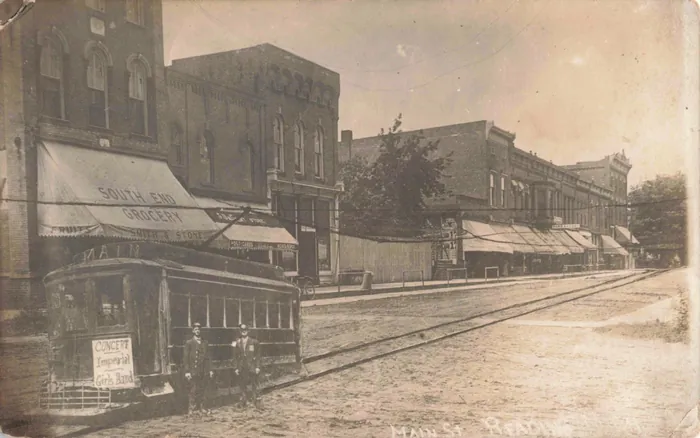
    Main St., Reading, Mich.
    Main St., Reading, Mich., 1911. Tinder Collection, Clements Library, University of Michigan.
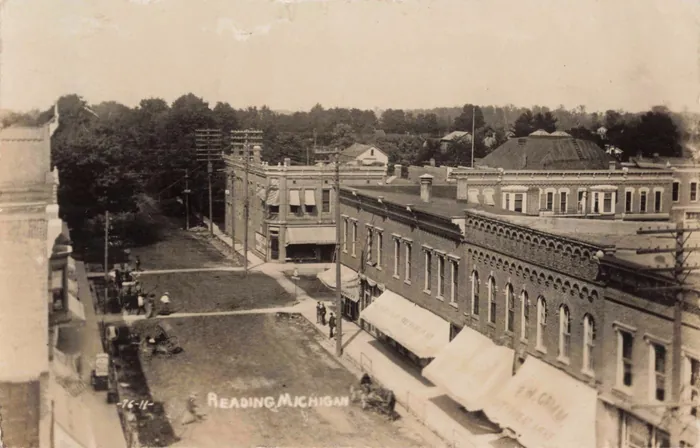
    Reading, Michigan (bird’s-eye view)
    Reading, Michigan (bird’s-eye view), 1909. Tinder Collection, Clements Library, University of Michigan.

    Come and see

    Through the year

    Read more

    Stories on Project Scroll

    Quick facts

    At a glance

    First settler
    John Mickle, October 5, 1835
    Earlier name
    Basswood Corners
    Named for
    Reading, Pennsylvania, it is supposed; the name was given by the legislature in 1837
    Railroad
    From Jackson, first regular train November 9, 1869
    Incorporated
    Village, April 12, 1873; city, 1934
    Township
    Reading
    Population
    2020 census: 1,095

    Know a story about Reading?

    Old photographs, letters, a school picture, a story your grandparents told: if it belongs to Reading, we would love to see it. A phone photo of the front and back is enough, and we credit you by name if you like.

    Send it to us Contact page

    Keep exploring

    Nearby in the valley

    For researchers: records and sources

    Where the records are

    Hillsdale is the county seat, and the county’s deeds, probate files and court records are kept by the county offices there; the Hillsdale County Courthouse stands at 29 N. Howell St., Hillsdale. Reading is covered in Johnson, History of Hillsdale County (1879), ‘Reading,’ pp. 310–324 (the village, pp. 317–319), and in Reynolds, Compendium of History and Biography of Hillsdale County (1903), ch. VII, pp. 63–64.

    Sources

    • Crisfield Johnson, History of Hillsdale County, Michigan, with Illustrations and Biographical Sketches of Some of Its Prominent Men and Pioneers (Philadelphia: Everts & Abbott, 1879), ‘Reading,’ pp. 310–324 (names, ridge and lakes, pp. 310–311; John Mickle, pp. 312–313; town meeting, p. 315; roads, Indian trade and post office, p. 316; Basswood Corners, plank road, mills and first store, p. 317; railroad, school and incorporation, p. 318); sketch of Hiram B. Chapman, pp. 325–326. link
    • Elon G. Reynolds, ed., Compendium of History and Biography of Hillsdale County, Michigan (Chicago: A. W. Bowen & Co., 1903), ch. VII, pp. 63–64 (Reading township, its settlers and churches; incorporation of April 12, 1873; 1900 population). link
    • ‘Reading Civil War Memorial’ (1884); transcription at the Historical Marker Database, entry 204004. link
    • Michigan Railroad History, ‘Station: Reading, MI’ (village 1873, city 1934; Fort Wayne and Jackson railroad). link
    • Hillsdale County Historical Society, ‘The Village of Reading’ (fire of August 25, 1899). link
    • ‘Reading, Michigan,’ Wikipedia (coordinates; Basswood Corners; 2020 census population). link
    • City Population, ‘Reading (City, Michigan)’ (2020 census population 1,095). link

    Dates and names are from the county histories and official sources listed here. Where they disagree, we say so. Know better? Send a correction.