The story
Welcome to Syracuse
Syracuse grew where Turkey Creek leaves Syracuse Lake, at a dam Samuel Crawson and Henry Ward threw across the creek before the land was even for sale. Laid out in 1837, it became the supply town for Lake Wawasee, the old Nine Mile Lake, once the Baltimore & Ohio brought sportsmen and summer people to its shores.
In the northeast corner of Kosciusko County, Turkey Creek widens into Nine Mile Lake, now Lake Wawasee, and its northwestern arm, Syracuse Lake, then runs west and north out of the county to the Elkhart River, of which it is the principal tributary, and so to the St. Joseph. In 1832, while the treaty with the Indians was still pending, Samuel Crawson and Henry Ward built a dam across the creek near its outlet from Syracuse Lake, meaning to put up a grist mill as soon as the land came on the market. Crawson built a log cabin near the mill site in 1833, the first house in what became Turkey Creek Township. Settlers followed in 1834–35, among them Estin McClintock, John C. and Patrick Johnson, William Cassiday, Andrew Guy and Robert Wagner, and Joseph Cowell started a forge at the village site in 1834.
In 1836 Crawson put up a frame building in which William Kirkpatrick opened a small store, later bought out by Crawson & Ward; William Cassiday opened another, George Kirkpatrick kept the first public house, Ward and Crawson finished a sawmill on the creek, and a log schoolhouse went up on the hill. When a son of Harvey Veniman died that year, Crawson gave an acre west of the town site for a cemetery. Crawson and Ward laid out the village as Syracuse on August 11, 1837, on land along the northwest shore of Syracuse Lake, and the county surveyor, Christopher D. Lightfoot, surveyed it. Turkey Creek Township held its first election at Henry Ward’s office in April 1838.
Read the full story
James Hall turned Crawson’s house into the ‘Rough and Ready House’ in 1848, and in 1853 Jacob Renfro built the Lake House at Main and Huntington streets, on the site of the first store. The Baltimore & Ohio began surveying its Chicago branch through the northern townships in 1873–74 and completed it to Syracuse, which it ‘greatly stimulated.’ Syracuse Lodge No. 454 of the Masons was chartered in 1873, Joseph Kindig built a four-room brick school on Main Street in 1874 over loud complaints about the cost, and the town was incorporated on October 19, 1876, with Evan Miles as president, after the warmest election the township had seen, with 113 votes cast inside the limits.
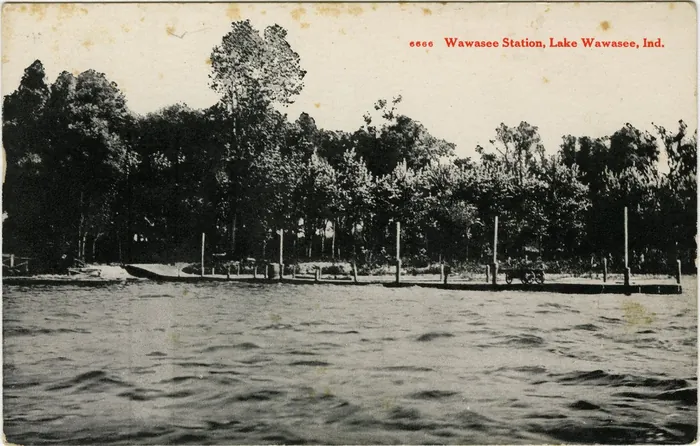
Sportsmen from the Cedar Beach Club already fished the big lake, where one member remembered acres of bluegills on the surface on calm June days. After the old clubhouse burned, the story told by the Syracuse Journal goes, the members asked Col. Eli Lilly to rename the club and the lake; he took the name of ‘an old Flat Belly Indian chief named Wawas’ and added ‘ee,’ and Nine Mile became Wawasee. George W. Miles, born in Syracuse, led the Wawasee Protective Association in the early 1890s, which got the railroad to build a better station and built a pier, and when he became the state’s commissioner of fisheries and game he chose the southeast end of the lake for a state fish hatchery between Lakes Wawasee and Papakeechie, enlarged in 1914. Miles died at his home in Syracuse in December 1914.
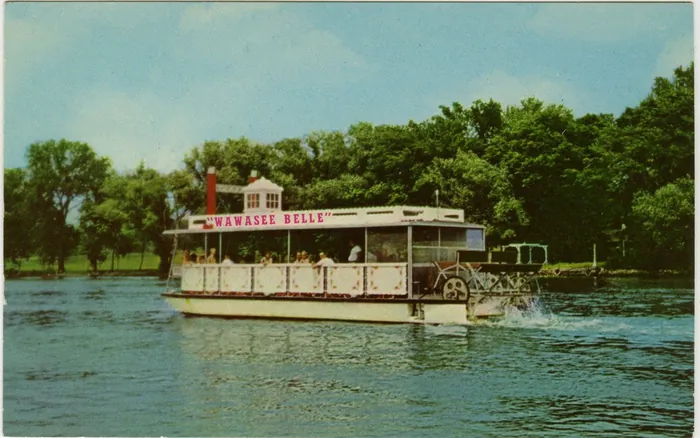
By 1919 Syracuse had a cement works, flour mills, a boat factory, a soap works and a box factory, a state bank organized in 1899, a library founded in October 1908 and a weekly, the Syracuse and Lake Wawasee Journal, begun the same year; in summer the resorters filled half a dozen hotels around the lake. The 1910 census counted 1,379 people in the town, and the 2020 census 3,079. Lake Wawasee, about 3,000 acres, is the largest natural lake wholly within Indiana.