Project Scroll

    Tip: press / or Ctrl K anywhere to search.

    ← Every place in Noble County

    Old photograph looking along a business street with two- and three-story brick blocks and a corner building with a tower.

    Noble County · Indiana · St. Joseph River Valley

    Ligonier

    An Elkhart River town and its Jewish merchants.

    Discover its storyThings to seeDirectionsThe valley map

    A street scene in Ligonier, photographed for the 1920 county history. Photograph from History of Northeast Indiana: LaGrange, Steuben, Noble and DeKalb Counties (Chicago and New York: Lewis Publishing Co., 1920), vol. 1, via the Internet Archive, Public domain.

    • Cityin Noble County
    • 1835founded
    • 4,568people, 2020 census
    • 10 mifrom Albion, the county seat

    Project Scroll is an independent local-history website. This is not an official page of the City of Ligonier or Noble County, and it does not speak for them. For official business, contact the city office directly.

    The story

    Welcome to Ligonier

    Ligonier was platted on the Elkhart River in 1835 and grew quickly once the Northern Indiana Railroad came through in the 1850s. Jewish merchants from Germany helped make it a busy market town, and their temple of 1889 still stands on Main Street.

    Isaac Cavin, who came from Westmoreland County, Pennsylvania, in 1830, laid out Ligonier in May 1835 on land he had entered at the Fort Wayne land office, the year before Noble County was organized; the plat was recorded at the seat of LaGrange County. Settlers found the site covered with wild strawberries, and the Elkhart River, then much larger, wound through it. Isaac Spencer, the first county clerk, opened a store in a small log building, and Ward Bradford built the first house about 1836. Nearby, Simpson Cummins laid out the rival village of Rochester in November 1836, with an iron works fed by ore hauled from Ore Prairie; Ligonier’s growth eventually emptied it.

    In 1840 only two or three families lived in Ligonier. The post office came in 1848, carrying on the Good Hope office, the first in the county. When it became certain in 1852 that the Northern Indiana Railroad would pass through, the town began to grow, and within five years its population and business had quadrupled; many of the newcomers were Jewish merchants. Myers & Strous, dealers in clothing and dry goods, began business about 1854. Ligonier was incorporated as a town in 1864. It became a great wheat market: 31,180 bushels were shipped in August and September 1860, and by 1882 nearly 500,000 bushels went out each year.

    Read the full story

    In 1867 Ligonier’s Jewish families organized a congregation in the Hostetter building, with Mathias Straus as president, Isaac Ackerman, Jonas Decker, H. B. Faulk, Solomon Mier, Leopold Schloss and F. M. Straus as officers and trustees, and in September of that year they put up a small synagogue; Jacob Straus gave a Bible valued at $200. The congregation took the name Ahavath Sholom. Two of the town’s banks grew out of these families’ firms: the Straus Brothers’ bank, which became the Citizens Bank, and Solomon Mier’s, later the Mier State Bank.

    In 1889 the congregation dedicated a new temple, with Rabbi Isaac Mayer Wise, founder of American Reform Judaism, speaking on religious tolerance. The state marker notes that the Jewish community and its neighbors shared pulpits and meeting places over the years, and that the Jewish population peaked around 1900 and then declined as younger people left for larger cities. The congregation later gave its whole library to the Ligonier Public Library, a Carnegie building finished in October 1908. In 1989 the Ligonier Public Library bought the temple, and for some thirty years it was the Ligonier Historical Society’s museum. In 2019 the library sold it, and it is now a private home, its architecture protected by a preservation easement held by Indiana Landmarks.

    Ligonier became a city in 1892. Its mills, refrigerator and carriage works were joined by the Lyon & Greenleaf flour mill, which by 1920 turned out about a thousand barrels a day. The 2020 census counted 4,568 people in Ligonier.
    Plan a visit

    Things to see

    • Ahavath Sholom temple

      503 S. Main St., Ligonier

      The temple dedicated in 1889, listed on the National Register in 1983 and marked by the state in 2014; the Ligonier Historical Society’s museum for some thirty years, and since 2019 a private home. Seen from the street only.

      Directions

    • Jacob Straus House

      210 S. Main St., Ligonier

      Home of Jacob Straus, an early member of the congregation, listed on the National Register in 1979.

      Directions

    • Ligonier Historic District

      Roughly bounded by the former railroad and Smith, Union, College and Grand streets, Ligonier

      The old business and residential center, listed on the National Register in 1987.

      Directions

    • Stone’s Trace

      U.S. 33 and State Road 5, south of Ligonier

      Historic site listed on the National Register in 1984.

      Directions

    Then and now

    Pictures

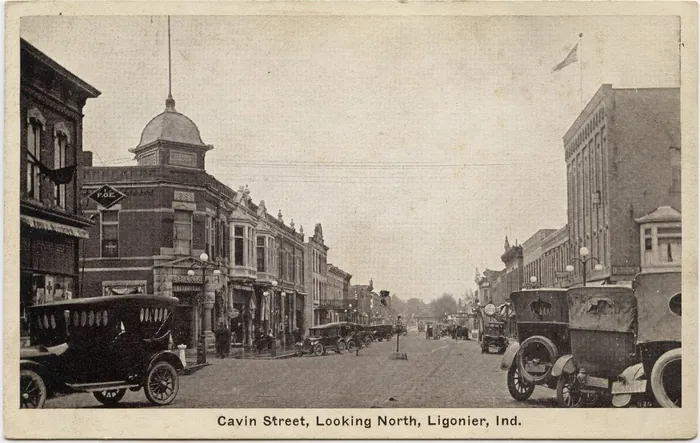
    Cavin Street, Looking North, Ligonier, Ind.
    Cavin Street, Looking North, Ligonier, Ind., about 1915. The Indiana Album.
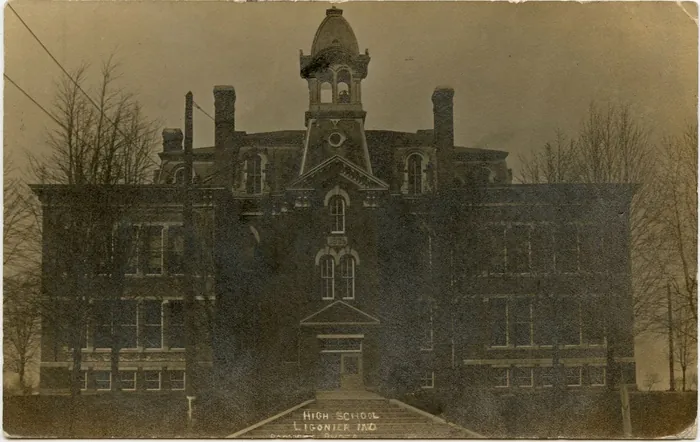
    High School, Ligonier, Ind.
    High School, Ligonier, Ind., about 1914. The Indiana Album.

    Come and see

    Through the year

    • Ligonier Marshmallow Festival Labor Day weekend, Friday–Monday
    • Charger House, 111 E. US Hwy. 6, Ligonier, IN 46767. A hometown restaurant known for its fried Icelandic cod.

    Quick facts

    At a glance

    Platted
    May 1835, by Isaac Cavin
    Post office
    1848, continuing the Good Hope office
    Railroad
    Northern Indiana, 1850s
    Incorporated
    Town, 1864; city, 1892
    Congregation
    Ahavath Sholom, organized 1867; temple dedicated 1889
    Township
    Perry
    Population
    2020 census: 4,568

    Know a story about Ligonier?

    Old photographs, letters, a school picture, a story your grandparents told: if it belongs to Ligonier, we would love to see it. A phone photo of the front and back is enough, and we credit you by name if you like.

    Send it to us Contact page

    Keep exploring

    Nearby in the valley

    For researchers: records and sources

    Where the records are

    Albion is the county seat, and Noble County’s deeds, court and probate records are kept by the county offices there; the Noble County Historical Society keeps the Old Jail Museum, one block west of the courthouse. The Ligonier Historical Society’s museum was in the old temple at 503 S. Main St. until about 2019; the town’s history museum is now Heritage Station, at the visitor center. The town is covered in Counties of LaGrange and Noble (1882), part II, ch. VII, ‘Town of Ligonier,’ pp. 145–160, and in History of Northeast Indiana (1920), vol. 1, ch. LXVIII, pp. 423–428.

    Sources

    • Counties of LaGrange and Noble, Indiana: Historical and Biographical (Chicago: F. A. Battey & Co., 1882), part II, History of Noble County, ch. VII, ‘Town of Ligonier,’ pp. 145–148 (plat, early stores and growth, pp. 145–146; post office, banks and incorporation, pp. 147–148); Jewish synagogue, p. 155. link
    • History of Northeast Indiana: LaGrange, Steuben, Noble and DeKalb Counties, ed. Ira Ford, Orville Stevens, William H. McEwen and William H. McIntosh (Chicago and New York: Lewis Publishing Co., 1920), vol. 1, ch. LXVIII, Perry Township, pp. 423–428 (Rochester, p. 423; Cavin and the plat, p. 424; railroad, banks and incorporation, p. 425; industries and library, pp. 427–428). link
    • Indiana Historical Bureau, ‘Ahavath Sholom’ marker (57.2014.1) and its annotations. link
    • ‘Ligonier, Indiana,’ Wikipedia (coordinates; 2020 census population 4,568). link
    • ‘National Register of Historic Places listings in Noble County, Indiana,’ Wikipedia (listings, dates and addresses). link
    • Indiana Landmarks, ‘Ligonier Temple Will Be Indy Couple’s Dream Home’ (25 March 2020) and ‘Protecting Their Investment’ (3 June 2020). link

    Dates and names are from the county histories and official sources listed here. Where they disagree, we say so. Know better? Send a correction.