Railroads
Two Tries at the Valley: How the Grand Trunk Came Through
A railroad map of 1887 names a “Michigan Air Line” that was not the Air Line Cassopolis knew. Behind that puzzle is how the Grand Trunk crossed the St. Joseph valley: two tries, a court ruling, a county’s own money, a bankruptcy and a fight for Chicago, then eighty years of steam to the very last scheduled run.
By Michael Urbanski · Project Scroll · · 27 min read

South Bend, Ind. On the last day of August 1871, a railroad crew finished its bridge over the St. Joseph River and turned onto Division Street. The street was then among the finest residence streets in South Bend, and nobody who lived on it had been asked. The crew laid its track along the street anyway, and the trains began to run, as the South Bend historian Timothy Howard put it thirty-six years later, “in the face of the angry protests of the residents.”
The line those trains ran on was called the Peninsular. Within a decade it would carry another name, the Chicago & Grand Trunk, and by 1887 it was a heavy black stroke across a railroad map printed in Chicago: Port Huron to Chicago, straight through Cass County and over the Indiana line at Granger. A copy of that map, with a little engraving of Chicago’s new Dearborn Station in its corner, is the picture at the top of this page.
Look closely at its title and something does not fit. It names four railroads, and the last of them is the “Michigan Air Line.” Every reader in Cassopolis in 1887 knew an Air Line, and it was not the Grand Trunk’s. It belonged to the rival Michigan Central. How one name came to belong to two railroads is the key to how the Grand Trunk reached this valley at all, because it took two tries, a state supreme court decision, about $100,000 of Cass County money, a bankruptcy and a contest between two of the most powerful railroad men of the age. This is that story, and the story of the steam engines that ran the line until the very end.
The map on the table
DocumentedThe map is a timetable map: a sheet that folded down into its own covers to slip into a traveler’s pocket. The David Rumsey Map Collection holds a copy and catalogs it in detail. Its covers read “Chicago and Grand Trunk Railway in connection with the Grand Trunk R’y of Canada including Great Western Division forming the Niagara Falls Air Line,” and they are dated: “Issued June 4th, 1887.” The front is printed in black on dark blue. Unfolded, the sheet measures 33 by 53 centimeters; folded, it is 18 by 10. One side carries timetables, a table of rates, text and a drawing of the lake steamer City of Milwaukee. The other side is the map, printed without color, at a scale of about 1:3,830,000, with the hills drawn in hachures, the old engraver’s short strokes. It reaches from Chicago to Halifax and from Louisville to the Gulf of St. Lawrence, and it carries the drawing of Dearborn Station, a view of Niagara Falls and more timetable text. The publisher is the railroad itself; the printer was a Chicago stationery and printing house whose imprint runs along the bottom margin.
ReadingThe copy shown here matches the Rumsey sheet: the same title in the same stacked lettering at lower right, the same Dearborn Station drawing at upper left, the same reach from Lake Michigan to Nova Scotia, and a line of small type along the foot where the Rumsey record places the printer’s imprint. At 843 by 530 pixels, that line cannot be read, so the match rests on everything else. Railroads of the 1880s reused engraved map plates from one timetable issue to the next, and other issues may carry the same map; the Rumsey copy of 4 June 1887 is the only catalogued one we found. Searches of the Library of Congress map collections, the University of Michigan’s map holdings and Wikimedia Commons turned up no other copy.
DocumentedThe engraving is the clue to the date. Dearborn Station, at Polk and Dearborn streets on the south edge of the Loop, opened on 8 May 1885. It was designed by Cyrus L. W. Eidlitz and owned by the Chicago & Western Indiana Railroad, which in turn was owned by the lines that used it. The Chicago & Grand Trunk had been one of the first three tenants of the Western Indiana’s tracks when they opened in 1880. The inset on the map calls the building the “New Dearborn Station” and locates it in the old street names: the block between Polk and Taylor streets and Third and Fourth avenues.

DocumentedEach name in the title is a company. The Chicago & Grand Trunk was the Port Huron–Chicago line through this valley, organized under that name in April 1880. The Detroit, Grand Haven & Milwaukee crossed the state from Detroit to Lake Michigan; it came under the Grand Trunk when the Grand Trunk took over the Great Western Railway of Canada on 12 August 1882. The Grand Trunk Railway was the Canadian parent. And the Michigan Air Line Railway, incorporated on 18 November 1875 and under Grand Trunk control from 1877, ran from Richmond, Michigan, through Romeo and Pontiac and, from 1 September 1884, all the way to Jackson.
ReadingSo the “Michigan Air Line” on this map is the Grand Trunk’s line northwest of Detroit, not the Air Line through Three Rivers and Cassopolis. Both, though, grew from the same seed, and that seed was the Grand Trunk’s first attempt to cross this valley.
The first try: an Air Line that got away
DocumentedBy the 1860s the Grand Trunk Railway of Canada had reached the St. Clair River and Port Huron, and it wanted Chicago. In 1867 and 1868 two companies were chartered with its name on them, the Grand Trunk Railway of Michigan and the Grand Trunk Railway of Northern Indiana, to build a line from Richmond, Michigan, toward Chicago. On 2 July 1868 they were consolidated as the Michigan Air Line Railroad. Howard’s History of St. Joseph County, Indiana (1907) describes a company formed at Jackson in 1867 “designed to aid in extending the Grand Trunk railroad” through Michigan and Indiana to Chicago, renamed the Michigan Air Line. Its first route ran by way of Niles and then straight to Chicago. “This would have left South Bend out,” Howard wrote.
DocumentedThe company built 14.2 miles from Romeo to Richmond, then called Ridgeway, in 1869. Then it began at Jackson and built west. On 29 September 1870, ten carloads of iron arrived for the stretch between Union City and Homer. The line reached Three Rivers in 1870. The 1882 History of Cass County records that its iron reached Cassopolis on 28 November 1870 and that the first regular passenger train ran on 16 January 1871. The road was finished to Niles in February 1871.
DocumentedThe Air Line was built, the Cass County history says, by the people along it, through Cass, St. Joseph, Calhoun and Jackson counties, and it was the Michigan Central that ran it. The sources differ on when the lease began: Howard says lack of funds “compelled the company in 1869 to lease its road”; the Air Line’s company history at Michigan Railroad History gives 1870; its encyclopedia entry gives February 1871, when the line reached Niles. In July 1873, unhappy stockholders called a meeting at Union City to replace the directors over a 999-year lease to the Michigan Central that had left the company with its bonded debt.
DocumentedIn Vandalia’s township, the 1882 county history notes, citizens gave right-of-way and private subscriptions to both the Air Line and the Grand Trunk, and in several cases the right-of-way had to be bought. A township along the line, Jefferson, got a station named Dailey, which owed its existence to the Air Line: after the line was finished in 1871, local people gave the railroad three acres for it, and a post office followed in 1872. South Bend, which the first survey had left out, raised $25,000 for an Indiana company to build a branch from the Air Line to the city; Howard credits Judge Thomas S. Stanfield and calls the ten miles from South Bend to Niles the most profitable ten miles in the Michigan Central system. Howard dates the branch to early 1870; the Air Line company’s history dates it to 1872, which fits better with the main line reaching Niles only in February 1871.
ReadingThe Grand Trunk’s first line across the valley was thus finished with local money and run by its rival. Only the eastern stub, Richmond to Romeo, stayed in reach of the Grand Trunk, and it carried the Air Line name into the Grand Trunk family. When the Grand Trunk finally got to Chicago, it would be by a second route.
A court says no, and Cass County pays anyway
DocumentedIn the late 1860s Michigan’s towns and townships were voting railroad aid bonds by the hundreds of thousands of dollars. In Climax Township, east of Kalamazoo, voters approved $15,000 for the Peninsular’s extension west from Battle Creek on 12 December 1866, on condition that $6,000 a mile be raised along the line; the condition was not met. They voted $15,000 again on 25 September 1869, and this time the bonds were issued and deposited with the state treasurer, to be paid out as the work was done.
DocumentedThen, on 26 May 1870, the Michigan Supreme Court decided People ex rel. Detroit & Howell Railroad v. Township Board of Salem (20 Mich. 452). Justice Thomas M. Cooley, writing for the majority, held that the state constitution did not allow a township to be compelled to issue bonds in aid of a privately owned railroad.
“…what the state as a political community cannot do it cannot require the inferior municipalities to do.”
DocumentedClimax took its bonds back out of the state treasury in 1872 and destroyed them. Glover’s Twentieth Century History of Cass County (1906) explains what the decision meant in Cass County: the towns could no longer obligate themselves, so the Air Line and the Peninsular, “now Grand Trunk,” were built through the county with private money. The 1882 county history puts the Cass County contribution to the Peninsular at about $100,000 in subscriptions and donated rights of way.
DocumentedThe county histories name the men behind it. Sylvador T. Read, born in Tompkins County, New York, in 1822, moved to Cassopolis in 1855, kept a store and shipped cattle, sheep and hogs to New York. The 1882 history says it was Read who suggested to the president of the Canadian railway at Port Huron a route across the peninsula to Chicago, and that the line came through the county largely through his efforts and money. Daniel Blackman, a Connecticut-born lawyer who had settled in Cassopolis in July 1851 and served as circuit judge from 1869 to 1872, “did much to bring the Peninsular Railroad through the village.”
ReadingRead’s story has a hometown flourish: one Cassopolis storekeeper putting the idea of a Chicago line into a Canadian railroad president’s head. The county history does not name the president or date the conversation, and no railroad source we found tells it. What is documented is the money: in a county that could no longer vote bonds, citizens paid for the road themselves.
Iron in the winter: the Peninsular comes down the valley
DocumentedThe Peninsular was a chain of charters. The Peninsular Railroad Company was chartered on 3 October 1865 to build from Lansing to Battle Creek. The Peninsular Railroad Extension Company followed on 3 January 1868, to carry the line from Battle Creek to the Indiana state line, and the two joined as the Peninsular Railway Company on 17 February 1868. Companies with the same name were incorporated in Illinois and Indiana in 1869 and folded in on 9 May 1870. Track went down north from Battle Creek from 14 September 1869, and the 45 miles to Lansing opened on 13 June 1870. South and west of Battle Creek, the line opened to Climax on 15 October 1870.
DocumentedThe line ran southwest across the corner of Kalamazoo County. Durant’s History of Kalamazoo County (1880) says the coming of the Peninsular started a little village at Climax, gave Scotts and Indian Lake their stations, and reached Vicksburg “about 1871.” At Schoolcraft the line was surveyed and grading began in 1869, and “trains began running about 1871.” The Vicksburg Historical Society’s history of its depot dates the Peninsular’s arrival to 1872; the county history of 1880, and the line’s opening to Cassopolis further on in June 1871, both point to 1871. In June 1871 the road built across the northwest corner of St. Joseph County, Michigan.
DocumentedThen it entered Cass County. At Marcellus, the 1882 history says, a Mr. Matthews had worked for the Peninsular project until the road was running and became the village’s first station agent and first express agent. Thomas Burney, who had built the first business building in Marcellus, sold goods on credit to the railroad’s laborers, “taking orders on the company, which were never paid.” A few miles on, a new village was named Wakelee, for C. Wakelee, the first treasurer of the railroad; its first plat was recorded on 12 December 1871.
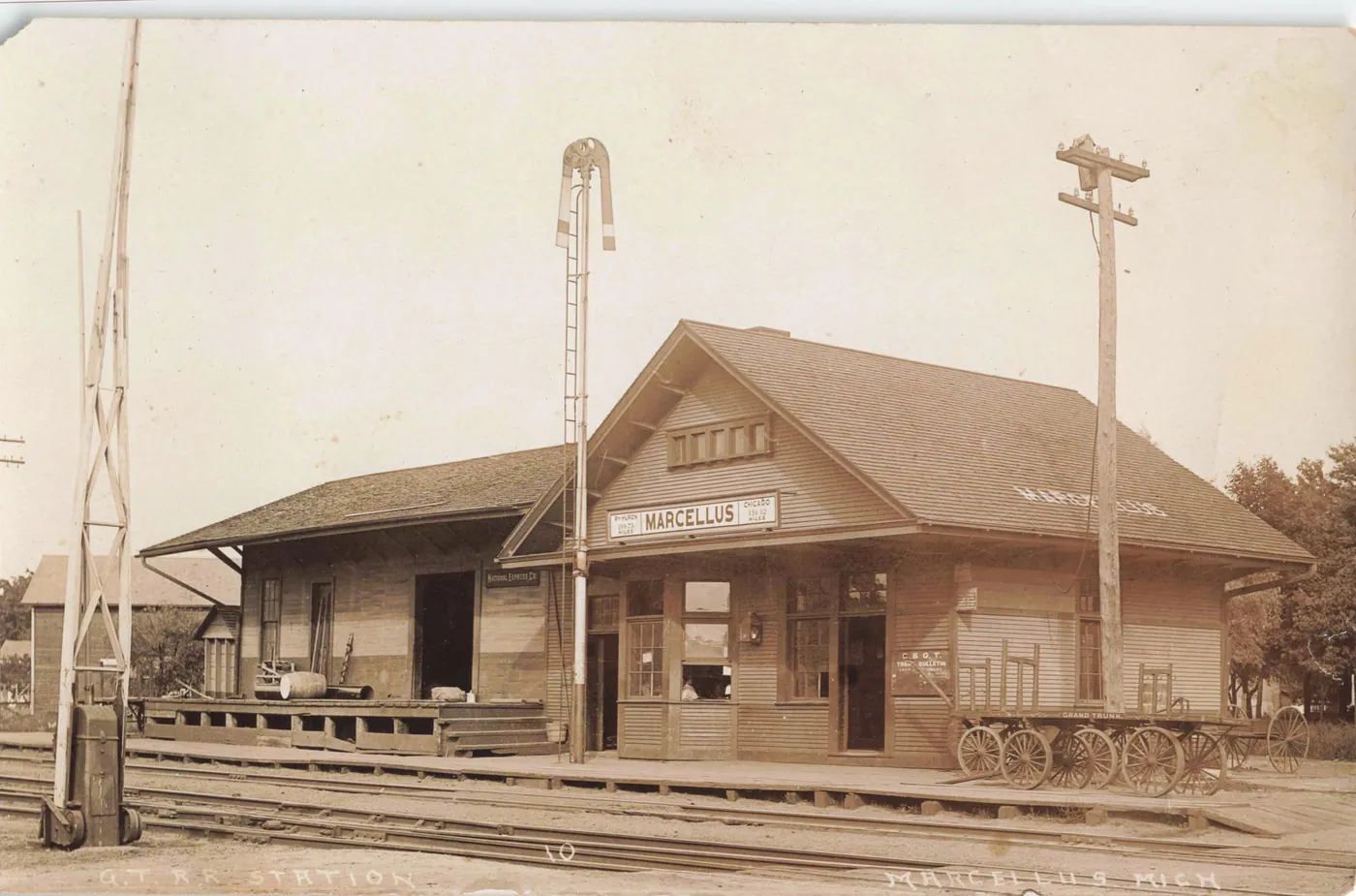
“He thus suffered a heavy loss, from which he never recovered.”
DocumentedThe iron reached Cassopolis on 9 February 1871, by the county history, and regular trains began running east from the village in June 1871. A history of the line compiled from period newspapers dates the opening of the extension to Cassopolis to 26 June 1871. The Cass County Agricultural Society, which had bought ground in 1857 where the Air Line depot later stood, had to give it up when the Peninsular’s right-of-way went through; in 1871 it bought twenty acres from Samuel Graham for $3,000.
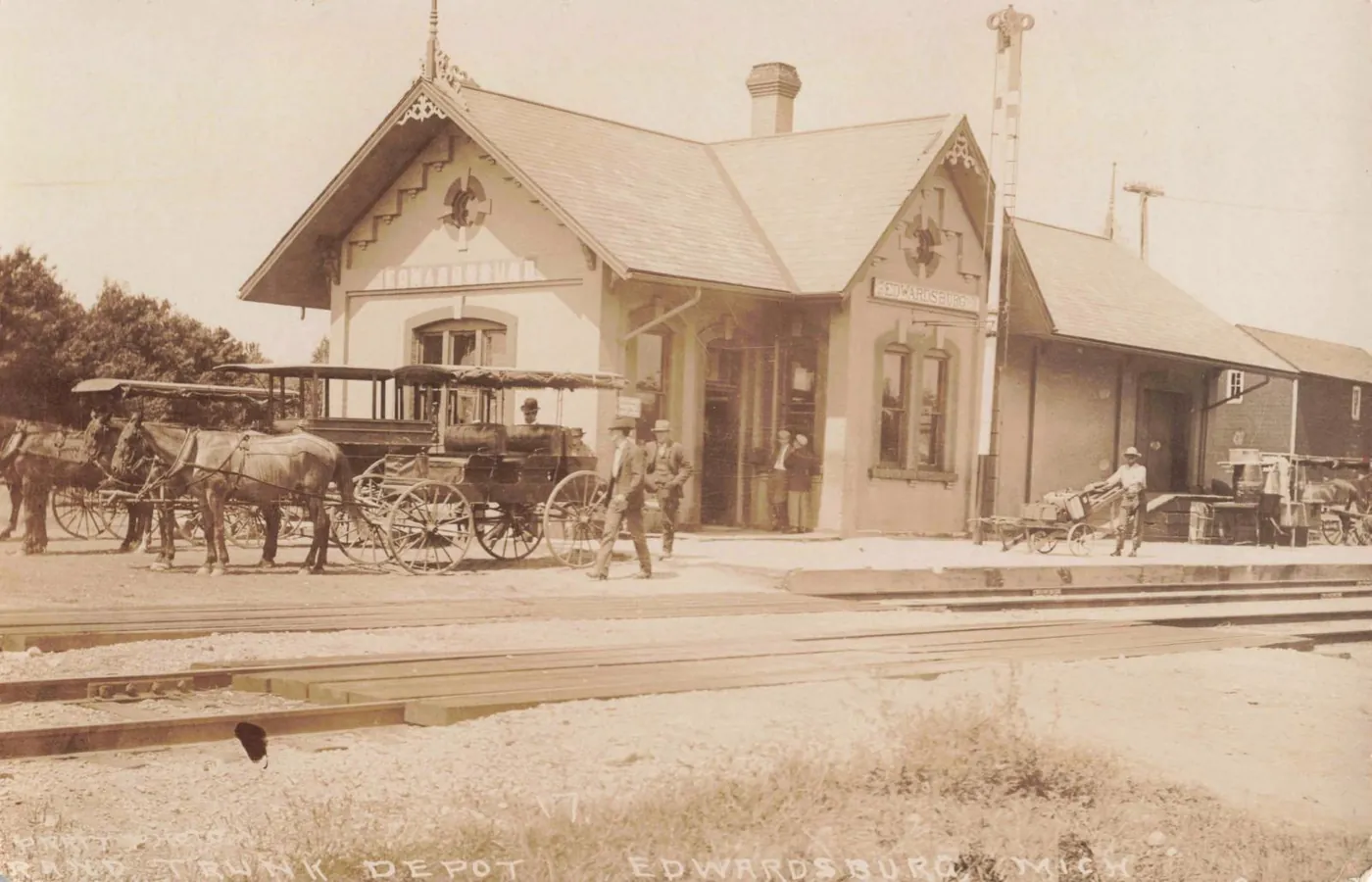
DocumentedGlover, in 1906, noticed something about the ground itself: the long glacial ridge that divides Cass County’s waters into two drainages is “roughly paralleled by the Grand Trunk Railroad.” South of Cassopolis the road reached Edwardsburg, and in Glover’s phrase it “revived the decadent village.” The population rose from 297 to 500 in ten years. By the early 1880s Edwardsburg had about twenty stores and shops and a grain elevator that held 16,000 bushels; in the year to 1 July 1881 the station shipped about 89,600 bushels of wheat, 46,100 of corn and 13,400 of oats.
DocumentedOver the Indiana line the road passed Granger, which Howard described as a small town on the Grand Trunk in Harris Township, with Edwardsburg the next station beyond it; he connects the town’s name with the Grange, the farmers’ movement of the 1870s. From there the line ran southwest through Harris and Penn townships to Mishawaka and South Bend, then on across Warren Township, where Christian Holler laid out the village of Crum’s Point on the railroad on 21 April 1875.
DocumentedIn South Bend the city council had passed an ordinance on 2 March 1868 that let the “Peninsular Railway Company of Indiana” lay its tracks on Division Street, today’s Western Avenue. When the company did so on 31 August 1871, the residents went to court, and Howard wrote in 1907 that the litigation “has not been ended even to this day.” The railroad came to see its action as “an impolitic thing,” he added, and never won local goodwill. The line opened to South Bend, 120 miles from Lansing, on 11 September 1871.
“…the end can never justify the means.”
DocumentedWest of South Bend the sources disagree about the date. The 1882 Cass County history says the line was finished to Valparaiso in 1871. A Cassopolis Vigilant article of 30 January 1873, cited in the line’s history, places the end of track at Kingsbury, Indiana, about twenty miles short of Valparaiso, and the Chicago Tribune of 8 October 1873 reported the Valparaiso extension completed on 7 October 1873, where it met the Pittsburgh, Fort Wayne & Chicago for through service to Chicago.
ReadingThe newspaper dates are the better evidence: Valparaiso was reached in October 1873, not 1871. In about two years, from the first track at Battle Creek to the trains at South Bend, the Peninsular had laid a line across the whole valley, from the Kalamazoo County prairies to the St. Joseph at South Bend, on private money and on credit that, as Thomas Burney learned, was not always good.
A bankrupt road, two barons, and the way into Chicago
DocumentedOn 15 August 1873 the Peninsular and the Port Huron & Lake Michigan, which ran from Port Huron to Flint, were consolidated as the Chicago & Lake Huron Railroad. Howard says the companies were all weak financially, and the road went into receivership in 1874, with the gap between Flint and Lansing still open. That gap was closed under the name of the Chicago & North Eastern, and by 1 January 1877 there was a continuous route from Port Huron to Valparaiso.
DocumentedThe Grand Trunk was not the only party that wanted the road. A history of the main line, first printed in the Durand Express on 18 May 1961 and reprinted in Inside Track in 1972, tells how early in 1878 a secret sale of $1.2 million of Chicago & Lake Huron bonds gave control to Vanderbilt, who in June 1878 also took the Michigan Central and blockaded the Chicago & North Eastern segment at Flint, stopping the Grand Trunk’s through freight. That history names William K. Vanderbilt; the line’s encyclopedia history names William Henry Vanderbilt and the New York Central. Against him stood Sir Henry Tyler, president of the Grand Trunk, who told his shareholders on 29 April 1879 that the Grand Trunk would fight for an independent route to Chicago.
DocumentedThe Grand Trunk won by buying the pieces. The eastern division was sold at auction on 21 June 1879 for $300,000. The western division, Lansing to the Indiana line, the old Peninsular through this valley, was auctioned on 26 August 1879 for $300,000. On 3 September 1879 the Grand Trunk bought Vanderbilt’s interest in the Chicago & North Eastern for $540,000. The property passed to companies of the Grand Trunk family, among them the North Western Grand Trunk; by 1880 Durant was calling the line through Vicksburg and Schoolcraft the Northwestern Grand Trunk.
DocumentedWhat was missing was Chicago. The new line from Valparaiso to the city was finished on 8 February 1880, according to the Michigan Railroad History timeline; the 1961 history has the first Grand Trunk train out of Chicago on the new line on 7 February and the first freight in on 9 February. In April 1880 the pieces were organized as the Chicago & Grand Trunk Railway Company, 330.40 miles from Port Huron to Chicago. The 1961 history notes that Chicago shippers welcomed the line because it stood outside the eastern railroads’ rate-fixing committee.
DocumentedBy 1900 the Grand Trunk had placed its lines in Michigan, Indiana and Illinois in a subsidiary, the Grand Trunk Western Railway Company. It was reincorporated as the Grand Trunk Western Railroad Company on 1 November 1928, and the same day the Grand Trunk’s Michigan Air Line Railway, the line on our map, was merged into it. The Grand Trunk Western name was withdrawn in 2002, and the line has run since as part of the Canadian National.
What the railroad made
DocumentedCassopolis had no railroad at all in 1870. By the middle of 1871 it had two, crossing at grade, the Air Line running east and west and the Grand Trunk running northeast to southwest. The crossing had its dangers: on 6 July 1888 a Grand Trunk freight ran into a Michigan Central freight there and wrecked both trains. In 1904 the Michigan Central approved a full interlocking plant with derails and signals for the crossing; by 1917 a Michigan Central leverman and Grand Trunk operators worked it around the clock. Under wartime orders in 1918, train orders for both roads were issued from the interlocking tower, and the Grand Trunk station closed each evening after the 8:16 train and opened again at 2:00 in the morning.
DocumentedIndustry followed the track. Glover records that the Cassopolis Manufacturing Company built a grain drill plant near the Grand Trunk depot around 1900, and that the village voted a $7,000 subsidy to the Kellogg Switchboard & Supply Company on condition of $150,000 in wages. Michigan Railroad History’s station file has a photograph of the Grand Trunk depot at Cassopolis captioned as built in 1888 and originally at Granger, Indiana; we found no second source for that history.
DocumentedNot every railroad hour was a good one. On 27 January 1900 a Chicago & Grand Trunk locomotive exploded at Edwardsburg, killing its engineer, fireman and conductor, all of Battle Creek, by the account in Michigan Railroad History’s station file. Edwardsburg’s wooden depot was replaced by a brick station in 1953. Granger, by 1915, had a passing track that held 144 cars, and by 1917 a day agent and telegraph operators on duty around the clock.
ReadingThe pattern along the line is plain in the county histories. Places with a depot grew: Marcellus, founded mainly because of the railroad; Wakelee, a lumber-shipping point; Penn, where Parker James opened a store once the line was finished; Edwardsburg, revived. Cassopolis, a county seat with no railroad until 1870, became a junction. The railroad also took things away: the fair society lost two grounds to the two railroads, and South Bend’s Division Street lost its quiet for nearly sixty years.
DocumentedIn South Bend the Division Street tracks lasted until 1929, when a track elevation project moved the Grand Trunk off the street and onto the New York Central’s line, where both railroads shared the new Union Station, an Art Deco building by Fellheimer & Wagner that opened that year.
The long goodbye to steam
DocumentedFor eighty years the line was steam country. The Grand Trunk Western dieselized its main line, the route through this valley, in April 1957, according to the railroad historian Jerry A. Pinkepank in Trains. What held out was the Detroit Division east of Durand, which kept the last regular intercity mainline steam freight in the United States and, on the Durand–Detroit local trains Nos. 21 and 56, the last regular steam passenger service.

DocumentedThat service ended on 27 March 1960. The state historical marker at Durand Union Station, erected in 1987, says that on that day a Grand Trunk Western train left the depot for Detroit as “the last regularly-scheduled passenger train in the United States to be pulled by a steam locomotive.” Accounts by railfans of the day, and the archival record of a contemporary film, say the crowd was so large that the railroad ran the train in two sections, behind the 4-8-4 locomotives Nos. 6319 and 6322. A Canadian National photograph in the Canada Science and Technology Museum’s archive is captioned “G.T.W. steam locomotive making its last run # 6319,” dated with a question mark to 1960.

DocumentedSteam did not quite stop there. In the same week, a Grand Trunk Western 2-8-2, No. 4070, made its last day in service, on 29 March 1960, photographed at Rochester, Michigan, by a Grand Trunk engineer. After 1960 only one big steam engine was left, the 4-8-4 No. 6323, which ran fan excursions to Battle Creek, Greenville, Durand, Richmond and Port Huron. J. David Ingles, writing in Trains, followed its last excursion, to Bay City, on 17 September 1961, three days before its last run on trains 21 and 56, on 20 September 1961. No. 6323 is preserved at the Illinois Railway Museum in Union, Illinois.
DocumentedElsewhere in Michigan, the Lake Superior & Ishpeming, an iron ore railroad in the Upper Peninsula, used steam until the middle of 1962, with no official date recorded for the last run.
DocumentedPassenger trains on the line through Cassopolis and South Bend lasted until Amtrak took over most intercity service on 1 May 1971. The Grand Trunk Western’s International Limited was the last intercity train out of Dearborn Station, the building on our map, on 30 April 1971. South Bend’s Union Station saw its last trains that year as well, and the last Grand Trunk Western passenger train stopped at Durand in 1971.

The 1965 claim, tested
DocumentedThe item that started this story, from the Historical Society of Michigan’s “this day in history,” reads: “October 23, 1965 The last steam locomotive used in regular service dropped its fire in Detroit after a run from Durand. It had been used by the Grand Trunk Western.”
What the record shows
- The event is real; the date is not. A last regular steam run from Durand into Detroit on the Grand Trunk Western is documented, on 27 March 1960, by the state historical marker at Durand, Trains magazine and the railroad’s own history.
- The engines on 27 March 1960 were the 4-8-4s Nos. 6319 and 6322, running the train in two sections, by several independent accounts and a Canadian National photograph caption.
- A last encore came on 20 September 1961, when No. 6323 ran the scheduled trains 21 and 56 one more time, by Ingles in Trains. It was a farewell, not regular steam service.
- Not the last steam in Michigan. The Lake Superior & Ishpeming kept steam until mid-1962. The 1960 distinction is narrower: the last regularly scheduled steam passenger train in the United States.
- Nothing on 23 October 1965. We found no record of a Grand Trunk Western steam run, regular or special, on that date, and no source that gives 1965 for the end of Grand Trunk Western steam.
ReadingThe wording of the “this day” item, a fire dropped in Detroit after a run from Durand, describes the 1960 trains closely. The year and the day look like an error in transmission; the substance belongs to 27 March 1960.
A timeline
- 1865 3 October: Peninsular Railroad Company chartered, Lansing to Battle Creek.
- 1868 17 February: Peninsular Railway Company formed to reach the Indiana line. 2 July: the Grand Trunk–backed companies become the Michigan Air Line Railroad. 2 March: South Bend lets the Peninsular use Division Street.
- 1869 Romeo–Richmond section of the Air Line built. Grading at Schoolcraft. 14 September: track laying north of Battle Creek.
- 1870 26 May: Michigan Supreme Court decides People v. Salem. 15 October: Peninsular opens to Climax. 28 November: Air Line iron reaches Cassopolis.
- 1871 16 January: first regular Air Line passenger train at Cassopolis. February: Air Line reaches Niles. 9 February: Peninsular iron reaches Cassopolis. 26 June: Peninsular opens to Cassopolis. 31 August: track laid on Division Street. 11 September: line opens to South Bend.
- 1873 15 August: Chicago & Lake Huron formed. 7 October: line reaches Valparaiso.
- 1874 Chicago & Lake Huron in receivership.
- 1879 26 August: western division, Lansing to Indiana, auctioned for $300,000; the Grand Trunk takes control.
- 1880 7–9 February: first Grand Trunk trains on the new line into Chicago. April: Chicago & Grand Trunk Railway organized.
- 1885 8 May: Dearborn Station opens in Chicago.
- 1887 4 June: the timetable with our map is issued.
- 1888 6 July: Grand Trunk and Michigan Central freights collide at the Cassopolis crossing.
- 1900 27 January: locomotive explosion at Edwardsburg. By this year, the Grand Trunk Western Railway Company.
- 1928 1 November: Grand Trunk Western Railroad Company; the Michigan Air Line Railway merged in.
- 1929 South Bend track elevation; Union Station opens.
- 1957 April: main line through the valley dieselized.
- 1960 27 March: last regularly scheduled steam passenger train in the United States, Detroit–Durand, Nos. 6319 and 6322.
- 1961 20 September: No. 6323 runs trains 21 and 56 one last time.
- 1971 30 April: the International Limited is the last intercity train out of Dearborn Station. 1 May: Amtrak.
- 2002 Grand Trunk Western name withdrawn; the line runs as Canadian National.
If you go
ReadingThe old Peninsular is still a working railroad, part of the Canadian National, through Vicksburg, Schoolcraft, Marcellus, Cassopolis, Edwardsburg, Granger and South Bend. Watch trains only from public places, such as station grounds, parks and public road crossings, and never walk on the tracks or the right-of-way.
DocumentedThe Vicksburg Union Depot, at 300 North Richardson Street, was built in 1904 where the Grand Trunk crossed the Grand Rapids & Indiana. The village bought it for one dollar in 1983, and since 1990 it has been the Union Depot Museum in the Vicksburg Historic Village. It was added to the National Register of Historic Places in 2024. The Vicksburg Historical Society gives its phone number as 269-649-1733; check its hours before you travel.
DocumentedIn South Bend, Union Station of 1929 stands at the end of the old track elevation. The city’s Redevelopment Commission bought the building in July 2024; view it from the street. At the line’s west end, the Grand Trunk station at Valparaiso still stands, moved a short way west and across the track in 2014.
DocumentedDurand Union Station, at 200 Railroad Street in Durand, is where the last steam trains of 1960 began and ended their runs east of the valley. The city bought the depot in 1979, Amtrak service there resumed in 1974, and the building houses railroad history museums; the state marker stands outside. In Chicago, the headhouse of Dearborn Station, at 47 West Polk Street, now holds offices and shops, and the 4-8-4 No. 6323 is on display at the Illinois Railway Museum in Union, Illinois.
Sources
- Chicago and Grand Trunk Railway, map side of the timetable “Chicago and Grand Trunk Railway in connection with the Grand Trunk R’y of Canada including Great Western Division forming the Niagara Falls Air Line,” issued 4 June 1887 (Chicago, 1887): “Map of the Chicago & Grand Trunk R’y, Detroit, Grand Haven & Milwaukee Railway, Grand Trunk Railway and Michigan Air Line R’y.” David Rumsey Map Collection, List No. 5262.001.
- The same timetable, covers (List No. 5262A). David Rumsey Map Collection.
- The same timetable, text page with timetables, rate table and the steamer City of Milwaukee (List No. 5262B). David Rumsey Map Collection.
- History of Cass County, Michigan (Chicago: Waterman, Watkins & Co., 1882), pp. 100 (the Air Line and Grand Trunk), 117 (Daniel Blackman), 187 (Agricultural Society), 222–223 (S. T. Read), 368 (subscriptions), 392 (Edwardsburg), 576 (Dailey), 604 (Thomas Burney), 616 (Marcellus station agent). Internet Archive.
- Lowell H. Glover, ed., A Twentieth Century History of Cass County, Michigan (Chicago, 1906), pp. 29, 154, 162, 168–169, 209–211, 223, 239, 318. Internet Archive.
- Timothy Edward Howard, A History of St. Joseph County, Indiana, vol. 1 (Chicago, 1907), pp. 289–291 (the Air Line, the Grand Trunk, the Division Street incident), 332 and 362–363 (Granger), 362 (Crum’s Point). Internet Archive.
- Samuel W. Durant, History of Kalamazoo County, Michigan (Philadelphia, 1880), pp. 185, 399 (Climax Township bonds), 413, 541, 564, 716 (Schoolcraft), 724 (Vicksburg). Internet Archive.
- “People v. Salem” (People ex rel. Detroit & Howell Railroad v. Township Board of Salem, 20 Mich. 452, decided 26 May 1870). Wikipedia, used for the date and the Cooley quotation.
- “Peninsular Railway (Illinois–Indiana–Michigan).” Wikipedia, citing the ICC valuation report (1929), the Detroit Free Press (17 September 1869), the Lansing State Journal (16 June 1870) and the Cassopolis Vigilant (30 January 1873), for the charters and opening dates.
- “Chicago and Lake Huron Railroad.” Wikipedia, citing the Chicago Tribune (8 October 1873), Railroad Gazette (18 October 1873), Poor’s Manual (1877) and Dunbar (1969).
- “Michigan Air Line Railroad.” Wikipedia.
- “Michigan Air Line Railway.” Wikipedia, citing Graydon Meints, Michigan Railroads and Railroad Companies (1992) and later works.
- Michigan Railroad History: “The Michigan Air Line Railroad Company.”
- Michigan Railroad History: “Peninsular Railway Company.”
- “The Grand Trunk Main Line and How It Got That Way,” Inside Track (September 1972), largely from the Durand Express, 18 May 1961. Michigan Railroad History.
- Michigan Railroad History: Time Line, 1871.
- Michigan Railroad History: Time Line, 1880.
- Michigan Railroad History: Station, Cassopolis, MI (the crossing, the 1888 collision, the 1904 interlocking, 1917 and 1918 working, depot photograph).
- Michigan Railroad History: Station, Edwardsburg, MI (the 1900 explosion, the 1953 station).
- Michigan Railroad History: Station, Granger, IN.
- Michigan Railroad History: “Grand Trunk Western Railroad.”
- “Grand Trunk Western Railroad.” Wikipedia, citing Dorin (1977), Hofsommer (1995) and Mika & Mika (1972), for the 1900 and 1928 companies and the 1971 end of passenger service.
- “Dearborn Station.” Wikipedia.
- “Chicago and Western Indiana Railroad.” Wikipedia.
- Michigan Historical Marker S316, “Durand Union Station,” erected 1987. Michigan Department of Natural Resources.
- “Durand Union Station” marker, Historical Marker Database.
- “Durand Union Station.” Wikipedia (the museums in the station).
- Jerry A. Pinkepank, “Grand Trunk Western history remembered,” Trains, 5 January 2025.
- J. David Ingles, “Grand Trunk Western steam: America’s last real show,” Trains, 19 January 2025.
- “G.T.W. steam locomotive making its last run # 6319,” negative, CN Images of Canada Collection, Canada Science and Technology Museum archives (Ingenium), no. 54867, dated [1960?].
- “1960 in rail transport.” Wikipedia, citing the film “Grand Trunk – last steam powered passenger run” (27 March 1960).
- Railway Preservation News forum, thread on GTW steam, posts of 30 August–1 September 2007 (Bill Yoder and others) on Nos. 6319, 6322 and 6323.
- Midwest Railway Preservation Society, “The Last Run of 4070 in Service on the GTW.”
- SteamLocomotive.com, “The Last of Steam” (Lake Superior & Ishpeming, 1962).
- “Grand Trunk Western 6323.” Wikipedia (preservation at the Illinois Railway Museum).
- “Vicksburg Union Depot.” Wikipedia, citing the National Register nomination by Don Wiertella and Margaret Snyder (2023).
- Vicksburg Historical Society, “Union Depot Museum.”
- The History Museum, South Bend: Division Street photograph and note (now Western Avenue).
- Chicago’s Lost Stations: Grand Trunk Western stations in Indiana (the 1929 track elevation; Valparaiso station).
- “Union Station (South Bend).” Wikipedia.
- Historical Society of Michigan, “this day in history” item for 23 October (text supplied by the reader; tested in this article).
- Dearborn Station, Chicago, before 1922, Wikimedia Commons, public domain
- Union Station Depot, Durand, postcard about 1905, Wikimedia Commons, public domain
- Engine & G. T. Round House, Durand, postcard dated 31 July 1909 (G. W. Beck), Wikimedia Commons, public domain
- Grand Trunk Western K-4-a No. 5628, about 1955, photograph by Robert Graham, Wikimedia Commons, public domain
- G. T. R. R. Station, Marcellus, Mich., 1908, David V. Tinder Collection, Clements Library
- Grand Trunk Depot, Edwardsburg, Mich., James H. Pratt, Tinder Collection, Clements Library
Numbers in the text point to this list; entries without a number are further sources we consulted. How we research › · The libraries behind all our stories ›
Corrections: none
First published 24 October 2026. Like all our pages, it is expanded from time to time with new records, pictures and features. No factual corrections have been needed so far.
About this research
Research and reporting Michael Urbanski Project Scroll
- Sources
- Every fact on this page is drawn from the sources listed above, and each can be checked where it is held.
- Corrections
- Errors are corrected on the page, and each correction is noted there.
- Contact
- To report an error or share a record that adds to the story, write to research@projectscroll.com.
- Method
- How we research ›
© 2026 Michael Urbanski and Project Scroll. All rights reserved. The text, original maps, charts and illustrations may not be reproduced without permission; brief quotations with credit and a link back are welcome. Material from other sources belongs to its holders and is credited where it appears; public-domain material is marked as such.


