Shipshewana · Part 1
The Shipshewana Puzzle: One Name, at Least Five People
A town, a lake and a monument carry the name of a Potawatomi chief. The old records hold more than one Shipshewana, the best-known story about him was first told in 1931, and the National Archives hold a man of his name alive in Kansas from February to December of the year the plaque says he died, and still there in 1842. Part 1 of a series on Shipshewana, Indiana.
Live research document
This story is part of a series still being researched. Several records named on this page are held at the National Archives and in local newspapers we have not yet been able to search; we will add what they show.
By Michael Urbanski · Project Scroll · · 41 min read

New finding 7 new findings in this story. See what’s new ›
Shipshewana, Ind. On Memorial Day 1931 the biggest crowd anyone could remember came out to Shipshewana Lake. There was a maypole dance and a cornet band. A nine-foot granite boulder, hauled twenty-three miles on a house-mover’s rig, stood on a grassy mound at the fork of the roads, with a bronze plaque bolted to its face. Fifteen or twenty Potawatomi men, women and children had come down from Athens, Michigan, and a Potawatomi minister, the Rev. William Soney, spoke on “The Attitude and Gratitude of the Indian of Today.” Then the plaque was unveiled.
It told a sad and simple story. Chief Shipshewana and his band were “removed from this reservation September 4, 1838,” and escorted to Kansas by soldiers. A year later “the heartbroken chief” was allowed to come home to “his old camping grounds on the banks of beautiful Shipshewana Lake,” where he died in 1841.
That is the story the town tells today, on a newer marker by the lake, on its website and in nearly every article about the place. It is a moving story. But when we went looking for the man behind it, in the treaties, the pay rolls, the county records and the oldest local histories, we found something most people don’t know: the record does not hold one Shipshewana. It holds several. And the story on the plaque was first told, as far as anyone has yet found, on the plaque itself. Then, in the National Archives, we found a chief of his name and his band very much alive, in Kansas and in Washington, in the last weeks of the year the plaque says he died.
What most people don’t know
- A chief of the name was alive from February to December 1841. In February a “Ship she wah no” signed a letter in Kansas with the Potawatomi who had just come west from Indiana and Michigan. On 16 November a “Ship she won no” signed his band’s petition to President Tyler, and on 15 December he was in Washington as one of its delegates. The plaque has him dying by the lake that year.
- And he was still there in 1842. When the government counted the Potawatomi of the Osage River in October 1842, it found two heads of family of the name: a man over forty with ten others in his house, and a man under forty with a woman and a boy.
- More than one person carried the name. Besides the chief, the records show a Potawatomi woman, Angelina Shipshewana, born in 1821 near South Bend, and a Shipshewana family that went west to Kansas and Oklahoma.
- The lake’s chief and the treaty chief may not be the same man. The county’s 1882 history says the old chief “died some time prior to the settlement,” before the settlers of the 1830s. Yet a Ship-she-wa-eno was alive, and making speeches, in 1836.
- The return-and-death story is first found in 1931. We found no record of it, or of the 1841 death, before the plaque. The 1882 history has him dead before the settlers came; the records of 1841 have a chief of his name alive in Kansas.
- The plaque’s date belongs to another removal. 4 September 1838 is the day the soldiers’ march known as the Trail of Death left Twin Lakes, some fifty miles away. No Shipshewana appears on its rolls.
The people in this story (21)
- Ship-she-wa-non The treaty chief: signed in 1828, 1832 and 1833; a war chief at the payment of 1836; a chief of the name went to Washington for his band in 1841.
- To-pen-e-bee Principal chief of the St. Joseph band in 1841, first of its delegates to Washington.
- Abram Burnett Potawatomi delegate to Washington in 1841, who signed his own name.
- Anthony L. Davis Indian sub-agent on the Osage River: forwarded the letter of February 1841, witnessed the petition of 16 November 1841, and counted the Potawatomi in October 1842.
- Mucka moat A leader of the emigrants of November 1840 who went off to Washington early in 1841 without, the others said, their consent; they said he was no chief. Also written Muck-e-moote and Muckmote.
- The Rev. Isaac S. Ketchum Assistant Indian agent who came west with the 1840 party and took Mucka moat to Washington.
- Luther Rice The “L. Rice” of the petition, a delegate to Washington in 1841, who signed the December letter in his own hand; head of a family on the 1842 roll.
- T. Hartley Crawford Commissioner of Indian Affairs, to whom the delegates wrote from Washington.
- Ashkum Potawatomi war chief who spoke beside him at the 1836 payment.
- J. W. Edmonds Federal commissioner who reported on the 1836 payment.
- A. St. C. Vance Government surveyor who wrote just “Lake” on the 1830 survey.
- Johnny Thorp White settler whose remembered stories were the 1931 committee’s only source; died about 1896.
- R. L. Case Spoke on the area’s Indian history at the 1931 dedication.
- The Rev. William Soney Potawatomi minister from Algonac, Michigan, the dedication’s best-remembered speaker.
- H. J. Bontrager Wrote to the universities and the Smithsonian to learn what the name meant.
- Thomas Topash Potawatomi of the Lake Wawasee country who gave the meaning “Vision of a Lion.”
- Jacob Piatt Dunn Indiana historian who printed Topash’s explanation in 1908.
- Mrs. Angelina Shipshewana Potawatomi woman born in 1821, of the Crumstown neighborhood.
- Edward, Zoa and Peter Shipshewano A family that carried the name to Kansas and Oklahoma.
- Howard L. LaHurreau Fort Wayne writer who signed himself “Shupshewana.”
- Hezekiah and Sarah Davis Platted the town in 1889; the town’s history says Sarah chose the name.
The man in the treaties
The first time the name certainly appears in writing, it is attached to an X. On 20 September 1828, at the Carey Mission on the St. Joseph River, near what is now Niles, Michigan, the Potawatomi signed a treaty with the United States. Fourth on the list of signers is “Ship-she-wa-non, his x mark.” Documented

A year later the name turns up again, in the pay roll an Indian agent kept for the payments of 1829. Row 70 reads: “Ship-shee-won no, head of Tippecanoe, 27.” The number seems to count the people in his household or band; no money or goods are entered against his name. Documented The “head of Tippecanoe” is the lake country where the Tippecanoe River rises, thirty-odd miles south-west of Shipshewana Lake. Reading

He signed again on 27 October 1832, at the treaty on the Tippecanoe River, as “Ship-she-wa-no,” and in 1833 at Chicago, where a clerk wrote “Ship-she-wuh-no” on the supplementary articles. Documented Each spelling is an English-speaking clerk’s attempt to catch a Potawatomi name by ear. That is why, a century later, the town’s committee had to write all the way to the Smithsonian to learn how to say it.
A war chief at the payment of 1836

In September 1836 the Potawatomi of northern Indiana gathered to be paid their annuities. It went badly. Traders crowded the payment ground with claims, rumors flew, and the agent called out the militia. A federal commissioner, J. W. Edmonds, was sent the next year to find out what had happened.
His report names our man twice. On the Monday of the trouble, it says, “Ashkum, and an Indian named Ship-she-wa-eno, made some speeches to an assemblage of about 200 Indians,” insulting the chiefs who had signed the latest land treaties, “daring them to come out of doors, telling them they were not Chiefs.” A witness put it more vividly: the St. Joseph Indians “despatched two of their war Chiefs, Ashkum and Ship-she-naw-a-no, followed by about three hundred young Indians,” who stood the two men on a big box in front of the agent’s house to speak. Documented
It is the only time the record lets us hear him, even at second hand. The man it shows is not a heartbroken old exile. He is a war chief in his prime, speaking for the St. Joseph Potawatomi, standing on a box in front of a crowd and telling the treaty chiefs they had no right to sell the land. Reading
Alive in 1841
Five years later the name turns up again, more than five hundred miles to the west, and it turns up early in the very year the plaque gives for his death. On 3 February 1841, at Potawatamie Creek on the Osage River, in what is now eastern Kansas, the chiefs and warriors of the Potawatomi “who lately emigrated from Indiana & Michigan” sent a letter to the Secretary of War. One of their number, Mucka moat, had gone off to Washington with a government man, the Rev. Isaac Ketchum, and they wanted Washington to know he did not speak for them. Twenty-seven men put their names to it. The sixth in the right-hand column is “Ship she wah no.” Documented New finding

Potawatamie Creek, 3 February 1841
Hon J. R. Poinsett, Sec’y of War
Our Father
We the Chiefs and warriors of the tribe of Potawatamie Indians who lately emigrated from Indiana & Michigan would most respectfully represent to you that Mucka moat and three others of our tribe have left us at our new homes on the Osage river in company with the Revd. Mr. Ketchum for Washington City these men have left here without the consent of the tribe or band to which they belong, we therefore take this means to inform our Father that these men are not considered by us as Chiefs and that they are not authorized to transact business of any kind for the nation …
The complaint is a lively one. The four men had left “without the consent of the tribe or band to which they belong”; they “are not considered by us as Chiefs”; and “should they represent any thing to our Father at Washington to be the wish of the Potawatamies it is our wish they should not be heard.” Worse, “it was not until several days after they left that we knew it was their purpose to go to Washington.” Documented

The twenty-seven names
O S mit his mark · Was saw me · Ken kosh · Kaps co wet · To pen ebe 2d · Kee wah co ack · M che tum · M ke tab na · Che quah · O ko ma ses
Pe nashes his mark · So wah quet · Po ka to · Show to na · Shat kah nah be · Ship she wah no · Nash ka was uck · Shik e nah · Tok ko che · Shah quah · To kaw gas · Cho check · Ka kaut a mo · O ka mass · Mock see · Show wek · Ka ke me kah
Spelling as written; the ditto marks after the first names stand for “his mark,” and the last five names have none. Po ka to, and very likely Pe nashes, would sign again in November, under the petition.
Who were the signers? The sub-agent Anthony L. Davis, sending the letter on to the Commissioner of Indian Affairs five days later, said it “embraces the principal men of the late Emigrants with whom Meck E moote emigrated.” Documented Two parties of Potawatomi from northern Indiana and southern Michigan were removed to Kansas in the autumn of 1840: one of 524 people, removed under contract by Alexis Coquillard of South Bend, which arrived on 6 October and settled mostly at Sugar Creek; and one of about 439, conducted by Robert A. Forsyth, which arrived on 25 November and settled on Pottawatomie Creek. Mucka moat came with the second; a citizen was paid $100 for capturing him on the way. Documented So if “Ship she wah no” was one of the principal men of that party, he came west not in 1838, as the plaque says, but in the late autumn of 1840. Reading
“I am inclined to the opinion that he is not taken to Washington to express the wish of the people he is said to represent, but to serve individual purposes.”
Washington agreed with them. On 22 March 1841 the Commissioner of Indian Affairs, T. Hartley Crawford, wrote to the new Secretary of War, John Bell, that “immediate provision should be made for the return of the four Potawatomies, improperly brought here by Mr. Ketchum.” Ketchum, he wrote, had made the journey “not only without authority, but directly contrary to the prohibition of the Superintendent at St. Louis”; his bills from before the men reached Washington should be refused, and his services dispensed with. Major Joshua Pilcher, the superintendent at St. Louis, put the cost of the trip home to the Osage River country at $350, and Crawford named a Mr. Rosecrants of Michigan, recommended by Senator Porter, to take them. Bell wrote “Approved” at the foot. Documented A note on the folder, in Crawford’s hurried hand and hard to read in places, adds that the men were to leave with Pilcher, but one of them had “a sore and swollen thigh,” and they set off instead on Sunday morning, 28 March 1841, under an arrangement with Ketchum himself. Reading New finding

Office of Indian Affairs, 22 March 1841
Sir,
It is important that immediate provision should be made for the return of the four Potowatomies, improperly brought here by Mr. Ketchum. Major Pilcher the Superintendent at St. Louis, estimates that it will cost 350 dollars to defray the expenses of their going back to the Osage river country and those of the conductor, who I presume ought to be Mr. Rosecrants as he has been favorably represented to you by the Hon. Mr. Porter of the Senate.
T. Hartley Crawford to John Bell, Secretary of War. The letter ends on the next page with Crawford’s signature and Bell’s “Approved.”
Hold on to that complaint. By the end of the year the bands on the Osage River would send a delegation of their own to Washington, and this time they made sure the record showed that the whole tribe agreed. Reading
Nine months later the name turns up again, on a bigger errand. In the autumn of 1841 the St. Joseph and Prairie bands of the Potawatomi were living on the Osage River, in what is now eastern Kansas. On 16 November their chiefs, head men, warriors and young men signed a petition to President John Tyler and chose six men to carry it to Washington. The third name on the list of delegates is “Ship she won no.” Documented New finding

The petition, 16 November 1841: the opening
To His Excellency, John Tyler, President of the United States } Nov. 16th 1841
Sir
We the undersigned Chiefs, head men, Warriors and young men of the St Joseph and the Prairie bands of the Putawatimie nation, now residing on the south side of the Missouri River in the Country assigned to us by the Government of the United States, do hereby nominate and appoint To pen e bee, our principal Chief, and Che bess. Ship she won no, Mich. E ke ko-ba Abram Burnett and L. Rice to be our delegates to Washington City, for the purpose of attending our business named in the following Petition,
The petition is a plain and practical document. The bands had lived in the West “four years,” it says, “under peculiar circumstances, and in a condition, unknown to our people, previous to our emigration here from our native lands.” They asked for “a portion of that one hundred and fifty thousand dollars” promised at Chicago in 1833, “for the purpose of building horse or ox Mills in our own Country, to open farms and to buy some live stock.” They complained that the Osages and Kansas “have repeatedly stolen our horses,” and they wanted back the money kept out of their annuities in 1838 and 1839 “without their Knowledge.” Documented
“they need it now; for their help and encouragements in their new homes.”

The signers: the head of the right-hand column
To pe ne be ✗ his mark
Che bass ✗ his mark
Ship She won no ✗ his mark
Mich E ke ko ba ✗ his mark
Po ke to ✗ his mark
Pe na shess [?] ✗ his mark
Mix ah ba ✗ his mark
The four delegates who signed by mark lead the column, in the order the petition named them. Each man made his mark, an X, and the clerk wrote “his mark” beside it.

The marks do not stop at the foot of that page. The petition runs on to a second sheet, image 520, with two more full columns of names, each followed by an X and “his mark.” By our count, 27 men signed on the first page and 78 on the second: 105 marks in all, from the St. Joseph and the Prairie bands together. And just past halfway down the second sheet’s right-hand column the name To pe ne be appears again: the name of the principal chief, who heads the right-hand column of the first page. Either a second man carried the name or the same man made a second mark; the page does not say which, and it is one more reminder that in these records a name is not yet a person. Documented
The man who wrote the government’s certificate under it, the same sub-agent Anthony L. Davis, said the petition was signed “by unanimous consent of the tribe,” and that the bands had saved enough from their own annuities to pay for the trip. This time, unlike Mucka moat in February, the delegates went with the tribe’s consent on the record. Documented

The sub-agent’s certificate
I Certify that I was present when the foregoing petition was signed, and so far as I could understand, it was signed by unanimous consent of the tribe, They requested me to say that they had saved out of their Annuity funds sufficient to pay the expences of their visit to the city, and that they did not intend to ask the Government to pay their expences
Anthony L Davis
Ind Sub Agt
November 16th 1841
A month later the delegates were in Washington. On 15 December they wrote to the Commissioner of Indian Affairs, T. Hartley Crawford, with three more points. A $2,000 annuity from the Chicago treaty, meant for their bands, had been paid “for four years past” to the Potawatomi at Council Bluffs. The iron and steel promised every year by “the Treaty at St Joseph in 1828” were “of no use to our people.” And they asked fair shares for families who had joined them. At the foot of the letter, the clerk wrote “Ship she wan no,” and beside it is his mark. Documented


The letter, Washington, 15 December 1841
Washington City Dec. 15th 1841
To T. Hartley Crawford Esqr, Commissioner Indian Affairs
Sir
We the undersigned Delegates of the St Joseph and Prairie bands of the Putawatimie Nation have arrived at the seat of your Government, upon business concerning the interest and prosperity of our people …
We are your Friends & brothers
To pen e bee his x mark
Che bass his x mark
Ship she wan no his x mark
Much ke kau boy his x mark
Abram Burnett
Luther Rice
Is this our man? The record cannot quite say. The name is the same, spelled as clerks spelled it, and so is the band: the St. Joseph Potawatomi, the band the war chief spoke for in 1836. The delegates even cite the 1828 treaty at St. Joseph, the treaty Ship-she-wa-non signed. Reading No document yet ties the man of 1828 to the man of 1841 by more than his name and his band. Open
But if they are one man, the plaque’s story cannot stand. In the very year it has him dying of a broken heart by the lake, he was on the Osage River, and then in Washington, talking to the government about mills, horses and money owed to his people. Reading
Still there in 1842
The records do not let him go. Following instructions from the superintendent at St. Louis, dated 22 August 1842, on 12 October 1842 Anthony L. Davis took a muster roll of the Potawatomi of the Osage River, page after page of heads of families, each with the number of males and females in the house, young and old. Documented Somewhere on those pages is our name. Before you read on, see if you can find it.
Spot the chief
This is the whole names column of one page of the 1842 roll, heads of families 170 to 197, as Davis’s clerk wrote them. One of them is our name. Can you find him before you open the answer? Watch out: there is a decoy.
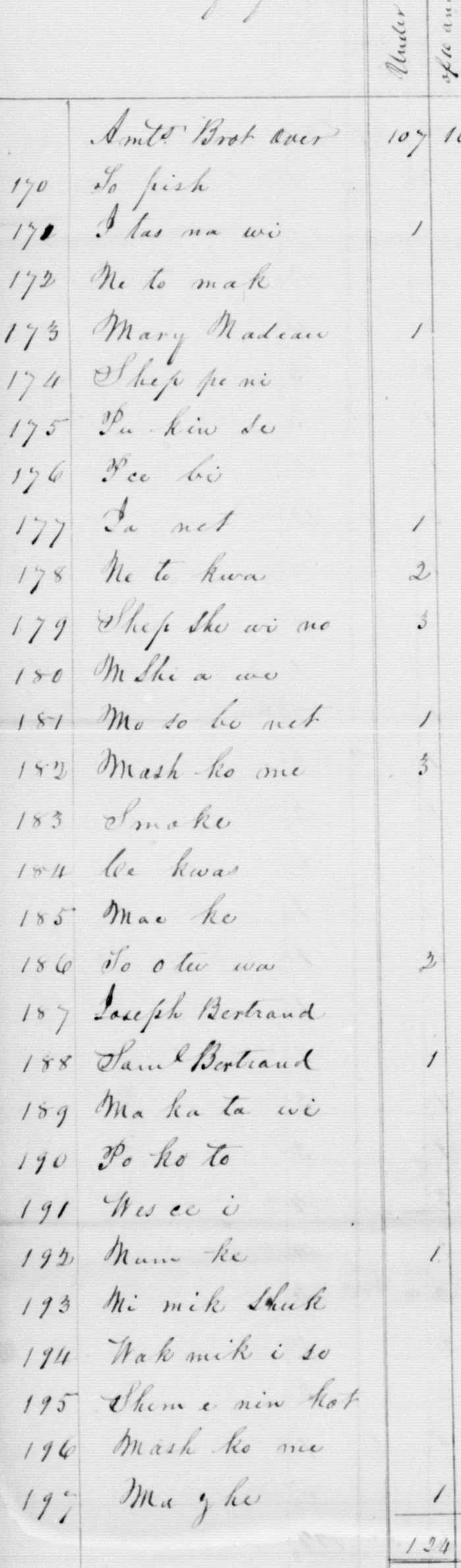
Show me where he is
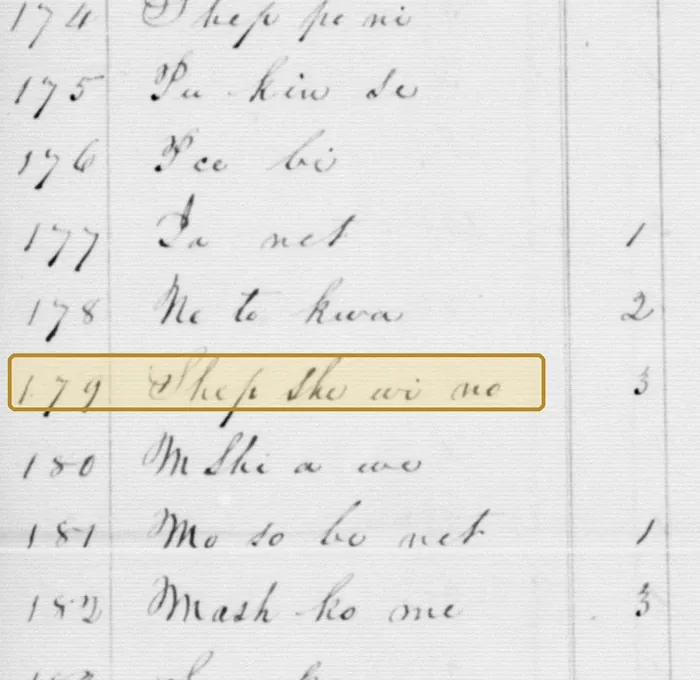
Number 179, “Shep She wi no,” the head of a household of eleven. The decoy is number 174, “Shep pe ni,” a different name that starts the same way.
There he is. Number 179 is “Shep She wi no,” with a household of eleven: a man over forty, a woman over forty, four people between ten and forty, and five children. Number 277 is another “Shep she wi no,” a younger man with one woman and one boy. Documented New finding


The count of 12 October 1842
A Muster Roll of Putawatomie Indians within the Osage river Sub Agency taken by Anthony L. Davis Ind Sub Agent agreeably to instructions received from the Supt. Ind. Affairs at St. Louis under date of the 22nd day of August 1842, this 12th day of October 1842
No. 179, Shep She wi no: males under 10, three; from 10 to 40, two; over 40, one. Females under 10, two; from 10 to 40, two; over 40, one. In all, eleven.
No. 277, Shep she wi no: a boy under 10, a man from 10 to 40, a woman from 10 to 40. In all, three.
Two heads of family, one name. The older man, with his large household, fits a chief who had been signing treaties since 1828; the younger could be a son or a nephew who carried the name on. Reading But the roll gives only names and numbers, and it does not say which of them, if either, is the man of the treaties, the delegate of 1841, or the chief of the lake. Open
Old friends are on the same pages: number 116, Abram Burnett; number 131, “To pe ne be”; number 190, “Po ko to”; and number 209, Luther Rice, the “L. Rice” of the petition. Documented Whatever else is true, the chief the plaque buried by the lake in 1841 has a name still being written on a government roll in Kansas a year after the plaque’s date for his death. Reading
For teachers: “Alive in 1841?”, a two-page classroom handout on the petition (PDF) ›
What his days were like
No one wrote down a day in Shipshewana’s life. But the county’s oldest history, written in 1882 from the memories of the first settlers, describes the world he moved through. Reading
His people’s “deeply cut trails ran through the woods, taking the best courses, and never missing the beaver dams, in every direction, so that the settlers had to blaze their road in order not to wander off on the wrong track.” They hunted alongside the newcomers. Deer, turkeys and bears were plentiful, and bees so thick that one hunter cut sixteen wild hives in a day. In spring, families went to the sugar bush to boil maple sap; settlers once found a sugar trough left behind by a White Pigeon party below Van Buren. Even after the removals, the history says, Potawatomi families came back “to exchange venison and cranberries for the pioneers’ extra potatoes and flour.” Documented
Put those lines beside the treaty records and a year in the life of a Potawatomi leader of the 1820s and 1830s comes into focus: the spring maple sugaring, the summer villages and cornfields, the autumn journey south to the treaty grounds and the payments, the winter hunting camps, and always the trails between the lakes. A chief’s work was talking: in council, at the treaties, at the payments, and, as the 1836 report shows, in front of a crowd. Reading
When did he die?
Here the stories part company.
The 1882 history says the chief is “said to be buried somewhere on the banks of the lake” and adds, plainly: “The old chief died some time prior to the settlement.” The first settlers came to the north part of the township in 1834. Documented
“The old chief died some time prior to the settlement.”
The 1931 plaque says he was removed in 1838, came back in 1839 and died in 1841. We searched the county and state histories of 1874, 1882, 1893, 1908 and 1920, and found the return and the 1841 death in none of them. The earliest telling we have found is the plaque itself, unveiled in 1931. New finding
Where did the 1931 story come from? An account of the monument, printed in 1932 from the Shipshewana Handbook and the Elkhart Truth, gives the answer its committee had. “Little if anything is of record concerning Chief Shipshewana,” it admits. Older residents remembered what they had heard “from the lips of Johnny Thorp,” a white man who had joined Shipshewana’s band when young, gone with it to Kansas, come back with the chief, and settled a few miles east of the town; he died about 1896, aged more than eighty. “What is recalled of Thorp’s reminiscences seems to be about all there is of available history.” Documented So the plaque rests on memories of memories, written down more than thirty years after the man who held them had died. Reading
The plaque’s date is a clue too. On 4 September 1838, soldiers marched the Potawatomi of Chief Menominee’s village from Twin Lakes, near Plymouth, toward Kansas, the removal remembered as the Trail of Death. Documented The muster rolls of that march, as transcribed, list no one named Shipshewana. Documented The 1931 committee seems to have borrowed the best-known date of removal in northern Indiana. Reading Later county writers put the La Grange removal in 1837 instead, and a researcher of the Citizen Potawatomi Nation wrote in 1995 that she believed she had found the chief’s name on a roll of a party that left the South Bend area on 17 August 1840. Reading We have not found that roll. The letter of February 1841 tells a slightly different story: it puts a “Ship she wah no” among “the principal men” of the party that came with Mucka moat, the second removal of that autumn. Documented Either way, the year is 1840, not 1838. Reading
And then there are the records of 1841. Alan McPherson’s Notable American Indians (2007) first reported that the National Archives held two letters sent from Kansas in November and December 1841, signed by a chief of the name, and he wondered whether the chief “actually may have lived out his life in Kansas.” Documented The petition and the Washington letter above match his dates. Reading His summary differs in one point: he wrote that one of the letters objected to the sale of Indiana lands, and in the pages we have read neither does. Reading Put the four answers side by side and they cannot all be true.
One chief, four endings
What each source says became of him, on one time line, 1826 to 1846. The plaque’s death falls between two of the government’s records.
1882 the county history
“Died some time prior to the settlement”: before the settlers of the 1830s. Buried, it is “said,” by the lake. Documented
1931 the plaque
Removed 1838, home 1839, died by the lake 1841. No earlier source found. Open
1828–1842 the government’s records
Treaties, a pay roll, a payment; in 1841 a letter in February, a petition in November and a letter in December; and a family count in October 1842. A man of the name alive at every point; that they are all one man is not proved. Reading
2007 a modern book
“May have lived out his life in Kansas,” with a name on a letter of 1843 that might be his or a namesake’s. Reading
a death as the source tells it a dated record uncertain
The monument of 1931

The monument was the work of the Shipshewana Chamber of Commerce, which had talked about it for years. The boulder came from the Deeter farm east of Brighton. Its owner had offered it free to anyone who could move it, and no one would, until the Chamber heard of it. Mel Weaver of Scott and his house-moving crew took three days to bring its eight or nine tons to the lake, and Jonathan Farver set it on its base for nothing. The Brethren camp association gave the triangle of ground at the entrance to its campgrounds; an artesian fountain bubbled in a pool at the foot of the mound. Documented
The Improved Order of Red Men, a fraternal society of white men, conducted the unveiling. R. L. Case spoke on the area’s Indian history. But the speaker people remembered was Potawatomi: the Rev. William Soney of Algonac, Michigan, minister to a Potawatomi congregation, who preached in the Brethren tabernacle the following Sunday as well. Dalby of South Bend showed his collection of Indian relics, and Memorial Day, Saturday, 30 May, was proclaimed Chief Shipshewana Day. Documented
The marker that stands by the lake today, erected in 2003, repeats the 1931 words almost exactly. Documented
Plaque or record?
Six things people say about Shipshewana, most of them from the 1931 plaque. Make your call on each, true, false or no record, and see what the record says.
Chief Shipshewana and his band were “removed from this reservation September 4, 1838.”
No record
No record found. 4 September 1838 is the day the march remembered as the Trail of Death left Twin Lakes, and no Shipshewana is on its rolls as transcribed.
A year later “the heartbroken chief” was allowed to come home to the lake.
No record
No record found before 1931. The county atlases and histories of 1874 to 1920 do not tell it; the earliest telling found is the plaque itself.
He died on the banks of Shipshewana Lake in 1841.
No record, and good reason to doubt it
On 3 February 1841 a “Ship she wah no” signed a letter in Kansas; on 16 November a chief named Ship she won no signed his band’s petition there, and on 15 December he made his mark on a letter in Washington. In October 1842 two heads of family of the name were counted on the Osage River. If he is the chief of the plaque, he did not die by the lake that year. The 1882 county history, for its part, has the old chief dead before the settlers came.
A Potawatomi chief named Shipshewana signed treaties with the United States.
True
True. Ship-she-wa-non made his mark on the treaty of 1828 at the Carey Mission, and signed again in 1832 and 1833.
The lake carried his name long before the town did.
True
True. A county road ran “to the Shipshewana Saw-mill” in 1839, fifty years before the town was platted.
The meaning “Vision of a Lion” came from a Potawatomi speaker.
True
True. Thomas Topash gave it to J. P. Dunn, who printed it in 1908. A linguist has since read the name as “great-cat-den-place.”
“Vision of a Lion”
The plaque ends with a translation: “SHUP-SHE-WAH-NO in Indian language means ‘VISION OF A LION.’” The committee found it through H. J. Bontrager, whose letters went from Indiana University to Columbia, to the Smithsonian, and finally to a book on the shelf back home: Jacob Piatt Dunn’s True Indian Stories (1908). Documented
Dunn had it from Thomas Topash, a Potawatomi of the Lake Wawasee country and a grandson of the chief Wawasee. Topash said the name was properly Shup’-she-wah’-no. Shup-she, he explained, was a fierce wild beast with a big head and mane. When Dunn objected that there were no lions in Indiana, Topash answered that the people “see everything in their vision.” Documented
Topash’s first word holds up: a Prairie Band Potawatomi word list gives shupshe, “lion (cougar).” The cougar, the great cat of the eastern woods, fits a name far older than any lion seen in America. Reading The second half is less certain. A linguist’s analysis, published in William Bright’s Native American Placenames of the United States (2004), reads the lake’s name instead as “great-cat-den-place,” a place name rather than a vision. Documented Was the lake named for the man, or the man for a place? For now, Topash is the only Potawatomi speaker on record, and his reading is the one the town chose to carry. Open
“They see everything in their vision.”
One name, more than one person
Here is the part of the story most people never hear.
| The name as written | Who | When | Source |
|---|---|---|---|
| Ship-she-wa-non (1828), Ship-shee-won no (1829), Ship-she-wa-no (1832), Ship-she-wuh-no (1833), Ship-she-wa-eno (1836) | The treaty chief; a war chief at the payment of 1836 | 1828–1836 | Treaties; 1829 pay roll; Edmonds report, 1837 |
| Ship she wah no | One of “the principal men” of the Potawatomi removed to Kansas in November 1840 | February 1841 | Letter from Potawatamie Creek, National Archives (M234, roll 642) |
| Ship she won no, Ship she wan no | A chief of the St. Joseph band and a delegate to Washington; whether he is the treaty chief is not proved | November and December 1841 | Petition and letter, National Archives (M234, roll 642) |
| Shep she wi no (twice) | Two heads of family on the Osage River: a man over forty with a household of eleven, and a younger man with a household of three | October 1842 | Muster roll, National Archives (M234, roll 642) |
| “The old chief” | The lake’s chief in the settlers’ memory, said to be buried by the lake | Died before the settlers of the 1830s | County history, 1882 |
| Mrs. Angelina Shipshewana | Potawatomi woman of the Crumstown neighborhood | Born 1821 | McDonald, 1899 |
| Edward Shipshewana; Peter Ship-she-wa-no | A family that went on to Kansas and Oklahoma | Peter born 1860; on the 1887 roll | Citizen Potawatomi Nation; allotment roll, 1887 |
| Shup-She-Wa-No | A member of the Society of American Indians at Mayetta, Kansas, on the Prairie Band reservation | 1913 | The Society’s Quarterly Journal, 1913 |
| Shupshewana, Shup-She | Howard L. LaHurreau, a 20th-century Fort Wayne writer who took the name | 20th century | His own writings |

A woman of the name. In 1899 a Plymouth historian, Daniel McDonald, printed the photograph of “Mrs. Angelina Shipshewana,” a Potawatomi woman who “did not speak a word of English.” She was born in 1821 and lived near Crumstown, in St. Joseph County, Indiana, sixty miles west of the lake. Documented Born seven years before the 1828 treaty, she belonged to a Shipshewana family that stayed in Indiana when most were sent west. The photograph has been in print for more than 125 years, but in no account of the town’s namesake that we have found is her name set beside the chief’s. New finding
A family that went west. The Citizen Potawatomi Nation of Oklahoma honors the Wano family, whose name, it says, “stemmed from the elusive Chief Edward Shipshewana,” the son of Pam-mon-ke-duck, Wandering Boy. Edward and his wife Zoa had a son, Peter Shipshewano, born in 1860, and the family’s story “spread through Indiana, Kansas and eventually Oklahoma.” Documented On the Citizen Potawatomi allotment roll of 1887, Peter Ship-she-wa-no, aged 28, is listed with a second name, Pah-mah-mka-quk, the name the family history gives his grandfather. Ellen, Passo and Gabe Ship-she-wa-no are on the roll too. Documented A man who had a son in 1860 was probably a generation younger than the chief who signed in 1828. He may have been his son or nephew, carrying the name on. Reading
A name that stayed in Kansas. In 1913 a “Shup-She-Wa-No” of Mayetta, Kansas, on the Prairie Band reservation, was listed as a member of the Society of American Indians. Documented
A man who took the name. In the 20th century a Fort Wayne man, Howard L. LaHurreau, who wrote and spoke on Potawatomi history, signed himself “Shupshewana” and “Shup-She.” Documented So when a history of 2001 credits “the Potawatomi elder Shup-Shewana” with dating an ancient council to A.D. 796, it is not quoting the chief of the lake. Reading
And the two at the heart of it: the lake’s chief, who in the 1882 history died before the settlers came, and the treaty chief, a war chief alive and speaking in 1836, and under the same name a delegate of his band in Kansas and Washington in 1841. They may be one man whose death the settlers got wrong, or two men, an older and a younger, under one name. The record so far allows both. Reading
How the town got the name

When the government surveyor A. St. C. Vance walked the township in 1830, he drew the lake in Sections 4 and 9 and wrote one word in it: “Lake.” Documented Within a few years the settlers had a name for it. Andrews and West built a dam and saw-mill on its outlet in 1835, and in the county commissioners’ road records of 1839 a new road runs “to the Shipshewana Saw-mill in Sec. 3.” That is the earliest dated use of the name for a place in La Grange County that we have found, thirty-five years before the name was printed on a map. New finding

For fifty years after that, Shipshewana was a lake, a creek and a mill, with farms around it. Then, in 1888, a railroad came through. Hezekiah Davis, who had come to the county as a boy in the 1830s and owned 1,400 acres by the end of his life, laid out a town beside the tracks, and the plat was recorded on 18 January 1889. Documented A marker put up in 2000 by the town and the Davis and Summey descendants says the new town was named to honor the chief, and the town’s own history adds that it was Hezekiah’s wife, Sarah, who chose the name. Documented We have not yet found Sarah’s part in a source older than these. Open


How the railroad made the town, and the town nearly lost it, is the story of Part 2.
The name, year by year
- 1828 “Ship-she-wa-non” signs the treaty at the Carey Mission.
- 1829 “Ship-shee-won no, head of Tippecanoe,” 27 people, on the pay roll.
- 1830 The surveyor marks the lake: just “Lake.”
- 1832–33 Signs again, on the Tippecanoe River and at Chicago.
- 1836 A war chief with Ashkum at the annuity payment.
- 1839 A county road runs to “the Shipshewana Saw-mill.”
- 1840 Two removal parties from northern Indiana and southern Michigan reach the Potawatomi lands in Kansas, 6 October and 25 November.
- 1841 “Ship she wah no” signs the emigrants’ letter on the Osage River, 3 February. “Ship she won no” signs his band’s petition, 16 November, and makes his mark in Washington, 15 December.
- 1842 Two heads of family named “Shep she wi no” on the Osage River muster roll, 12 October.
- 1860 Peter Shipshewano is born, son of Edward and Zoa.
- 1874 “Shipshewana Lake” printed on a county map.
- 1882 The county history: the old chief “died some time prior to the settlement.”
- 1889 Hezekiah Davis’s town plat is recorded.
- 1899 Mrs. Angelina Shipshewana’s portrait is printed.
- 1908 Thomas Topash tells J. P. Dunn the name means “Vision of a Lion.”
- 1913 A “Shup-She-Wa-No” of Mayetta, Kansas, joins the Society of American Indians.
- 1931 The boulder monument and the story of the 1839 return.
- 2003 A new marker repeats the 1931 words.
The Potawatomi today
Documented The removals did not end the Potawatomi story in this country. Some families, like Angelina Shipshewana’s, never left; others went west, and some came back. The fifteen or twenty Potawatomi who came to the dedication in 1931 came down from Athens, Michigan, near the Pine Creek reservation that Chief Moguago bought in 1845, today the home of the Nottawaseppi Huron Band of the Potawatomi.
Documented Today there are Potawatomi nations in Michigan, Indiana, Wisconsin, Kansas and Oklahoma, and First Nations in Ontario. The Shipshewana name is still carried in Oklahoma, by the Citizen Potawatomi family that traces itself to Chief Edward Shipshewana.
Why it matters
None of this takes anything away from the 1931 monument. The people who raised it wanted to honor a Potawatomi leader in the place that still bears his name, and they asked Potawatomi people to come and speak. That was more than most towns did. But a monument can only carry what its makers knew, and they knew, by their own account, very little.
The record knows more. It knows a war chief who stood up at the payment of 1836, a chief of his name who went to Washington for his people in 1841, and a family of eleven under that name on a government roll in 1842. It knows a woman born near South Bend in 1821, and a family that carried the name to Kansas and Oklahoma and carries it still. The town’s name belongs to all of them.
To cite this page: Michael Urbanski, “The Shipshewana Puzzle: One Name, at Least Five People,” Project Scroll, first published 26 October 2026, https://projectscroll.com/news/who-was-shipshewana/. To cite a single finding, use its own link on our Discoveries page. Corrections are welcome, and any we make are noted on this page.
Sources
- Treaties between the United States and the Several Indian Tribes, from 1778 to 1837 (Washington, 1837): the treaties of 20 September 1828 (p. 434), 27 October 1832 and 26 September 1833 with supplementary articles. Internet Archive.
- The John Tipton Papers, vol. II, 1828–1833 (Indiana Historical Collections XXV, 1942), p. 236: the pay roll of 1829. Internet Archive.
- The John Tipton Papers, vol. III, 1834–1839 (1942), searched for every form of the name. Internet Archive.
- J. W. Edmonds, Report of J. W. Edmonds, United States’ Commissioner, upon the Disturbances at the Potawatamie Payment, September, 1836 (New York, 1837), pp. 12 and 43. Internet Archive.
- Letter from the Secretary of War … in relation to the payment of Indian annuities (Washington, 1838): the same testimony (“Ship-shewaw-a-noo”). Internet Archive.
- Original plat of Township 37 North, Range 8 East, 2nd Meridian, surveyed in 1830 by A. St. C. Vance, copy certified by Lucius Lyon, Detroit, 1 November 1849. Indiana PLSS state plats. Internet Archive.
- La Grange County Board of Commissioners, docket, November 1837 to August 1841: the road to “the Shipshewana Saw-mill in Sec. 3” (1839). Internet Archive.
- Counties of La Grange and Noble, Indiana: Historical and Biographical (Chicago: F. A. Battey, 1882): the chiefs (p. 18), Newbury Township (pp. 233–34), Elisha Thorp (p. 145), the Pashan post office (p. 241), the Thorps of Clay Township (p. 255). Internet Archive.
- Illustrated Historical Atlas of La Grange County, Indiana (Chicago: Andreas & Baskin, 1874): Newbury Township. Internet Archive.
- Illustrated Atlas and Columbian Souvenir of La Grange County, Indiana (La Grange Publishing Co., 1893): the plat of Shipshewana, the county chronology, and “Tharp, John S, Shipshewana” among the Clay Township freeholders. Internet Archive.
- Jacob Piatt Dunn, True Indian Stories, with Glossary of Indiana Indian Names (Indianapolis, 1908), pp. 98–100 and 304. Internet Archive.
- Ira Ford and others, History of Northeast Indiana (Chicago: Lewis, 1920), vol. I, p. 144 (the lake), and the biography of Hewlitt Davis (Hezekiah Davis). Internet Archive.
- Rose Marjorie Waddell, comp., History of La Grange County, Indiana (La Grange, 1936): the 1837 removal and the 1841 “legend.” Internet Archive.
- “Tribute to ‘Vision-of-a-Lion’ by the Shores of Shipshewana,” adapted from the Shipshewana Handbook and the Elkhart Truth, in The Brethren Evangelist, 2 July 1932, pp. 10–11, with the photograph of the monument. Internet Archive.
- Daniel McDonald, Removal of the Pottawattomie Indians from Northern Indiana (Plymouth, 1899): the portrait of Mrs. Angelina Shipshewana, facing p. 39, and the journal of the 1838 removal. Internet Archive.
- R. David Edmunds, comp., Kinsmen through Time: An Annotated Bibliography of Potawatomi History (1987), entry for McDonald (“Shipshewano, Angeline”). Internet Archive.
- Muster rolls of the 1838 removal (the Trail of Death), transcribed: searched; no Shipshewana. Kansas Heritage.
- Alan J. McPherson, Indian Names in Indiana (1993), pp. 66–67. Internet Archive.
- Alan J. McPherson, Notable American Indians: Indiana and Adjacent States (2007): the Kansas letters of 1841 and 1843. Internet Archive.
- William Bright, Native American Placenames of the United States (Norman, 2004), s.v. Shipshewana. Internet Archive.
- Smokey McKinney, Prairie Band Potawatomi word list (1996): “shupshe, lion (cougar).” Kansas Heritage.
- “Honored Families of 2018”: the Wano family. Citizen Potawatomi Nation.
- Wano family collections. Citizen Potawatomi Nation Cultural Heritage Center, research portal.
- HowNiKan (Citizen Potawatomi Nation), vol. 10 no. 10 (December 1988): the 1887 allotment roll. Internet Archive.
- HowNiKan, vol. 17 no. 4 (April 1995): Helen C. Depel on the roll of 17 August 1840. Internet Archive.
- HowNiKan, vol. 10 no. 2 (February 1988), p. 9: Howard L. La Hurreau’s signature as “Shupshewana.” Internet Archive.
- Sepass Poems: The Songs of Y-Ail-Mihth (1963), preface signed by Waupauka LaHurreau (“Shup-She”), March 1962. Internet Archive.
- Patty Loew, Indian Nations of Wisconsin: Histories of Endurance and Renewal (Madison, 2001): “the Potawatomi elder Shup-Shewana.” Internet Archive.
- “The Trading Place Story” and the town’s history pages. Visit Shipshewana (the county visitors’ bureau).
- “Chief Shipshewana” marker (erected 2003), County Roads N 900 W and N 905 W. The Historical Marker Database.
- “Shipshewana” marker (2000), Town of Shipshewana and the Davis and Summey descendants. The Historical Marker Database.
- Nottawaseppi Huron Band of the Potawatomi, “1845: Purchase of Pine Creek Reservation, June 10th 1845,” tribal history timeline.
- “Potawatomi,” Wikipedia: the present-day Potawatomi nations and First Nations.
- National Archives, Letters Received by the Office of Indian Affairs, 1824–1880 (microfilm M234), roll 642, Osage River Agency, 1824–1843, images 515–521: petition of the St. Joseph and Prairie bands to President John Tyler, 16 November 1841, with the certificate of Anthony L. Davis, sub-agent; letter of the delegates to T. Hartley Crawford, Washington, 15 December 1841; office note, 28 December 1841. National Archives Catalog, NAID 164251872.
- R. David Edmunds, The Potawatomis: Keepers of the Fire (Norman: University of Oklahoma Press, 1978), pp. 268–74 and notes: the muster roll of 6 October 1840. Internet Archive.
- HowNiKan, vol. 17 no. 3 (March 1995): the chaplain’s reply on the removal. Internet Archive.
- The Quarterly Journal of the Society of American Indians, vol. 1 no. 2 (April–June 1913), p. 249: “Shup-She-Wa-No, Mayetta, Kans.” Internet Archive.
- LaGrange Standard, the Old Settlers’ meeting, June 1898 (“John Thorp,” 1836), as transcribed by LaGrange County INGenWeb.
- A. T. Wirick, “A Brief History of the Shipshewana Brethren Retreat,” The Brethren Evangelist, 8 December 1934 (“who is buried nearby”). Internet Archive.
- The United States Post Office Directory and Postal Guide (1854): “Pashawn … Amos Davis.” Internet Archive.
- U.S. Census Bureau, cartographic boundary files, via the us-atlas package: the state outlines on the map.
- National Archives, Letters Received by the Office of Indian Affairs, 1824–1880 (M234), descriptive pamphlet: the roll list.
- “Highlights from the Letters Received by the Office of Indian Affairs, 1824–1880 (Microfilm M234),” The Text Message, National Archives blog, 27 May 2025.
- “Osage River Indian Agency (Kansas),” FamilySearch Research Wiki: the agency’s microfilm rolls.
- National Archives, “American Indian Records: Rolls,” including Annuity Payment Rolls, 1841–1949 (NAID 1949676).
- HowNiKan, vol. 16 no. 12 (December 1994): the chaplain’s travel article on Shipshewana Lake. Internet Archive.
- HowNiKan, vol. 17 no. 2 (February 1995): Helen C. Depel on the 1838 removal. Internet Archive.
- Larry M. Wyckoff, “Potawatomi Removal Muster Rolls 1833–1840” (2017): searched; no Shipshewana. Academia.edu.
- The Potawatomi rolls of 1838 (the Twin Lakes roll of 14 September, printed in part, and the Osage River roll of December), transcribed: searched; no Shipshewana. Kansas Heritage.
- National Archives, Miscellaneous Indian Removal Muster Rolls (M1831), contents: no Potawatomi roll of 1840. Center for Research Libraries catalog.
- Robert A. Trennert, Indian Traders on the Middle Border: The House of Ewing, 1827–54 (Lincoln, 1981): the removal of 1840. Internet Archive.
- David A. Nichols, “Potawatomi Resistance, Renewal, and Removal,” Indiana Magazine of History 117 (June 2021): 66–81.
- Official Register of the United States (1889), vol. I: an Indian policeman “John Ship-she.” Internet Archive.
- Catalog of Copyright Entries, 1931, Part 1, Group 2, vol. 28, entry 9570: A. T. Marvel and R. L. Case, Shipshewana. Internet Archive.
- The Brethren Evangelist (1955), “Camp Shipshewana,” with the plaque’s text. Internet Archive.
- 7 Score and 10: La Grange County’s 150th Year (LaGrange Publishing Co., 1982): Davis Town and Sumney Town. Internet Archive.
- Burr, Map of Ohio and Indiana (1839): the lake unnamed. David Rumsey Map Collection.
- E. Chamberlain, The Indiana Gazetteer (3rd ed., Indianapolis, 1849), La Grange County and Newbury: searched; no name for the lake. Internet Archive.
- George Winter, Ten Potawatomi Chiefs (oil, about 1837). Crystal Bridges Museum of American Art; photograph on Wikimedia Commons.
- National Archives, Letters Received by the Office of Indian Affairs (M234), roll 642, Osage River Agency, images 821–823: Anthony L. Davis to T. Hartley Crawford, Osage River Sub Agency, 8 February 1841, enclosing the letter of the Potawatomi chiefs and warriors to J. R. Poinsett, Secretary of War, Potawatamie Creek, 3 February 1841. National Archives Catalog, NAID 164251872.
- National Archives, M234, roll 642, images 680–699: “A Muster Roll of Putawatomie Indians within the Osage river Sub Agency,” taken by Anthony L. Davis, 12 October 1842; nos. 179 and 277, “Shep she wi no.” Also read, images 544–930: the agency’s letters of 1842–43 and the muster rolls of the other tribes of the sub-agency. National Archives Catalog, NAID 164251872.
- Louise Barry, “Kansas Before 1854: A Revised Annals, Part Eleven, 1840–1841,” Kansas Historical Quarterly 29 (1963), pp. 336–339: the parties of 6 October and 25 November 1840 and the letter of 3 February 1841, summarised with five of its signers. Kansas Historical Society.
- Annual Report of the Commissioner of Indian Affairs, 1841, 1842 and 1843: searched; no Shipshewana, and no mention of the delegation of 1841. Internet Archive.
- Michigan Pioneer and Historical Collections, vol. 21 (1892), pp. 305–311, cited by Barry for the removal of 1840: searched; no Shipshewana. Internet Archive.
- National Archives, Letters Received by the Office of Indian Affairs (M234), roll 642, Osage River Agency, images 522–524: T. Hartley Crawford, Commissioner of Indian Affairs, to John Bell, Secretary of War, 22 March 1841, on the return of the four Potawatomi brought to Washington by Isaac Ketchum, endorsed “Approved”; with the office notes of 22 and 28 March 1841. National Archives Catalog, NAID 164251872.
Numbers in the text point to this list; entries without a number are further sources we consulted. How we research › · The libraries behind all our stories ›
The Shipshewana town page Read next: White Pigeon’s run Part 2: The railroad that made Shipshewana Know something? Write to us
Corrections: none
First published 26 October 2026; last updated 27 October 2026. Like all our pages, it is expanded from time to time with new records, pictures and features. No factual corrections have been needed so far.
About this research
Research and reporting Michael Urbanski Project Scroll
- Sources
- Every fact on this page is drawn from the sources listed above, and each can be checked where it is held.
- Corrections
- Errors are corrected on the page, and each correction is noted there.
- Contact
- To report an error or share a record that adds to the story, write to research@projectscroll.com.
- Method
- How we research ›
© 2026 Michael Urbanski and Project Scroll. All rights reserved. The text, original maps, charts and illustrations may not be reproduced without permission; brief quotations with credit and a link back are welcome. Material from other sources belongs to its holders and is credited where it appears; public-domain material is marked as such.


