The Pioneer Society · Part 2
The cabin a county built
In 1923 the families of Cass County each cut a log from their own woods, and in four weeks a two-story cabin had risen on the shore of Stone Lake. Every log has a number and every number a name. Part 2: the Pioneer Log Cabin, its builders and its keepers.
Live research document
This story is part of a series still being researched. New records are added as they are found.
By Michael Urbanski · Project Scroll · First published · Updated · 48 min read
This is part 2 of a series. Start with Part 1 ›

New finding 12 new findings in this story. See what’s new ›
Cassopolis, Mich. On the morning of Wednesday, 23 May 1923, the schoolchildren of Cassopolis had a holiday, and a parade formed at the Court House behind the Cassopolis Military Band. It marched down to the east shore of Stone Lake, where the logs were waiting. “There are 146 logs on the grounds,” the South Bend News-Times reported that morning, in an item dated the day before, “donated … from every part of the county.”
Each one had a number painted on its end. Somewhere a list matched every number to a name and, for most, a town and a kind of tree: a fifty-two-foot beech from Cassopolis, walnut from Vandalia, whitewood from Marcellus, elm from Dowagiac. That morning a black walnut log twenty-six feet long was carried to its place by twenty-four men while about three thousand people sang. Four weeks later the cabin was dedicated, and a county had signed its name in timber.
The cabin also keeps its secrets. Its donor list numbers 144 logs, the newspaper counted 146, and an old postcard says 170. Its first log came from a pioneer homestead that can be narrowed to one of two farms, but not yet to one. It had its own song, and its words have not been found. And the “Lease Deed” its builders spoke of in 1924 has not been found, if it was ever signed.
This is the story of that building, the Pioneer Log Cabin, and of the people who have kept it for more than a hundred years. It is the second of three parts. Part 1 tells the story of the Pioneer Society and the museum it kept long before the cabin was built; Part 3 follows the Cass County Historical Society.
A log from every woodlot
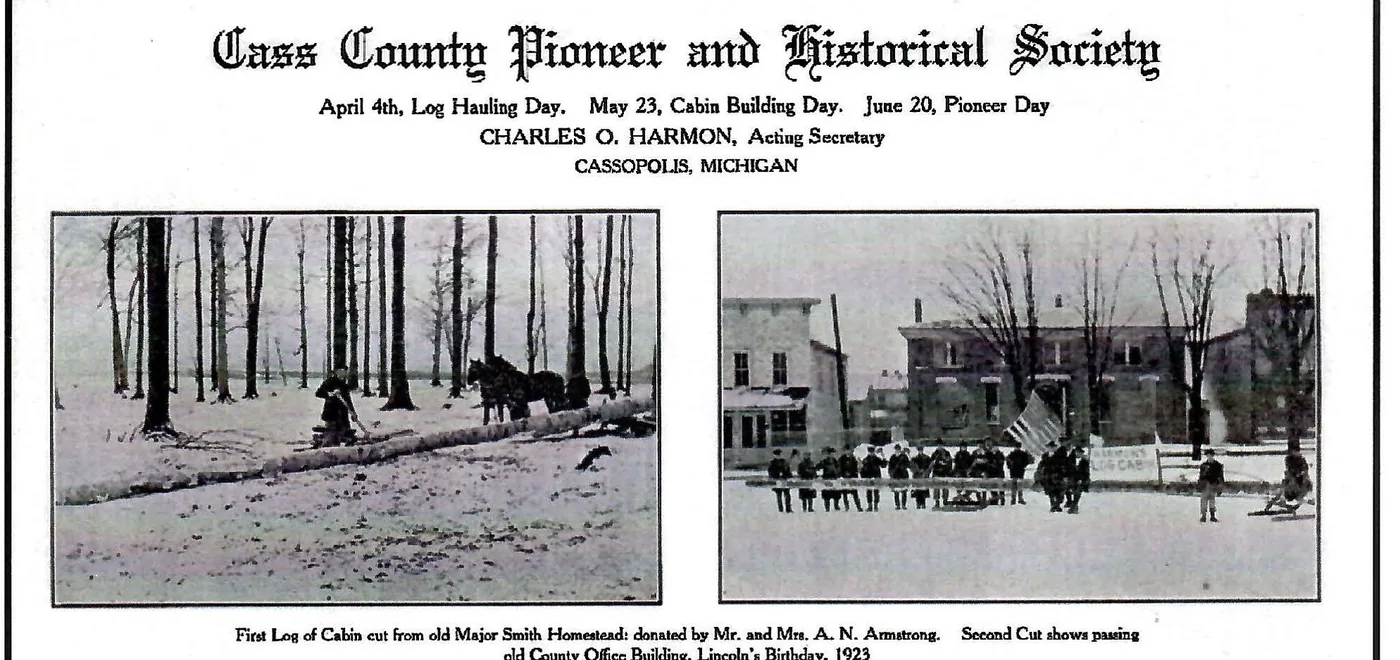 12 Feb 1923Lincoln’s Birthday: the first log, a beech, is hauled past the old county office building
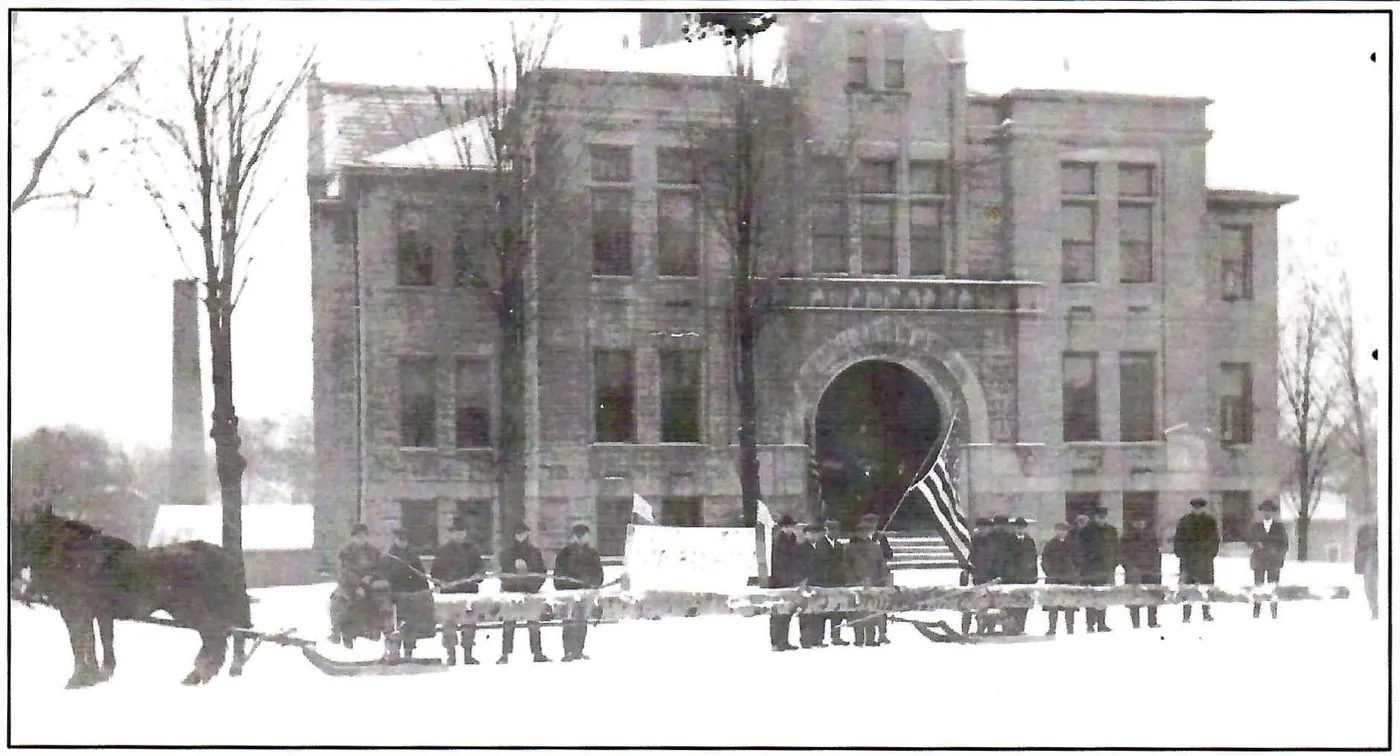 Probably 12 Feb 1923The first log cut reaches the Court House
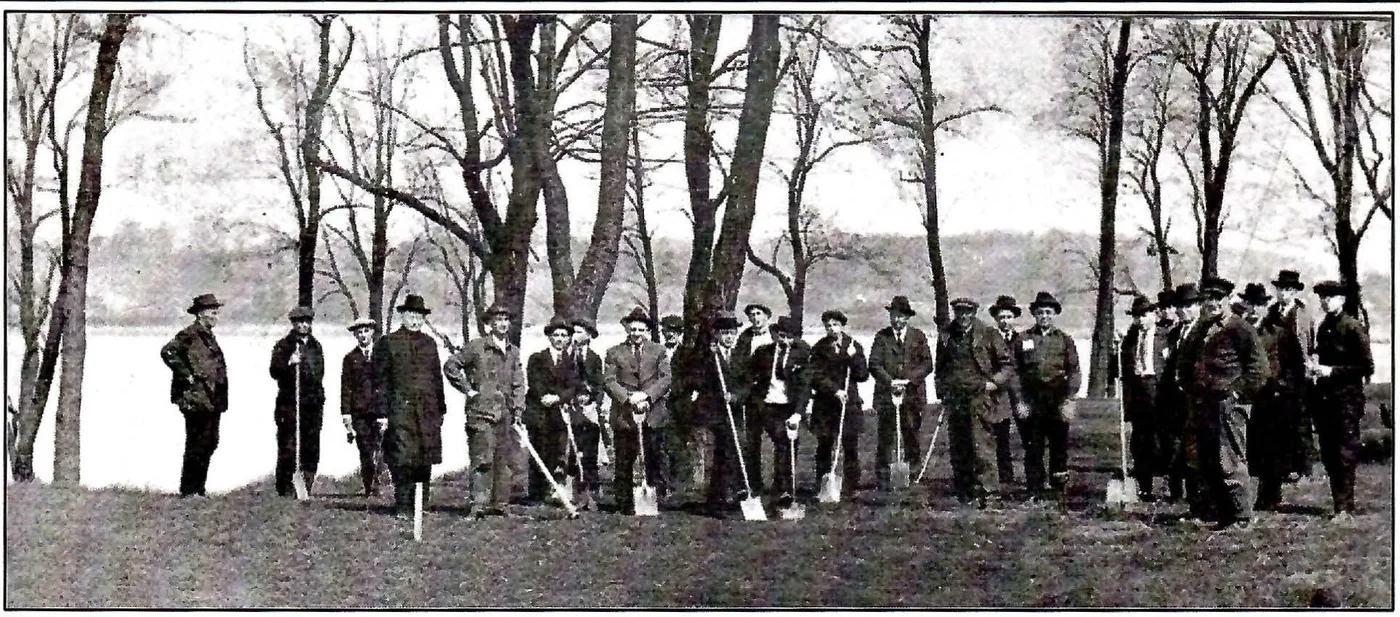 14 May 1923Ground is broken on the shore of Stone Lake
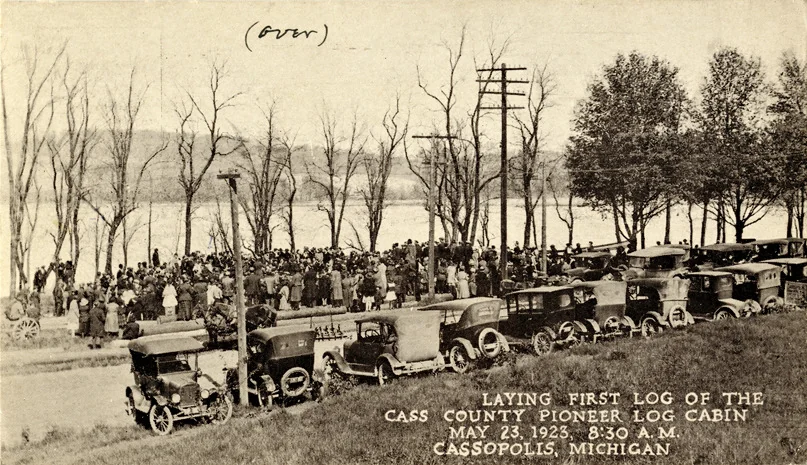 23 May 1923The first wall log, a black walnut, is laid before about 3,000 people
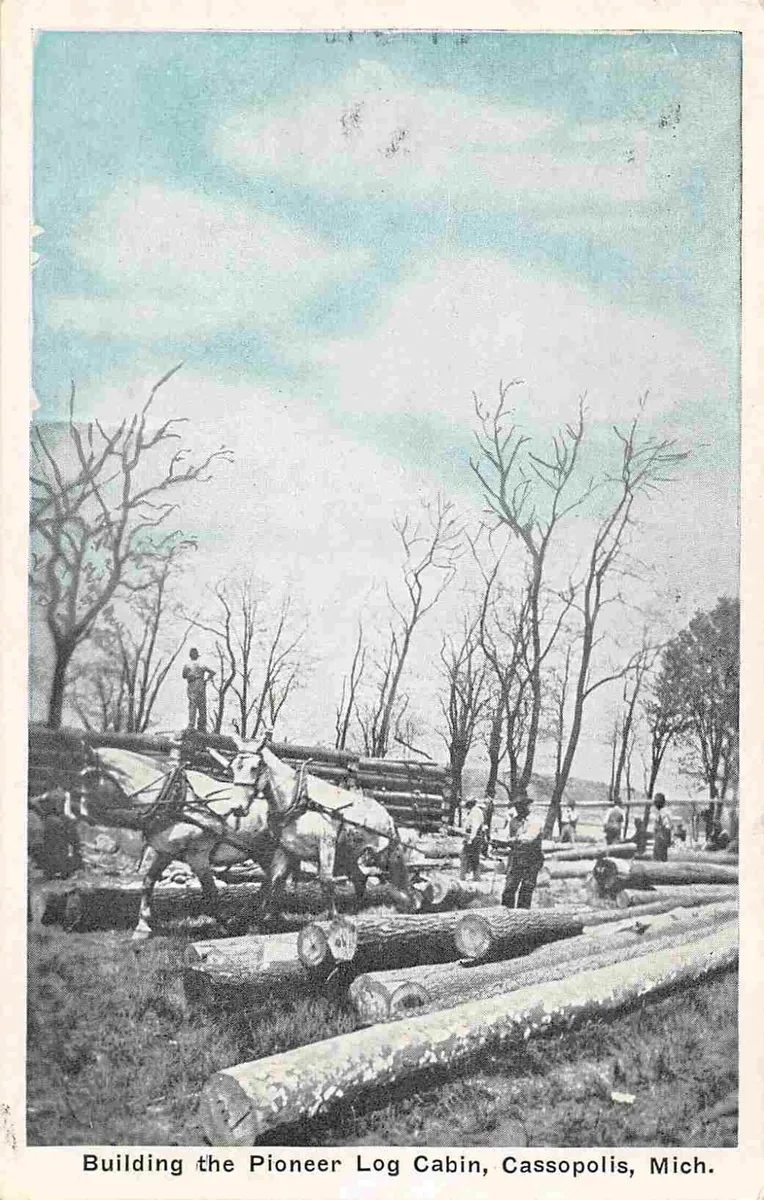 May 1923Teams bring in the logs as the walls rise
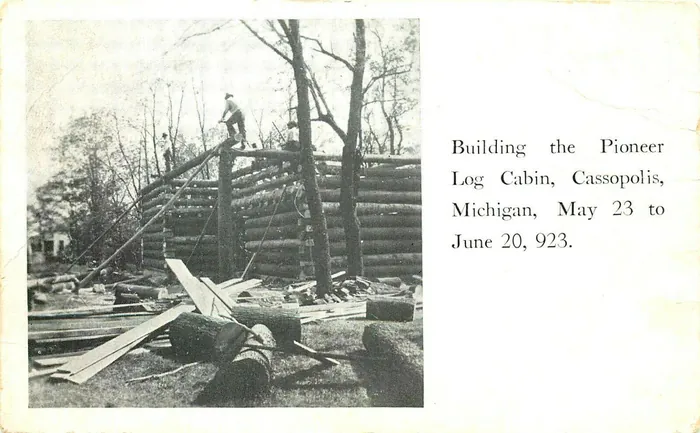 1 Jun 1923The walls are up to the second story
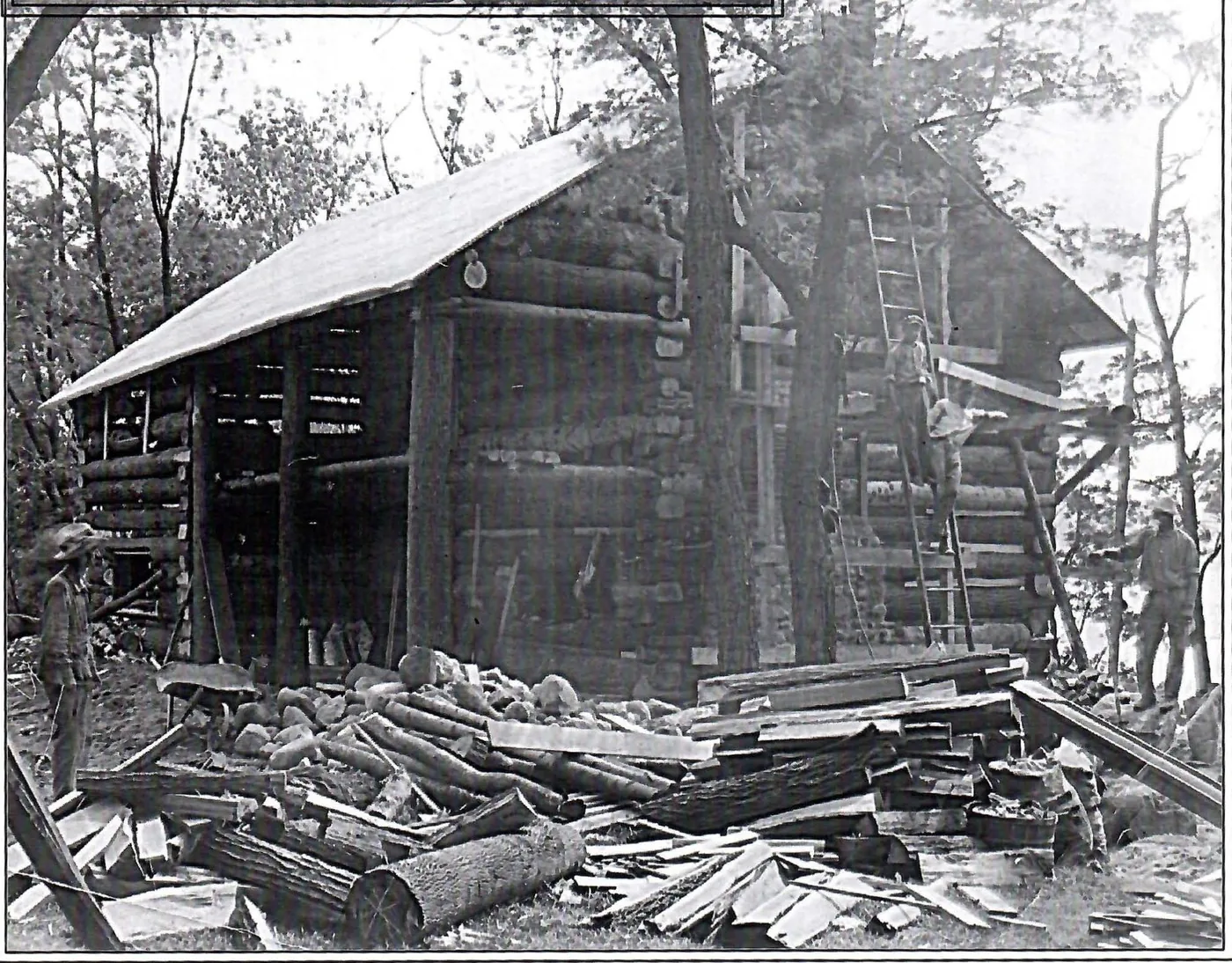 20 Jun 1923Pioneer Day: the cabin is dedicated
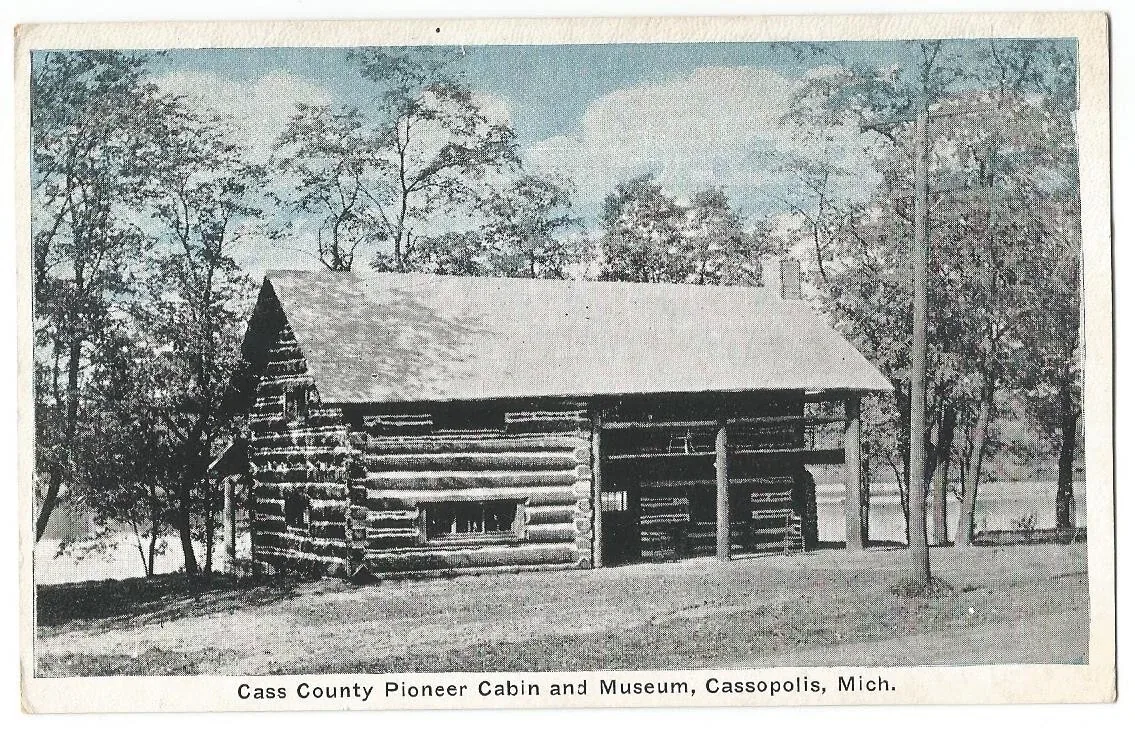 18 Jun 1924The museum opens in the cabin
Scroll for more. The pictures illustrate each step and are those shown in this story; not all were taken on the day itself.
Documented The idea began with Charles O. Harmon, a Cassopolis lawyer and the secretary of the Cass County Pioneer Society, which he had set about reviving in January 1923. That winter he wrote postcards and letters to the county’s surviving pioneers. According to the history compiled from the cabin’s papers, the cabin “was originally conceived as a temporary structure for the Pioneer Day Picnic.” Yet in March 1923 the News-Times already said the logs would be drawn to the fair grounds on Log Hauling Day and that the cabin “is to shelter the historical curios of the county” (23 March 1923). Families were asked to cut a log from their own woodlots and bring it into the village.
Documented Harmon’s letter to the donors was practical. It asked whether each could bring a log on hauling day, how long it would be and whether they could drive a team, and it promised a free dinner. When he wrote it, “twenty-three logs are on the ground,” and in early March a report from Dowagiac said, “Logs are now being hauled to Cassopolis” (News-Times, 9 March 1923). Log Hauling Day was set for Wednesday, 4 April 1923. The booklet says the haulers met at the south end of town and paraded past the Court House. New finding A report from Cassopolis dated 6 April gives the scale: some eighty farmers came to town “with auto trucks, teams and tractors,” paraded through the streets behind two bands, and took their logs of ash, maple, oak, sycamore, whitewood and birch to the fair grounds (News-Times, 7 April 1923). Documented By the end, the booklet says, 146 logs were banked on the ground, and everyone who brought one was given a chicken dinner. Open The same report says the farmers came on “Thursday,” which would be 5 April. Whether the day was put off by one day, or the report is loose, we have not settled.


Documented The first log cut for the cabin was a fifty-two-foot beech “from the Major Smith Homestead,” given by Mr. and Mrs. A. N. Armstrong of Cassopolis. It is No. 1 on the donor list. Mrs. Armstrong was the Major’s granddaughter (see the mysteries below).

Twenty-four men and a black walnut log
Documented Building day had its speeches: Harmon welcomed the crowd and introduced the village president, Asa K. Hayden, and Charles H. Kimmerle. New finding Asa Hayden was a son of the old Pioneer Society: his father, James G. Hayden, had been one of its officers as late as 1917. Documented Charles Kimmerle was a son of Henry Kimmerle, and a Henry Kimmerle is on Glover’s list as the Society’s president in 1888. Reading They were almost certainly the same man: Glover’s history knows only one Henry Kimmerle, a pioneer of 1833 who farmed four miles west of Cassopolis and whose name is on the Society’s roll (Part 1). So the revival of 1923 was carried in part by the children of the society it revived. Documented Mrs. Addie Tietsort was there; she owned the original parchment deed to the ground, issued to her pioneer ancestors in 1831 under President Andrew Jackson. Documented She was the widow of John Tietsort, the eldest son of Abram Tietsort Jr., who had built a log cabin on the lake’s east bank in 1830, and in 1873 John had been the Pioneer Society’s first assistant secretary (Part 1). Reading So the “pioneer ancestors” were very probably her husband’s family. The speaking program closed with the schoolchildren singing “America.” On the back of a postcard of the moment, now in the Burton Historical Collection of the Detroit Public Library, someone wrote: “The 1st log, a 26 ft black walnut was placed at 8:30 am witnessed by 3000 people, many from 50 miles drive. Carried to place by 24 men as the band played and the 3000 voices sang ‘Home sweet home.’” That morning has a story of its own.

Documented A second card, the one at the top of this page, shows the walls already rising, with a crowd around them. On its back, in handwriting, is a line signed with three initials, transcribed in the library’s catalogue: “The first fore-noon’s work, done by 52 volunteers. C.O.H.” New finding Those are almost certainly Charles O. Harmon’s initials. If so, the man who organized the cabin was also writing notes for posterity on its souvenir cards.


Documented Ground had been broken nine days earlier, on Monday, 14 May, when a party of men with spades posed on the lakeshore for a postcard lettered “Ground Breaking for Cass County Pioneer Log Cabin” and dated 14 May 1923. The work had a foreman. Ed Ferguson, an experienced cabin builder, supervised the construction, the booklet says; a crew of 46 men assembled for it, and Tom Connelly and Mack Weikel are named for the axe work. Trenches were dug around the outline, filled with cobblestone and grouted with concrete for a foundation, and Ack Anderson built the fieldstone fireplace and the stick chimney. By 1 June the walls were up to the second story, with the materials and the labor given, the paper said. On Pioneer Day, 20 June 1923, the cabin was dedicated to the pioneers of Cass County, and there was a log-riding contest on Stone Lake.

Did your family give a log?
Documented Every log has a number, and every number has a name. The list, published in the cabin’s 2012 booklet, gives the donor for all 144 numbered logs, and for most of them the post-office town and the kind of wood. Eighty-three came from Cassopolis people; others came from Dowagiac, Marcellus, Vandalia, Edwardsburg, Decatur, Jones, Wakelee and across the state line at Bristol, Indiana. Twenty-eight of the entries mention a woman. Some logs were given in memory of the dead, such as “Myron & Minnie Robinson (dec’d),” and some by a son “for Father.” No. 119 is “2 pine logs for chinking.”
Cassopolis 83 logs · most often whitewood 16, oak 16, beech 7
- No. 1 A. N. Armstrong · beech · 52 ft
- No. 3 W. B. Spyer · sycamore · 26 ft
- No. 6 Jay C. Northrop · walnut · 26 ft
- No. 8 C. J. Griffis · whitewood
- No. 9 Wm. Wade · hackberry
- No. 10 Geo. McCoy · red elm
- No. 11 Frank Underwood · whitewood
- No. 15 Joseph Burnes · butternut
- No. 16 John. L. Stevens · w. oak · 26 ft
- No. 20 Don E. Hurlbut · r. oak · 26 ft
- No. 26 Chas. F. Northrop · beech · 12 ft
- No. 27 James W. Springsteen · walnut · 18 ft
- No. 28 Henry Springsteen · walnut · 18 ft
- No. 29 Mrs. Frank Miller · pine · 18 ft
- No. 34 Geb Rude · beech · 12 ft
- No. 36 Arthur & Mary Playford · walnut
- No. 37 Mary Ann Adamson · red oak
- No. 38 Geo. Keene · sug. maple · 12 ft
- No. 39 Sylvester Smith · sug. maple · 12 ft
- No. 40 Mr. & Mrs. Harvey Feirick · beech · 12 ft
- No. 41 Mrs. Mary Feirick · beech · 12 ft
- No. 42 I. R. Shurte · butternut
- No. 45 Ritter & Funk · ash · 26 ft
- No. 46 Joe Lybrook · maple · 26 ft
- No. 47 Sam Holtz · r. oak · 26 ft
- No. 50 Gene Wooden · w. oak · 12 ft
- No. 51 Cornelius Lawson · maple · 10 ft
- No. 53 Mark Witherell · red oak · 18 ft
- No. 55 S. A. Bogue (Walter Bogue) · pin oak · 26 ft
- No. 57 E. H. Black · w. beech · 18 ft
- No. 59 J. W. Billingham · hickory · 18 ft
- No. 60 John F. Wade · red oak
- No. 61 Ben Akin · cherry · 12 ft
- No. 62 Ira Reames · yellow oak · 18 ft
- No. 63 Thomas McCully · red elm · 26 ft
- No. 64 Clarence Lawson · red oak · 12 ft
- No. 66 May Kingsbury · yellow pop. · 18 ft
- No. 71 Spaulding Est. (W.W. Warren) · whitewood · 16 ft
- No. 72 C. R. Dodge · red oak · 26 ft
- No. 81 Richard Rinehart · yellow poplar
- No. 85 Joe Parker · r. oak · 8 ft
- No. 86 Jerome Cousins · sycamore · 16 ft
- No. 87 Emma Ritter & Ida VanRiper · maple
- No. 91 Freeman Robinson · elm · 4 ft to 6 ft
- No. 97 H. G. Leich · whitewood
- No. 102 Winfield S. Leach · walnut · 5 ft
- No. 103 J. T. Pemberton · maple · 18 ft
- No. 104 J. T. Pemberton for father · maple · 12 ft
- No. 105 Henry Messenger · whitewood
- No. 106 Henry Messenger · whitewood
- No. 107 Giles Morton · birch
- No. 109 Francis Gleason · whitewood
- No. 110 Archie Gleason · whitewood
- No. 111 H. W. Crook · whitewood
- No. 112 Mrs. B. F. Marsh · locust
- No. 113 Claude Marsh · locust
- No. 114 Wm. Allen · grey ash · 16 ft
- No. 115 Mary June Dool · hickory elm · 42 ft
- No. 116 Mary Kimmerle King · white ash
- No. 117 Emily Haines · whitewood
- No. 118 Emily Haines · whitewood
- No. 119 Henry Jones · pine
- No. 120 Wilson Decker · red oak
- No. 121 Wilson Decker · oak
- No. 123 Walkers Woods(Frank Walker) · hickory
- No. 124 Walkers Woods (Frank Walker) · hickory
- No. 125 May Springsteen Gleason · whitewood
- No. 126 Harry Gleason · whitewood
- No. 127 Belle Donough Gleason · whitewood
- No. 128 Frank & Helen Gleason · whitewood
- No. 129 Dr. K. · oak
- No. 130 Dr. K. · oak
- No. 131 Ab Dool
- No. 132 Ab Dool
- No. 133 Ab Dool
- No. 134 Mrs. Oscenia Sears · w. ash · 30 ft
- No. 135 French Alexander · beech · 26 ft
- No. 136 Mrs. Emma Clark
- No. 137 Mrs. Emma Clark
- No. 138 Mrs. Emma Clark
- No. 142 McNab · ironwood
- No. 143 Harry Gleason
- No. 144 Art Nixon for Nixon Estate
Dowagiac 13 logs · most often elm 5, beech 3, whitewood 2
- No. 18 Levi Merritt · elm · 12 ft
- No. 19 John Clendenin · elm
- No. 21 Elmer Griffis · whitewood · 8 ft
- No. 22 James Griffis(Elmer Griffis) · whitewood · 8 ft
- No. 23 Chas. E. Howard · elm · 8 ft
- No. 24 Martha A. Howard · elm · 8 ft
- No. 89 E. J. Robinson · elm · 12 ft
- No. 95 Edgar Gard · cherry · 12 ft
- No. 101 Wm. N. Wright · cherry · 12 ft
- No. 108 M. L. Morton · birch
- No. 139 Richard Hartsell · beech
- No. 140 Giy Hartsell · beech
- No. 141 Lyle Hartsell · beech
Marcellus 12 logs · most often whitewood 3, oak 2, maple 2
- No. 2 J. M. East · oak · 26 ft
- No. 12 Edwin McKinzie · whitewood
- No. 13 Geo. Cropsey(Otis Cropsey) · maple · 18 ft
- No. 32 Paul & Mildred Savage · wild cherry · 18 ft
- No. 54 Wm. & John Cowham · cherry · 18 ft
- No. 68 I. M. Smith · g. oak · 12 ft
- No. 76 Len Norton for Father · maple · 12 ft
- No. 84 Clyde Goodrich · hickory · 18 ft
- No. 92 Otis Huff for father · walnut · 12 ft
- No. 93 Geo. Nash · whitewood · 12 ft
- No. 94 Julias Waterstradt (write Bros.) · whitewood · 18 ft
- No. 122 W. R. Shetterly
Vandalia 12 logs · most often oak 3, beech 3, walnut 2
- No. 14 J. N. Curtis · tamarack
- No. 33 Wm. Johnson · w. oak · 18 ft
- No. 58 Chas. Carter · w. beech · 26 ft
- No. 65 W. W. Hollister · red oak · 18 ft
- No. 73 O. J. Williams · walnut · 10 ft
- No. 75 Frank Chapman · w. oak · 12 ft
- No. 77 Mrs. Conrad Gephard · w. beech · 10 ft
- No. 78 Lyman Gephard · w. beech · 10 ft
- No. 79 Martin Gephard · whitewood · 18 ft
- No. 80 Gilbert Wright · elm
- No. 83 W. A. Locke · cherry · 4 ft
- No. 96 Elam Green · walnut
Edwardsburg 7 logs · most often oak 4, cherry 2, beech 1
- No. 35 Will Bement · yellow oak · 12 ft
- No. 48 H. A. Hanson · cherry · 12 ft
- No. 49 H. A. Hanson · cherry · 16 ft
- No. 52 Charlie Hanson · yellow oak · 18 ft
- No. 67 G. H. Redfield · w. beech · 26 ft
- No. 69 Jasper Ross · red oak · 18 ft
- No. 70 Jasper Ross · r. oak · 18 ft
Decatur 5 logs · most often elm 2, walnut 1, sycamore 1
- No. 17 Owen Scutt · walnut · 18 ft
- No. 25 Thomas Rutherford · sycamore · 18 ft
- No. 56 Fred Pollock · w. elm · 18 ft
- No. 90 Otis Huff or Lytle Robinson · elm · 8 ft
- No. 100 Mrs. Matilda Cary · cherry · 10 ft
Bristol, Ind. 3 logs · most often cherry 2, oak 1
- No. 4 Chancey Krouse · cherry · 26 ft
- No. 5 Geo. McNanee · cherry · 26 ft
- No. 82 John Rine · w. oak · 4 ft
Jones 3 logs · most often walnut 1, ash 1, hickory 1
- No. 7 Frank East · walnut · 18 ft
- No. 43 Geo. Tolbert · ash · 14 ft
- No. 44 Aaron Arnold · hickory · 14 ft
Wakelee 1 log
- No. 74 J. B. Cox · walnut · 4 ft
No town given 5 logs · most often ash 2, walnut 2, elm 1
- No. 30 Frank & Mary Savage (dec'd) · ash · 18 ft
- No. 31 Richard & Sarah (dec'd) · w. ash · 12 ft
- No. 88 Myron & Minnie Robinson (dec'd) · elm · 12 ft
- No. 98 James M. Wright & Wife (dec'd) · walnut · 12 ft
- No. 99 J. H. Warner & Wife (dec'd) · walnut · 12 ft

Tap or click any bar for the count.
Documented The woods tell their own story. Oak is the commonest, with 26 logs (red, white, yellow and pin oak), then whitewood or yellow poplar with 23, beech with 14, walnut and elm with 13 each, cherry with 11 and maple with 9; ash, hickory, sycamore, butternut, pine, birch, locust, hackberry, tamarack and ironwood make up the rest. An undated postcard, probably of the 1920s, speaks of 38 varieties of 20 native species, gives the cabin as 36 by 42 feet overall, and says its logs would stretch 2,800 feet laid end to end. Reading The list is a census of the county’s woodlots in 1923, taken by the people who owned them.
Ten things you probably didn’t know about the cabin
1. It was never supposed to last. Documented According to the cabin’s papers, it was planned as a temporary building for the Pioneer Day picnic. It is now more than a hundred years old.

2. The pieces inside have donors too. Documented The cabin’s papers list some forty-five gifts of boards and fittings from about thirty givers: the mantel, a bench on the front porch, the legs of an exhibit table, a corner shelf, the casings of a particular window. Four lines simply begin “From Mill.”
3. The wood of the doors is older than the cabin, by a lifetime. Documented The doors were made of black walnut boards more than seventy-five years old, the stair rail of lumber from an 1845 barn, and the door hinges of hickory. Some logs were sawn into boards for the upstairs floor.
4. Nobody bought “one square inch.” Documented A 2003 newspaper account says that, to raise money for the museum, Harmon sold “lots” of the cabin ground “of one square inch each for one dollar.” The cabin’s papers tell it differently. In June 1924, to clear a remaining debt of $1,200, the grounds were platted into 1,212 “souvenir lots,” each one foot wide by three feet long, offered at $1 each. A Society letterhead of 18 August 1924 counts 728 subscribers; since one person could buy several lots, that does not tell us how many of the 1,212 were taken. Every buyer signed a certificate giving the lot back to the Pioneer Society.

5. It opened more than once. New finding After the dedication in June 1923, the papers announced a “grand opening day for the completed log cabin” for Wednesday, 17 October 1923. Documented The museum opened on Pioneer Day, 18 June 1924. The story of the two openings is told in The cabin that opened twice. Some modern summaries give 17 June 1924 for the museum’s opening; 18 June was the Wednesday.
6. It had its own song. Documented At a commemoration at the cabin on Sunday, 28 October 1923, the program included a poem to the cabin by Ralph Scoles Thomas, “the Blind Poet.” New finding It also included a song, “Old Log Cabin,” with words by Jay C. Northrop (South Bend News-Times, 24 October 1923), who had given log No. 6. See “Old Log Cabin”.
7. A woman was born on this ground, says the record. Documented The cabin’s papers record that Julia Tietsort, the first white child in the township, was born in a cabin at this site. A county history of 1882 says that in 1830 Abram Tietsort Jr. “built a small log cabin on the east bank of Stone Lake,” and that Julia Ann Tietsort “was born there July 3, 1830, and was the first white child which had its nativity in Cassopolis.” Open The 1893 memorial of her mother calls Julia “the second white female child born in Cass county,” and the 1882 history places the Tietsort cabin “near the spot where the bowl factory now stands,” “between the sites of the foundry and bowl factory”; an 1899 directory puts it “near the place where the ice houses now stand, but it was south of the village plat.” Whether that was this ground is not yet shown. Documented The same book, in its chapter on the township, gives the township’s first white child as Mary Bonnell, born 6 January 1830, and says Julia Ann “has been commonly considered” the first.
8. In 1931 it stood “on M-60.” Documented When Michigan History Magazine listed the state’s historical markers and memorials in 1931, it described the “Pioneer log cabin on M-60, corner of Broadway and South Sts., Cassopolis. Erected in 1923 by the citizens of Cassopolis largely through the efforts of Chas. O. Harmon,” and said it held “a large collection of pioneer relics” that were “supported by the Women’s Club of Cassopolis.”
9. It once closed, and was brought back. Documented According to the cabin’s papers and a 2003 newspaper account, the museum was open in summers for years and then closed as interest faded. George R. Fox and Joseph K. Ritter, the son of the Society’s treasurer of 1924, Charles A. Ritter, among others, worked with local businesses and organizations to reopen it. Reading Fox settled in Cass County about 1933 and died in 1963, and a 1941 state guide lists the cabin as open June to September, so the reopening came between about 1933 and 1963; whether it was before or after 1941, the record does not say. Open When it closed, and for how long, is not yet known.
10. “An apparent oversight of many years.” Documented The souvenir-lot certificates of June 1924 said the money was going to the cabin’s debts “according to a Lease Deed from said Village of Cassopolis, conveying to The Cass County Pioneer and Historical Society, the Pioneer Log Cabin Grounds.” New finding In June 1972 the Cass County commissioners took a 99-year lease on the cabin grounds from the Village of Cassopolis, at $1 a year. The Herald-Press called it “rectifying an apparent oversight of many years”: the question had come up when the county was asked to cover the museum under its liability insurance, and a check showed the village still held title. The museum, the paper said, was run by the “Cass County Pioneer and Historical association.” Reading That lease runs to about 2071, at a dollar a year, the price of a souvenir lot. Open Whether the 1924 lease deed was ever signed and recorded, and what became of it, is not known. A lease would have left the title with the village, as the 1972 check found it.

Who has looked after the cabin
Documented Charles Owen Harmon died at his home on North O’Keefe Street on Monday, 26 March 1928, aged 62, five years after the logs came in. He had been ill with tuberculosis for two years. He was buried at Prospect Hill Cemetery in Cassopolis with Masonic rites, under a stone he shares with his wife, Catherine Greenawalt Harmon, who died in 1931. His obituary remembered a lawyer of 33 years and a former county clerk who in 1924 “reorganized the Cass County Historical Society, and was secretary of that organization” (South Bend News-Times, 29 March 1928). It does not mention the cabin.

Documented The caretaker was Peter Eby. A Peter Eby, born in 1848, was a son of Gabriel Eby, and Glover’s county history of 1906 calls him the brother of “Catherine, the widow of John B. Harmon,” Charles Harmon’s mother. Reading The caretaker was almost certainly that Peter, which made him Harmon’s uncle. New finding No earlier account of the cabin we have found names its caretaker. Open When he was chosen is not recorded. Documented He was still on duty past eighty in June 1930, and died in January 1935, aged 86. See The caretaker was Harmon’s uncle.

Documented Since 1923 the cabin has passed through several pairs of hands:
- 1923 to the 1930s: the Cass County Pioneer and Historical Society, with, by 1924, Benjamin Franklin Thompson, a Cassopolis merchant (1856–1929), as president through 1928, Charles A. Ritter as treasurer and Harmon as secretary. Its picnic at the cabin drew 5,000 to 8,000 people in 1924. No picnic was planned for June 1928, after Harmon’s death. By 1930 Ritter was the last of the original officers; he died at Cassopolis on 12 October 1933, and his son Joseph gave the details for his death certificate. A 1933 directory says the cabin was “owned by” the society, and a 1941 state guide lists it as open June to September.
- 1930–31: the Cassopolis Woman’s Club began cataloguing and labeling the relics in 1930; the club’s officers were Mrs. F. E. Sinclair, president, Mrs. A. D. Greenawalt (so printed; we read her as very probably Mrs. Adam B. Greenawalt, whose husband was the brother of Harmon’s widow, Catherine), vice-president, Mrs. Edith Parker, secretary, and Mrs. S. A. Noecker, treasurer. In 1931 the relics were “supported by the Women’s Club of Cassopolis.” At the village centennial that August much of the program was held at the cabin, with a pageant scene of the pioneers’ picnic of 1876, and the souvenir airmail cachet carried an engraving of the cabin by Helen Fitzsimmons.
- Sometime between the 1930s and 1960s: a closing, and a reopening with help from George R. Fox and Joseph K. Ritter.
- 1961–65: Mrs. Arthur Nixon, director, with the cabin open daily from 15 June to 1 September (Museums Directory, 1961 and 1965). Reading She was almost certainly Tillie J. Nixon of Cassopolis, Arthur Nixon’s widow. Documented Tillie Nixon, a retired teacher in the Dowagiac and Cassopolis schools, died in 1975; her obituary says her second husband, Arthur Nixon, died in 1951, and her first, Fred Mater, before him (Herald-Palladium, 25 August 1975). Documented The last log on the 1923 list, No. 144, was given by “Art Nixon for Nixon Estate.” Reading “Art Nixon” was Arthur K. Nixon, the county’s under-sheriff in 1923, a grandson of John Nixon of Penn Township, whom the county history of 1882 called “the father of the Cass County Pioneer Society” (Part 1). Documented The state’s index of Arthur K. Nixon’s death, in 1951, gives his father as Phineas, and Phineas Nixon’s own death certificate, of 1 June 1901 in Penn Township, names his parents as John Nixon, born in North Carolina, and Esther, born in Ohio. The census of 1850 lists Phineas, aged 11, in John Nixon’s household. New finding So the cabin’s last numbered log was given by the grandson of the man called the Pioneer Society’s father.
- 1972–73: the “Cass County Pioneer and Historical association” ran the museum when the county took its lease. A 20 by 40 foot room replaced the old back porch over the lake; the county commissioners helped pay off that debt in 1973. Lee Dodd was the cabin’s listed contact; he sat on the county board of commissioners in 1972–74, and by 1970 he was also president of the Cass County Historical Society.
- 1975: a Lewis Cass memorial plaque was to be dedicated at the cabin on Saturday, 1 November, by Masonic Lodge No. 55 (announced in the Herald-Palladium, 25 October 1975).
- 2012 to today: a volunteer board, incorporated as the Cass County Pioneer Log Cabin Museum, a Michigan nonprofit, on 17 August 2012 and recognized as a 501(c)(3) charity in July 2013; that year the local paper called its volunteers the “Pioneer Log Cabin Society.” Its articles give its purpose as “to promote and preserve the Pioneer Log Cabin located in the Village of Cassopolis, Michigan and local historical artifacts from the early days of Cass County.” Its annual report of 17 September 2026 lists Darren Bettinger, president of the Cass County Historical Society, as its president too.
Reading So the cabin has a line of its own, running from Harmon’s society through the 1972 association to today’s volunteers. The Cass County Historical Society, which grew from the same roots and today counts the cabin among the historic sites it helps keep, is the subject of Part 3.
What’s inside
Documented The cabin holds the household goods of Cass County’s first century, given by families and later by their descendants. Published accounts mention baby shoes, a long black dress, wire-framed spectacles, the county clerk’s original safe, the desk of A. H. Redfield, Cassopolis’s first postmaster, dollhouses and toys, Civil War memorabilia, household tools, pots and dishes, and a case of Michigan birds and animals from the 1860s that includes a passenger pigeon. Documented In the years around 1903, when the cornerstone of its new building was laid, the Dowagiac library received from Elias Pardee, “an old resident of the city,” a museum of “stuffed birds and small animals and some very fine deer and elk heads; birds’ nests and eggs, shells, etc.” (Glover, 1906, p. 288). In 1970 the Dowagiac historian Everett Claspy wrote that a Dowagiac library collection, whose donor had died in 1908, had been moved to the log cabin. Reading That donor was very probably Pardee, and the cabin’s bird case very probably began as his gift to the library. New finding Earlier accounts we have found describe the birds but not where they came from.

Documented Some fittings have their givers on record. Andirons, a crane and lug hooks were given for the fireplace, and the cabin’s papers credit Harry Gleason with the mantel, the top of an exhibit table and a shelf in the wing. Documented One small exhibit is especially moving. A 2003 newspaper account describes a doll carriage and doll that belonged to Ethel Harson, a twelve-year-old who died of diphtheria in 1898.
Reading Some of these things may have come from the collection in the courthouse lobby, probably the Pioneer Society’s older museum, before it was moved down to the lake. A doll, a desk, a safe: things like these usually get thrown away. These were kept because there was a log house by the lake to keep them in.


Which Major Smith?
- Which Major Smith? The first log came “from the Major Smith Homestead,” given by Mr. and Mrs. A. N. Armstrong. Documented Glover’s county history of 1906 says that Armstrong, the village postmaster from 1897, married May S. Smith in 1880, “a daughter of John and Adelia (Tietsort) Smith,” and that “the father was a son of Major Joseph Smith, who was a prominent Democrat and early settler of Cass county.” The 1882 history says Joseph Smith (1809–1880) was “commonly spoken of by old settlers as Maj. Smith,” was “Major of the regiment of militia organized in Cass County in 1841,” sat in the first legislature under the state constitution and bought large tracts of land near the village. New finding So the first log came from the homestead of Mrs. Armstrong’s own grandfather. New finding He was almost certainly also the Pioneer Society’s first treasurer of 1873 (Part 1): the Joseph Smith elected to that office came from the Cassopolis area, where the Major lived, and “Maj. Joseph Smith” spoke at the Society’s reunion of 1878. So, almost certainly, the cabin’s first log came from the land of one of the Society’s founders. On her mother’s side she was a Tietsort, the surname of the family whose pioneer cabin stood on the shore. Reading A compiled family genealogy makes her mother, Adelia, a daughter of Henry Tietsort; the county history of 1882 names a Henry among the sons of Abram Tietsort Sr., which would make Adelia a first cousin of John Tietsort. New finding The county atlas of 1872 shows land in the Major’s name north of the village, inside it and south of it: 131½ acres just north of the village line, across the road from the county fair grounds, with no house drawn on it; 38 acres inside the village; and, marked “Jos. Smith,” 154 acres in Jefferson Township, just south of the village toward Diamond Lake, with a house drawn on it. Beside that farm is land marked “J. Smith,” and directly south of it 240 acres of “L. Graham.” In the atlas of 1896 the Major’s widow, Jemima, held land in the same corner north of the village, then 150 acres. Documented The 1882 county history says the Major bought “1,000 acres of land in Jefferson Township” and farmed there for about eighteen years before he turned to trade in Cassopolis, and it names among his children “John Henry,” then deceased, and “Margaret (wife of Lester Graham, of Jefferson Township).” Reading So the farm with the house south of the village, among his children’s land, is the likelier homestead, and the neighboring “J. Smith” may well be John, Mrs. Armstrong’s father. Documented Mrs. Armstrong had left the village by 1928, when the News-Times listed “Mrs. May S. Armstrong, of South Bend, a member of the class of 1879, the second graduated by the local school,” at the Cassopolis alumni banquet.
Why it should be kept
Reading Start with what the county did. In a few months of 1923 a county of farms and small towns raised a two-story log cabin almost entirely out of its own woods. Some eighty farmers hauled logs into town on one day; fifty-two volunteers did the first morning’s work on the walls; families gave a mantel, a porch bench, the casings of a window; Harmon asked his subscribers for dimes for the back-porch steps. The logs, most of the fittings and the work were given, and Harmon set out to pay off the last of the debt a dollar at a time. Nobody had to remember the pioneers that way. It seems they did it because they thought the past belonged to everyone, and that a child ought to be able to walk into it.
Documented The cabin is not listed on the National Register of Historic Places or on the Michigan State Register of Historic Sites, as far as the public listings we checked show. Reading Its protection comes from people: the village that owns the ground, the county that leases it, and the volunteers who open the door. Documented Upkeep costs real money. In August 2012, as the cabin neared its ninetieth anniversary, the local paper reported that it needed a new roof that would cost $12,000. That summer a Cassopolis man and his two grandsons from Mishawaka patched it “to get it through the winter,” and in March 2013 the paper still reported that “the roof needs to be replaced.” That month the Cassopolis–Vandalia Chamber of Commerce gave $3,000 toward the roof and the display cases.

Reading What threatens a log building is slow, not dramatic. The National Park Service’s guide to historic log buildings (Preservation Brief 26) warns above all about water, calls chinking “the least durable part of a log building,” and advises that repairing a log only partly decayed “is always preferable to replacing it.” Those are general principles, not a report on this cabin; we have not seen a condition survey. But a building of hand-hewn logs on a lakeshore, more than a century old, will always need a sound roof, dry sills, sound chinking and someone watching.
“The silent voice of the days gone by of which it and its contents speak in an influence to the younger people, instilling in them a reverence for labor, loyalty, self denial, and patriotism.”
Reading The cabin is a document you can walk into. A newspaper tells you that 3,000 people came; the cabin shows you what they made. The donor list tells you a family gave a cherry log from Vandalia; the wall holds the cherry log. If the building is lost, the list becomes a list of things that no longer exist. A hundred years on, the cabin needs what it needed in 1923: a county that shows up.
The case for the registers
Reading The cabin belongs on the National Register of Historic Places and on the Michigan State Register of Historic Sites. It is more than a century old, it stands where it was built, and its whole making is written down.
Documented The National Register of Historic Places admits buildings tied to events that shaped a community’s history, buildings that show a way of building, and, when time has given them a significance of their own, buildings put up to honor the past (36 CFR 60.4). Pioneer cabins built to keep settlers’ memory are already on it. The Old Settlers’ Association of Johnson County, Iowa, built two log cabins in 1889 and 1913 “to commemorate the community’s common pioneer heritage”; they were listed in 2013. A pioneer log cabin in City Park at Manhattan, Kansas, was listed in 2020, and the Lincoln Pioneer Village at Rockport, Indiana, a set of log buildings of 1934–35, in 1998. Reading We have not found another surviving cabin in Michigan built, as this one was, from logs given by families across a whole county as a pioneer society’s memorial and museum. If there is none, Cassopolis has something rare.
Reading The cabin meets each of those tests. It is the work of a county-wide commemoration and has housed what is probably the county’s oldest museum collection since 1924. It is a full-size two-story log building raised in a single season by volunteers, with 144 numbered logs, nearly all from the county’s own woods. And after a century it has a history of its own, from the souvenir lots to the 1972 lease.
Documented A listing is a mark of recognition. In the words of the state’s preservation office, it “brings honor and recognition to a property and community,” and “can also facilitate investment through rehabilitation projects and tourism and support some grant funding.” Reading A nomination would go best with the support of the Village of Cassopolis, which owns the ground, and of Cass County, which leases it. Open Who would prepare and sponsor a nomination has not been decided. Reading What it needs first is what the cabin needed in 1923: people in the county who say they want it done. If you would like to see the cabin on the registers, tell the village council, the museum’s board, or us.
How you can help
Who’s who across the series
The same names turn up across fifty years and three parts: founders of 1873, their children and grandchildren in 1923, and the keepers who followed. Follow a family from one part to the next.
- George NewtonChaired the first morning of the pioneers’ founding meeting, 1873; the Newton House was his homePart 1Part 3The Newton House
- Major Joseph SmithAlmost certainly the Society’s first treasurer, 1873; the cabin’s first log came from his homesteadPart 1Part 2
- John and Addie TietsortHe was the first assistant secretary, 1873; his widow stood at Building Day, 1923Part 1Part 2
- John and Arthur Nixon“The father of the Cass County Pioneer Society”; the cabin’s last numbered log, from his grandsonPart 1Part 2
- Henry MichaelGave the miniature log cabin, 1878; president, 1896Part 1The miniature cabin
- James G. and Asa K. HaydenAn officer of the Society, 1917; his son, the village president, spoke at Building DayPart 1Part 2
- Henry and Charles H. KimmerleCharles spoke at Building Day; his father Henry was almost certainly the Society’s president of 1888Part 1Part 2
- Charles O. HarmonRevived the Society and led the building of the cabin, 1923–28Part 1Part 2Part 3
- Peter EbyAlmost certainly Harmon’s uncle; the cabin’s caretakerPart 2Part 3The caretaker
- Charles A. and Joseph K. RitterTreasurer of the revived Society, 1924; his son helped reopen the cabinPart 1Part 2Part 3
- Jay C. NorthropGave log No. 6 and wrote the cabin’s song; named as the Historical Society’s secretary in a 1944 directoryPart 2Part 3The song
- George R. FoxHelped reopen the cabin; president of the Historical Society until 1963Part 2Part 3
- Lee DoddPresident, later chairman, of the Historical Society from 1970 or earlier to about 1990, and head of the county Historical Commission in 1974; the cabin’s contact, 1973Part 2Part 3
Timeline
- 1830 Abram Tietsort Jr. builds a small log cabin by Stone Lake; the cabin’s papers place Julia Tietsort’s birth “at this site”
- 1873 The Cass County Pioneer Society founded at the Court House (Part 1)
- Jan 1923 Charles O. Harmon begins reviving the Society
- 4 Apr 1923 Log Hauling Day (the date set)
- 23 May 1923 Cabin Building Day: 146 logs on the grounds; the first wall log, a 26-foot black walnut, laid before about 3,000 people
- 20 Jun 1923 Pioneer Day: the cabin dedicated to the pioneers of Cass County
- 17 Oct 1923 “Grand opening day for the completed log cabin” announced
- 28 Oct 1923 A commemoration at the cabin, with Jay C. Northrop’s song “Old Log Cabin”
- 18 Jun 1924 The museum opens; “more than 5,000” come
- Jun–Aug 1924 1,212 souvenir lots offered at $1; 728 subscribers by 18 August
- 26 Mar 1928 Charles O. Harmon dies
- 1930 The Woman’s Club begins cataloguing and labeling the relics; Peter Eby, past eighty, still caretaker
- 1931 Michigan History Magazine lists the cabin “on M-60”
- 1961–65 Mrs. Arthur Nixon, director
- Jun 1972 The county takes a 99-year, $1-a-year lease on the grounds
- 1972–73 A 20 by 40 foot rear room replaces the back porch
- 2012 The roof patched, and a new one reckoned at $12,000; the Cass County Pioneer Log Cabin Museum incorporated (17 August)
- 23 May 2023 Centennial of Cabin Building Day
- Sep 2026 Darren Bettinger, president of the Historical Society, is listed as the cabin museum’s president
Editorial independence. Project Scroll is an independent publication. It is not affiliated with or sponsored by the Cass County Historical Society or the Cass County Pioneer Log Cabin Museum, and it does not speak for either. Neither organization commissioned, reviewed or approved this story; their names are used only to identify them. We would welcome either organization as a sponsor of this series, and we would be glad to collaborate on research and writing projects or to publish articles by their members and volunteers. Sponsors and collaborators are always credited on the page, and our research remains independent. Ways to work with us ›
Sources
- 1923 Pioneer Log Cabin Museum Searchable Donor List, compiled by Marcia Gaskin (Cassopolis, 2012): the cabin’s history, the numbered donor list, Harmon’s 1923 letter, the 1924 souvenir-lot papers and letterhead. Internet Archive.
- Laying first log of Cass County Pioneer Cabin (postcard, 1923), Burton Historical Collection, Detroit Public Library.
- Men building the Cass County Pioneer Cabin (postcard, 1923), Detroit Public Library.
- Cass County Pioneer Cabin (Auburn Post Card Mfg. Co.), with Harmon’s note on the roof, Detroit Public Library.
- Cass County Pioneer Cabin and Relic Museum (Auburn Post Card Mfg. Co.), Detroit Public Library.
- South Bend News-Times, 18 January, 2 February, 23 March, 23 May and 1 June 1923 (the reorganization and the building). Library of Congress, Chronicling America.
- South Bend News-Times, 21 September and 24 October 1923 (the grand opening and the commemoration). Library of Congress, Chronicling America.
- South Bend News-Times, 18 April, 19 and 20 June 1924 (the picnic at the cabin, 1924). Library of Congress, Chronicling America.
- South Bend News-Times, 27 July 1926, 29 March, 2 April and 15 June 1928, 26 April, 7 June and 29 July 1930 (the Eby family; Harmon’s death; no picnic in 1928; the Woman’s Club). Library of Congress, Chronicling America.
- Michigan death certificates of Charles O. Harmon (1928), B. F. Thompson (1929), Charles A. Ritter (1933) and Peter Eby (1935). Archives of Michigan, Michiganology.
- Percy H. Andrus, “Historical Markers and Memorials in Michigan,” Michigan History Magazine 15 (Spring 1931). Internet Archive.
- Museums Directory of the United States and Canada (1961 and 1965).
- L. H. Glover, ed., A Twentieth Century History of Cass County (1906): the Eby family; Elias Pardee’s gift to the Dowagiac library (p. 288). Internet Archive.
- L. V. Coleman, Historic House Museums (1933): the cabin “owned by” the society. Internet Archive.
- Michigan: A Guide to the Wolverine State (Federal Writers’ Project, 1941). Internet Archive.
- Handbuch der Museen (1973): the cabin’s contact.
- Herald-Palladium (Benton Harbor), 25 August 1975 (Tillie J. Nixon). Internet Archive.
- Herald-Palladium (Benton Harbor), 29 May 1976 (Lee Dodd, president of the Cass County Historical Society). Internet Archive.
- St. Joseph Herald-Press, 14 June 1972 (the county’s 99-year lease). Internet Archive.
- Alfred Mathews, History of Cass County, Michigan (1882). Internet Archive.
- Cass County memorial transcriptions, 1893. MIGenWeb.
- Marcia Steffens, “Log Cabin Days,” Leader Publications, 26 June 2003.
- “Log cabin in need of new roof,” Leader Publications, 26 August 2012.
- “Pioneer Log Cabin gets $3,000 donation from chamber,” Leader Publications, 20 March 2013.
- Michigan State Historic Preservation Office, National Register of Historic Places Preliminary Questionnaire (updated 30 June 2022), introduction; and general guidance for National Register nominations in Michigan.
- Michigan corporation files of the Cass County Historical Society (ID 800837091: articles of incorporation, 1977; annual reports 1994 and 2007–2026) and of the Cass County Pioneer Log Cabin Museum (2012–2026). Michigan Department of Licensing and Regulatory Affairs.
- Bruce D. Bomberger, Preservation Brief 26: The Preservation and Repair of Historic Log Buildings (National Park Service, 1991).
- 36 CFR 60.4, National Register criteria for evaluation.
- “Pioneer Log Cabin Museum,” Wikipedia (exhibits; the 17 June 1924 date).
- “Log cabin museum open on Dec. 1,” Leader Publications.
- Library of Michigan, Michigan Authors entry for George R. Fox (career table: 1933, Dowagiac).
- Wisconsin Archeologist 44 (1963): obituary of George R. Fox. Internet Archive.
- W. A. Norton’s directory of Dowagiac, Cassopolis and nearby townships (1899), p. 233: the Tietsort cabin. Internet Archive.
- Gravestone of Charles Owen Harmon (1866–1928) and Catherine Greenawalt Harmon (1864–1931), Prospect Hill Cemetery, Cassopolis; photograph on Find a Grave, memorial 103861338.
- Lincoln Pioneer Village (Rockport, Indiana), Wikipedia: built 1934–35, listed on the National Register 1998.
- Village of Cassopolis, Parks and Recreation.
- Pioneer Log Cabin Museum community page (Facebook).
- Herald-Palladium (Benton Harbor), 25 October 1975 (the Lewis Cass plaque) and 29 October 1976 (Lee Dodd, county commissioner 1972–74). Internet Archive.
- IRS exemption record, Cass County Pioneer Log Cabin Museum. ProPublica Nonprofit Explorer.
- Leader Publications, 28 June 2013 (the “Pioneer Log Cabin Society” and the 90th Log Cabin Day).
- South Bend News-Times, 18 and 19 August 1931 (the village centennial and its cachet). Library of Congress, Chronicling America.
- Everett Claspy, The Dowagiac–Sister Lakes Resort Area (1970): the Dowagiac library collection moved to the cabin. Internet Archive.
- Postcard, “Ground Breaking for Cass County Pioneer Log Cabin,” Cassopolis, dated 14 May 1923; copies offered for sale online, October 2026.
- George N. Fuller, ed., Historic Michigan, vol. III: An Account of Southwest Michigan and St. Joseph County (National Historical Association, mid-1920s), plate “Cass County Pioneer Memorial Cabin.” Internet Archive.
- South Bend News-Times, 23 March 1923 (“to shelter the historical curios of the county”). Library of Congress, Chronicling America.
- Old Settlers’ Association of Johnson County Cabins (Iowa City), Wikipedia: built 1889 and 1913, listed on the National Register 2013.
- National Register of Historic Places listings in Riley County, Kansas, Wikipedia: Pioneer Log Cabin, Manhattan City Park, listed 3 February 2020.
- D. J. Lake, Atlas of Cass County, Michigan (Philadelphia: C. O. Titus, 1872), p. 17 and p. 25 (Jefferson Township): “Maj. Jos. Smith 131½,” “Maj. J. Smith 38” and “Jos. Smith” with a house. Internet Archive.
- Standard Atlas of Cass County, Michigan (Chicago: Geo. A. Ogle, 1896), p. 19: “Jemima Smith 150.” Internet Archive.
- South Bend News-Times, 9 March 1923, p. 3 (“Logs are now being hauled to Cassopolis”). Library of Congress, Chronicling America.
- South Bend News-Times, 17 July 1917, p. 10 (James G. Hayden buried). Library of Congress, Chronicling America.
- South Bend News-Times, 1 June 1930, p. 10 (Joseph K. Ritter, son of Charles Ritter). Library of Congress, Chronicling America.
- South Bend News-Times, 7 April 1923, p. 3, “80 Farmers Assist Cass Log Rolling.” Library of Congress, Chronicling America.
- Tietsort and Smith family pages (compiled genealogy, citing censuses and FamilySearch), burness.ca.
- Herald-Palladium (Benton Harbor), 25 August 1975 (Mrs. Tillie J. Nixon). Internet Archive.
- Early Burials and Residents of Cass County, Michigan, 1850–1950, vol. 2 (1850 census of Penn Township: John Nixon’s household). Internet Archive.
- L. H. Glover, pioneer necrology for 1901 (Phineas Nixon). Cass County MIGenWeb.
- “Log cabin in need of new roof,” Leader (Dowagiac), 26 August 2012.
- South Bend News-Times, 1 June 1923, p. 3 (the walls to the second story; roofing given). Library of Congress, Chronicling America.
- South Bend News-Times, 26 June 1928, p. 9 (Mrs. May S. Armstrong, class of 1879). Library of Congress, Chronicling America.
- South Bend News-Times, 21 May 1929, p. 14 (obituary of Ezra Planck: Adam Greenawalt and Catherine Harmon). Library of Congress, Chronicling America.
- Museums Directory of the United States and Canada (1961, 1965): “Pioneer Log Cabin … Director: Mrs. Arthur Nixon.” Internet Archive.
- Michigan certificate of death: Phineas Nixon, Penn Township, 1 June 1901 (parents John Nixon and Esther). Archives of Michigan, Michiganology.
- Michigan death index: Arthur K. Nixon, Cass County, 1951 (father Phineas). Archives of Michigan, Michiganology.
- Michigan certificate of death: Charles A. Ritter, Cassopolis, 12 October 1933. Archives of Michigan, Michiganology.
Numbers in the text point to this list; entries without a number are further sources we consulted. How we research › · The libraries behind all our stories ›
Did your family give a log? Part 3: Keepers of the county The cabin’s community page (Facebook)
About this research
Research and reporting Michael Urbanski Project Scroll
- Sources
- Every fact on this page is drawn from the sources listed above, and each can be checked where it is held.
- Corrections
- Errors are corrected on the page, and each correction is noted there.
- Contact
- To report an error or share a record that adds to the story, write to research@projectscroll.com.
- Method
- How we research ›
© 2026 Michael Urbanski and Project Scroll. All rights reserved. The text, original maps, charts and illustrations may not be reproduced without permission; brief quotations with credit and a link back are welcome. Material from other sources belongs to its holders and is credited where it appears; public-domain material is marked as such.


