The Pioneer Society · Part 1
A museum before there was a museum
Nearly fifty years before the Pioneer Log Cabin, Cass County already had a museum: a by-law, a committee and a room in the court house, kept by a society of pioneers whose June picnics drew crowds reported at ten thousand and more. Part 1 of the story of the Cass County Pioneer Society, 1873–1924.
Live research document
This story is part of a series still being researched. The Pioneer Society’s own papers have not yet turned up in the public collections we have searched, and new records are added as they are found.
By Michael Urbanski · Project Scroll · First published · Updated · 34 min read

New finding 9 new findings in this story. See what’s new ›
Cassopolis, Mich. In June 1887 a newspaper reported that a drum had gone missing in Cass County. It was a bass drum “captured on a southern battle field,” said to have been given to the county’s pioneers in 1874, and its inscriptions were said to show it more than two centuries old, “with a record in Scotch regiments” that included the battle of Culloden. “For the last few years all trace of it has been lost,” the paper said, “and the society is anxiously looking for it.” We have found no report that it ever turned up.
The drum is not the only thing missing. The catalogues the society’s by-laws ordered, its journal and its roll of 590 signatures have not been found either. Yet enough survives, in old county histories, reports and scattered newspaper lines, to show that the drum belonged to a museum few people now remember: one that was at work nearly fifty years before the Pioneer Log Cabin was built.
On Wednesday, 18 June 1879, the pioneers of Cass County held their picnic at the county seat, and the news went out across Michigan in a single line: “Ten thousand people attended the annual pioneers’ picnic at Cassopolis, Wednesday. Levi Bishop of Detroit delivered the address.” A paper in Grayling, in the pine country far to the north, printed it a week later.
Ten thousand was a guess, and probably a generous one. But it was a guess the papers made again and again in those years. Once a year the people who had cleared the county’s farms in the 1830s and 1840s came back to the county seat, with their children and grandchildren, to eat, to hear a speech and to put their names on a roll.
And the Society had a museum. Within a year of that picnic it was in the care of the new assistant secretary, I. V. Sherman, at his store. It had a committee, a by-law and a plan for a printed catalogue, and it was nearly fifty years older than the Pioneer Log Cabin that holds the county’s pioneer collection today.
This is the story of that museum, of the society that kept it (the Cass County Pioneer Society, founded in 1873), and of the clues they left behind. It is the first of three parts. Part 2 tells the story of the cabin, and Part 3 the story of the Cass County Historical Society.
The call goes out, 1873

Documented The call went out in the autumn of 1873, and about two hundred of the county’s early settlers answered it. They met at the Court House in Cassopolis on 9 October. George Newton was temporary chairman for the morning, and Uzziel Putnam Sr. was chosen permanent chairman. Glover’s county history says every township was represented except Howard; Mathews’s says Marcellus, Milton and Howard were missing from the morning session. Documented In a biography elsewhere in the same book, Mathews calls John Nixon of Penn Township the man who “may appropriately be called the father of the Cass County Pioneer Society, having made the initial movement for its establishment, and of which he has been President.” Open Nixon is not on Glover’s list of presidents, so either he presided in a year the list does not record or the biography stretched his title. What his “initial movement” was is not described. New finding His family stayed with the story: the last numbered log of the 1923 cabin was given “for Nixon Estate” by Arthur Nixon, his grandson (Part 2).

Documented At an adjourned meeting on 6 November, Mathews says, they adopted a constitution for “The Society of the Pioneers” and elected their first officers: Putnam as president, George Meacham as vice-president, A. B. Copley as secretary with John Tietsort as his assistant, and Joseph Smith as treasurer. Glover puts the constitution, the officers and the first forty-one signatures at the first meeting, on 9 October. Membership was open to anyone who had lived in the county before 1850, for twenty-five cents.
Documented Three of the men named that autumn reach forward into this story. George Newton of Volinia, the morning’s chairman, lived in the farmhouse near Decatur that the Cass County Historical Society keeps today (Part 3). New finding The treasurer, Joseph Smith, was almost certainly the county’s Major Joseph Smith (1809–1880): the founders’ list gives him as a Cassopolis-area man, where the Major had lived since 1855, and “Maj. Joseph Smith” spoke at the Society’s reunion of 1878. And fifty years later the cabin’s first log was cut “from the Major Smith Homestead” and given by his granddaughter (Part 2). The assistant secretary, John Tietsort, was the eldest son of Abram Tietsort Jr., who in 1830 had built a log cabin on the east bank of Stone Lake, and John’s widow, Addie, was in the crowd when the new cabin’s first wall log was laid beside the same lake in May 1923.

Documented Lowell H. Glover, who signed the constitution seventy-second and was the Society’s secretary in most years from 1877 to 1906, wrote in 1906 that it was “older by one year than the State society.” By 1880 the constitution carried 517 signatures, and by 1882, 590.

A museum from the start, 1874–1882
Documented The by-laws, adopted on 21 January 1874, made collecting part of the Society’s purpose. A committee was to gather “books, maps, pictures, relics.” The secretary was to receipt “books, documents, relics, or other articles contributed or deposited in the museum of the society,” acknowledge each gift in the county-seat newspapers, and “make out semi-annually, a catalogue of the same for publication.”
Documented The museum was more than a plan. Howard S. Rogers wrote his 1875 History of Cass County at the request of old settlers “and those who were interested in establishing the Cass County Pioneer Association and Museum.” At the picnic of 21 June 1876 the Society appointed John Haines, Eli Green, William Baldwin and John Struble to raise money “and take proper care of the specimens in the museum.”

Documented By 1880 the collection was living in a shop. That year the Society reported that “the museum has been continued under charge of Mr. I. V. Sherman, at his store,” where Sherman, the assistant secretary, had “carefully cared for” it. Then the county gave it a proper home. The board of supervisors had set apart a room in the Court House for the Society. When C. W. Clisbee’s rental of that room ran out, the Society took possession on 17 May 1882 “and removed the relics to that place,” promising show cases and labels as soon as they could be had.


New finding No modern account of the cabin we have found brings these records together: they show the county’s pioneer museum at work from 1874, about fifty years before the cabin. Reading A society with a by-law requiring a published catalogue, a collections committee, a curator and a room in the county’s chief public building was running a museum by any fair definition. It was doing so decades before the log cabin was built. The building that held that room is the white courthouse that later became the Colonial Opera House; its story is told in The courthouse that became the Colonial.
Ten thousand at the picnic
Documented The Society’s first reunion and picnic was held at the fair grounds on 17 June 1874. At the second, on 16 June 1875, “many interesting relics were exhibited.” After that, Glover says, the reunion was held on the third Wednesday of June “with a single exception of one year.” The reunions were numbered, and the numbers run without a break: the 24th in 1897, the 26th in 1899, the 27th in 1900, the 31st in 1904 and the 33rd in 1906.
Documented They drew enormous crowds for a rural county. At the picnic of 21 June 1876, some three thousand people heard Governor John J. Bagley give an address later printed as Old Times. The next year the attendance was “variously estimated at from 3,500 to 5,000.” Of the picnic of 19 June 1878 a Dowagiac paper wrote, “to say that it was a grand success is mild language,” and forty-one names were added to the roll. New finding Henry Michael “presented to the society a miniature log cabin all complete, which attracted much attention” (Cass County Republican, 26 June 1878). Documented Ten thousand came in 1879, a paper reported; in 1880 “ten thousand being the average guess,” with bands from Volinia, Calvin and Mechanicsburg. In 1881, 5,796 people were counted and about 7,500 estimated, and Governor David H. Jerome spoke. In 1882 the crowd was put at six to eight thousand.

New finding On 18 June 1890, at the seventeenth reunion, the crowd was “estimated over 10,000,” and there were “two successful balloon ascensions and parachute leaps.” Documented The prize clock for the most descendants went to Mrs. Anna East of Vandalia, with 61 (Detroit Plaindealer, 27 June 1890). The prize ten years earlier had been a copy of Levi Bishop’s poems, won by Mrs. Lovina Reames (printed “Reams” in the Cass County Republican), aged 83, with 116 descendants.
Tap or click any bar to see who reported that crowd, and where.
- Counted (1881 only)
- Estimate
- Upper end of a range
- 1923: the first log, not a picnic
- The whole village of Cassopolis
Documented By 1906, Glover wrote, “no less than seven of Michigan’s governors” had come to Cassopolis for the picnic, which was then held in the grove on the fair grounds. Besides Bagley in 1876 and Jerome in 1881, the papers announced Governor Josiah W. Begole for 1883, Governor John T. Rich for 1893 and Governor Fred M. Warner for 1905; Thomas W. Palmer of Detroit, soon to be a United States senator, was announced for 1882, and Judge O. W. Coolidge spoke at the 31st reunion in 1904. The 1904 picnic had a printed program from the Cassopolis Vigilant’s press. The Society paid its way with booth rents and entry fees; its treasurer reported balances of $73.17 in 1879, $114.34 in 1880 and $73.06 in 1882.

Reading The presidents were farmers, merchants and lawyers from every corner of the county, and the office changed hands nearly every June. The full list is at the end of this page.
A drum, a sickle and a beaver’s tail
Documented What did the museum hold? The Society’s reports, the county histories and the newspapers name only a few pieces:
- A piece of oak with clothes-line nails grown over inside it, given by L. B. Reames (1880).
- About a dozen Oregon specimens from “Uncle Ben. Silver”: petrified wood, lava, agates, cinnabar ore that had been shown at the Oregon State Fair of 1879, and a beaver’s tail (1880).
- The lock of the old log jail, made by George Fosdick of Barren Lake (Mathews, 1882). Seventeen years later a directory still called it “a relic in the pioneer museum.”
- A millstone from a township’s “first and only grist-mill,” in “the Pioneer Museum at Cassopolis” (Mathews, 1882).
- A two-tined pitchfork presented by Jedediah Grennell, and a hatchel and flax from William Hass (1882).
- A bass drum “captured on a southern battle field,” the earliest dated gift. An 1887 paper says Sidney Russey gave it in 1874, but his own letter of 1 June 1875 shows it still in his hands. New finding Its giver told its history himself, in a letter from Vandalia dated 1 June 1875 and addressed to G. B. Turner, which the Cassopolis National Democrat printed on 3 June and Tennessee papers copied. Signing himself A. S. Russey, he wrote that a squad of the Eleventh Michigan had captured the drum while foraging on the Nashville pike, about seven miles from Nashville, in 1862; that he belonged to the regimental band and traded his own band drum for it when he was mustered out; that it had split, and about ten inches had been cut off; and that through an air-hole could be read the maker’s name: “Richard Bicknell, Dundee, March 23, 1640.” “I will send it to you the first chance I get,” he told Turner; “you will please take care of it.” The paper wondered whether it had seen Cromwell’s wars in Scotland, and on 4 June its publisher, C. C. Allison, sent it to the Nashville Union and American, asking for anything more of its history (copied in the Memphis Daily Appeal, 12 June 1875). New finding In 1887 a newspaper said its inscriptions and dates showed it to be “more than two centuries” old, “with a record in Scotch regiments” that included the battle of Culloden, and that by then “all trace of it has been lost, and the society is anxiously looking for it” (Ypsilantian, 2 June 1887).
- An old sickle, said to be the first used in the county, brought from Greene County, Ohio, by Baldwin Jenkins in 1834. In 1876 it was in what the Society’s report calls “the Old Settler’s Museum,” “where it may now be found suitably inscribed.”


Documented At the 1882 picnic Orlean Putnam also showed Continental money and three old newspapers: the New England Weekly Journal of 1728, the Boston Gazette of March 1770 and the New York Morning Post of 7 November 1788.

Open Where these objects are now is not known; the drum was already lost by 1887. Some may have gone into the cabin by June 1924 with the courthouse-lobby collection. Others may have gone home with their owners’ families. The catalogues the by-laws demanded would answer the question, if any were printed and survive in the old newspapers.
The quiet years, about 1910–1922
Documented The 33rd picnic, in June 1906, is the last one Glover’s history records. The founders were dying: Glover counted that of the first seventy-two names on the constitution, only five were still living. In 1917 the Society still had officers: John A. Root of Dowagiac was president and J. Boyd Thomas of Cassopolis secretary, and James G. Hayden of Cassopolis was also named. But it reported that “few meetings have been held for the past three or four years” and that “it is now extremely difficult to arouse interest.” Within a few years all three men were dead: Hayden in July 1917, Root in September 1921 and Thomas on 25 April 1924.
Documented The collection still existed in 1906: a biography in Glover’s county history of that year speaks of an object “now in the museum at Cassopolis.” Glover also followed the 1899 directory’s account of the lock of the county’s first log jail, calling it “now a relic in the Pioneer Society’s collection,” and wrote that the village’s ladies’ library was “sheltered in the Pioneer Room of the Court House.” Reading By 1906 “the Court House” was the new stone building, so it seems the pioneers had a room of their own there; whether the relics were kept in it is not stated.

New finding The picnics had not stopped in 1906. The 34th annual reunion and picnic was announced for the fair grounds on Wednesday, 19 June 1907, with Lieutenant Governor Patrick H. Kelley to give the principal address (True Northerner, Paw Paw, 14 June 1907). Kelley, “a native of Cass county,” was announced again for the 35th, on 17 June 1908 (Detroit Times, 9 June 1908). And on 15 June 1910 United States Senator Julius C. Burrows “was the central figure in the annual pioneer picnic celebration,” “delivering an address to the Cass county pioneers” (Detroit Times, 17 June 1910). Documented In July 1916 a paper far to the north reported: “Because there are so few old pioneers left and no one anxious to take up the work, the annual picnic … will probably not take place this year” (L’Anse Sentinel, 1 July 1916). Reading If the numbering ran unbroken, the 1910 picnic was the 37th. With the 1917 report of “few meetings” in “the past three or four years,” the last regular picnics were probably held about 1911 or 1912, and the 1916 notice marks the end. Open No notice has yet been found for 1909, or for any year from 1911 to 1922. Documented The South Bend News-Times, which carried a Cassopolis column, reported no pioneer picnic in the week of the third Wednesday of June in any year from 1913 to 1922 that survives online, and in 1928 it wrote that the reunions had been “resumed in 1924 following a lapse of many years” (15 June 1928; the paper counted from 1924, the year the museum opened, not from the 1923 dedication, as Part 3 explains). Reading So the picnics had very probably stopped by 1913.
Reading The museum seems to have outlived the picnics: by the 1920s a museum collection, probably the Society’s, was on display in the lobby of the Court House. When it got there, and who looked after it in the years between, is not recorded.
The man with the postcards, 1922–1924
Documented The man who woke the Society up was Charles Owen Harmon. He was born in Porter Township on 6 March 1866, the son of a county clerk. He taught school from the age of sixteen, was register of deeds from 1889 to 1893 and worked in the Department of State at Lansing until July 1896, studying law in his spare hours; he was admitted to the bar there. He practiced at Dowagiac and then Marcellus, and in November 1898 came to Cassopolis, where he practiced law and ran the county abstract business. He married Catherine Greenawalt on 6 March 1889, his twenty-third birthday. He was county clerk himself, and by 1925 a circuit court commissioner and secretary of the Cassopolis Community Club. He was a Mason, a Knight of Pythias and a trustee of the Baptist church, and he wrote songs. New finding He registered copyrights in 1921 and 1923, one of them for “On the Winding Christianna.”
Documented In the summer of 1922 Harmon was corresponding secretary of a reunion of the old pupils of a one-room school where the poet Will Carleton had taught. He printed a list of more than four hundred living former pupils, and 126 automobiles came. Reading The next year he seems to have brought the same method to the whole county: a printed appeal, a list and a big day.
Documented The revival began that winter. “Reorganization of the Cass County Pioneer and Historical society has been started by Attorney Charles O. Harmon,” the South Bend News-Times reported on 18 January 1923, and Harmon asked all persons born in Cass County who had lived in it sixty years or more to send him their names. By February more than 600 had enrolled, “Uncle Joe” Cannon was announced as a speaker (no report that he came has been found), “more than 20,000” were expected at the picnic, and “every community in the county will be asked to contribute a log.” In March a division of “Junior pioneers” was formed for members under fifty (News-Times, 2 February and 9 March 1923).
Documented As secretary, Harmon sent postcards and letters to the surviving pioneers asking each to give a log from their own woodlot. By March 1923 the cabin was already meant to house the county’s relics: the News-Times wrote that it “is to shelter the historical curios of the county” (23 March 1923). Log Hauling Day was set for 4 April 1923. Volunteers began raising the cabin on 23 May on the shore of Stone Lake, before about three thousand people, and it was dedicated on Pioneer Day, 20 June 1923, at what the papers called “the revival of the Cass County Pioneer picnic,” with former U.S. Senator William Alden Smith as principal speaker. Building day, 23 May, has its own story: The day 3,000 people came to watch one log.
“Any kind of timber; a foot through at the top end and as near the same at the butt as is usual.”
Documented The Society, now the Cass County Pioneer and Historical Society, had by 1924 Benjamin Franklin Thompson, a Cassopolis merchant, as president, Charles A. Ritter as treasurer and Harmon as secretary. The collection from the Court House lobby was moved into the cabin, people gave more relics to furnish it, and the museum opened there on Pioneer Day, 18 June 1924, before a crowd the News-Times put at “more than 5,000.” To clear the debt, Harmon platted the cabin grounds into 1,212 souvenir “lots,” each one foot by three, and offered them at a dollar apiece; that August he had 728 subscribers. The buyers gave their lots straight back to the Society.

Documented Harmon did not live long to enjoy it. He died on 26 March 1928, aged sixty-two, and is buried at Prospect Hill Cemetery in Cassopolis. His obituary said that in 1924 he had “reorganized the Cass County Historical Society, and was secretary of that organization” (South Bend News-Times, 29 March 1928).
Reading The cabin is usually remembered as the beginning of something. In the Society’s own story it was a homecoming: a museum probably close to fifty years old finally given a building of its own, by a fifty-year-old society that had nearly died.
One society becomes two
Documented The old society was still alive in its new home. On Wednesday, 29 April 1925, the centennial of the arrival in 1825 of Uzziel Putnam Sr., its first president, was to be celebrated at the cabin “under the direction of the Pioneer society” (South Bend News-Times, 29 April 1925), and Michigan History that year called Harmon the “founder of the Pioneer Log Cabin and Museum.” But the story does not end there; it divides. As early as April 1923 a newspaper called Harmon’s society the “Cass County Historical society,” by 1927 the papers were using that short name often, and by 1942 a society of that name had as its president George H. Tolbert, who was married to Charles Harmon’s sister Linda. Meanwhile a “Cass County Pioneer and Historical association” was still running the cabin as late as 1972. Today there are two incorporated bodies: the Cass County Historical Society (1977), and the Cass County Pioneer Log Cabin Museum (2012), which looks after the cabin. Since September 2026 the same man has been listed as president of both.
Reading Both can claim descent from the 1873 society. One kept its purpose and the other kept its building, and we have not yet found a record that documents an unbroken organizational link between either of them and the 1873 society. The cabin’s line is told in Part 2, and the Historical Society’s in Part 3.
Why it matters
Reading The pioneers of 1873 were doing something every family does sooner or later. The people who had cleared the county were dying, and their stories would die with them unless somebody wrote them down. So the Society signed its members on a roll, had its speeches printed, and kept a sickle, a lock and a pitchfork where the next generation could see them. At the picnic of 1878 its historian, C. W. Clisbee, read out the names of about seventy pioneers who had died that year.
Reading Most of what they kept is now lost, and that is the lesson. A collection is only as safe as the people who look after it, and a record lasts only as long as somebody keeps it. What survives best is the log cabin on Stone Lake, which their successors built in 1923 to house what was left. Part 2 tells how, and why it deserves to stand another hundred years.
How you can help
The presidents, 1873–1924
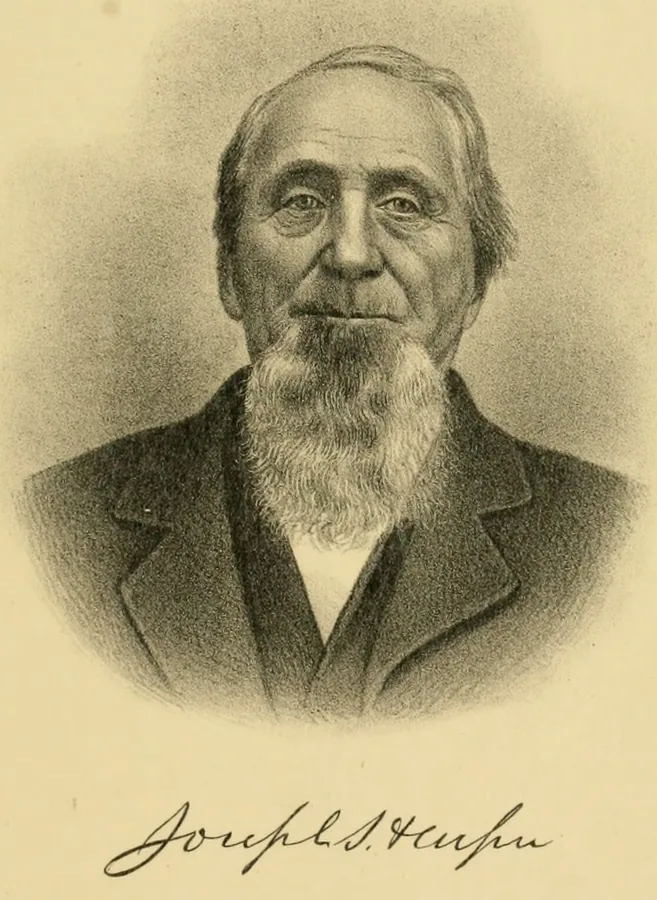
Documented From Glover’s 1906 list, the Society’s reports in the Michigan Pioneer and Historical Collections, and later notices. Years are as Glover lists them; a president elected at one June picnic presided at the next. The portraits are engravings from Mathews’s county history of 1882, which pictures some of the Society’s men but not most; a blank frame is a president whose likeness we have not found. If your family has one, please write to us.
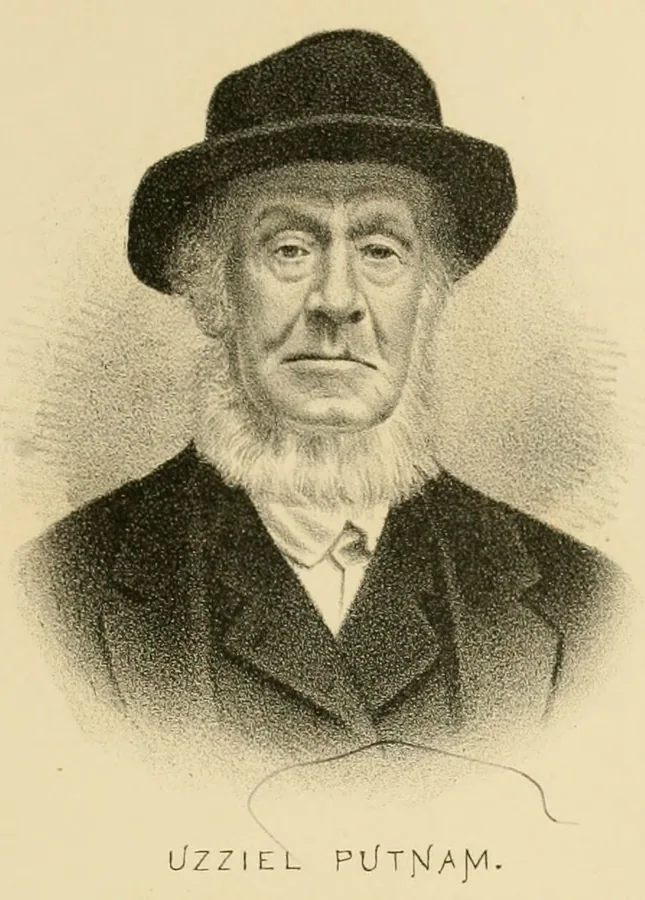 1873–74Uzziel Putnam Sr. (portrait probably his)
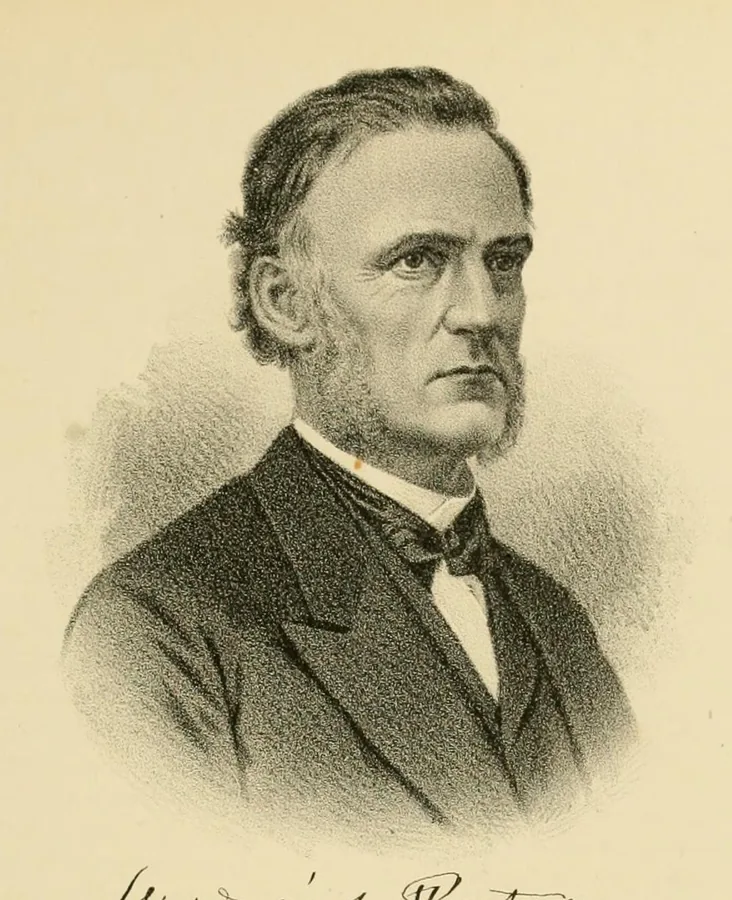 1875–78Uzziel Putnam Jr.Mathews has his father elected in 1875 and 1876
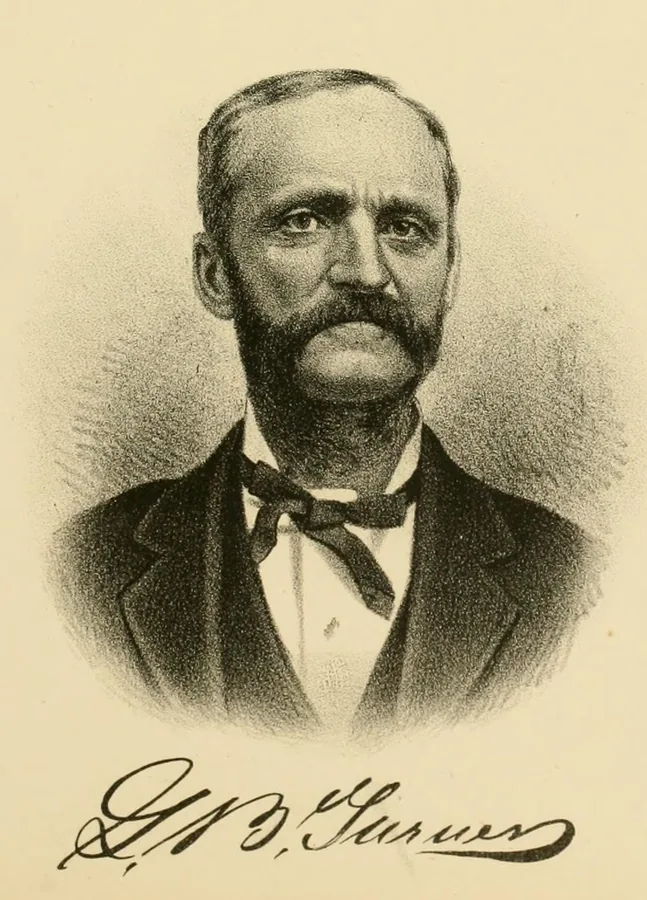 1879–80George B. Turner
 1881Joseph Harper
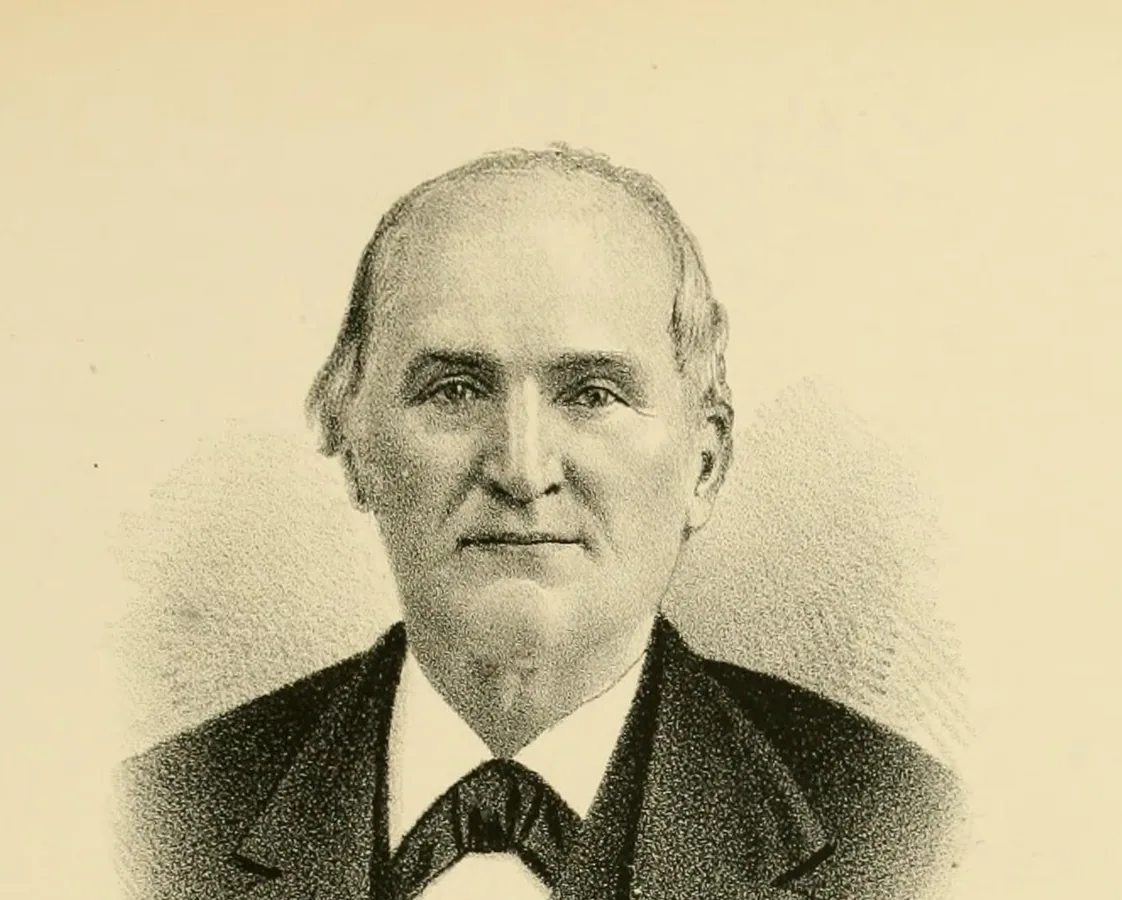 1882Jesse G. Beeson
- 1883–84Gillman C. Jones
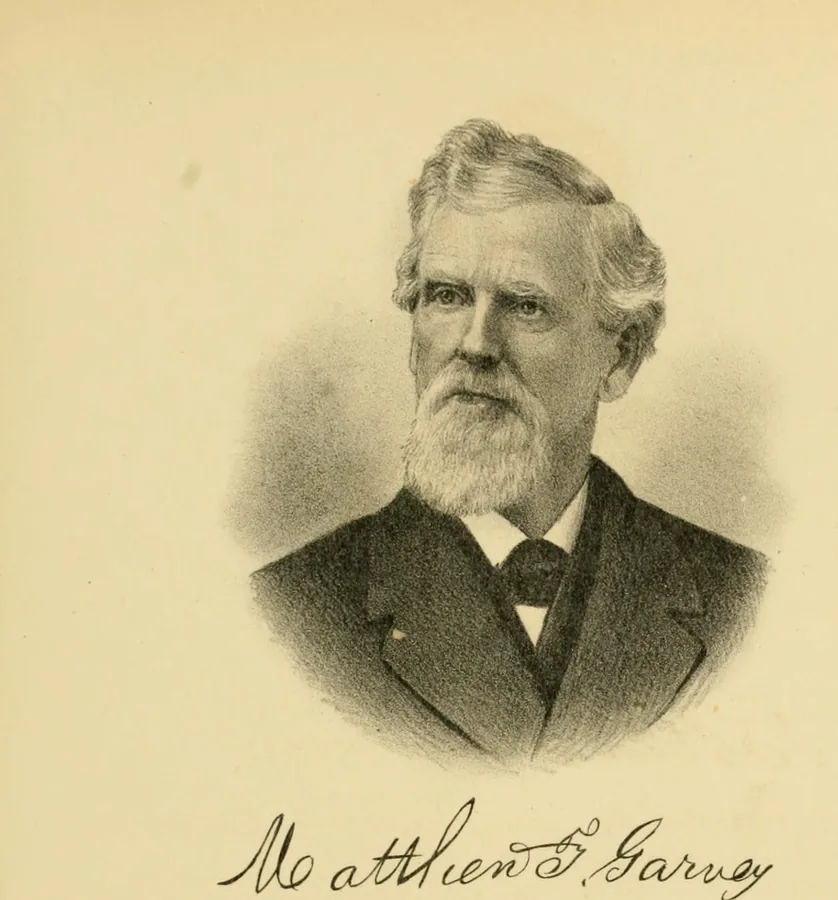 1885M. T. Garvey
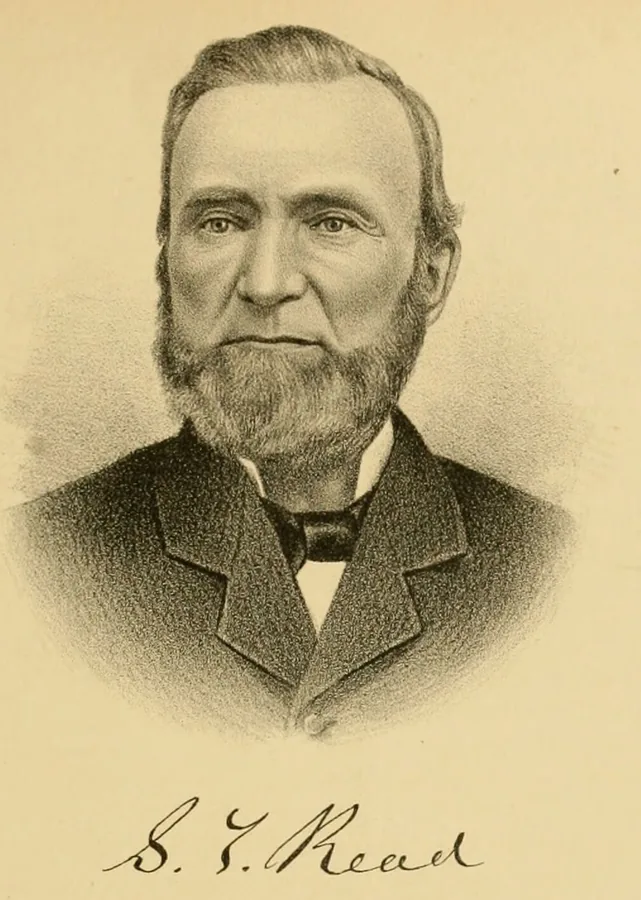 1886S. T. Read
- 1887Joseph N. Marshall
- 1888Henry Kimmerle
- 1889Ezekiel Smith
- 1890George T. Shaffer
- 1891Chester Morton
- 1892Abijah Huyck
- 1893George Longsduff
- 1894M. J. Gard
- 1895David R. Stevens
- 1896Henry Michael
- 1897Elias Morris
- 1898James M. Truitt
- 1899Levi J. Reynolds
- 1900J. Boyd Thomas
- 1901Isaac Wells
- 1902Jonathan C. Olmsted
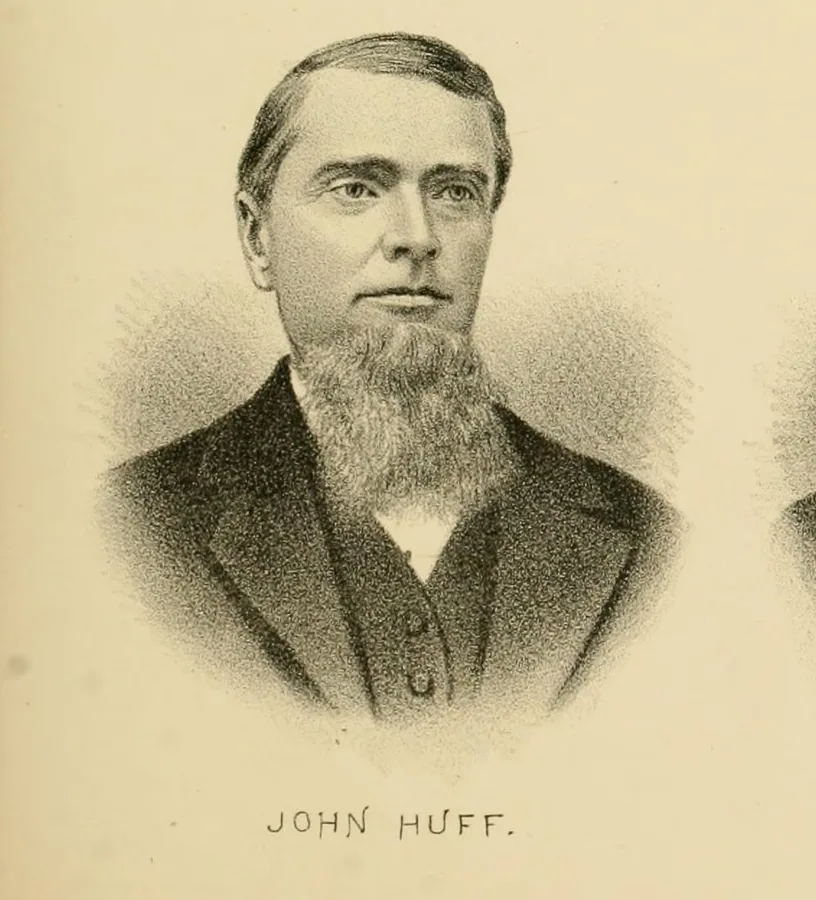 1903John Huff (portrait probably his)
- 1904George J. Townsend
- 1905Henry A. Crego
- 1906S. M. Rinehart
- c. 1916–17John A. Root
- 1924–28Benjamin Franklin Thompson
Documented The secretaries kept the Society going. A. B. Copley was the first. John T. Enos served in 1875–76. Lowell H. Glover was secretary “yearly since, with but few exceptions” from about 1877 to 1906, and Charles W. Clisbee, whom a Society report calls “the historian of the society,” served in the 1880s. J. Boyd Thomas, a former sheriff and state representative who was still marrying couples as a justice of the peace “in the court house” in 1916, was secretary in 1917, and Charles O. Harmon from 1923 until his death in 1928.
Who’s who across the series
The same names turn up across fifty years and three parts: founders of 1873, their children and grandchildren in 1923, and the keepers who followed. Follow a family from one part to the next.
- George NewtonChaired the first morning of the pioneers’ founding meeting, 1873; the Newton House was his homePart 1Part 3The Newton House
- Major Joseph SmithAlmost certainly the Society’s first treasurer, 1873; the cabin’s first log came from his homesteadPart 1Part 2
- John and Addie TietsortHe was the first assistant secretary, 1873; his widow stood at Building Day, 1923Part 1Part 2
- John and Arthur Nixon“The father of the Cass County Pioneer Society”; the cabin’s last numbered log, from his grandsonPart 1Part 2
- Henry MichaelGave the miniature log cabin, 1878; president, 1896Part 1The miniature cabin
- James G. and Asa K. HaydenAn officer of the Society, 1917; his son, the village president, spoke at Building DayPart 1Part 2
- Henry and Charles H. KimmerleCharles spoke at Building Day; his father Henry was almost certainly the Society’s president of 1888Part 1Part 2
- Charles O. HarmonRevived the Society and led the building of the cabin, 1923–28Part 1Part 2Part 3
- Peter EbyAlmost certainly Harmon’s uncle; the cabin’s caretakerPart 2Part 3The caretaker
- Charles A. and Joseph K. RitterTreasurer of the revived Society, 1924; his son helped reopen the cabinPart 1Part 2Part 3
- Jay C. NorthropGave log No. 6 and wrote the cabin’s song; named as the Historical Society’s secretary in a 1944 directoryPart 2Part 3The song
- George R. FoxHelped reopen the cabin; president of the Historical Society until 1963Part 2Part 3
- Lee DoddPresident, later chairman, of the Historical Society from 1970 or earlier to about 1990, and head of the county Historical Commission in 1974; the cabin’s contact, 1973Part 2Part 3
Timeline
- 9 Oct 1873 About 200 settlers meet at the Court House, Cassopolis
- 6 Nov 1873 Constitution of “The Society of the Pioneers”; Uzziel Putnam Sr. president (Mathews; Glover dates both to 9 October)
- 21 Jan 1874 By-laws: a collections committee, published acknowledgments, a museum catalogue twice a year
- 17 Jun 1874 First reunion and picnic, at the fair grounds
- 1875 Rogers’s History of Cass County, written for those establishing “the Cass County Pioneer Association and Museum”
- 21 Jun 1876 About 3,000 at the picnic; Governor Bagley speaks; a committee to care for “the specimens in the museum”
- 19 Jun 1878 Henry Michael presents a miniature log cabin
- 18 Jun 1879 “Ten thousand people” at the picnic; Levi Bishop of Detroit speaks
- 1879–80 The museum kept at I. V. Sherman’s store
- 15 Jun 1881 5,796 counted; Governor Jerome speaks
- 17 May 1882 The relics move into a Court House room set apart by the county supervisors
- 18 Jun 1890 “Over 10,000”; two balloon ascensions and parachute leaps
- 1898–1900 The stone courthouse is built; the old one is moved off the square in 1898 or 1899
- 1906 33rd annual picnic; seven governors have attended over the years
- 1907–10 The picnics go on: the 34th (1907) and 35th (1908) announced with Lt. Gov. Patrick H. Kelley to speak; Senator Burrows speaks in 1910
- 1916 The picnic “will probably not take place this year”
- 1917 “Few meetings have been held for the past three or four years”
- Jan 1923 Harmon begins the reorganization
- 4 Apr 1923 Log Hauling Day (the date set)
- 23 May 1923 Cabin building begins on Stone Lake; the first wall log laid before about 3,000 people
- 20 Jun 1923 Dedication on Pioneer Day; “the revival of the Cass County Pioneer picnic”
- 18 Jun 1924 The museum opens in the cabin; 1,212 souvenir lots offered to clear the debt
- 26 Mar 1928 Charles O. Harmon dies
Editorial independence. Project Scroll is an independent publication. It is not affiliated with or sponsored by the Cass County Historical Society or the Cass County Pioneer Log Cabin Museum, and it does not speak for either. Neither organization commissioned, reviewed or approved this story; their names are used only to identify them. We would welcome either organization as a sponsor of this series, and we would be glad to collaborate on research and writing projects or to publish articles by their members and volunteers. Sponsors and collaborators are always credited on the page, and our research remains independent. Ways to work with us ›
Sources
- Michigan History 9 (1925), contributors’ notes: Charles O. Harmon, attorney and circuit court commissioner. Internet Archive.
- South Bend News-Times, 11 June 1927 (the short name, Cass County Historical Society). Library of Congress, Chronicling America.
- Michigan History 26:3 (1942), p. 410: George H. Tolbert, president of the Cass County Historical Society. Internet Archive.
- St. Joseph Herald-Press, 14 June 1972 (the Cass County Pioneer and Historical association and the lease). Internet Archive.
- Michigan corporation files of the Cass County Historical Society (ID 800837091: articles of incorporation, 1977; annual reports 1994 and 2007–2026) and of the Cass County Pioneer Log Cabin Museum (2012–2026). Michigan Department of Licensing and Regulatory Affairs.
- Gravestone of Charles Owen Harmon (1866–1928) and Catherine Greenawalt Harmon (1864–1931), Prospect Hill Cemetery, Cassopolis; photograph on Find a Grave, memorial 103861338.
- Michigan death certificate of Benjamin Franklin Thompson (1929). Archives of Michigan, Michiganology.
- U.S. census populations of Cassopolis, 1870–1930 (728, 912, 1,369, 1,330, 1,358, 1,385, 1,448), as tabulated in “Cassopolis, Michigan,” Wikipedia; 1870 and 1880 also in Mathews (1882).
- Village of Cassopolis, Parks and Recreation: the Pioneer Log Cabin Museum, 400 S. Broadway.
- Laying first log of Cass County Pioneer Cabin, Cassopolis, Michigan (postcard, 1923), with a note on the back: “witnessed by 3000 people.” Burton Historical Collection, Detroit Public Library.
- Alfred Mathews, History of Cass County, Michigan (Chicago, 1882): the founding, by-laws, picnics, the jail lock and millstone. Internet Archive.
- Howard S. Rogers, History of Cass County from 1825 to 1875 (Cassopolis, 1875), preface. Internet Archive.
- L. H. Glover, ed., A Twentieth Century History of Cass County, Michigan (Chicago, 1906): the Pioneer Society chapter and list of officers; the jail lock (p. 212), the Pioneer Room (p. 244) and “the museum at Cassopolis” (p. 698); biographies of Charles O. Harmon and George H. Tolbert. Internet Archive.
- Pioneer Collections (Michigan Pioneer and Historical Collections), vol. 1 (1877): the Cass County report. Internet Archive.
- Michigan Pioneer and Historical Collections, vol. 4: the Cass County report of 1880 (the museum at I. V. Sherman’s store). Internet Archive.
- Michigan Pioneer and Historical Collections, vol. 29: the 1882 report (the Court House room). Internet Archive.
- Michigan Pioneer and Historical Collections, vol. 35 (1907). Internet Archive.
- Cass County Republican (Dowagiac), 26 June 1878 (the 1878 picnic). Library of Congress, Chronicling America.
- Crawford Avalanche (Grayling), 25 June 1879 (“Ten thousand people”). Library of Congress, Chronicling America.
- Cass County Republican, 30 June 1880 (the 1880 picnic). Library of Congress, Chronicling America.
- The Plaindealer (Detroit), 27 June 1890, p. 2 (the seventeenth reunion). Library of Congress, Chronicling America.
- L’Anse Sentinel, 1 July 1916 (the picnic “will probably not take place”). Library of Congress, Chronicling America.
- John J. Bagley, Old Times (1876), the address at the 1876 picnic. Internet Archive.
- F. B. Streeter, Michigan Bibliography (1921), nos. 170 and 613 (the 1904 program). Internet Archive.
- Ypsilantian, 2 June 1887 (the bass drum). Internet Archive.
- Benton Harbor Evening News, 15 June 1897 (the 24th reunion). Internet Archive.
- Benton Harbor Evening News, 13 June 1900 (the 27th reunion). Internet Archive.
- W. A. Norton’s directory of Dowagiac, Cassopolis and nearby townships (1899), p. 233 (“the pioneer museum”). Internet Archive.
- Michigan History magazine 1:1 (1917): the Cass County society’s report. Internet Archive.
- Michigan History magazine 7 (1923), pp. 107–08 (the Carleton school reunion). Internet Archive.
- South Bend News-Times, 18 January, 2 February and 9 March 1923 (the reorganization). Library of Congress, Chronicling America.
- South Bend News-Times, 19 and 20 June 1924 (the picnic at the cabin, 1924). Library of Congress, Chronicling America.
- South Bend News-Times, 29 March and 15 June 1928 (Harmon’s obituary; B. F. Thompson as president). Library of Congress, Chronicling America.
- Charlevoix County Herald, 29 June 1923. Internet Archive.
- 1923 Pioneer Log Cabin Museum Searchable Donor List, compiled by Marcia Gaskin (2012), with the 1924 letterhead and the souvenir-lot papers. Internet Archive.
- Michigan death certificates of J. Boyd Thomas (1924), John A. Root (1921), James G. Hayden (1917) and Charles O. Harmon (1928). Archives of Michigan, Michiganology.
- Prospect Hill Cemetery, Cassopolis, transcription. MIGenWeb.
- South Bend News-Times, 29 April 1925 (the Uzziel Putnam centennial at the cabin). Library of Congress, Chronicling America.
- Catalog of Copyright Entries, musical compositions, 1921 and 1923 (Charles O. Harmon’s songs; “On the Winding Christianna,” 1923, no. 11291). Internet Archive.
- Real-photo postcard, “Race Track at Cassopolis, Mich.,” about 1905–1918. David V. Tinder Collection of Michigan Photography, William L. Clements Library, University of Michigan.
- Cass County Pioneer Cabin and Relic Museum (postcard, Auburn Post Card Mfg. Co.), Burton Historical Collection, Detroit Public Library.
- South Bend News-Times, 23 March 1923. Library of Congress, Chronicling America.
- True Northerner (Paw Paw), 14 June 1907, p. 1. Library of Congress, Chronicling America.
- Detroit Times, 9 June 1908, p. 1. Library of Congress, Chronicling America.
- Detroit Times, 17 June 1910, p. 8. Library of Congress, Chronicling America.
- South Bend News-Times, 21 September 1923, p. 25. Library of Congress, Chronicling America.
- South Bend News-Times, 2 February 1923 (“Uncle Joe” Cannon announced; logs from every community). Library of Congress, Chronicling America.
- South Bend News-Times, 1 September 1916 (a marriage before Justice J. Boyd Thomas in the court house). Library of Congress, Chronicling America.
- South Bend News-Times, 15 June 1928, p. 24, “Cass Pioneer Picnic to Be Postponed This Year.” Library of Congress, Chronicling America.
- South Bend News-Times, 7 June 1930, p. 23 (the picnic “discontinued after having long been a reunion of old settlers”). Library of Congress, Chronicling America.
- Connelly Funeral Home listings, 1924 (“Thomas, J.B.”). Cass District Library, Local History Branch.
- Jay G. Hayden scrapbooks, 1916–1965 (finding aid). Bentley Historical Library, University of Michigan.
- Research guide: index to the microfilm reels of the Cassopolis Vigilant. Cass District Library, Local History Branch.
- Newspaper holdings, Cass County. Library of Michigan.
- Michigan certificate of death: J. Boyd Thomas, Cassopolis, 25 April 1924. Archives of Michigan, Michiganology.
- “A Venerable Relic,” from the Cassopolis National Democrat, 3 June [1875], with a note from its publisher, C. C. Allison, copied from the Nashville Union and American into the Memphis Daily Appeal, 12 June 1875, p. 2 (the drum’s history in A. S. Russey’s letter). Library of Congress, Chronicling America.
Numbers in the text point to this list; entries without a number are further sources we consulted. How we research › · The libraries behind all our stories ›
Part 2: The cabin a county built Did your family give a log? Know something? Write to us
About this research
Research and reporting Michael Urbanski Project Scroll
- Sources
- Every fact on this page is drawn from the sources listed above, and each can be checked where it is held.
- Corrections
- Errors are corrected on the page, and each correction is noted there.
- Contact
- To report an error or share a record that adds to the story, write to research@projectscroll.com.
- Method
- How we research ›
© 2026 Michael Urbanski and Project Scroll. All rights reserved. The text, original maps, charts and illustrations may not be reproduced without permission; brief quotations with credit and a link back are welcome. Material from other sources belongs to its holders and is credited where it appears; public-domain material is marked as such.


