The story
Welcome to Climax
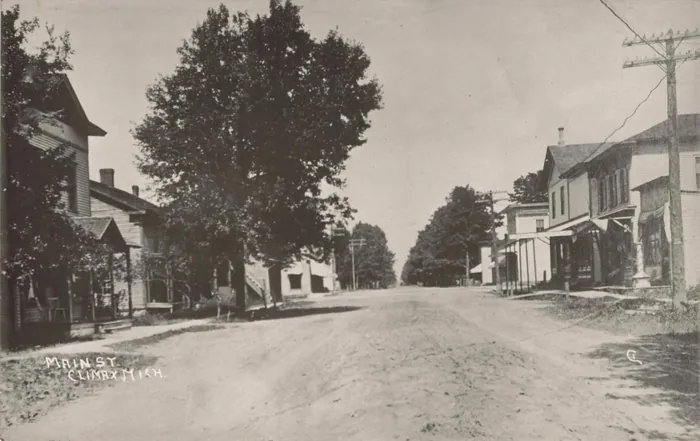
Climax takes its name from the small prairie that Daniel B. Eldred said capped the climax of everything he had seen. The settlement at ‘the Corners’ grew slowly until the railroad came in 1871, and on December 3, 1896, its carriers set out on the first rural free delivery in Michigan.
Col. John Mullett began surveying the township lines on November 18, 1825, and Robert Clark Jr. divided the township into sections the next June. Most of it was heavy timber, but Climax Prairie, about 300 acres in the northeast part, was its height of land: water from around it runs east and north to the Kalamazoo, south to the St. Joseph and southwest into the Portage. Calvin White crossed the prairie on foot early in 1831 and told Judge Caleb Eldred, newly settled at Comstock, what he had found.
In April or May 1831 the judge, his son Daniel B. Eldred, Hiram Moore and White camped beside Potter’s Lake at the west edge of the prairie, and each proposed a name; the judge offered Laurens, his New York town. Daniel spoke last: ‘This caps the climax of everything I ever saw. I propose we call it Climax.’ That May the judge staked his claim by having a long strip of twenty acres plowed on section 2, and in June his sons Stephen and Daniel entered three quarter-sections on sections 2 and 3. Judge Eldred made his home near ‘the Corners,’ at the quarter post between sections 2 and 3, in 1832, and in 1834 he brought in the first post office, with Stephen Eldred carrying the mail from Comstock.
Read the full story
Daniel B. Eldred built his house in 1835, thought to be the earliest frame dwelling in Climax, and the township was organized under the name of Climax at a meeting held there on April 2, 1838. A post route from Marshall to Niles brought weekly mail from 1840. Daniel’s little store east of the Corners was sold in 1844 to W. E. Sawyer and Moses Hodgman, who moved it to the Corners; in later years it served as a dwelling, shoe shop, post office, saloon and tailor shop, then as a barn, and by 1880 it stood by the railroad as the depot, still bearing its old signs, ‘Store’ and ‘Farmers’ Exchange.’ Sawyer’s steam sawmill of 1848 was the first mill in the town, and Reuben Coe opened the first tavern in 1851. Hiram Moore of Climax invented the Moore and Hascall harvester, which cut, threshed, cleaned and bagged grain in one operation.
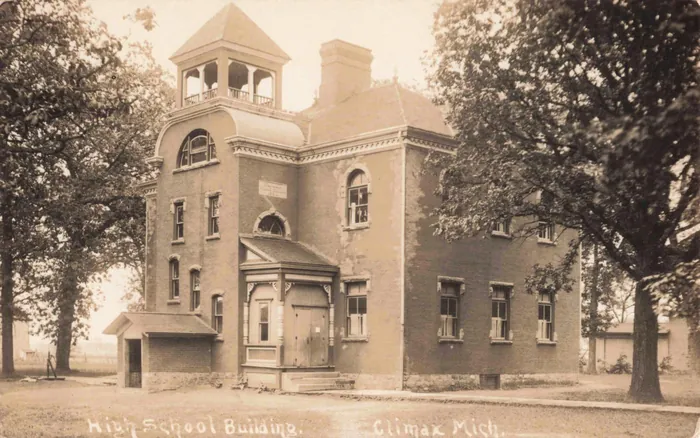
In 1880 Climax was not incorporated and had no recorded plat; its history, Francis Hodgman wrote, ‘is only a history of the people and industries of the place.’ The Peninsular Railway reached it in September 1871, and the station soon shipped about 150,000 bushels of wheat a year; in May 1879 one buyer shipped 51,000 bushels, 21,000 of them bought in small lots in a single day. A description of 1880 quoted by Fisher and Little put the village at three hundred people, with C. E. Hodgman’s new block and public hall, John O. Wilson’s hotel, stores, two doctors and a carriage works. The village was incorporated in 1899.
On December 3, 1896, Climax became the starting point of the first rural free delivery in Michigan, part of a $40,000 test of delivering mail to farmers’ homes that the national and state Granges had won from Congress. The first carriers were Lewis A. Clark and Willis L. Lawrence, and in 1917 the rural letter carriers, the Daughters of the American Revolution and the State Grange raised a monument there, built of stones given by about 300 farmers. Lawrence built the village’s stone post office himself in 1931; it is now the Lawrence Memorial Library. The 2020 census counted 712 people in Climax.