The story
Welcome to Vicksburg
Vicksburg grew around the log grist mill John Vickers built on Portage Creek in 1831, believed to be the first in Kalamazoo County. For decades the village and its post office were called Brady; the miller’s name came back when the village was incorporated in the early 1870s, just as two railroads met there.
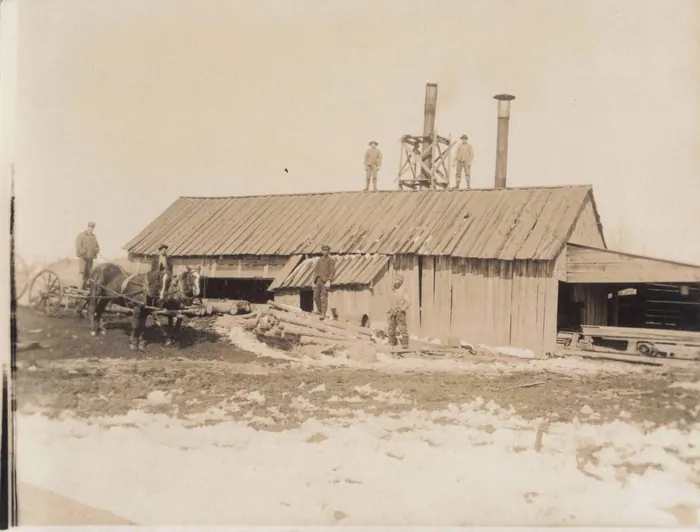
John Vickers had already built a grist mill on the western edge of Prairie Ronde, about three and a half miles southwest of Schoolcraft, when in the spring of 1831 he found a better site on Portage Creek. He brought a small pair of millstones from Logan County, Ohio, carried on horseback in saddle-bags, and set them in a log building about fourteen feet square. Old settlers wrote for William Bair in 1876 that the mill had no bolt for sifting flour in 1831 or 1832; Joseph Frakes said his wife sifted all their flour that winter in a hand-sieve. About 1832–33 Vickers built a larger log mill on the same spot, roofed it with shakes, put in a bolt and fitted up part of it as a distillery. The state marker in Clark Park says his brush dam over an eight-foot waterfall made the pond that became Sunset Lake.
Hezekiah G. Wells, speaking to the Pioneer Society at Vicksburg in August 1875, remembered bringing a grist to the mill in December 1833 and taking supper in Vickers’s one-room log house, at a table of split board held up by two pins driven into the wall. While they ate, ‘Uncle Robert Frakes’ came in with William Robinson, James Dycus, William P. Hunt, half a dozen hounds and a fox-skin from the morning’s hunt. Vickers died about 1842–43. George Stuart and Elias Cooley then built a large flouring mill farther south, fed by a race cut from the millpond; it burned about 1855–56, and Isaac A. and Asa S. Briggs built the next one.
Read the full story
Vickers is said to have had a plat drawn and named it Vicksburg, but it was never recorded. The plat that was recorded, acknowledged on September 17, 1849, with Hugh Finlay as proprietor, was the village of Brady, on the southeast quarter of section 13 in what is now Schoolcraft Township. Clark Briggs and John Noyes had built the first store about 1836, and Finlay opened the first store of any size about 1845–46 and later turned his building into the first regular hotel. The post office, first called Holland and kept on Gourd-Neck Prairie and then at Rufus A. Royce’s house, was moved into the village about 1846 and renamed Brady. A log schoolhouse stood there before 1844, and in 1869 a union school district put up a two-story brick school costing about $6,000.
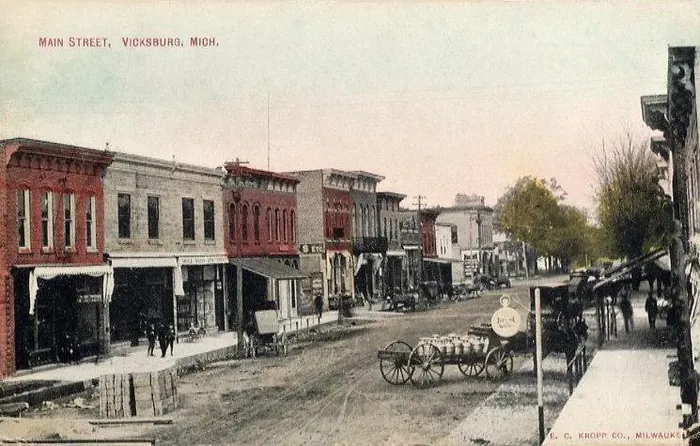
The Grand Rapids and Indiana Railway was completed to the village on July 19, 1870, a day marked with the village band and salvos of artillery, and the Peninsular Railway, later part of the Grand Trunk, came about 1871. Durant wrote that the supervisors incorporated the village in 1872 as the Village of Vicksburg, a name given ‘in honor of its founder and first settler’; the change also ended the confusion of mail between Brady and another Michigan office called Bradley. By 1880 the place had twenty-five or more stores, a sawmill, two flouring mills, a stave and heading factory, a windmill factory and a foundry, and two weeklies, the Vicksburg Monitor of 1875 and the Vicksburg Commercial of 1879.
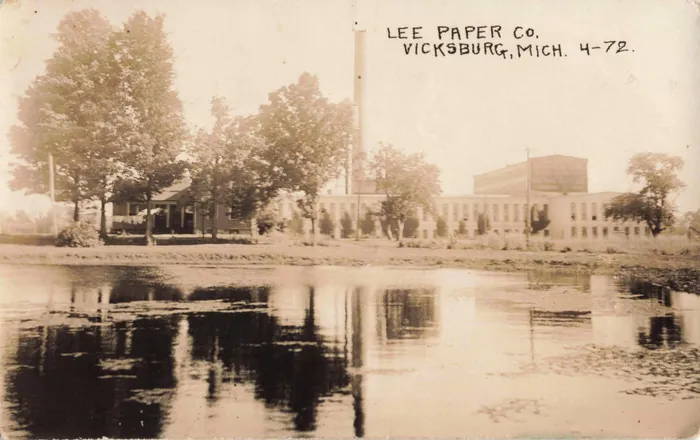
Industry followed the railroads. The Eclipse Governor Company, founded in 1892 by J. E. Kimble, Ransom Kimble and Dr. McKain to make Emory Kimble’s governor for steam engines, built its plant in 1900 and employed more than thirty men by 1906, and Charles S. Cooley raised nine thousand dollars to bring the Lee Paper Company to the village. The Grand Rapids and Indiana depot of 1904 is now the Vicksburg Historical Society’s Union Depot Museum, listed on the National Register in 2024. The 2020 census counted 3,706 people in Vicksburg.