The story
Welcome to Schoolcraft
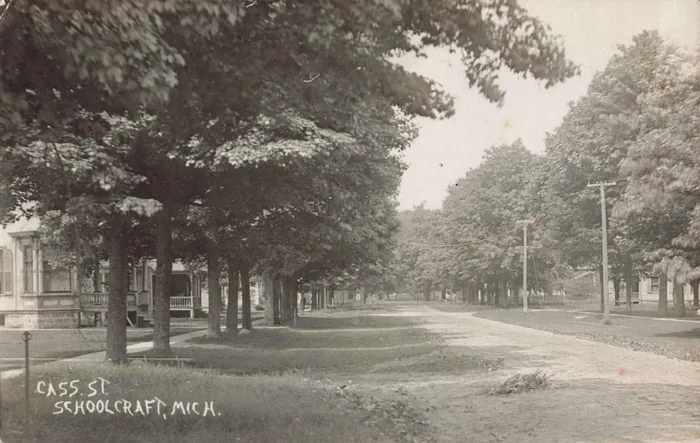
Schoolcraft was platted in 1831 on Prairie Ronde, the great prairie where Kalamazoo County’s first settler made his home, and the first goods sold in the county were sold there. Named for Henry R. Schoolcraft, it was also the home of Dr. Nathan M. Thomas, the county’s first physician and its Underground Railroad station agent.
Prairie Ronde, the broad prairie at the southwest corner of Kalamazoo County, drew the county’s first white settler: Bazel Harrison settled there in November 1828, and little Harrison Lake bears his name. A band of some 250 Potawatomi and Ottawa under the chief Sa-ga-maw had a village and fields on the northwest corner of the prairie; Durant writes that they moved to the Nottawa-seepe reservation and were finally removed west in 1840. Men named Rue and Bond made the first claims on the future village site, but the first permanent settler was Thaddeus Smith of Cavendish, Vermont, who had walked across Michigan in 1829 and, as E. Lakin Brown remembered it, told his friends that Prairie Ronde was ‘the most beautiful place in the world.’
Smith and his Vermont neighbours James Smith Jr. and Hosea B. Huston formed Smith, Huston & Co. In 1830 they had $700 worth of goods shipped around the lakes to St. Joseph and boated up the St. Joseph River to McIntaffer’s, where Lockport now is, and sold them that winter from part of Abner Calhoon’s cabin, the first goods sold in the county; in the spring of 1831 they built a log store ‘east of the Big Island.’ Thaddeus Smith brought his family in June 1830. The village was surveyed by Stephen Vickery for its proprietor, Lucius Lyon, and the plat was received for record on October 5, 1831; Lyon named it for his friend Henry R. Schoolcraft. Helen A. Smith, born October 3, 1831, was the first white child born in the village. The Big Island Hotel was raised in March 1832, and that year the post office was moved in from Insley’s Corners and renamed Schoolcraft.
Read the full story
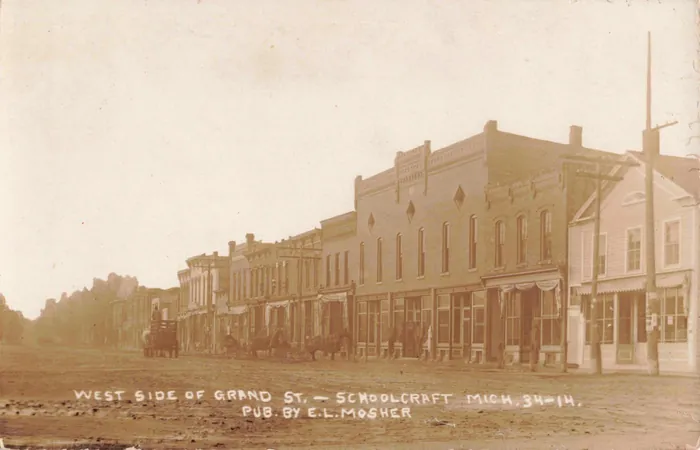
Business first gathered at Centre and Eliza streets, but in 1836 Bull’s Addition was laid out on the old University lot to the east, a public house went up on Grand Street, and after a long lawsuit over a closed highway the stores and even the buildings moved to Grand Street. The land office had gone from White Pigeon to Kalamazoo in 1834, and in the winter of 1837–38 the Farmers’ Bank of Prairie Ronde was organized, one of 46 such associations under the banking law of 1837; for nearly twenty years afterward the village stood still. Its farmers took up the harvester of Hiram Moore of Climax, which cut, threshed, cleaned and bagged the grain in one operation behind sixteen horses; several were built at Schoolcraft between 1835 and 1848.
Dr. Nathan M. Thomas, the son of Quakers at Mount Pleasant, Ohio, began practice on Prairie Ronde in June 1830, the first physician to settle in the county, and moved to Schoolcraft, where he built his house in 1835. Durant calls him one of the organizers of the Underground Railroad and the Schoolcraft station agent. The first fugitive on the line entered Michigan in Cass County in October 1838 and passed through Schoolcraft, Battle Creek, Marshall, Jackson and Detroit; over nearly twenty years the number who passed was put at one thousand to fifteen hundred. Four young men from Kentucky who came to the Schoolcraft station in 1856 stayed in Michigan and served in the Union army.
Schoolcraft was incorporated on January 4, 1866, with Evert B. Dyckman as first president, re-incorporated on March 12, 1869, and given a new charter in 1875. The Kalamazoo and White Pigeon Railroad, completed from Three Rivers to Kalamazoo in May 1867, gave it a station, and in 1868 Pursel & Co. built a four-story flouring mill near the depot that could make 200 barrels a day before fire destroyed it. Fire took a planing mill in 1871, the new union school soon after it opened, and five stores on Grand Street in January 1879. The Ladies’ Library Association formed on July 8, 1879, and on October 8, 1896, dedicated its red-brick clubhouse on Hayward Street, built largely with gifts from James H. Bates. The 2020 census counted 1,466 people in Schoolcraft.