The story
Welcome to Rome City
Rome City grew beside a reservoir dammed on the Elkhart River for a canal that was never finished. The lake, renamed Sylvan Lake, drew the Island Park Assembly, a mineral-spring sanitarium and the author Gene Stratton-Porter, whose estate is now a state historic site.
Under Indiana’s internal improvements program of 1836, the state planned a canal from Fort Wayne toward Lake Michigan, fed from a reservoir at Northport. The earthen dam on the Elkhart River was built in 1837–38 and backed up about 630 acres of water. After spending some $200,000, the state abandoned the work; the dam broke in 1839, in 1844 and again in 1855. The water power was given to the county for the common schools and leased for ninety-nine years, and Mitchell & Weston took the lease about 1840.
Francis Comparet, a French trader, laid out Northport in December 1838, but Rome was laid out in June 1839 by John C. Mather and Ebenezer Pierce, the township trustees, on the school section, so that the money from the lots went to the schools. The 1920 county history tells the story that during the dam work the foreman Francis Aveline kept his French crews on the north side and moved the Irish to the south, and after a fight told the Irish that, being with the Romans, they ‘must do as did the Romans’; the south side became Rome. When the post office was moved from Northport, letters went for a time to ‘Northport Post Office, Rome,’ and the office was finally named Rome City.
Read the full story
The Weston grist-mill first brought the village to life, and in 1855 Bliss, Poole & Co. built a three-story woolen factory employing some sixty people, nearly half of them women. It failed after about four years, ruining farmers who had pledged their farms for its stock, and later burned; a second woolen mill burned in 1877. George L. Gale, an early merchant, helped fifteen or twenty people escaping slavery on their way to Canada.
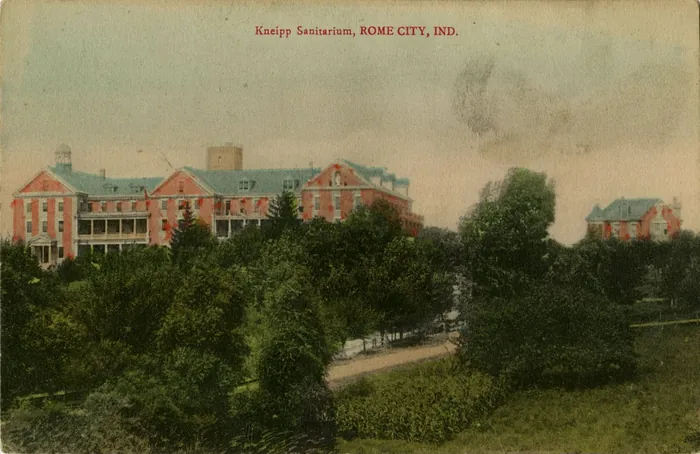
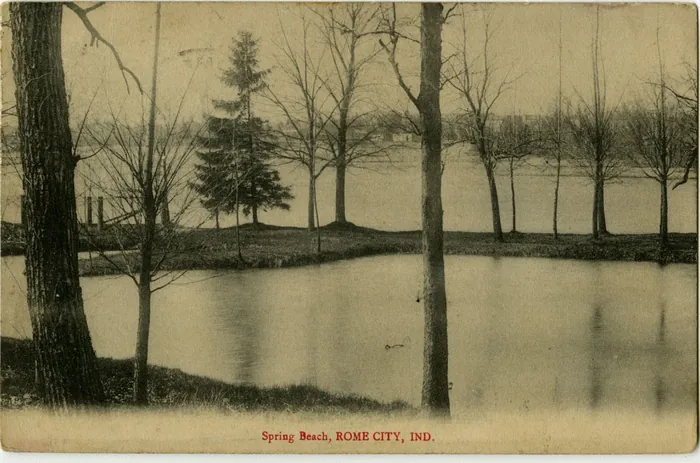
The Grand Rapids & Indiana Railroad, which owned the island and mineral springs, set out to make Sylvan Lake a resort. A Sunday-school congress first met there in 1878, and on October 15, 1879, it was reorganized as the Island Park Assembly on the plan of New York’s Chautauqua, with a tabernacle seating about three thousand; the first full assembly met in June 1880. In 1894 Dr. W. G. Geiermann interested the Sisters of the Most Precious Blood in the springs, and from 1897 the Spring Beach Sanitarium there offered the Kneipp water cure.
In a 1923 letter Gene Stratton-Porter wrote that she had bought 120 acres on Sylvan Lake with the proceeds of her writing. By 1913 she was building a cottage there, Limberlost Cabin, on the estate she called Wildflower Woods; she began living part of each year in California in 1919 and died there in 1924. Wildflower Woods is now a state historic site. The 2020 census counted 1,322 people in Rome City.