How the towns got their names
How Cassopolis got its name
Everyone knows half of it: Cassopolis is the city of Cass. The other half is stranger. The county seat was first somewhere else, the man who won it for Stone Lake is said to have walked through a night of cold rain, and the village was spelled with an A for nearly forty years.
By Michael Urbanski · Project Scroll · First published · Updated · 11 min read

New finding 1 new finding in this story. See what’s new ›
Cassopolis, Mich. Ask how Cassopolis got its name and the answer comes quickly: it is the city of Cass, named for Lewis Cass, governor of Michigan Territory, with the Greek word for a city on the end. That much is true. But the county seat was first at another village, the man who won it for Stone Lake is said to have walked through a night of cold rain to do it, and for nearly forty years the post office spelled the name with an A.
We went back to the county’s three histories, of 1875, 1882 and 1906, to Michigan’s first gazetteer of 1838, and to the hand-coloured county map of 1860, to see what the record shows and what is only a good story.
The case in brief
What the record shows
- The county was named Cass in 1829. The act says only “the name thereof shall be Cass.” That it honours Lewis Cass is understood, not written.
- The county seat came first to Geneva, on Diamond Lake, in 1830. A new commission moved it in 1831.
- The village was platted in 1831 as “Cassapolis,” with an A, and proclaimed the county seat on 19 December 1831.
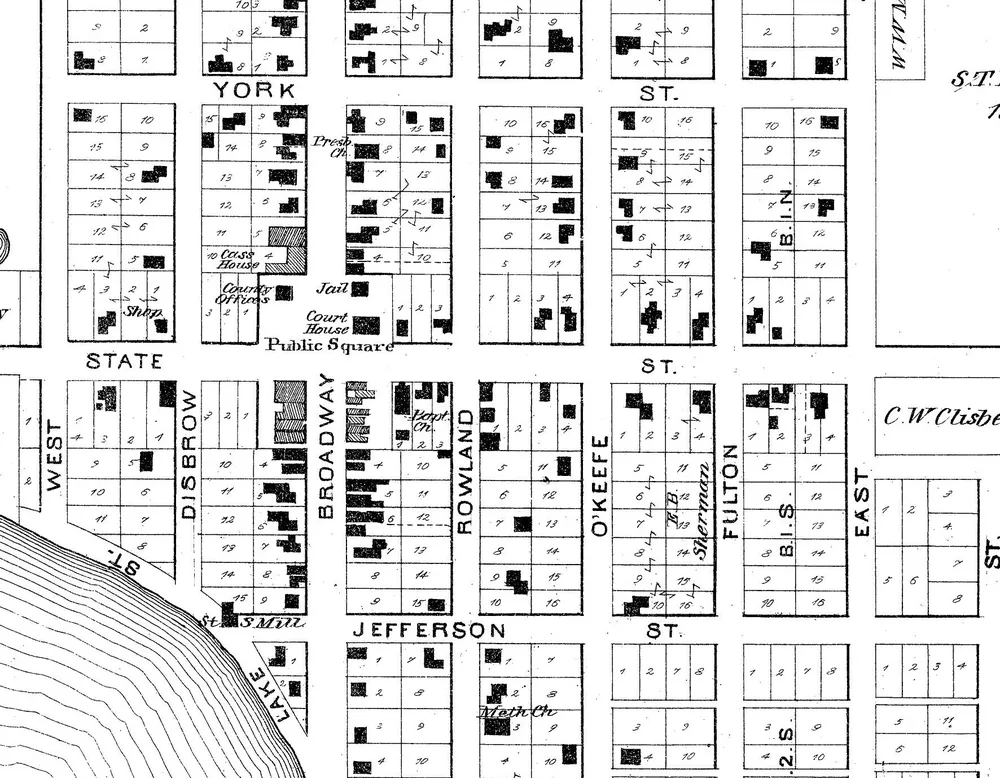
- Three streets on the plat carry the commissioners’ names: Disbrow, Rowland and O’Keefe.
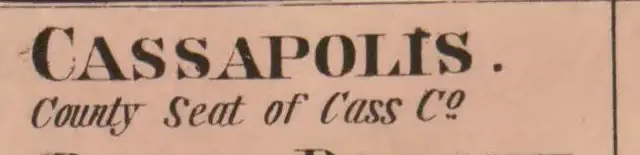
- The O came slowly. “Cassopolis” is in print by February 1833, but the post office kept “Cassapolis” until 1870, and the county map of 1860 still letters the village “Cassapolis.”
What it does not show, yet
- The plat and the governor’s proclamation themselves. We have read them only as the county histories report them.
- Who chose the name, and why “-polis.”
- Why the A became an O. The 1906 history thought it was for the sound.
Story or record? Play along
Here are eight things people say about the name. For each, make your call: true, false, or no record either way. Then see what the paper shows.
“Cassopolis was Cass County’s first county seat.”
No
Rogers’s history of 1875 records that the seat was first located at Geneva, on Diamond Lake, in 1830. It moved to the new plat on Stone Lake by the governor’s proclamation of 19 December 1831.
“The village was first spelled Cassapolis.”
True
Rogers says the plat was “to be called Cassapolis,” and Glover’s history of 1906 says the original spelling, “as found on old letters and the first plat, was ‘Cassapolis.’”
“The law that created the county says it was named in honour of Lewis Cass.”
No
The act of 1829, as the 1882 history prints it, says only “the name thereof shall be Cass.” The honour is understood, not stated.
“Lewis Cass himself chose the name of the village.”
No record
The histories credit the local proprietors with the plat and its name. Nothing we have read connects Cass himself to the choice.
“Three of the town’s streets were named after the men who picked the county seat.”
True
The commissioners were Thomas Rowland, Henry Disbrow and George A. O’Keefe, and Disbrow, Rowland and O’Keefe streets are on the original plat, and on the county map of 1860.
“The change from Cassapolis to Cassopolis was made official by the post office.”
True
Glover says the change was “finally affirmed by the postoffice department.” Postal listings give Cassapolis from 1832 and Cassopolis from 1870.
“As late as 1860, the county map still spelled it Cassapolis.”
True
The plan of the village on Geil, Harley & Siverd’s map of 1860 is headed “CASSAPOLIS. County Seat of Cass Co.”
“The county seat was won in a race through the night.”
A good story
Rogers tells it in 1875, forty-four years after the event: E. B. Sherman heard of rivals’ plans and set out on foot “through the cold rain and dismal darkness in this race for a County seat.” No record of 1831 tells it.
The county named Cass
DocumentedCass County was set off by an act of the Legislative Council of Michigan Territory approved on 29 October 1829. The act draws the county’s lines and ends that the land “be, and the same is hereby set off into a separate county and the name thereof shall be Cass.”
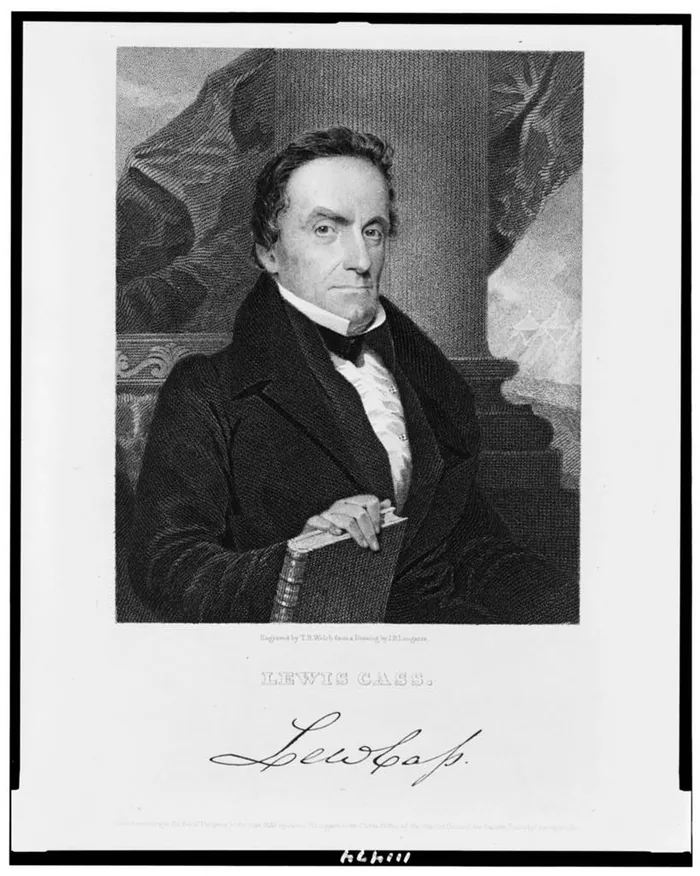
ReadingThe act names no one. That the county honours Lewis Cass, governor of the territory from 1813 to 1831, is the reading everyone has always given, and it is surely right; but it is understood, not written. Henry Gannett’s federal Origin of Certain Place Names (1905) lists the county and the village among the names given “for Gen. Lewis Cass, governor of Michigan in 1820.”
The county seat that came first
DocumentedCassopolis was not the first county seat. Howard S. Rogers, in the county’s first history (1875), writes that “sometime in 1830 the County seat of Cass County was located at Geneva, on the bank of Diamond Lake,” by commissioners appointed by the governor. Geneva had been named, Rogers says, after the village of that name in New York.
DocumentedRogers also passes on a story about how Geneva lost: “it is said that some of the Commissioners ... withheld information of their decision one day, and in the mean-time sent an agent to the Land Office.”
Reading“It is said” is Rogers’s own warning. The story may be true, but it is a rumour he heard, not a record he read.
DocumentedOn 4 March 1831, Rogers reports, the Legislative Council passed an act for a new commission to relocate the seats of justice of Cass, St. Joseph and Branch counties. The commissioners for Cass, Glover’s history of 1906 says, were Thomas Rowland, Henry Disbrow and George A. O’Keefe, and they were to meet in the county “on the third Monday in May, 1831.”
A race through the rain
DocumentedRogers tells how the new site was won. E. B. Sherman, one of the men who would own it, learned of other men’s plans for the land on Stone Lake, “kept his own counsel,” took his leave, and “started on foot for Edwardsburg”; and on he went, “through the cold rain and dismal darkness in this race for a County seat,” to enter the land first.
ReadingIt is a fine story, and it may be true in its outline: whoever owned the land the commissioners chose stood to gain a town. But Rogers wrote it down forty-four years later, from what old settlers told him, and we have found no record of 1831 that tells it.
A village to be called Cassapolis
DocumentedRogers again: the proprietors “prepared a plat of a village to be called Cassapolis, containing one hundred and sixty acres of land, and each of the four proprietors signed an agreement to donate to the County one-half of his portion of the same, providing the County seat should be located thereon.” Glover, in 1906, counts not four but five proprietors whose names are signed to the plat: E. B. Sherman, A. H. Redfield, Abram Tietsort, Oliver Johnson and Ephraim McCleary.
DocumentedThe commissioners chose the site, and Acting Governor Stevens T. Mason’s proclamation fixing the seat of justice there was, the 1882 history says, “issued December 19, 1831.”
DocumentedThe proprietors had made sure of the commissioners’ goodwill. Glover writes that they “announced with effective ostentation the naming of three principal streets after the commissioners,” and he lists Disbrow, Rowland and O’Keefe streets on the plat. Copies of the original plat, he adds, “are still extant.”
ReadingCass for the governor and the county; polis, Greek for a city, for the town. It was a fashionable ending in the 1820s and 1830s; Indianapolis had been named in 1821. Nobody recorded who chose it.
The A and the O
DocumentedThe first post office, the 1882 history says, had Alexander H. Redfield, one of the proprietors, as its postmaster. Postal-history listings give the office as “Cassapolis” from 1832 to 1870 and “Cassopolis” from 1870.
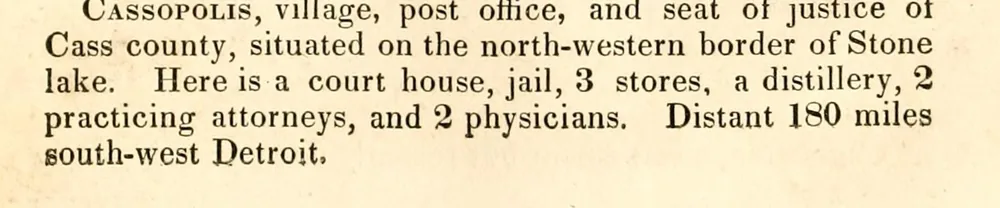
DocumentedThe O was in print long before the post office took it. John T. Blois’s Gazetteer of the State of Michigan (1838) has “Cassopolis, village, post office, and seat of justice” for Cass County.
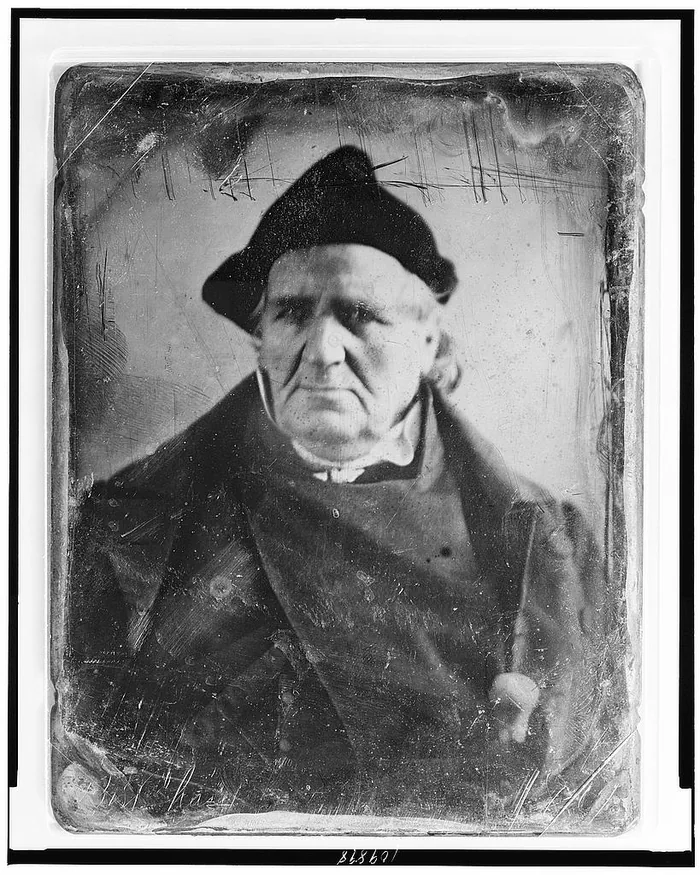
New findingEarlier still: the Episcopal Recorder of Philadelphia, on 23 February 1833, reprinted from the St. Joseph’s Beacon the appointments of Bishop Philander Chase on his winter journey through south-west Michigan: “On January 27th at White Pigeon, on the 29th at Edwardsburgh, on the 30th at Niles, at Edwardsburgh again on the 1st of February, and at Cassopolis on the 2nd and 3rd.” That is the earliest printing of the O spelling we have found, five years before Blois, and in the same year that the federal Official Register still listed the post office, with Alexander H. Redfield as postmaster, as “Cassapolis.” The village was spelled both ways from almost its first year.
DocumentedEven the town’s own historian used both. Rogers’s book of 1875 was printed at “Cassopolis, Mich.,” as its title page says, but his chapter on the village calls it “Cassapolis” throughout.
DocumentedGlover, in 1906, gives the only explanation we have: “the change from a to o, which was clearly dictated by euphony, took place gradually in custom and was finally affirmed by the postoffice department.”
Reading“Euphony” is Glover’s guess. An O also matches the other -opolis towns, from Annapolis to Indianapolis, and that may have pulled the spelling as much as the sound did.
Stone Lake
DocumentedThe village grew on the east shore of Stone Lake. The 1882 history says the lake was “so named from the fact that its shores were originally very thickly strewn with stone.” A settler named Abram Tietsort Jr. had built a log cabin on the east bank in 1829 or 1830; the histories disagree by a year. The Pioneer Log Cabin of 1923 stands on the same east shore today; its story is told in The cabin a county built.
OpenWho named the lake, and when, we have not found.
The name on paper
Play the spellings in order, from the county of 1829 to the town today.
- 1829 Cass (the county, by act of 29 October)
- 1831 Cassapolis (the plat)
- 1832 Cassapolis (the post office)
- 1833 Cassopolis (Bishop Chase’s appointments, in print)
- 1838 Cassopolis (Blois’s gazetteer)
- 1860 Cassapolis (the county map)
- 1870 Cassopolis (the post office)
- 1875 Cassopolis (Rogers’s title page, with Cassapolis inside)
To cite this page: Michael Urbanski, “How Cassopolis got its name,” Project Scroll, projectscroll.com/news/how-cassopolis-got-its-name/, first published 22 October 2026. Corrections are welcome, and any we make are noted on this page.
Sources
- Howard S. Rogers, History of Cass County, from 1825 to 1875 (Cassopolis, 1875): Geneva, pp. 182 and 236; the race for the county seat, pp. 236–238; the plat, p. 239. Internet Archive.
- History of Cass County, Michigan (Chicago: Waterman, Watkins & Co., 1882): the act of 29 October 1829; the proclamation of 19 December 1831, p. 68; the plat, p. 155; the post office, p. 170; Stone Lake. Internet Archive.
- L. H. Glover, A Twentieth Century History of Cass County, Michigan (Chicago, 1906): the commissioners, pp. 99–100; the proprietors, the streets and the spelling, in the chapter on Cassopolis. Internet Archive.
- John T. Blois, Gazetteer of the State of Michigan (Detroit, 1838), p. 261. Internet Archive.
- Henry Gannett, The Origin of Certain Place Names in the United States (U.S. Geological Survey Bulletin, 1905). Internet Archive.
- Geil, Harley & Siverd, Map of the Counties of Cass, Van Buren and Berrien, Michigan (Philadelphia, 1860), with the plan of Cassapolis. Library of Congress, Geography and Map Division.
- Jim Forte Postal History, post offices of Cass County, Michigan (Cassapolis 1832–1870, Cassopolis from 1870).
- Episcopal Recorder (Philadelphia), vol. 10, no. 47, 23 February 1833, p. 187, “Bishop Chase,” from the St. Joseph’s Beacon: “at Cassopolis on the 2nd and 3rd.” Internet Archive.
- Official Register of the United States, 30 September 1833: the post office “Cassapolis,” Alexander H. Redfield. Internet Archive.
- Lewis Cass, engraving by T. B. Welch after J. B. Longacre, about 1833. Library of Congress, Prints and Photographs Division.
- Atlas of Cass County, Michigan (Philadelphia: C. O. Titus, 1872), plan of Cassopolis. University of Michigan copy, Internet Archive.
- Philander Chase, daguerreotype, between 1844 and 1852. Library of Congress, Prints and Photographs Division.
Numbers in the text point to this list; entries without a number are further sources we consulted. How we research › · The libraries behind all our stories ›
The place-names map Write to us All the news
Corrections: none
First published 22 October 2026; last updated 25 October 2026. Like all our pages, it is expanded from time to time with new records, pictures and features. No factual corrections have been needed so far.
About this research
Research and reporting Michael Urbanski Project Scroll
- Sources
- Every fact on this page is drawn from the sources listed above, and each can be checked where it is held.
- Corrections
- Errors are corrected on the page, and each correction is noted there.
- Contact
- To report an error or share a record that adds to the story, write to research@projectscroll.com.
- Method
- How we research ›
© 2026 Michael Urbanski and Project Scroll. All rights reserved. The text, original maps, charts and illustrations may not be reproduced without permission; brief quotations with credit and a link back are welcome. Material from other sources belongs to its holders and is credited where it appears; public-domain material is marked as such.


