The story
Welcome to Hartford
Hartford grew at the centre of its township on the road from Paw Paw to St. Joseph. In the early 1850s the crossroads had a rough name, ‘Bloody Corners’; it was platted as Hartford Center in 1859 and grew quickly after the Chicago and West Michigan Railroad came through about 1870.
Hartford Township, town 3 south, range 16 west, lies in the Paw Paw River valley, once heavily timbered with black walnut, beech, maple and ash. Bands of Potawatomi, Ottawa and a few Chippewa camped in its maple groves to make sugar when settlers came. The river was used in early days to float lumber and flour to St. Joseph in flatboats. Harvey Saulsbury, a hunter and trapper, built a basswood-log cabin on section 14 not far from 1835.
The township belonged first to Lawrence and then to Keeler, and was set off by itself in the spring of 1840. It was meant to be called Hartland, after the town Mr. Olds came from, but there was already a Hartland in Michigan, and it was named Hartford at the suggestion of B. A. Olney. The first town meeting was held that April at Smith Johnson’s house on section 17. The township records burned in June 1877.
Read the full story
About the spring of 1844 Bartholomew Showrie bought land from A. P. Pinney where the village now stands and built a log cabin; the only road then was the Paw Paw–St. Joseph road. About 1852 Francis Wilkes and Truman Fowler opened a frame store at Main and Centre with ‘a few goods and more whisky,’ and the corner became known as ‘Bloody Corners.’ From 1854–55 Roswell Hart, Ware Hilliard, Truman Stratton and others settled at ‘the Centre.’ A post office was opened at Hartford Centre in 1855 with James E. Griffin postmaster, and Antoinette Stoughton taught the first school there the same year.
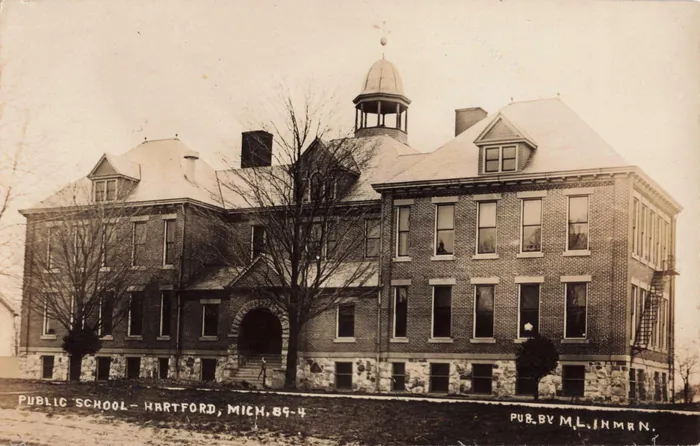
The village was platted on March 3, 1859, by Truman Stratton, W. W. Shepard, Ware Hilliard, James Wolcott, Roswell Hart, J. C. Crandall and James Smith. It grew slowly until the Chicago and West Michigan (later Pere Marquette) railroad was built through in 1870. A fire in June 1877 burned thirteen business places, but the village was incorporated by the legislature that year, with a charter granted April 1 and John W. Hubbard elected first president on April 10. By 1880 it had about 800 people, a brick school, two churches and a newspaper office.
The narrow-gauge line from Lawton later crossed the Pere Marquette at Hartford, and by 1912 sixteen passenger trains a day stopped there. The 1910 census counted 1,268 people, third among the county’s villages. Hartford is now a city, independent of the township around it; the 2020 census counted 2,515.