The story
Welcome to Decatur
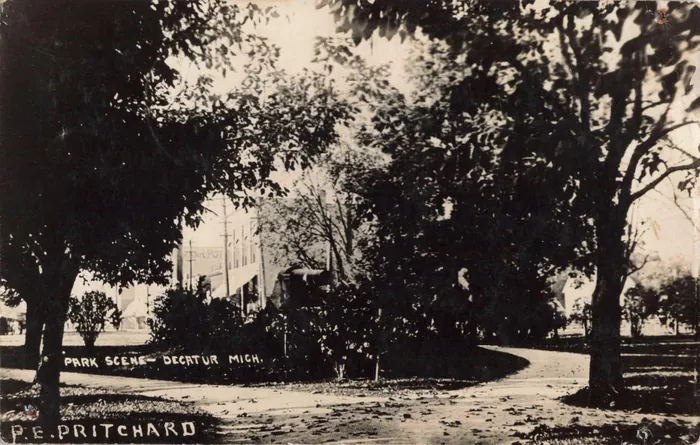
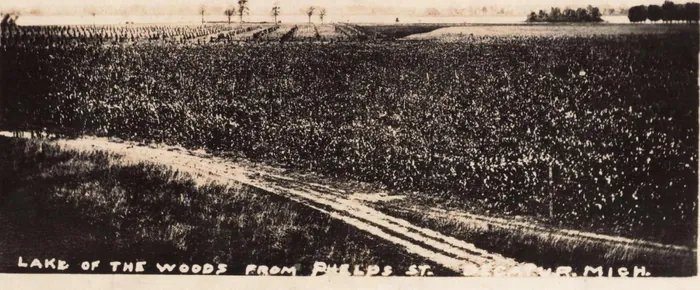
Decatur grew up around a Michigan Central station that two New York land owners laid out in the woods in 1848–49, in the township where Dolphin Morris built the first settler’s cabin in Van Buren County in 1829. A plank-and-puncheon road across the great swamp opened its trade to the south, and by 1880 it was the county’s busy ‘trading town.’
Decatur Township, town 4 south, range 14 west, received the first white settler in Van Buren County. Dolphin Morris of Scioto County, Ohio, began cutting logs for a cabin on section 35 on March 27, 1829, and moved his family in during the first week of April. For two years his was the only family in the county. The first birth in the county, of his son Lewis Creighton Morris, took place in that cabin on August 4, 1830, and the child’s death that December 20 was the county’s first death; the cabin also saw the first sermon and the first school. Le Grand Anderson, Samuel Morris, George Tittle, H. D. Swift and David Curry were settled nearby by November 1832.
The township was created under the act of March 11, 1837, that divided Van Buren County into seven townships. It then covered what is now Decatur and Porter, and was named for Commodore Stephen Decatur, the naval hero of the War of 1812. Porter was set off from its eastern half in 1845. A stage route between Cassopolis and Paw Paw was opened through the township in 1838.
Read the full story
Until 1847 the village site was a hunting ground near Pickerel Lake. Beers & Sherwood of New York City held some 5,000 acres there, and when the Michigan Central pushed west from Kalamazoo they donated land for depot buildings, put up in 1848, the year the road reached Niles. Hiram Lee bought the first village lot that year, and Sarah Cook taught twenty pupils in the first schoolhouse in the winter of 1848–49. In 1849 C. S. Tucker opened a boarding house and the first stores were opened by A. H. Dixon, Goss & Dixon and T. E. Phelps. Settlers said deer and wolves could then be seen in the heart of the village.
What made the place was a road through the great swamp to the south, built in 1848–49 by Beers & Sherwood with $500 from the railroad and $300 from the villagers. Most of it was split puncheons about ten feet long laid on pole stringers, a single track with turnouts. It was finished in November 1849, and Miss Hathaway, later Mrs. A. B. Copley, was the first person carried south across it. A new road west of the old one followed in 1856.
Decatur was incorporated by the board of supervisors on October 11, 1859, with E. P. Hill as first president, and again by the legislature in 1861. A brick town hall costing over $11,000 went up in 1870, and the First National Bank of Decatur was chartered on October 15 of that year. In 1880 the village had about 2,000 people, a barrel-stave works employing 25 to 40 men, a foundry and mills, and it shipped wheat, lumber, stock and, in 1878, 10,000 barrels of apples. By 1911 its station also shipped grapes, celery from drained muck land worked largely by Dutch growers, and some 50,000 pounds of peppermint oil.
The 1910 census counted 1,286 people, second only to Paw Paw among the county’s villages. The 2020 census counted 1,651.