The story
Welcome to Paw Paw
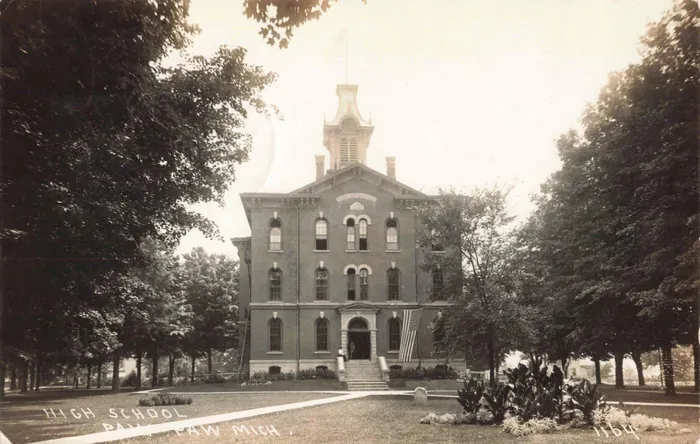
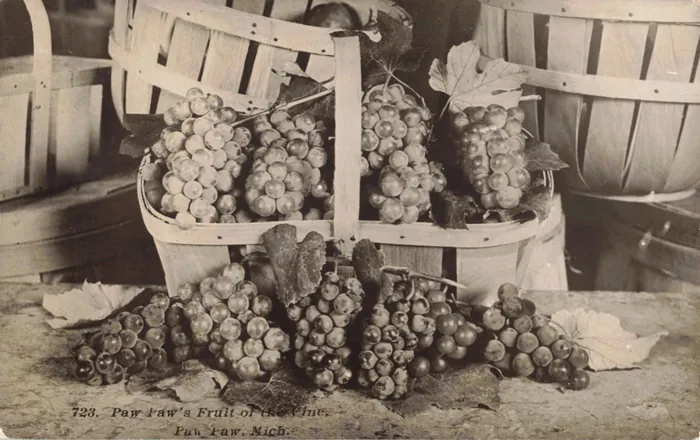
Paw Paw grew around a sawmill at the forks of the Paw Paw River, bought in 1833 by Peter Gremps and Lyman J. Daniels, and around Daniel O. Dodge’s famous tavern on the Territorial road. It took the courts from Lawrence and became the county seat by law in 1840, held it against South Haven in 1901, and stands among the vineyards of a grape-growing township.
The first settlement in the township was made on the village site in 1832, when Rodney Hinckley took up a farm and Pierce Barber of Prairie Ronde began a sawmill on the river. In 1833 the mill passed to Peter Gremps and Lyman J. Daniels. Gremps, who had come from the Mohawk Valley looking for a mill site, was guided to the place from Schoolcraft by John Derosier, entered a good deal of land, and came back with his family in 1835 to stay; Daniels never lived there. The township history of 1912 says the village was named for the river, and the river for the pawpaw trees that once grew thick along its banks.
The Territorial road was expected to pass through, and in 1834 Daniel O. Dodge was offered a whole block and a board house if he would come and keep tavern. His four-room inn, about sixteen by twenty-four feet, became one of the best-known stopping places on the road; Mrs. Dodge was a famous cook, and Dodge is said to have had as many as a hundred people at breakfast. Trees were so thick that travelers often rode through without knowing there was a town, and asked at Dodge’s where Paw Paw was. Gremps had the carpenter Williamson Mason build a store in July 1835, the first in the village, and was the first postmaster from 1835. On New Year’s Day of 1836 about twenty-five Indians made the customary calls on the settlers, and when they insisted on kissing the women, Mrs. Dodge drove them from her house with a rolling pin.
Read the full story
Gremps, Isaac W. Willard and Daniels surveyed the village plat of fifty-one blocks in the spring of 1838, and that year Willard and Gremps began the grist mill long known as the Paw Paw Mills. Commissioners had fixed the county seat at Lawrence in 1835, but the supervisors had the courts held at Paw Paw from 1837, in the schoolhouse from 1838, and an act of 1840 moved the seat of justice to the village. The first court house was built by Stafford Godfrey and Reuben E. Churchill under a contract of 1842 and accepted in 1845. The county’s first newspaper, the Paw Paw Democrat, began in January 1843.
The legislature incorporated the village in 1859, repealed the act in 1863 and passed a new one in 1867, and the first village election was held at the court house on May 6, 1867. Fires in 1859, 1866 and January 1868 swept the business center, and the burned part of Main Street was rebuilt with brick blocks. The First National Bank was chartered on August 11, 1865, and in March 1867 more than $22,000 in bonds and currency was found missing from its safe. In 1867 a local company built the four-mile Paw Paw Railroad to the Michigan Central at Lawton; its engine was named Vulcan. Malinda Russell, who had settled in the area in 1864, published A Domestic Cook Book in 1866, the oldest known published cookbook by an African American woman.
At the spring election of 1901 the county voted on moving the county seat to South Haven, and in the largest poll the county had ever seen, 8,520 votes, removal lost by 356; Paw Paw Township at once issued $50,000 in bonds toward new county buildings. The cornerstone of the court house was laid on September 2, 1901, and the building was first occupied in February 1903. A village dam completed in the summer of 1908 gave power for lights and water works and created Maple Lake through the middle of the village. The 2020 census counted 3,362 people in Paw Paw.