Project Scroll

    Tip: press / or Ctrl K anywhere to search.

    ← Every place in Van Buren County

    Old halftone photograph of a frame church with a tall pointed corner tower, a broad roof and a row of narrow arched windows, with a tree at the right.

    Van Buren County · Michigan · St. Joseph River Valley

    Lawton

    Paw Paw Station, an iron town that became the heart of the grape belt.

    Discover its storyThings to seeDirectionsThe valley map

    The Baptist church at Lawton, from the 1912 county atlas. Photograph from Standard Atlas of Van Buren County, Michigan (Chicago: Geo. A. Ogle & Co., 1912), p. 105, via the Internet Archive, Public domain.

    • Villagein Van Buren County
    • 1849founded
    • 1,850people, 2020 census
    • 4 mifrom Paw Paw, the county seat

    Project Scroll is an independent local-history website. This is not an official page of the Village of Lawton or Van Buren County, and it does not speak for them. For official business, contact the village office directly.

    The story

    Welcome to Lawton

    Lawton began as ‘Paw Paw Station’ on the Michigan Central and took the name of its proprietor, Nathan Lawton of Watertown, New York, who never lived there. An iron furnace backed by General Grant and other army officers made it boom in 1867–75, and grapes made it prosper again.

    Nathan Lawton of Watertown, New York, owned the land where the business part of the village stands, and when it was chosen as a station on the Michigan Central he gave ten acres for depot buildings, erected in 1848, and laid out a town. The station was called Paw Paw, or South Paw Paw. When a post office was opened in 1851, Col. Andrew Longstreet named it Lawton for the proprietor, and the name passed to the town and, in time, to the station. Lawton’s sons George W. and Charles D. Lawton lived in the village for many years.

    Henry McNeil opened the first store in a log cabin on what became Main Street, selling chiefly to the railroad laborers; Longstreet set up a shoe shop in an empty laborer’s shanty, and Gilbert Johnson of Paw Paw opened ‘The Farmers’ Headquarters.’ Growth was slow: in 1854 Lawton had a hotel, two stores, a sawmill, two or three frame houses and half a dozen log cabins. The board of supervisors incorporated the village on October 15, 1858, and 75 votes were cast at the first election that December 4.

    Read the full story

    In 1867 Maj. Joseph Walker, the Lawton brothers and Maj. T. D. Brooks, an iron miner from Lake Superior, organized the Michigan Central Iron Company with $150,000 of capital. Gen. Q. A. Gillmore was president, and Gens. Grant, Barnard and Porter were among the stockholders. The furnace started on December 24, 1867, under Henry Ford, a practical iron man and later village president, smelting Lake Superior ore landed at the company’s docks at Michigan City; the company bought about 1,500 acres of timber land besides a peat bed. About 150 men worked there, and Lawton reached some 2,000 people. Depressed iron prices stopped the works in April 1875 and they never reopened; by 1880 the village had about 800 people.

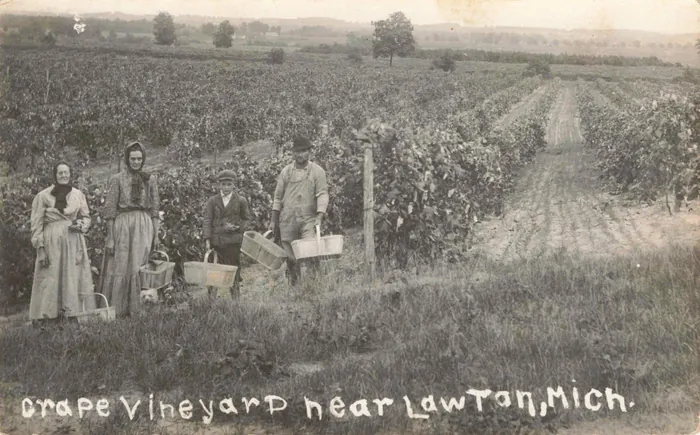
    Fruit took the furnace’s place. Nathan H. Bitely had marketed peaches since about 1860, and in 1868 A. B. Jones set out a hundred Concord and Delaware vines and made the district’s first grape shipment, to Lansing. The Lawton Pomological Society was formed in April 1878, and that year Lawton shipped 50,000 to 60,000 baskets of peaches and 30 tons of grapes. After the hard years of the 1890s hundreds of farmers turned to grapes; by 1911 there were about 15,000 acres of vineyard in Antwerp and Porter townships, and Lawton shipped 1,132 carloads of grapes that season, nearly 4,000,000 eight-pound baskets. Its factories then included grape-juice plants pressing 400 to 500 tons of grapes for unfermented juice.

    A short line, the Paw Paw Railroad, was built from Lawton to Paw Paw after a reorganization in 1866–67, and by 1912 the village streets were shaded with maples and bordered with cement walks. The 1910 census counted 1,042 people; the 2020 census counted 1,850.
    Plan a visit

    Things to see

    • Houppert Winery Complex

      646 Nursery St., Lawton

      A Michigan State Historic Site (1997), also on the National Register.

      Directions

    • Site of the Michigan Central Iron Company works

      Lawton (exact site not marked in the sources read)

      The iron works that ran from December 24, 1867, to April 1875 and made Lawton a town of about 2,000.

      Directions

    Then and now

    Pictures

    Grape Vineyard near Lawton, Mich.
    Grape Vineyard near Lawton, Mich., 1911. Tinder Collection, Clements Library, University of Michigan.
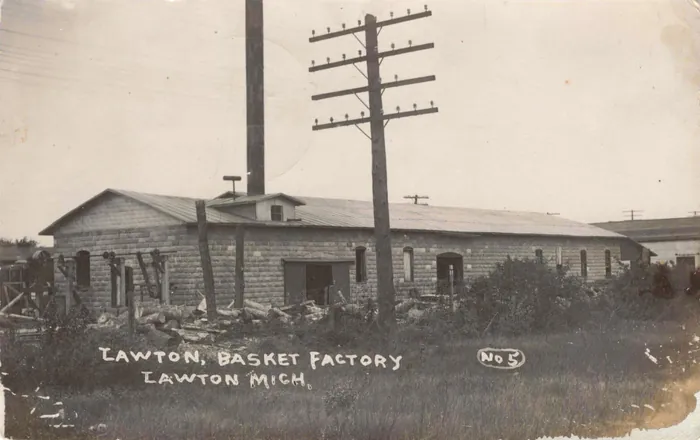
    Basket Factory, Lawton, Mich.
    Basket Factory, Lawton, Mich., 1914. Tinder Collection, Clements Library, University of Michigan.

    Come and see

    Through the year

    • A&A's Little Red Shed Farm Market, 79202 M-40, Lawton, MI 49065. Produce from an 11-acre farm (hydroponic strawberries, sweet corn, tomatoes, melons, peppers, cut flowers) and a bakery with donuts, cookies, pies and jams.

    Quick facts

    At a glance

    Earlier name
    Paw Paw Station (also South Paw Paw)
    Named for
    Nathan Lawton of Watertown, N.Y., the proprietor
    Post office
    1851, Andrew Longstreet postmaster
    Platted
    Laid out about 1849 (Ellis); plat recorded September 6, 1853 (Rowland)
    Incorporated
    October 15, 1858, by the supervisors; reincorporated 1869
    Railroad
    Michigan Central (depot 1848); Paw Paw Railroad
    Township
    Antwerp
    Population
    1910 census: 1,042; 2020 census: 1,850

    Know a story about Lawton?

    Old photographs, letters, a school picture, a story your grandparents told: if it belongs to Lawton, we would love to see it. A phone photo of the front and back is enough, and we credit you by name if you like.

    Send it to us Contact page

    Keep exploring

    Nearby in the valley

    For researchers: records and sources

    Where the records are

    Van Buren County’s courthouse is at 212 E. Paw Paw St., Paw Paw, the county seat; county land, court and vital records are kept by the county offices there. The Van Buren County Historical Society’s museum, in the old county poorhouse at 58471 Red Arrow Hwy., Hartford, displays life in the county from 1829 to 1929. Lawton is covered in Ellis (1880), Antwerp Township, pp. 374–389 (Lawton village, pp. 382–384), and in Rowland (1912), vol. 1, pp. 413–419, with the grape industry at pp. 329–331.

    Sources

    • Franklin Ellis, History of Berrien and Van Buren Counties, Michigan (Philadelphia: D. W. Ensign & Co., 1880), Antwerp Township, p. 374 (iron company and fruit, general); Lawton village and incorporation, pp. 382–383; Michigan Central Iron Company, pp. 383–384; fruit culture and railways, p. 387. link
    • O. W. Rowland, A History of Van Buren County, Michigan, 2 vols. (Chicago and New York: Lewis Publishing Co., 1912), vol. 1, Michigan Central stations, p. 109; Paw Paw Railroad, p. 111; grape industry, pp. 329–331; village of Lawton, pp. 413–419. link
    • ‘Lawton, Michigan,’ Wikipedia (coordinates; 2020 census population 1,850). link
    • ‘List of Michigan State Historic Sites in Van Buren County,’ Wikipedia (Houppert Winery Complex). link
    • U.S. Census Bureau, 2020 Census Redistricting Data (P.L. 94-171), table P1, Lawton village, Van Buren County, Michigan. link
    • ‘Van Buren County Courthouse (Michigan),’ Wikipedia (address; built 1901; National Register 1979). link
    • Southwest Michigan Tourist Council, ‘Van Buren County Museum’ (address; poorhouse of 1884; displays 1829–1929). link

    Dates and names are from the county histories and official sources listed here. Where they disagree, we say so. Know better? Send a correction.