Soldiers of the valley
Company D: the 85 men Dowagiac sent in 1861
Raised at Dowagiac in the summer of 1861, Company D followed a steamboat captain to the lower Mississippi: Baltimore, New Orleans, Baton Rouge, Port Hudson and Mobile Bay. Here is who they were, where they fought, and the nineteen who did not come home.
By Michael Urbanski · Project Scroll · · 14 min read

Dowagiac, Mich. In the summer of 1861 a company was raised at Dowagiac, the second organized in Cass County, under Captain Charles E. Clarke. It became Company D of the Sixth Michigan Infantry.
Its men enlisted in a young railroad town in a farming county. Within a year they were on the lower Mississippi, a thousand miles from home, in a climate that killed more of them than the enemy ever did. Four years later the survivors came home as heavy artillerymen, by way of Baltimore, New Orleans, Baton Rouge, Port Hudson and the forts at the mouth of Mobile Bay.
This is their war, told from the county history Alfred Mathews published in 1882, the regimental record compiled by Frederick Dyer, and the company roll itself, which is now on the site, checked line by line against the page scans.
The company that went to Illinois
DocumentedCompany D was the second company Cass County raised. The first, Mathews writes, had a stranger war before it ever left home. It was organized at Dowagiac that spring, reorganized on 18 May 1861 with much the same officers, and spent six weeks in barracks in the town. It was assigned first to a Michigan regiment forming at Adrian, the Fourth, then switched to the Sixth. Before it could report, the officers were ordered to Detroit for instruction and the privates were told to go home.
DocumentedThe men would not accept it. They voted unanimously to join the Douglas Brigade then forming in Chicago, went to Chicago in June, and came home again when the brigade was not accepted. Only after the defeat at Bull Run did the call come. On 26 July 1861 a United States mustering officer, Captain Webb, swore them in at Dowagiac as Company E of the Forty-second Illinois Volunteer Infantry.
ReadingSo the first Dowagiac company to go to war wore an Illinois number, and the Sixth Michigan, the regiment it had been promised, took a second Dowagiac company instead. That second company was Company D.
Raising Company D
DocumentedMathews names its first officers: Charles E. Clarke, captain; Frederick J. Clarke, first lieutenant; James Ellis, second lieutenant; and William H. Gage, orderly sergeant. The roll shows most of the men enlisting on 20 August 1861, the day the regiment was mustered into federal service.
DocumentedThe captain was a man of the rivers. Mathews’s note on him says Charles E. Clarke was born in Lebanon, Connecticut, and before settling at Dowagiac had spent several years as a captain of steamboats on the Ohio and Mississippi. His first lieutenant was his nephew: Frederick J. Clarke, a printer from Rochester, New York, the son of Joseph B. Clarke.
DocumentedThe regiment gathered at Kalamazoo and left for the East on 30 August 1861, 944 strong. Mathews calls it a “camp instruction regiment”: the governor chose its commissioned officers, who chose the sergeants and corporals, and the officers had drilled for nearly two months at a camp of instruction at Detroit before the men assembled.
ReadingA steamboat captain who knew the lower Mississippi was exactly the kind of officer the army would soon need there. Nobody in Dowagiac in August 1861 could have known that the company was going to spend most of the war on that river.
Baltimore and the Gulf
DocumentedAfter garrison duty at Baltimore it went to New Orleans and the lower Mississippi. Mathews gives the details. The regiment spent close to six months in Baltimore, under General John A. Dix’s command by Dyer’s account, with duty on Maryland’s Eastern Shore. The first death on the company roll came there: Private Jefferson Gates died of disease at Baltimore on 8 October 1861, seven weeks after he enlisted.
DocumentedOn 22 February 1862 the regiment moved to Newport News, near Fortress Monroe, and on 4 March it sailed with General Benjamin Butler’s expedition for the Gulf, riding out a severe storm off Cape Hatteras. It took part in the operations against Forts Jackson and St. Philip below New Orleans, and Mathews says it was the first Union regiment to enter New Orleans by daylight. On 9 May it moved up the Mississippi and met no resistance until Warrenton, just below Vicksburg. Its list of engagements includes Vicksburg on 20 May and Grand Gulf on 27 May 1862.
DocumentedIn July six companies made a raid toward Camp Moore, sixty miles east of Baton Rouge, after Charles M. Conrad, a former United States Secretary of War serving the Confederacy. Meanwhile the river was taking its toll. Private Levi W. Patrick died of disease at Baton Rouge on 3 July 1862, and Private Milton Montgomery there on 3 August.
Baton Rouge, 5 August 1862
DocumentedTwo days after Montgomery died, the Confederates under General John C. Breckinridge attacked Baton Rouge. The Sixth Michigan was one of the seven infantry regiments of General Thomas Williams’s brigade. Williams was killed in the battle; Union losses came to 383 killed, wounded and missing, and Breckinridge was driven off.
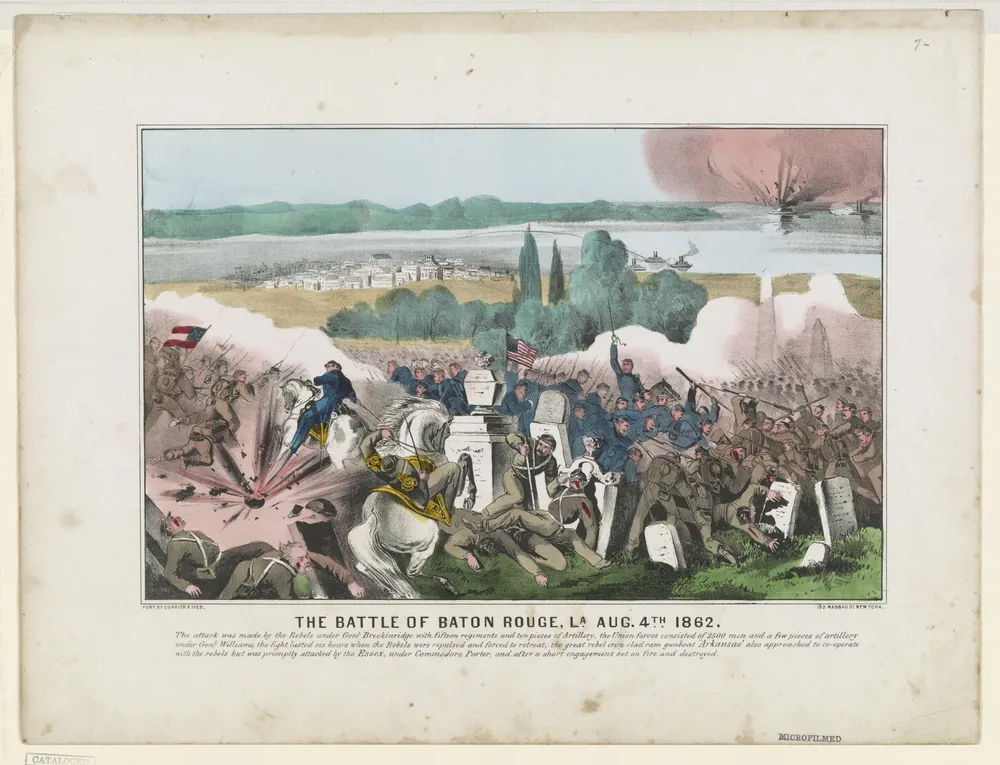
DocumentedMathews says the Sixth repulsed the main Confederate attack. Its senior officers were away in New Orleans, so the regiment’s main force was led by a captain: Charles E. Clarke of Company D. The regiment lost 20 killed, 43 wounded and 6 missing, and Captain Clarke and Lieutenant Clarke were both specially mentioned in the reports.
ReadingFor the Dowagiac company this was the high point of the war. Its own captain led the regiment in its best-known fight, and its lieutenant, his nephew, was named beside him. Promotion followed: the roll records Charles E. Clarke “prom. Major,” and his nephew became acting captain of the company.
DocumentedThe army gave up Baton Rouge on 20 August, and the regiment spent the autumn guarding the approaches to New Orleans from Metairie Ridge. Only 755 men were fit for duty when it reached New Orleans on 6 December. Privates George R. Myers and Edmund Stone died of disease at New Orleans on 12 August 1862, Edward Curtis on 30 November, and George W. Kirk at Camp Williams on 21 November. On 14 January 1863 the regiment helped destroy the Confederate gunboat Cotton on Bayou Teche, and that spring it skirmished at Ponchatoula, the Amite River and the Tickfaw. Private William H. Wilsey died of disease at Carrollton on 6 March 1863.
Port Hudson
DocumentedPort Hudson, on a bluff above the Mississippi north of Baton Rouge, was the last Confederate stronghold on the river below Vicksburg. General Nathaniel Banks’s army closed around it in the last week of May 1863, and the Sixth Michigan was placed, Mathews says, in one of the most exposed positions.
DocumentedOn 27 May Banks threw four columns at the works. The Sixth was in General Thomas W. Sherman’s division, which attacked from the east in the afternoon; Sherman himself was wounded. None of the Union columns reached the parapets. Union losses that day were 293 killed, 1,545 wounded and 157 missing. Mathews says the Sixth lost about a third of the men engaged. It was the same day the First and Third Louisiana Native Guards, Black regiments, made their famous charge.
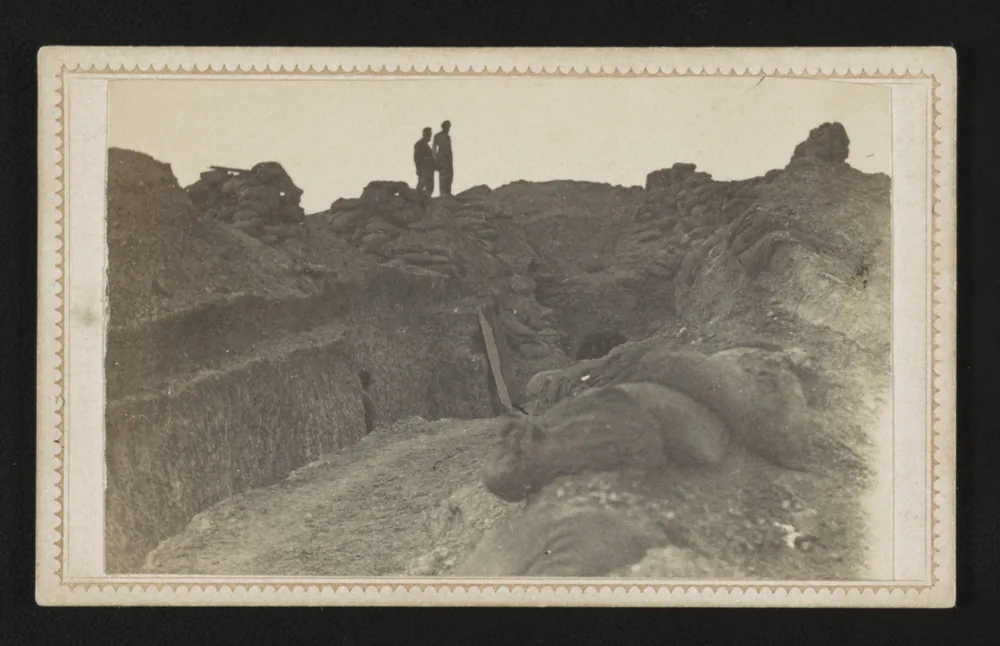
DocumentedLieutenant Frederick J. Clarke, acting captain of Company D, was killed leading the company in what Mathews calls “a desperate assault” on the works. His body was carried off the field under fire by his uncle, the company’s drummer boy and two Black soldiers, and he was buried in the National Military Cemetery at Baton Rouge. Two privates of the company, Elijah H. Carter and Benjamin H. Harmon, died of wounds that day.
DocumentedThe roll prints the lieutenant’s death as 27 May 1862, a year too early; the book’s date is kept as printed on our roll and marked. Port Hudson was 27 May 1863.
DocumentedOthers were hit and lived. Jacob McIntosh, whose biography is in Mathews, enlisted in the Sixth in August 1861, was promoted sergeant on 27 May 1863 and was struck that day by a minié ball above the right knee, not badly enough to put him out of the ranks. William W. McIlvaine of Cassopolis, who rose from sergeant to first lieutenant in Company D, was wounded during the siege; Mathews’s sketch of him says he served nearly four years and kept a store in Cassopolis afterward.
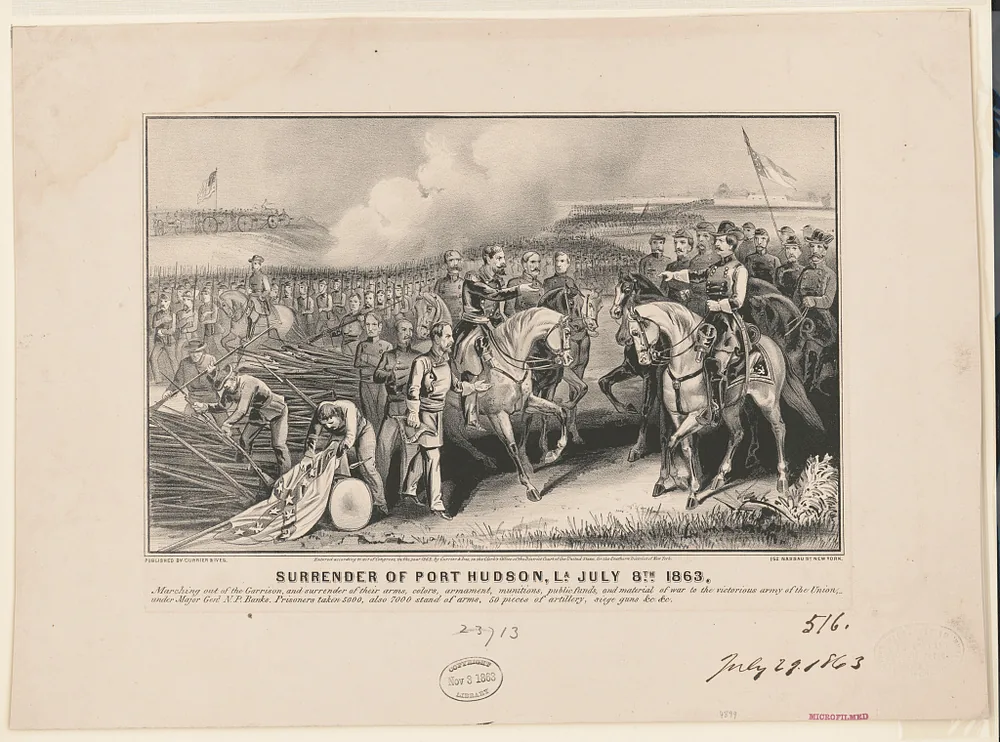
DocumentedThe siege went on for 48 days. On 30 June Private George W. Sickles was killed in action at Port Hudson. The Sixth’s men worked the trenches opposite the Confederate strongpoint called the Citadel, and some of them used Merrill carbines in the raids there. Port Hudson surrendered on 9 July 1863, five days after Vicksburg, and the whole Mississippi was in Union hands.
The summer that killed more
Of its men, four were killed or died of wounds and fifteen died of disease. As in the whole war, sickness killed more of them than battle did.
DocumentedPort Hudson shows how. After the surrender the regiment stayed on as garrison through the hot season, and the company’s deaths came one after another: Samuel Montgomery on 18 July 1863; Peter Lewis on 12 August; Sylvester Harmon on 13 August; Lewis Swinehart on 29 August; John M. Carter on 2 September; Spencer Tracy on 22 September; and Job E. Osborn on 4 October. All seven died of disease at Port Hudson, in less than three months, more than the company lost to Confederate fire in the whole war.
DocumentedThe regiment’s figures, as Dyer compiled them, tell the same story on a larger scale. The Sixth Michigan lost 2 officers and 76 enlisted men killed or mortally wounded, and 6 officers and 498 enlisted men to disease: 582 dead in all.
ReadingThat is more than six deaths from disease for every death in battle. Company D’s own ratio, fifteen to four, is almost exactly in line with its regiment’s. The killers were the lower Mississippi’s summers, bad water and crowded camps: men from a cool northern county posted for years in the swamps and river towns of Louisiana.
Heavy artillery, Fort Morgan and home
The regiment had gone to New Orleans and the lower Mississippi, fought at Baton Rouge, and joined the assault on Port Hudson on 27 May 1863, where Lieutenant Frederick J. Clarke was killed. It ended the war as heavy artillery, and was discharged at Jackson, Michigan, on 5 September 1865.
DocumentedAfter Port Hudson the Sixth was converted to heavy artillery; Dyer says the change was made in July 1863 and approved by the Secretary of War on 30 July. It garrisoned Port Hudson until the summer of 1864. Many of the original men chose to stay: the company roll shows a row of them re-enlisting as veterans on 1 February 1864, and Mathews says 247 men of the regiment had re-enlisted when it started north on veteran furlough on 11 March 1864. After thirty days at home the regiment went back south and reached Port Hudson again on 11 May, with many recruits.
DocumentedThat summer it moved by way of Morganza, Vicksburg and St. Charles, Arkansas, and worked for a time as engineers. It reached Mobile Bay for the siege of Fort Morgan, though too late to take part in it. Admiral David Farragut’s fleet had run past the fort on 5 August 1864; Fort Gaines surrendered on 8 August, and Fort Morgan on 23 August. On 1 November 1864, with Charles E. Clarke now colonel, Company D was one of five companies garrisoning Fort Morgan and Fort Gaines on Dauphin Island, while the others went on the expedition against Mobile. Clarke, Mathews says, commanded Fort Morgan after its capture.
DocumentedThe regiment’s last campaign was the siege of Mobile, 20 March to 12 April 1865, with operations at Spanish Fort and the forts around the city. It was mustered out on 20 August 1865 and paid off and discharged at Jackson on 5 September.
DocumentedThe colonel kept soldiering. Mathews says Charles E. Clarke was commissioned a captain in the regular army, with the brevet rank of major for gallant and meritorious service, and served chiefly as commander of posts in New Mexico and Dakota before retiring at his own request. The book gives his retirement as 1880 in its biographical note and 1878 in the regimental roster.
Reading the roll
The roll of all 85 men, as Mathews printed it in 1882, is now on the site, checked line by line against the page scans, with this week’s anniversaries from their service. Read the roll of Company D.
DocumentedRead it slowly and patterns appear. Eight men were discharged for disability on the same day, 14 October 1862, among them three named Meacham: Sergeant Hiram, and Privates Cyrus and William J. A long row of the original three-year men were discharged at the end of their service on 23 August 1864. Two men left the company to become officers elsewhere: Sergeant Ira Coe was promoted second lieutenant in the United States Colored Troops, and Corporal Charles K. Weil first lieutenant in the First Louisiana Battery on 29 November 1862.
ReadingSurnames repeat: three Harmons, three Osborns, two Montgomerys, two Estabrooks, two Reynoldses, two Carters. Some were surely brothers or cousins; the roll does not say, and a shared name proves nothing by itself. The Harmons are a hard example. Benjamin died of wounds on 27 May 1863, Sylvester of disease on 13 August, and James was discharged by order in March 1864.
ReadingA line on the roll is a lead, not the whole story. Each man’s service record and pension file, held at the National Archives, can say where he was wounded, whom he married and where he lived after the war. ReadingIf you descend from a man of Company D, or hold his letters or photograph, write to research@projectscroll.com.
DocumentedDowagiac sent more than this one company. In 1862 the Nineteenth Michigan Infantry was organized at the town under Colonel Henry C. Gilbert and left camp on 14 September 1862 with 995 men, and a bronze tablet placed in 1922 by the Woman’s Relief Corps of Cass County remembers that regiment in Dowagiac today.
A timeline
- 26 Jul 1861 Cass County’s first company mustered at Dowagiac into the 42nd Illinois
- 20 Aug 1861 Most of Company D enlist; the Sixth Michigan mustered in
- 30 Aug 1861 The regiment leaves Kalamazoo, 944 strong
- 8 Oct 1861 First death on the roll, at Baltimore
- 4 Mar 1862 Sails for the Gulf with Butler
- 5 Aug 1862 Battle of Baton Rouge; Captain Clarke leads the regiment
- 27 May 1863 Assault on Port Hudson; Lt. Frederick J. Clarke killed
- 9 Jul 1863 Port Hudson surrenders
- Jul–Oct 1863 Seven of the company die of disease at Port Hudson
- 1 Feb 1864 Veterans re-enlist
- Nov 1864 Company D garrisons Forts Morgan and Gaines
- Mar–Apr 1865 Siege of Mobile
- 5 Sep 1865 Discharged at Jackson
If you go
The tablet to the Nineteenth Michigan stands in James E. Burke Park, at North Lowe and Main streets in Dowagiac. Lieutenant Frederick J. Clarke, Mathews says, lies in the national cemetery at Baton Rouge. To find a man of Company D, start with the roll on the site and his name in our name index.
Sources
- Alfred Mathews, History of Cass County, Michigan (1882), pp. 117–120, University of Michigan
- Alfred Mathews, History of Cass County, Michigan (Chicago: Waterman, Watkins & Co., 1882): the first company and the 42nd Illinois, p. 115; Company D, the Clarkes and the Sixth Michigan, pp. 117–120; William W. McIlvaine, p. 179; Jacob McIntosh, p. 252. Internet Archive copy of the University of Michigan scan
- Company D, Sixth Michigan Infantry: the roll, Project Scroll
- Frederick H. Dyer, A Compendium of the War of the Rebellion (1908): 6th Regiment Michigan Infantry (6th Heavy Artillery), as reproduced by The Civil War Archive
- 6th Michigan Heavy Artillery Regiment, Wikipedia
- Battle of Baton Rouge (1862), Wikipedia
- Siege of Port Hudson, Wikipedia
- Battle of Mobile Bay, Wikipedia
- 19th Michigan Infantry Memorial (Dowagiac, Michigan), Civil War Monuments database
- Dowagiac Civil War Memorial, James E. Burke Park, Memorial Day Foundation
- The Battle of Baton Rouge, La. (Currier & Ives, New York, 1862). Library of Congress, Prints and Photographs Division.
- McPherson & Oliver, “The tunnel under the ‘Citadel’ dug by the Union forces,” Port Hudson, La., 1863. Robin G. Stanford Collection, Library of Congress.
- Surrender of Port Hudson, La. July 8th. 1863 (Currier & Ives, New York, 1863). Library of Congress, Prints and Photographs Division.
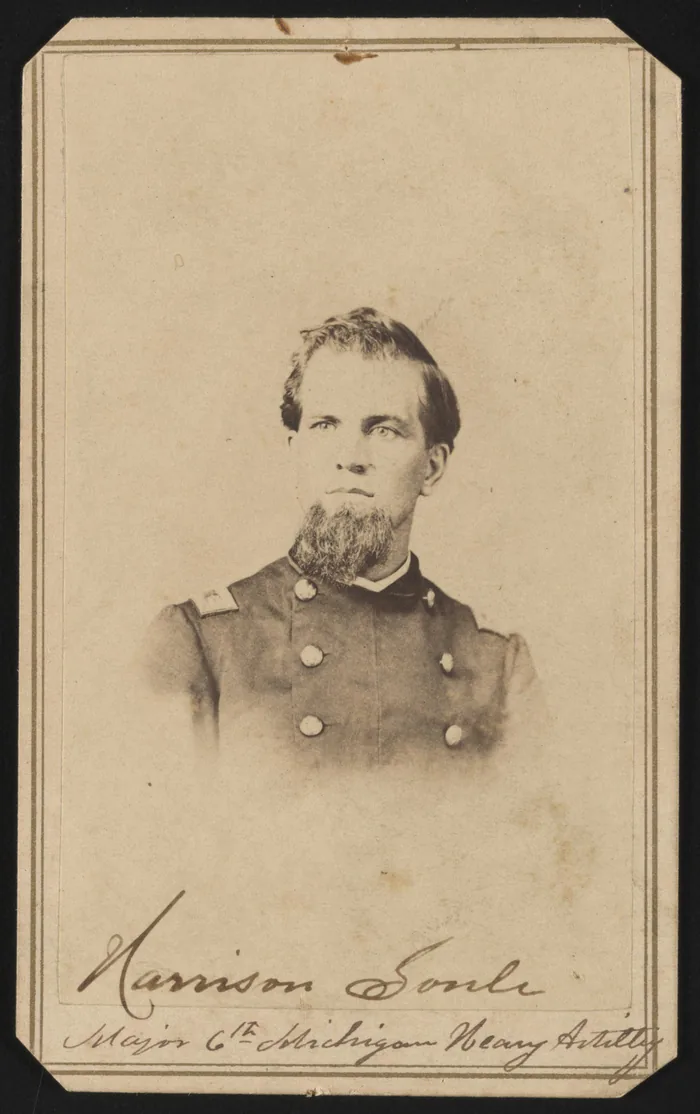
- Harrison Soule, 6th Michigan Infantry and Heavy Artillery (carte de visite, E. A. Piffet, New Orleans, between 1861 and 1865). Liljenquist Family Collection, Library of Congress.
Numbers in the text point to this list; entries without a number are further sources we consulted. How we research › · The libraries behind all our stories ›
Read the roll Search every name
Corrections: none
First published 22 October 2026; last updated 24 October 2026. Like all our pages, it is expanded from time to time with new records, pictures and features. No factual corrections have been needed so far.
About this research
Research and reporting Michael Urbanski Project Scroll
- Sources
- Every fact on this page is drawn from the sources listed above, and each can be checked where it is held.
- Corrections
- Errors are corrected on the page, and each correction is noted there.
- Contact
- To report an error or share a record that adds to the story, write to research@projectscroll.com.
- Method
- How we research ›
© 2026 Michael Urbanski and Project Scroll. All rights reserved. The text, original maps, charts and illustrations may not be reproduced without permission; brief quotations with credit and a link back are welcome. Material from other sources belongs to its holders and is credited where it appears; public-domain material is marked as such.


