The story
Welcome to Kendallville
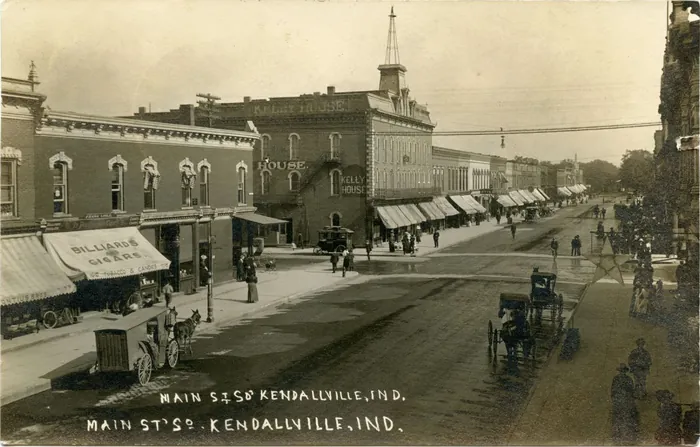
Kendallville began as a roadside cabin on the Fort Wayne and Lima road and took its name from Postmaster General Amos Kendall. The railroad of 1852 made it the largest town in Noble County, and its Flint & Walling works shipped windmills and pumps across the country.
In the autumn of 1832, or perhaps the spring of 1833, a man named David Bundle put up a small round-log cabin with a bark roof beside the newly surveyed Fort Wayne and Lima road and hung out a sign that travelers could be entertained. In the fall of 1833 Frances Dingman, whose husband had died at Fort Wayne while the family looked for land, bought Bundle’s right to the cabin and kept the inn herself; Bundle disappeared. In 1836 she built the first frame house in Kendallville, and about 1837 she married Truman Bearss, the two walking to the Haw Patch for the ceremony. George Ulmer, William Mitchell, Ezra T. Isbell, Henry Iddings and Daniel Bixler settled nearby in the next few years.
A post office was opened at William Mitchell’s cabin a little before 1840 and named for Postmaster General Amos Kendall; when the village was laid out it took the post office’s name. Growth was slow, and in 1849 perhaps a dozen families lived there, when nearby Lisbon was the bigger place. On June 1, 1849, Mitchell had the county surveyor lay out twenty lots on the west side of Main Street. Samuel Minot, who had opened a store a few years before, made pearl-ash for the Fort Wayne market and sawed lumber for the plank road. The 1920 county history says the road was much traveled by people escaping slavery on their way to Canada, helped by S. Whitford, John Longyear and others living along it.
Read the full story
The village grew from about seventy-five people in 1849 to more than three hundred by 1857, the fastest growth coming in 1852, when it became certain that the Southern Michigan & Northern Indiana Railroad would pass through. Kendallville was incorporated as a town in 1863, and on October 6, 1866, it held its first election as a city, choosing Tim Baker as mayor. During the Civil War the training camp for the Tenth Congressional District, Camp Mitchell, was at Kendallville, and the 12th Indiana Cavalry and the 129th Indiana Infantry were organized there.
A small foundry begun in 1856 passed, about the time of the Civil War, to Flint, Walling & Co. By 1882 the firm was making wind-pumps of its own patent faster than it could fill the orders, and by 1920, the county history says, it had grown into one of the largest concerns in the United States, rivaled in Kendallville by the McCray Refrigerator Company. The Mid-America Windmill Museum, incorporated in 1992, holds all eleven windmill models the company made from 1870 until it stopped making windmills in 1954.
Kendallville lies on Bixler Lake, named for the old settler Daniel Bixler; about 1866 a small steamboat, the Flying Dutchman, carried passengers on it. The waterworks of 1887 stand at the lake’s edge, and a Carnegie library, its corner stone laid July 19, 1913, opened on May 2, 1914. The 2020 census counted 10,271 people in Kendallville.