The story
Welcome to Mattawan
Mattawan grew on the Michigan Central at the east edge of Van Buren County and was named after Matteawan on the Hudson River in New York. It shipped lumber in the 1860s and grapes after 1900, and in 1910 it formed the only consolidated school in the county.
While the Michigan Central was being built, Nathaniel Chesebro, attorney for the railroad, bought forty acres on part of the site, laid out a town and called it Mattawan after a village on the Hudson River in New York. In 1848 Charles W. Scott enlarged the plat and gave land for the depot on condition that trains stop there; the company later ignored the condition, and Scott tried without success to be paid for the land. The first recorded plat, of four blocks north of the tracks, was made by Lyman Lawrence on November 9, 1850.
The first building of any importance was a grocery put up in 1850 by John Cronkhite and sold to the Rev. J. J. Bliss, a Canadian who lived on the ground floor, kept store upstairs, worked as a railroad switchman and preached, first as a Protestant Methodist and later as a Free-Will Baptist. Bliss also built the warehouse by the railroad later owned by Morgan L. Fitch. He became postmaster when the office opened in 1850 and kept the letters in a cigar box. There was no hotel until J. F. Parmenter built the Antwerp House on Front Street in 1855.
Read the full story
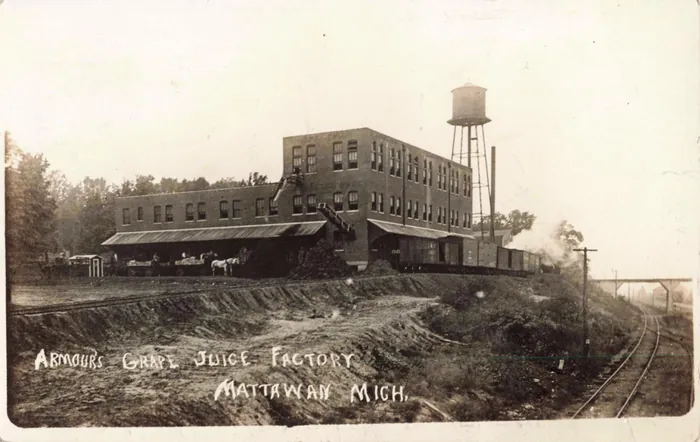
About 1869 Mattawan had some 800 people and shipped great quantities of lumber hauled in from mills to the north, but the Chicago and West Michigan and the Kalamazoo and South Haven railroads drew that trade away, and by January 1880 the village had about 400. The vineyards brought it back: by 1912 Mattawan was a station on the ‘Fruit Belt’ line as well, shipped 461 carloads of grapes in a season, and had a grape-juice factory that pressed 1,356 tons of grapes into about 300,000 gallons of unfermented juice.
In the summer of 1910 four rural districts joined the village district to form a consolidated school, the only one in the county, with pupils carried in covered vehicles and a twelve-grade course. As late as 1912 Rowland noted that the village had never been incorporated. It is now an incorporated village; the 2020 census counted 2,550 people.