How the towns got their names
How Niles got its name
Before it was Niles it was Pog-wa-tigue, a trading settlement on the St. Joseph. The village took the name of a Baltimore newspaper editor in 1829, the county history explains why only in 1906, and of the four flags of its nickname, the record shows three, one of them flown for a day or less.
By Michael Urbanski · Project Scroll · First published · Updated · 9 min read

New finding 1 new finding in this story. See what’s new ›
Niles, Mich. Niles is named for a newspaper editor who never lived here: Hezekiah Niles of Baltimore, whose Weekly Register was read across the young republic. That much is in every guidebook. Less often told is that the settlement had another name first, written at the head of a trader’s account book; that the village plat was recorded in a county more than a hundred miles away; and that the county’s own history gave no reason for the name until 1906.
We went back to the Berrien County histories of 1880 and 1906, the state’s historical marker at the fort, and the county map of 1860, to see what the record shows.
The case in brief
What the record shows
- The trading settlement was called “Pog-wa-tigue” in 1828–29; a trader’s account book of 1 January 1829 is headed with it.
- The village plat was signed on 1 August 1829 and recorded in Lenawee County, then the county for this part of the territory, as “the plat of the village of Niles.”
- The name honours Hezekiah Niles of Baltimore, chosen, says the 1906 history, by Obed P. Lacey, a reader of his paper.
- France and Britain held Fort St. Joseph, and Spain held it for a day or less in February 1781: hours, says the state marker; a few days, says Coolidge.
What it does not show, yet
- Who among the founders chose the name. The 1829 report speaks of “the founders”; only the 1906 history names Lacey.
- What “Pog-wa-tigue” meant. The 1880 history says “running water,” and gives no source.
- Any record of a United States flag or garrison at the fort.
Story or record? Play along
Here are eight things people say about the name. For each, make your call: true, false, or no record either way. Then see what the paper shows.
“Niles was named for Hezekiah Niles, the Baltimore editor.”
True, as printed
The papers said so in November 1829: “in honor of Hezekiah Niles, of Baltimore,” for his work “in behalf of the American System.” Coolidge’s county history of 1906 adds that Obed Lacey chose it.
“Niles was named after the town’s own newspaper editor.”
No
In 1829 the settlement had no newspaper. The editor was Hezekiah Niles, in Baltimore.
“Before it was Niles, the settlement was called Pog-wa-tigue.”
True
The traders’ account books open “Pog-wa-tigue, Jan. 1, 1829,” and in 1828 “the settlement was then called Pog-wa-tigue,” says the 1880 history.
“Pog-wa-tigue means ‘running water.’”
No record
The 1880 history prints “(running water)” beside it, but gives no source, and we have found no linguist’s analysis.
“The village was platted on 1 August 1829.”
True
The plat was signed by William Justus and by Samuel B. Walling for Walling & Lacey on 1 August 1829.
“The first plat of Niles was recorded in Berrien County.”
No
It was “registered in liber A, folios 134 and 135, records of Lenawee County” on 29 August 1829. Berrien County had only just been set off, and was not yet organized.
“The Register was a Whig paper when Niles was named.”
No
The 1906 history calls it “a Whig newspaper,” but the Whig party did not exist until 1833–34, four years after the plat.
“Four flags, the Stars and Stripes among them, flew over Fort St. Joseph.”
Three, and one barely
France and Britain held the fort, and a Spanish force from St. Louis raised its flag there for a few hours in February 1781. We have found no record of a United States flag or garrison at the fort.
Pog-wa-tigue
DocumentedThe traders came first. The account books of Walling & Lacey for 1829, the 1880 county history says, open under the heading “Pog-wa-tigue, Jan. 1, 1829.” In 1828, the same history says, “the settlement was then called Pog-wa-tigue (running water).”
ReadingThe gloss “running water” is printed without a source, and we have not found a linguist’s account of the word. It may be right; it is not yet proven.
DocumentedThere was a post office before there was a plat. In the fall of 1828, the 1880 history says, “Obed P. Lacey was appointed as acting postmaster; the office was kept in Mr. Walling’s house.” Isaac Gray received the first regular commission in 1830.
The plat of the village of Niles
DocumentedOn 1 August 1829, the 1880 history says, a village plat was laid out on the southwest fractional quarter of section 26, “signed by William Justus and by Samuel B. Walling, on behalf of Walling & Lacey,” and acknowledged before Ezra Beardsley, a justice of the peace. It was “registered in liber A, folios 134 and 135, records of Lenawee County, Saturday, Aug. 29, 1829,” and recorded “as the plat of the village of Niles.”
ReadingLenawee? In August 1829 there was no Berrien County government yet. The county was set off that October and organized later, and this corner of the territory was attached for record-keeping to counties far to the east. The earliest dated “Niles” we have found is that plat of 1 August 1829.
DocumentedOn 29 October 1829 the township of Niles was erected, the same day Berrien County was set off. The village was incorporated by an act approved 12 February 1835, and Niles became a city by charter on 12 February 1859.
Why Niles?
DocumentedThe 1880 history, for all its detail, never says why the village was called Niles. The explanation enters the county histories with Orville W. Coolidge in 1906: “The village was designated by Obed Lacey as Niles after the name of the editor of the Niles Register,” which Coolidge calls “a Whig newspaper published at Baltimore, which was a favorite journal of Mr. Lacey.”
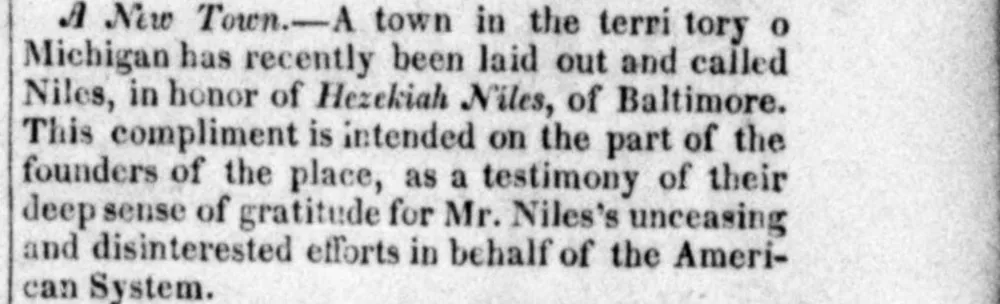
DocumentedThe reason was in print long before, in the year of the plat. On 20 November 1829 Benjamin Lundy’s Genius of Universal Emancipation reported (p. 87): “A town in the territory of Michigan has recently been laid out and called Niles, in honor of Hezekiah Niles, of Baltimore. This compliment is intended on the part of the founders of the place, as a testimony of their deep sense of gratitude for Mr. Niles’s unceasing and disinterested efforts in behalf of the American System.” The American System was Henry Clay’s programme of protective tariffs and internal improvements, the cause Niles’s Register argued week after week. So the founders’ own reason, as the papers had it in 1829, was politics as much as reading.
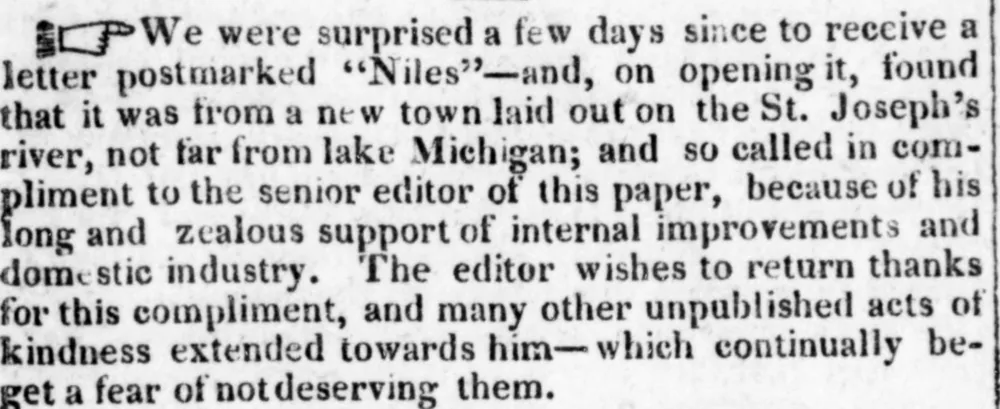
New findingHezekiah Niles printed the news himself, two weeks earlier. On the front page of his Weekly Register of 7 November 1829 he wrote: “We were surprised a few days since to receive a letter postmarked ‘Niles’—and, on opening it, found that it was from a new town laid out on the St. Joseph’s river, not far from lake Michigan; and so called in compliment to the senior editor of this paper, because of his long and zealous support of internal improvements and domestic industry. The editor wishes to return thanks for this compliment.” It is the earliest notice of the name in print that we have found, and its postmark shows that by the first days of November 1829, at the latest, letters were leaving the new town marked “Niles.”
ReadingCoolidge was writing seventy-seven years later, and his “Whig” is wrong for 1829: the Whig party formed in 1833–34. But the attribution is reasonable. Hezekiah Niles (1777–1839) had published his Weekly Register at Baltimore since 1811, and it was one of the most widely read news digests of its day.
DocumentedSome modern summaries say the town was named for “the town newspaper editor.” In 1829 Niles had no newspaper.
Three flags and a few hours
DocumentedNiles calls itself the City of Four Flags. The French built Fort St. Joseph on the river south of the present city; the state’s historical marker of 1957 dates it to 1691. Britain took the fort in 1761. In February 1781 a Spanish force from St. Louis, Coolidge writes, “captured Fort St. Joseph, hauled down the British flag and raised the Spanish flag. The Spanish troops remained but a few days.” The state marker says the Spanish flag flew “for a few hours.”
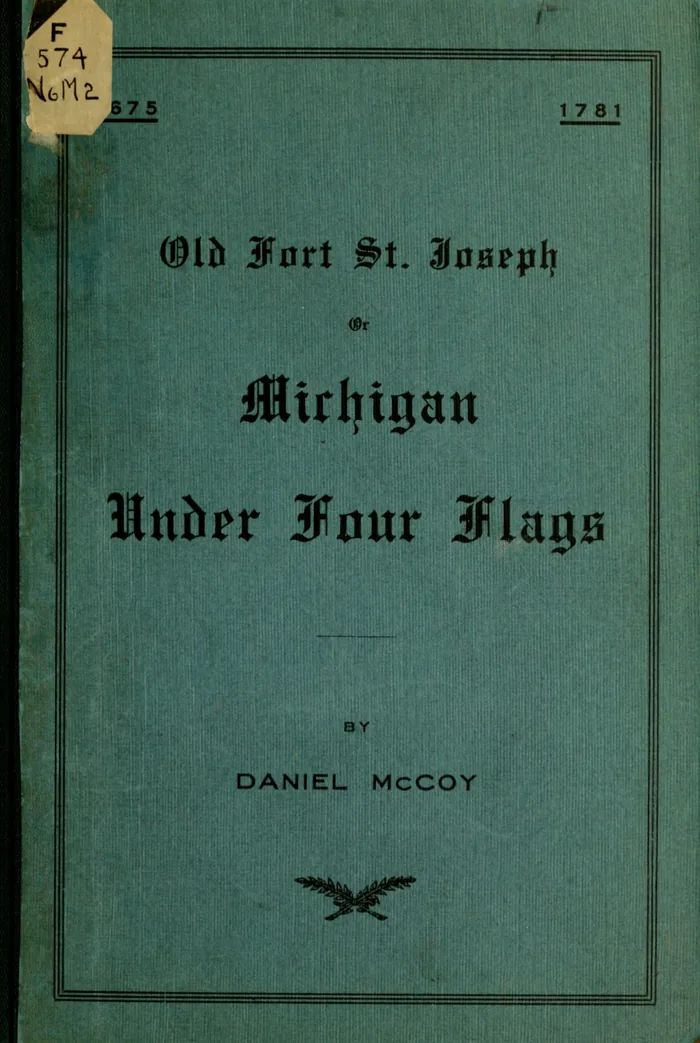
ReadingThe United States gained the region by treaty in 1783 and took possession of the western posts in 1796, but we have found no record of an American flag or garrison at the fort itself. The phrase “four flags” is in print by 1907, in Daniel McCoy’s address Old Fort St. Joseph; or, Michigan under Four Flags.
OpenAn earlier printing of “four flags,” or a record of the Stars and Stripes at the fort, would change this section.
The name on paper
Play the names in order, from the trader’s ledger to the city.
- 1829 Pog-wa-tigue (Walling & Lacey’s account book, 1 January)
- 1829 Niles (the plat, 1 August)
- 1829 township of Niles (29 October)
- 1835 village of Niles (the act of incorporation)
- 1859 City of Niles (the city charter)
- 1860 City of Niles (the county map)
To cite this page: Michael Urbanski, “How Niles got its name,” Project Scroll, projectscroll.com/news/how-niles-got-its-name/, first published 22 October 2026. Corrections are welcome, and any we make are noted on this page.
Sources
- History of Berrien and Van Buren Counties, Michigan (Philadelphia: D. W. Ensign & Co., 1880): Pog-wa-tigue and the account books, pp. 141, 154, 160; the plat, pp. 155, 160; incorporation and charter, p. 161; the township, p. 267. Internet Archive.
- Orville W. Coolidge, A Twentieth Century History of Berrien County, Michigan (Chicago, 1906): the Spanish flag, p. 12; the post office and the name, pp. 141–142. Internet Archive.
- Michigan historical marker “Fort St. Joseph” (1957), on the Historical Marker Database.
- Daniel McCoy, Old Fort St. Joseph; or, Michigan under Four Flags (Lansing, 1907). Western Michigan University ScholarWorks.
- Geil, Harley & Siverd, Map of the Counties of Cass, Van Buren and Berrien, Michigan (Philadelphia, 1860), with the plan of the City of Niles. Library of Congress, Geography and Map Division.
- Genius of Universal Emancipation (Baltimore), 20 November 1829, p. 87, “A New Town.” Internet Archive.
- Niles’ Weekly Register (Baltimore), vol. 37, no. 947, 7 November 1829, p. 1: the letter postmarked “Niles.” Internet Archive.
- Daniel McCoy, Old Fort St. Joseph; or, Michigan under Four Flags (Lansing, 1907). Library of Congress copy, Internet Archive.
Numbers in the text point to this list; entries without a number are further sources we consulted. How we research › · The libraries behind all our stories ›
The place-names map Write to us All the news
Corrections (1)
First published 22 October 2026; last updated 25 October 2026. Like all our pages, it is expanded from time to time with new records, pictures and features. Factual corrections are listed here, with their dates.
- The explanation of the name is in print by 1829, not first in 1906.
About this research
Research and reporting Michael Urbanski Project Scroll
- Sources
- Every fact on this page is drawn from the sources listed above, and each can be checked where it is held.
- Corrections
- Errors are corrected on the page, and each correction is noted there.
- Contact
- To report an error or share a record that adds to the story, write to research@projectscroll.com.
- Method
- How we research ›
© 2026 Michael Urbanski and Project Scroll. All rights reserved. The text, original maps, charts and illustrations may not be reproduced without permission; brief quotations with credit and a link back are welcome. Material from other sources belongs to its holders and is credited where it appears; public-domain material is marked as such.


