The story
Welcome to Coldwater
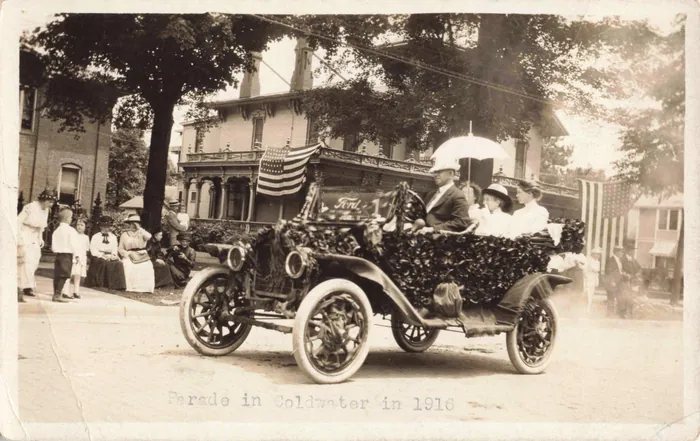
Coldwater began in 1830 with Hugh Campbell’s log house beside the Chicago road and was laid out in 1832 under the name Lyons. It took the county seat from the village of Branch, became a city in 1861, and was home to Michigan’s State Public School for dependent children.
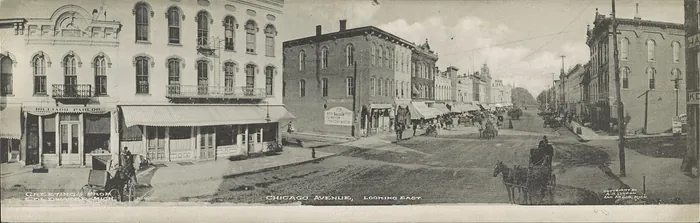
The Chicago road, the 1879 county history says, was at first simply the Indian trail, marked out in 1829 and not worked until 1832, and it ran through what became the north side of the city. In 1830 Hugh Campbell put up a log house on Chicago Street, on ground later covered by the Lewis Art Gallery; the Cross brothers, Lemuel Bingham, Abram F. Bolton and others entered land close by. The name comes from the Potawatomi word for the place, given on the 1961 city marker as ‘Chuck-sew-ya-bish,’ cold spring water: the 1879 history says that cold springs bubbled up in the bed of the little river through the west part of the town.
In the spring of 1832 Allen Tibbits and Joseph Hanchett laid out the village, surveyed by James B. Tompkins, and called it Lyons after Tibbits’ native town in New York; the name was soon changed to Coldwater, and the post office of that name was moved there, leaving the first Coldwater settlement on the river to be absorbed. Tibbits, a Methodist preacher, gave the first sermon in his log house in July 1831, and the first Methodist society in the county was organized there on June 19, 1832. Cynthia Gloyd opened a school of nine pupils in a cabin in July 1832, Peter Martin built a sawmill the same year, and in 1833 a post office was opened with Silas A. Holbrook as postmaster.
Read the full story
The county seat had first gone to Masonville and then to Branch, chosen by a governor’s commission as the center of the county. Coldwater won it in the end, and the 1879 history says the contest was not settled until a legislative decree of 1842. A colony from the East in 1835, the Crippens, Fisks, Haineses and others, gave the place a new start. When fever and chills ran high in the 1830s, the townspeople blamed a mill-dam south of the village, marched on it in a body one morning and tore it down, throwing in the protesting proprietor, Mr. Frink. The village was incorporated in 1837.
The Michigan Southern Railroad was finished through the village about 1850–51, after a riot by unpaid track laborers that the marshal, Roland Root, managed to quiet. Fires in 1850 and 1851 burned much of Chicago Street, and the business blocks were rebuilt at once. In 1861 the legislature gave Coldwater a city charter; Albert Chandler was the first mayor. The State Public School, authorized in 1871 for dependent and neglected children, opened in Coldwater on May 21, 1874, with the children living in family-like cottages until homes could be found for them.
B. S. Tibbits built the opera house on South Hanchett Street, which opened on September 21, 1882, with ‘The Maid of Arran.’ The city voted for water works on April 8, 1890, and installed its own electric lighting plant in 1891, and about 1900 Chicago Street was paved with brick from the public square to Jackson Street. The 2020 census counted 13,822 people in Coldwater.