The story
Welcome to Quincy
Quincy grew around John Cornish’s tavern on the Chicago road, six miles east of Coldwater. The Berry family owned most of the village site, the railroad station of 1850 gave it its start, and it was platted in 1856 and incorporated in 1858.
Quincy Township lay along the Chicago road, and its first land entries all followed the road. Horris Willson of Batavia, New York, made the first purchase in June 1830 and built a hewed-log house on the north side of the road in section 14, which he opened as a tavern. James G. Corbus bought land in section 13 in 1832 and built the township’s first frame house the next year, also an inn. The township was named, the 1879 county history says, on the suggestion of Dr. Hiram Alden, then the county’s representative, after the settlers’ choice of Springfield or Springville was found to be taken; it is claimed he took the name from Quincy, Massachusetts, his former home.
On October 16, 1832, John Cornish, then living in Girard, entered the southwest corner of section 15, whose west line is now the village’s Main Street. He built a log cabin in the fall of 1833, and in 1834 a frame house where Main Street meets the Chicago road, on the site later taken by the Quincy House; he opened it as a tavern, and the first township meeting was held there. The Berrys, Samuel and his sons Joseph, Enos G. and Ezra, came from Chautauqua County, New York, in 1835 and bought most of the land on which the village stands. Their house became a hotel, and when a post office was opened there in 1837, Dr. Enos G. Berry was postmaster; tradition says the mail was kept in a bushel basket.
Read the full story
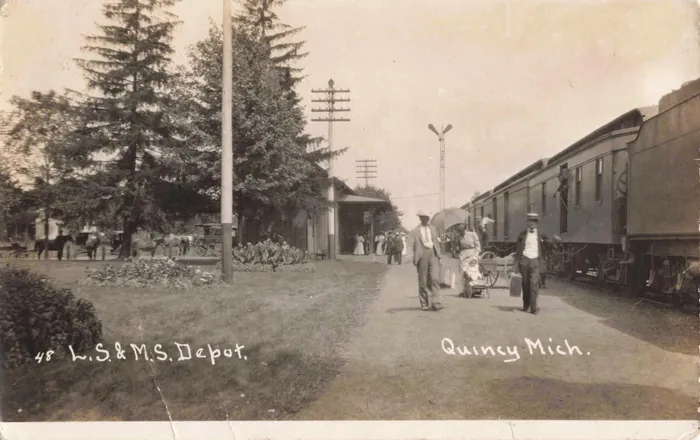
Daniel Bagley kept a blacksmith shop on the road, and John Broughton moved to the settlement in 1836. Even so, the village grew slowly. The railroad, built through the site in 1850, gave it its start: the 1906 county history says Quincy would have lost the station to a point on the county line had not Lucas Joseph and others built a freight house. In 1853 there were still only about a dozen dwellings, one tavern on the Quincy House site and one store.
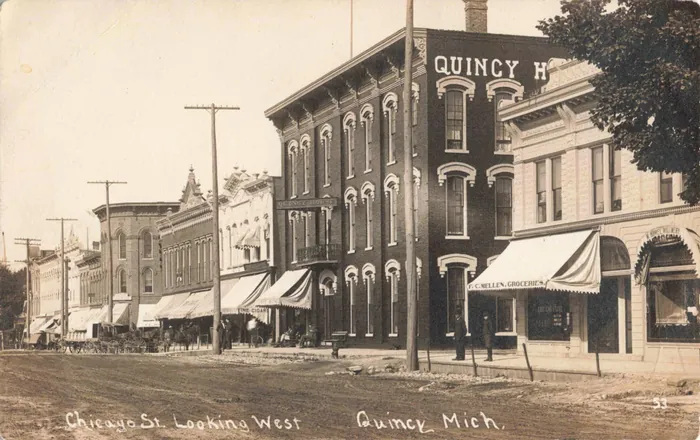
In 1856 the owners of the site, among them Enos G. and Joseph Berry, John Broughton and William Arnold, signed the village plat. The county board of supervisors incorporated the village of Quincy on October 14, 1858, and at the first election, on November 15, Ebenezer Mudge was chosen president. A sawmill was built in 1855, a flouring mill in 1863 and a stave and heading factory in 1864, and the first brick store went up on Chicago Street in 1855.
By 1879 the village was shipping grain, apples, live stock and manufactured goods over the Lake Shore and Michigan Southern, and its newspapers included the Times and the Herald. It voted an electric light plant on August 4, 1890, and water works, by 203 votes to 118, on August 6, 1894. The 2020 census counted 1,554 people in Quincy.