How the towns got their names
How Kalamazoo got its name
Everyone in Kalamazoo knows two stories: a footrace against a boiling pot, and a founder run out of town over a stolen cherry tree. We went back to the record, from French route notes of the 1700s and a Royal Navy log of 1779 to the Senate journal and the act of 1836, to see where each story really starts, where the letter L came from, and what the Potawatomi names for the place and the river say today.
By Michael Urbanski · Project Scroll · First published · Updated · 42 min read

New finding 8 new findings in this story. See what’s new ›
Kalamazoo, Mich. Ask anyone in Kalamazoo why the city is called Kalamazoo and you will hear about a footrace: a young man running to the river and back before a pot of water boiled away. Ask why it is not still called Bronson and you will hear about a stolen cherry tree. You will find both on the city’s own website. Neither one, it turns out, rests where people think it does.
We went back to the paper: a Jesuit’s route notes of about 1760, a French map of 1744, a French memoir of the lake shore, a British road description and a Royal Navy log of the 1770s, Henry Schoolcraft’s journal of 1820, the treaty of 1821, the Senate journal of 1836, an atlas map of 1822, the act of the legislature that changed the name in 1836, the county’s first histories, and the linguists who have argued over the word for 170 years. Then we set beside them the names that the Potawatomi people use for the place and the river today. The record does not hand over a single tidy answer. It does show which stories are old, which are new, where the letter L came from, and which explanation has the oldest written support.
The case in brief
What the record shows
- The name came from the river, and the river’s name is old. A form of it, “kikanamaso,” is in a Jesuit’s route notes dated to about 1760, nearly seventy years before the first settler’s cabin. The same N is in a French memoir of the lake shore, a British road description of the early 1770s and a Royal Navy log of 1779.
- The L arrived late. The oldest spellings have an N; the first L we can find is Henry Schoolcraft’s “Kikalemazo,” written on 4 September 1820 and printed in 1821, and then the treaty of 1821. The Potawatomi language has no L sound.
- The boiling pot was in print by 1838, and the race by 1867, told as an anonymous “Indian” runner and a pot boiling on the fire at Toland’s Prairie. Torrey’s telling of 1869 already speaks of “the fleetest runners in the tribe.” The hero’s name, “Fleet Foot,” his bride and the year 1810 are not found before a newspaper of 1922.
- The village became Kalamazoo by an act of the state legislature, approved 2 March 1836. The bill first renamed only the township; the village was added on the Senate floor, on the motion of Senator Comstock. The county’s 1880 history gives no reason beyond “some good reason, we presume,” but George Torrey, in 1869, gave one: the proprietors were “disgusted with the eccentricities, obstinacy, and want of enterprise” of their partner Bronson.
- The Potawatomi names in use today are Gzigmezé or Gzigmezék for the place and Giknamezo zibé for the river.
What it does not show, yet
- The cherry tree in any record we have read: nothing in the county histories from 1869 to 1906. The earliest telling we can find is Nick Kekic’s book of 1984, which quotes “the court record” of 1833: Bronson was fined $4.62½ for a cherry tree. What no source we have found shows is that the fine had anything to do with the renaming.
- What the word meant to the people who first said it. Every published meaning is someone’s explanation, not a speaker’s testimony on record.
- For certain, which river was the “little” kikanamaso. Potier’s editor, in 1986, made the little one the main river and the great one its north branch.
Story or record? Play along
Kalamazoo tells itself some good stories. Here are eight things people say about the name. For each, make your call: true, false, or no record either way. Then see what the paper shows.
“Kalamazoo was first called Bronson.”
True
Titus Bronson and Stephen Richardson recorded the plat of the Village of Bronson on 12 March 1831. It was the county seat under that name until 1836 (Exhibit E).
“The state legislature changed the name.”
True
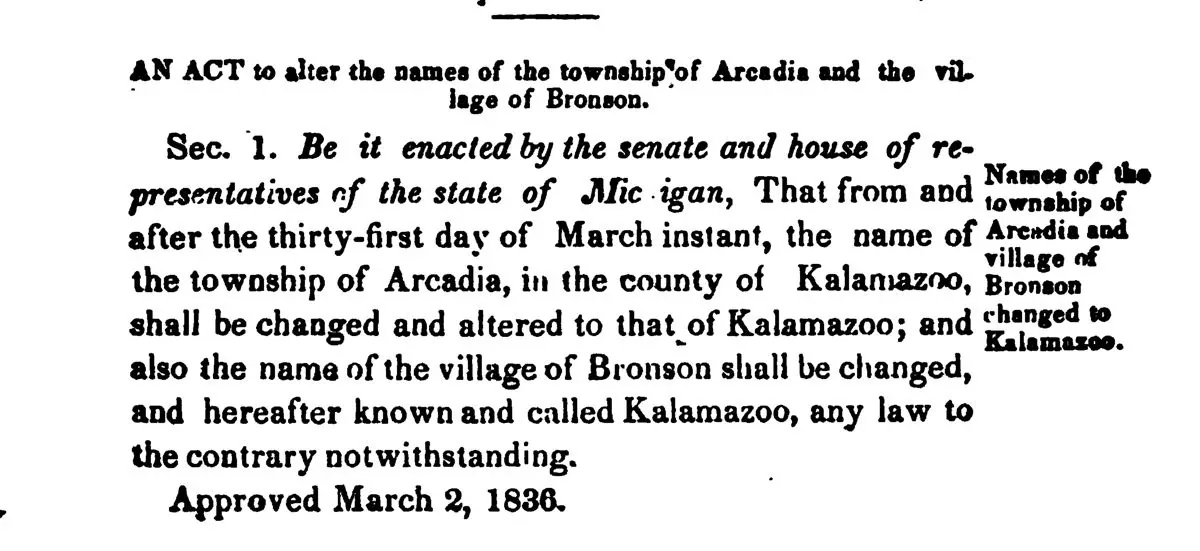
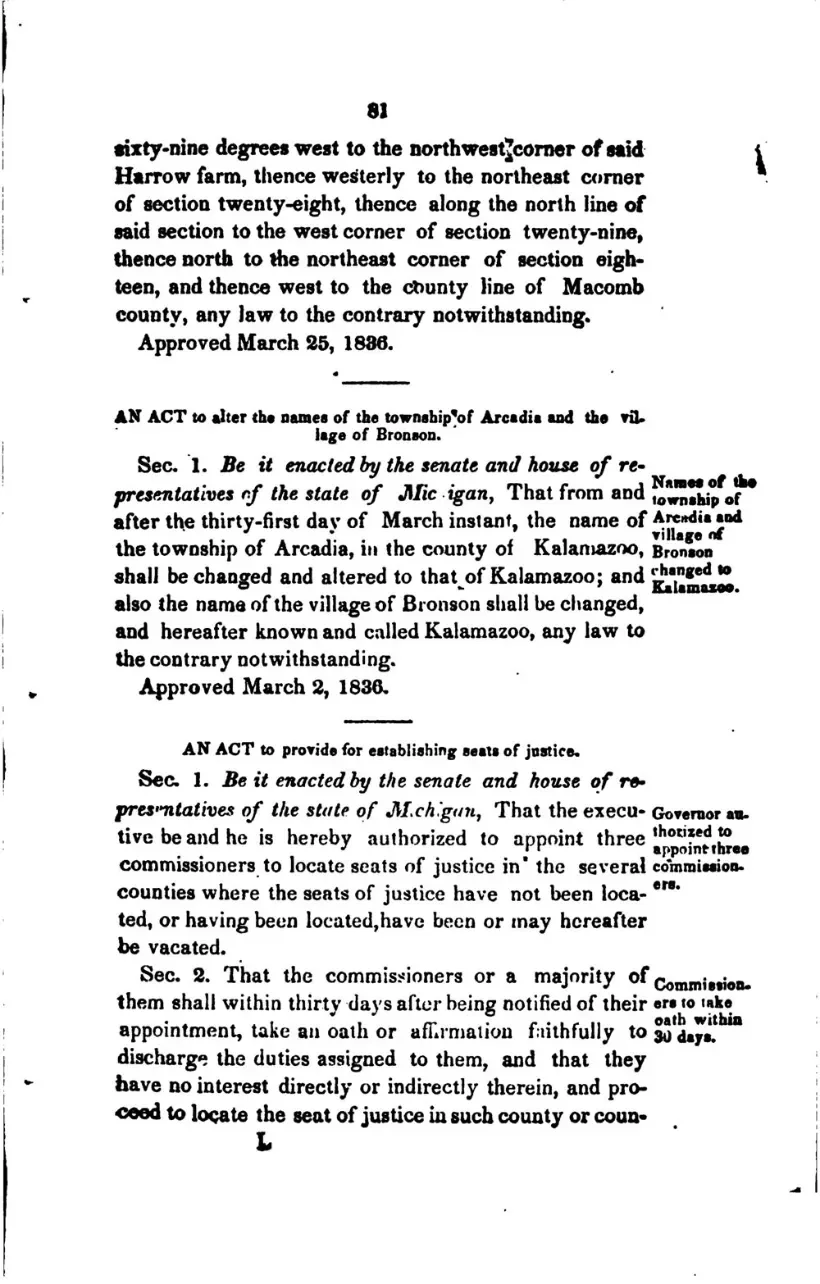
“An act to alter the names of the township of Arcadia and the village of Bronson” was approved on 2 March 1836. From 31 March both were to be “known and called Kalamazoo.”
“Bronson lost his town over a stolen cherry tree.”
Half of it
The fine is real enough: Nick Kekic’s book of 1984 quotes the court record of 1833, a jury of six and a fine of $4.62½. But nothing we have found ties it to the renaming: not Torrey’s county history of 1869, not Durant (1880), not the 1906 Compendium, not the county’s 1877 report. Torrey, in 1869, gave a different reason for the renaming: the proprietors were tired of Bronson’s “eccentricities, obstinacy, and want of enterprise.”
“The footrace story was made up in the twentieth century.”
No, it is older
The boiling pot was in print by 1838, in a state gazetteer, and the race to the river by 1867, in George Torrey’s history of the village, quoting A. J. Sheldon. What the twentieth century added was the romance.
“The runner was called Fleet Foot, and he ran for his bride.”
Not before 1922
In the 1867 telling the runner has no name and there is no bride. “Fleet Foot,” the bride and the year 1810 appear in the Kalamazoo Gazette of 20 August 1922, the earliest telling we have found. Torrey’s telling of 1869 speaks of “the fleetest runners in the tribe,” which may be where the name was born.
“The oldest spelling of the name has an L in it.”
No
The oldest forms we can find, “kikanamaso” in Father Potier’s route notes of about 1760 and “Kikanamaso” in a French memoir of about 1763, have an N. The first L is Henry Schoolcraft’s “Kikalemazo,” written in 1820 and printed in 1821; the Treaty of Chicago followed.
“A famous explorer said the name was about otters.”
True
Henry Rowe Schoolcraft, in 1855: stones in the riverbed that looked like an otter swimming beneath the surface. In 1911 William Gerard called his explanations “etymological absurdities.”
“Kalamazoo means ‘reflecting river.’”
No good source
The “mirage” or “reflecting river” meaning is older than we first thought, in print by 1874, but it comes with no source behind it but a name, and Vogel’s Indian Names in Michigan rejects it.
Who’s who
- Match-e-be-nash-she-wish Potawatomi leader · village at the head of the river, 1821
- The 1821 Treaty of Chicago reserved a tract “at the village of Match-e-be-nash-she-wish, at the head of the Kekalamazoo river,” on ground that is now the city. The reserve was ceded in 1827. The Gun Lake Tribe, the Match-E-Be-Nash-She-Wish Band of Pottawatomi Indians, carries his name today.
- Father Pierre Potier 1708–1781 · Jesuit missionary at Detroit
- Missionary to the Wyandot at the Assumption mission across the river from Detroit. His papers include route notes for travelers; the one that names the “kikanamaso” is dated by his modern editor, Robert Toupin, to the autumn of 1760. Toupin also showed that Potier copied out itineraries drawn up by other travelers.
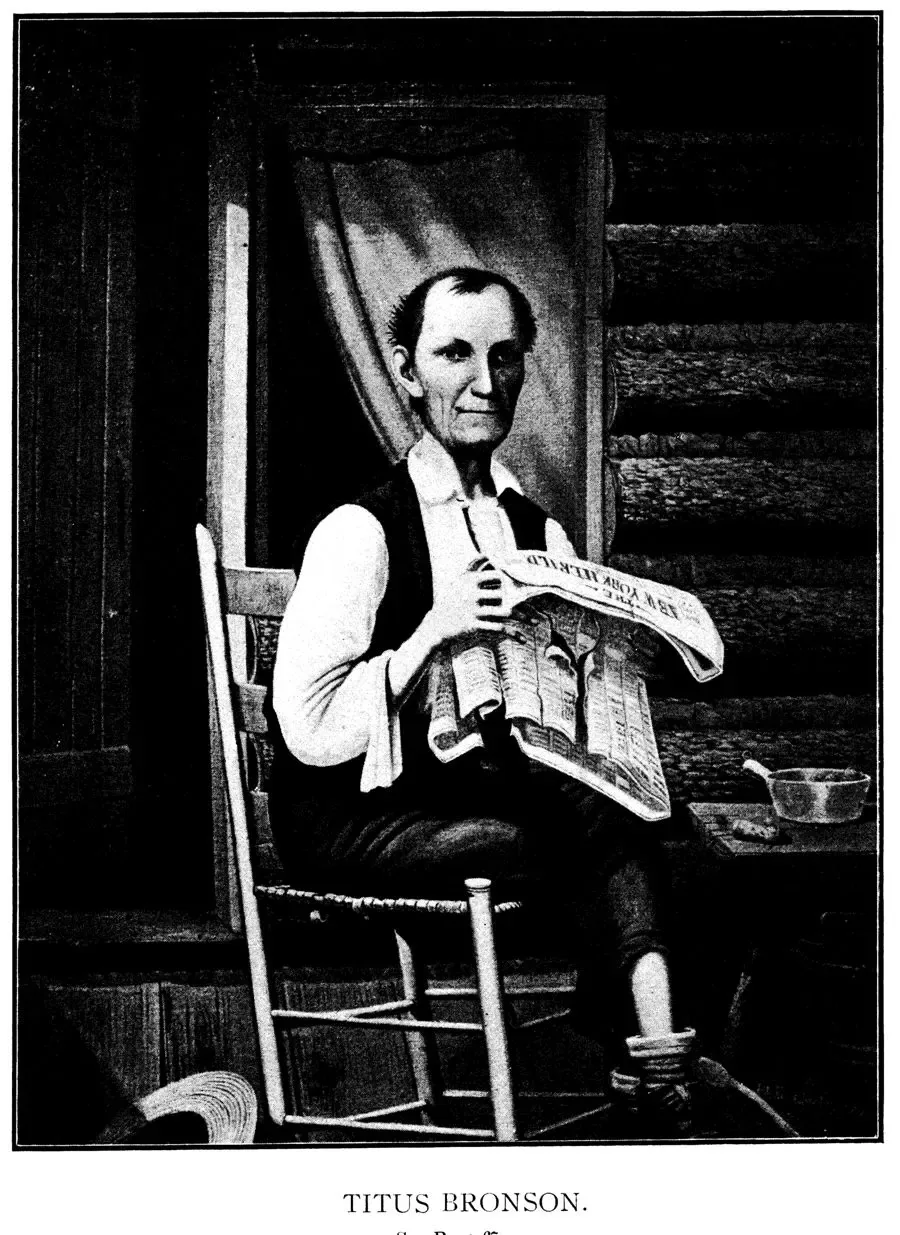
- Titus Bronson 1788–1853 · founder of the village
- Connecticut-born pioneer, known in his day as “Potato Bronson.” He settled on the site in 1829, platted the Village of Bronson in 1831, and left after the name was changed. He died in Connecticut, at his brother’s house, and his gravestone stands at Middlebury.
- Henry Rowe Schoolcraft 1793–1864 · explorer and Indian agent
- Passed the mouth of the river on 4 September 1820 and wrote it “Kikalemazo” in his journal, printed in 1821: the first L we can find. In 1855 he published the explanation that the name describes stones in the riverbed that look like swimming otters.
- A. J. Sheldon and George Torrey early Kalamazoo residents and writers
- Torrey’s history of the village, printed in the directory of 1867, quotes Sheldon’s version of the race to the river: the oldest printing of that story we have found. Torrey wrote the county history in the directory of 1869 too, with the race again and a reason for the renaming.
- Mr. Comstock state senator, 1836
- Moved the amendment that added the village of Bronson to the bill renaming Arcadia township. The Senate journal’s roll names him: Horace H. Comstock, senator for the third district, the founder of Comstock and Otsego.
- Samuel W. Durant compiler, History of Kalamazoo County (1880)
- Reprinted Torrey’s account and the act of 1836, and wrote that the name came from a Potawatomi word meaning “the boiling-pot.”
- Father Chrysostom Verwyst 1841–1925 · Franciscan missionary and Ojibwe scholar
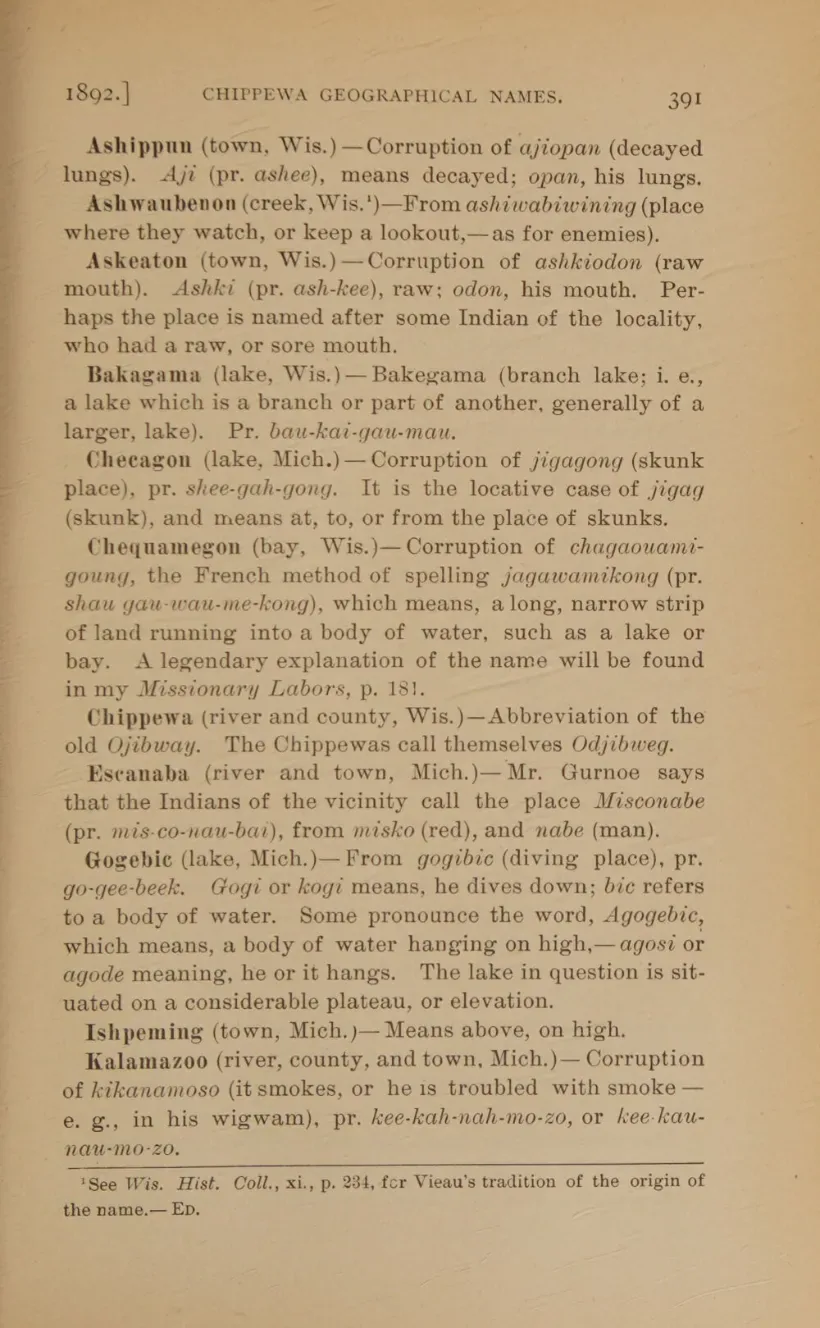
- In 1892 explained Kalamazoo as a corruption of the Ojibwe kikanamoso, “it smokes, or he is troubled with smoke.”
- William R. Gerard 1841–1914 · student of Algonquian languages
- In 1911 took Schoolcraft’s otters apart and argued for a smoke word, kikalâmozo.
- Virgil J. Vogel 1918–1994 · historian
- Author of Indian Names in Michigan (1986), the standard reference, which weighs every theory and accepts none outright.
The river and its places
Every place in this story lies along one river. Durant, in 1880, puts the race on “Galesburg, or Toland’s Prairie,” east of the town.
- The village of Bronson, now Kalamazoo
- Where the race was run, in the 1867 telling
- Other places once called Kalamazoo
- Where the lead painting was made
- Towns, for reference
Drawn for this page. State outline: U.S. Census Bureau, via us-atlas; the river: Natural Earth (public domain), simplified. Places are placed by town.
Exhibit A: the oldest spelling, about 1760
DocumentedThe oldest form of the name we can find on paper is in the writings of Father Pierre Potier, the Jesuit at Detroit. Among his papers are itineraries: lists, stage by stage, of the rivers and portages along routes through the Great Lakes country. In them the word appears as two rivers, a “little” one and a “great” one: le petit and le grand kikanamaso. His editor, Robert Toupin, prints them in Les Écrits de Pierre Potier (1996), pages 144 to 151, and dates the itinerary to the autumn of 1760.
ReadingSpelled with an N, not an L. That one letter matters a great deal, as we will see. The date is the editor’s dating of the notes, not a date written on them, and route notes of this kind could be copied from other travelers; so “about 1760” is the safest way to put it. Either way, the river had this name well before any American surveyor saw it.
New findingIt is not the only one. A French memoir of the lake shore, “Mémoire sur la partie occidentale du Canada, depuis Michillimakinac jusqu’au fleuve du Mississipi,” printed in the Bulletin des recherches historiques in 1920, walks the east shore of Lake Michigan from north to south. Three leagues past the Maskigon comes the Ouichitanon, the Grand River; then: “A quinze lieues de celle-ci est celle de Kikanamaso plus considérable et qui est navigable vers le sud l’espace, de quarante lieues.” Fifteen leagues on, the Kikanamaso, larger, navigable southward for forty leagues. Its author is unknown. The editor of 1920 thought it written “en 1763 ou peu après,” in 1763 or a little after; it calls the Ottawa settlement at L’Arbre Croche “le nouveau village,” and that village was founded about 1741 or 1742, so it can be no older than that. Either way it is an eighteenth-century witness to the N.
DocumentedThe British wrote it with an N too. A description of “The Road from Detroit to Fort St Josephs by land,” printed among the Haldimand papers in the Michigan Pioneer and Historical Collections (vol. 10, 1886, p. 248) between papers of 1771 and 1772, lists the crossings: “To Reccanamazo River, or Pusawpaco Sippy otherwise the Iron mine river.” And in the autumn of 1779 the log of His Majesty’s sloop Felicity, sailing down the east shore, records: “We kept her along shoar for the Kikanamaso, as Mr. Gautly told me…” (printed in Michigan History, 1929). Neither is new to the story of the name: William L. Jenks tied the road description’s “Reccanamazoo” to the Kalamazoo in 1912, taking the R for a misprint of K; the Sons of the American Revolution’s Minute Man, reporting a talk by Claude T. Hamilton, printed the Felicity’s “Kikanamaso (Kalamazoo)” in March 1925; and Albert F. Butler listed “Reccanamazo” among the river’s old spellings in Michigan History in 1949.
Reading“Reccanamazo” is very likely, as Jenks thought, a misreading of “Keccanamazo,” the R and the K being easy to confuse in an old hand. Either way, French, British and naval writers kept the N for some sixty years, from the French regime until Schoolcraft’s L of 1820.
DocumentedIn an earlier article, in 450 ans de noms de lieux français en Amérique du Nord (Québec, 1986), Toupin explains how Potier worked. During the English occupation of Detroit in 1760–1761, Potier “a pris soin de transcrire pour son usage personnel les itinéraires dressés par d’autres voyageurs,” travelers such as Charleau, Pascal Chevalier and Derouen; and “ces rédactions ne prouvent pas que Potier a parcouru tous les chemins.” He took care to copy out, for his own use, the routes drawn up by others; the copies do not prove he walked them.
OpenWhy autumn 1760 for this route in particular? Toupin ties the date to a journey of Potier’s, on page 144 of the 1996 edition; we have seen that page only through a search of the borrowed book, and have not yet read his reasoning in full.
DocumentedWhich river was the “little” kikanamaso? Toupin answered in 1986. He prints the stages, “Le Ruisseau a Baptiste (aux balots) 2 lieues jusqu’au Grand Kikanamaso 5 lieues jusqu’au Petit Kikanamaso 3 lieues jusqu’au Ruisseau Bourbeux 4 lieues jusqu’a la Grande Riviere,” and glosses them: “Le petit kikanamaso [Kalamazoo River],” “Le grand kikanamaso [Kalamazoo-north branch].”
OpenThat is the editor’s identification, and he does not give his reasons in the passage we have read. The 1996 edition’s notes, pages 144 to 151, may; the book is on loan through the Internet Archive and in university libraries.
Exhibit B: the French maps
DocumentedThe French named the river differently. Jacques-Nicolas Bellin’s Carte des Lacs du Canada of 1744 marks the rivers on Lake Michigan’s eastern shore. Going north from the St. Joseph, the map shows the “Riv. Noire,” then “R. Marameg,” then “R. a la Barbue” and the “R. au Raisin,” and then the Grand River.
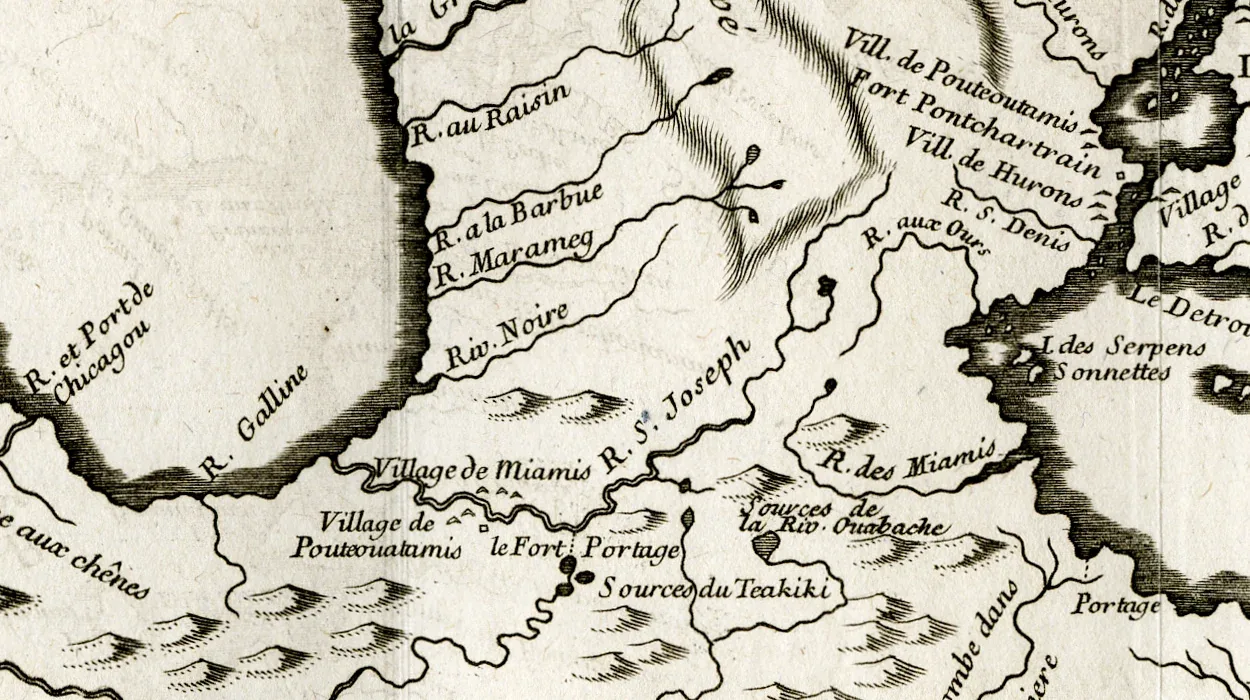
ReadingRead from the St. Joseph northward, the order matches the real coast: the Black River, then the Kalamazoo, then the Grand. That puts “Marameg” where the Kalamazoo should be. The Kalamazoo Public Library also reports the river called by forms of “Marame” on maps of the early 1800s, and the historian Larry Massie gives “Meramec” or “Merame” for the French name. Marameg was also the name of a band of the Miami people; Vogel says the river’s name in the French period was Meramec, which he translates “catfish.” And the next river north on Bellin’s map, “à la Barbue,” is French for “of the catfish.”
DocumentedThe same Handbook entry, though, writes the river as “Maramec (Kalamazoo) r.,” citing a French document of 1695 that places the “Miamis of Maramek” on it. What it rejects is the idea that the northern Marameg people lived there, not that the river was once called Maramec.
DocumentedOlder French sources point the same way. A county history of about 1925 reads Jean-Baptiste-Louis Franquelin’s “Carte de la Louisiane” of 1684 from south to north: “The St. Joseph is the Riviere des Miamis; the Black river, the Noire; the Kalamazoo, the Maramee;” and it quotes the Jesuit Charlevoix, who calls the river “Meremek, * * * one of the streams emptying into the eastern part of Lake Michigan.” The Michigan Historical Collections of 1912 gloss the French name: “Its meaning is Great Cat Fish, or possibly has the same derivation as Merrimac, and may mean in that case ‘rapid.’”
ReadingThe weight of the French evidence now leans toward yes: Franquelin in 1684, Bellin in 1744 and Charlevoix all put a Maramee or Meremek where the Kalamazoo runs. Whether “Marameg” on the 1744 map really is the Kalamazoo is still not proved. The Handbook of American Indians (1907) thought the Marameg people lived far to the north, near Sault Ste. Marie, and called the Kalamazoo identification of their name “certainly erroneous.” Only a full survey of the French maps and journals will decide it.
Exhibit C: the first L, 1820 and 1821
New findingThe first L we can find is not in the treaty. It is in Henry Schoolcraft’s Narrative Journal of Travels, printed at Albany in 1821. Coasting down the east shore of Lake Michigan with the Cass expedition, he wrote on 4 September 1820: “On travelling ten miles, we passed the river Kikalemazo, which appears from its mouth,” and, a little further on, “Eight miles beyond the Kikalemazo, there is a river of secondary size, called Black river.” When he revised the journal in 1855, the spelling became “Kalamazoo.”
ReadingSo the L was on paper a year before the treaty, in the hand of the man who was also the government’s expert on Indian languages, and who would later say that L was a French habit for N. The same “Kikalemazo” turns up in the books that drew on the expedition: Cleaveland’s Mineralogy (1822), Worcester’s Gazetteer (1823), Keating’s narrative of the Long expedition (1824) and Melish’s Traveller’s Directory (1825).
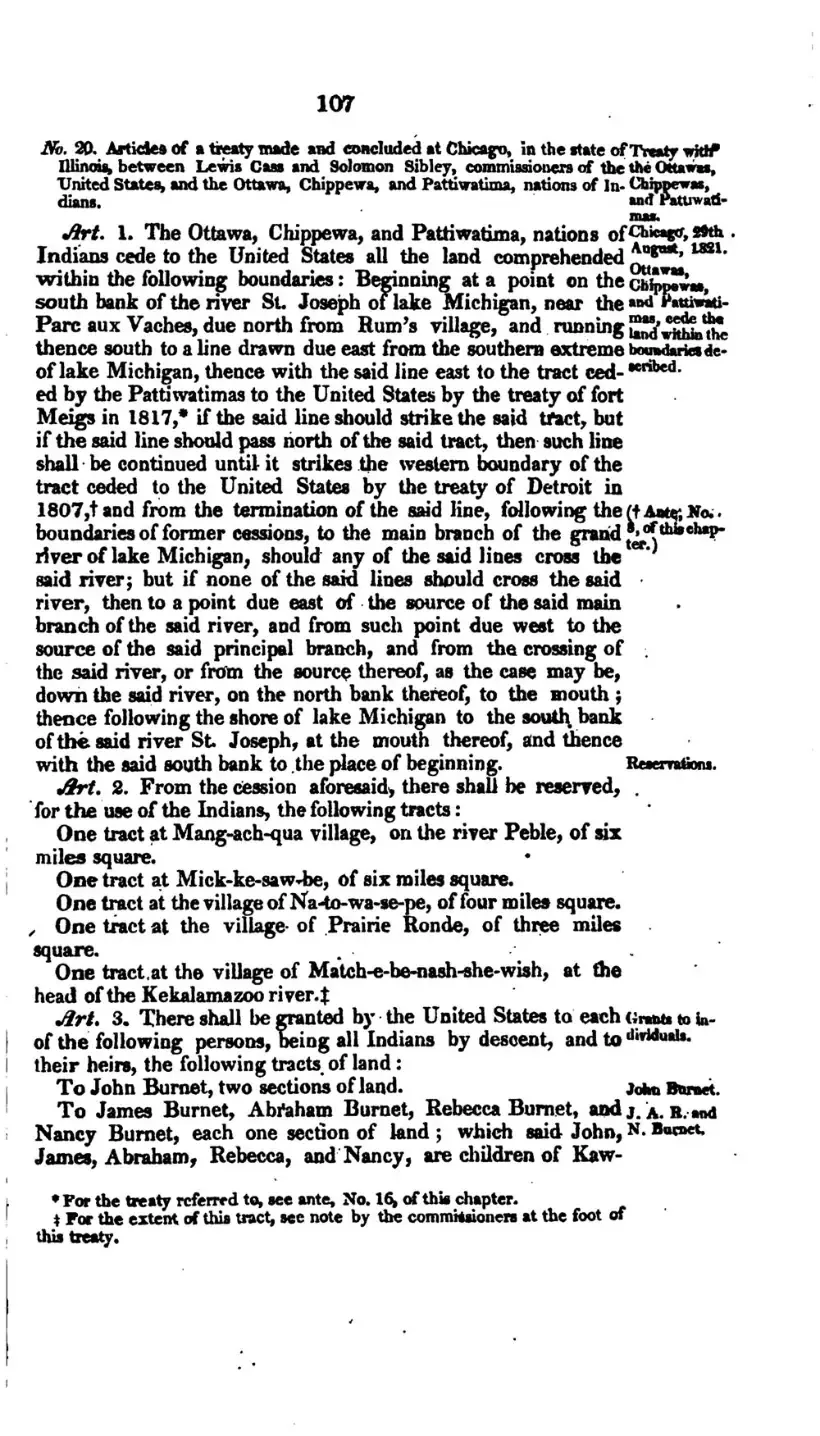
DocumentedThe earliest government document we have found that names the river is the Treaty of Chicago, signed on 29 August 1821 by Lewis Cass and Solomon Sibley for the United States and by the Odawa, Ojibwe and Potawatomi. Its second article reserved, among other tracts, “One tract at the village of Match-e-be-nash-she-wish, at the head of the Kekalamazoo river.” A note after the signatures, fixing the size of that tract at three miles square, spells the river a second way: “Ke-kal-i-ma-zoo.”

ReadingTwo spellings in one document, both with an L, both with the extra syllable in front: “Ke-.” The village of Match-e-be-nash-she-wish stood on the ground of the present city. The 1827 Treaty of St. Joseph took the reserve back, and the first settlers arrived two years later.
Exhibit D: the map of 1822
DocumentedThe Kalamazoo Public Library and others report that the river is spelled “Kikalemazo” on an atlas of 1823 (“five years before any white settlement,” in the library’s words; Titus Bronson came in 1829), without saying which atlas. Henry Carey and Isaac Lea’s American Atlas, published at Philadelphia in 1822 and reissued in 1823, includes a Geographical, Statistical, and Historical Map of Michigan Territory. Its river, rising in the interior and running west to Lake Michigan between the Grand and the St. Joseph, is lettered “Kikalemazo R.”
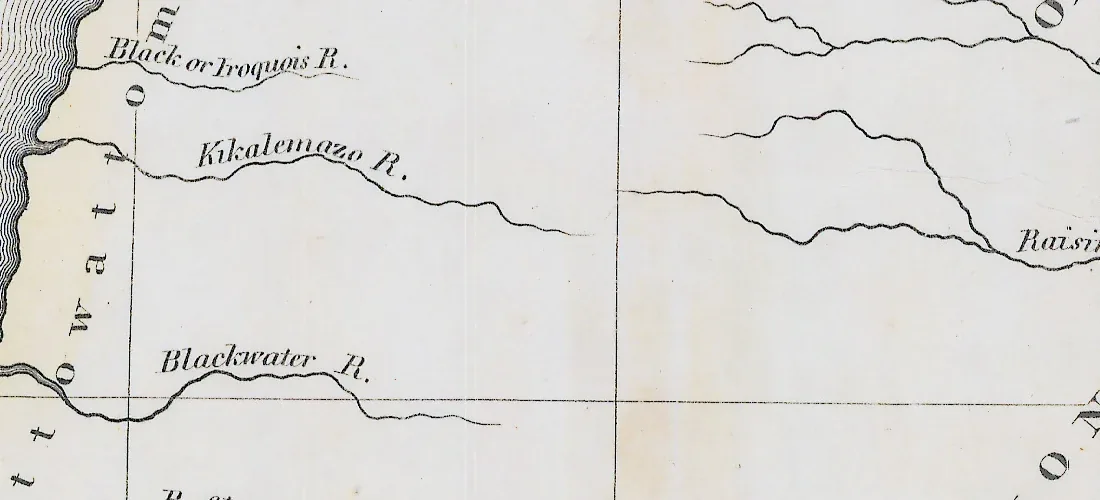
New findingWe think this is the atlas the library means. The map’s spelling has been noticed before: The Rag Picker, the journal of Michigan’s paper-money collectors, noted in 1984 that “an 1822 Michigan Territory map by J. Finlayson spells the Kalamazoo River as Kikalemazo.” What no one had done, as far as we can find, is tie it to the library’s unnamed atlas. The Carey & Lea map is dated 1822; the atlas came out again in 1823, “unchanged in most copies,” and its Michigan map was still not redrawn in the edition of 1827 (David Rumsey Map Collection); and its spelling matches the library’s exactly.
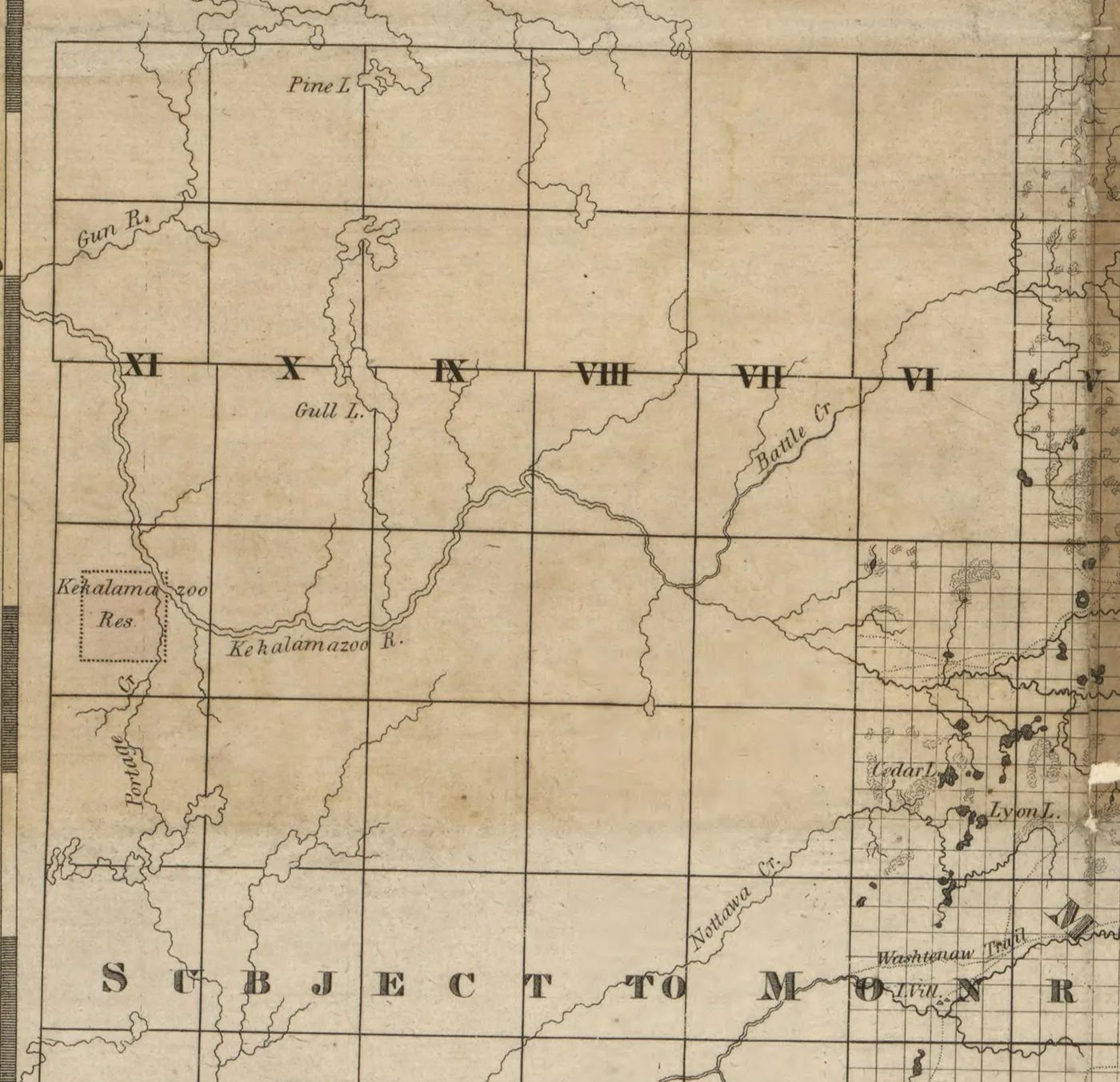
ReadingSo by the early 1820s the name had two forms on paper: a government spelling with “Ke-” and an L, and Schoolcraft’s “Kikalemazo,” which the map shares letter for letter. The map is very likely drawing on Schoolcraft’s journal, or on the expedition behind it, rather than on an older tradition of its own; but its “Kik-” at the front is still close to Potier’s “kikanamaso.”
ReadingThe library calls that atlas the first appearance of a word like today’s spelling. The treaty of 1821, with its “Kekalamazoo,” is a year older than the map and two years older than the 1823 issue, and Schoolcraft’s journal is older still.
Exhibit E: the county, the village and the act of 1836
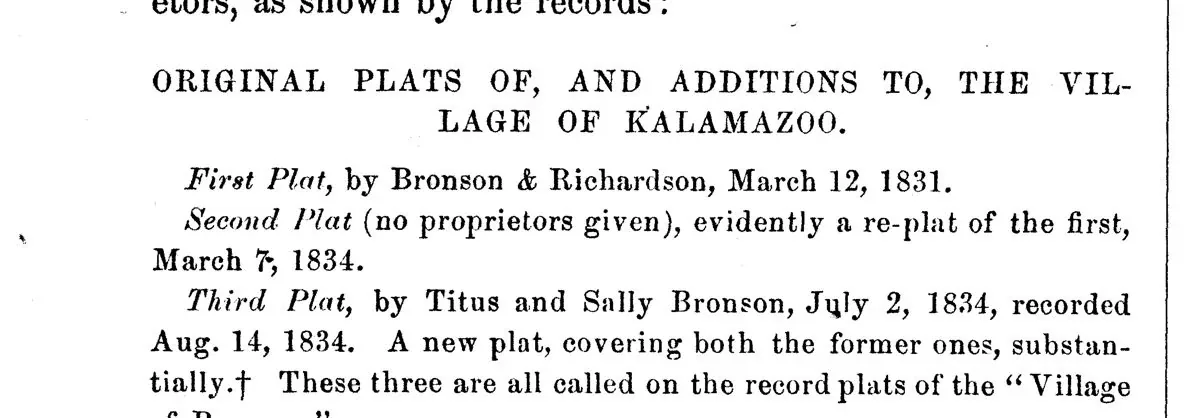
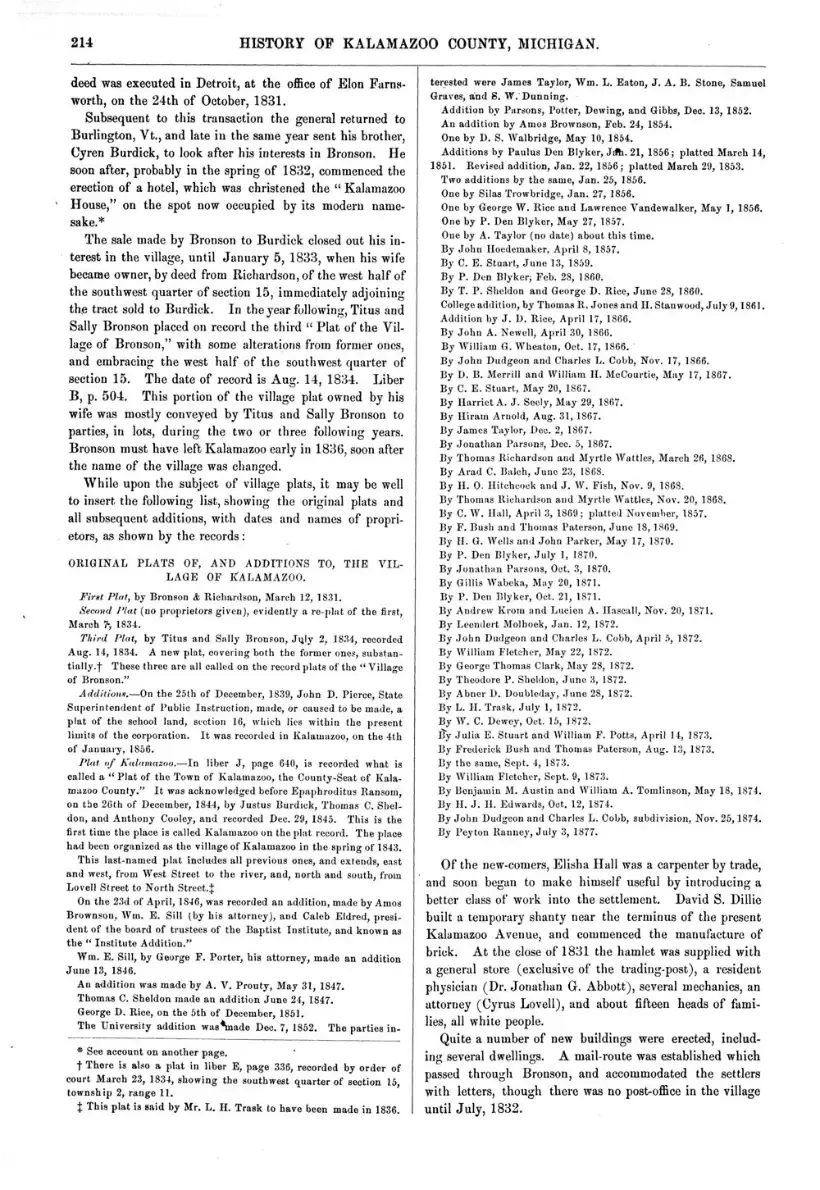
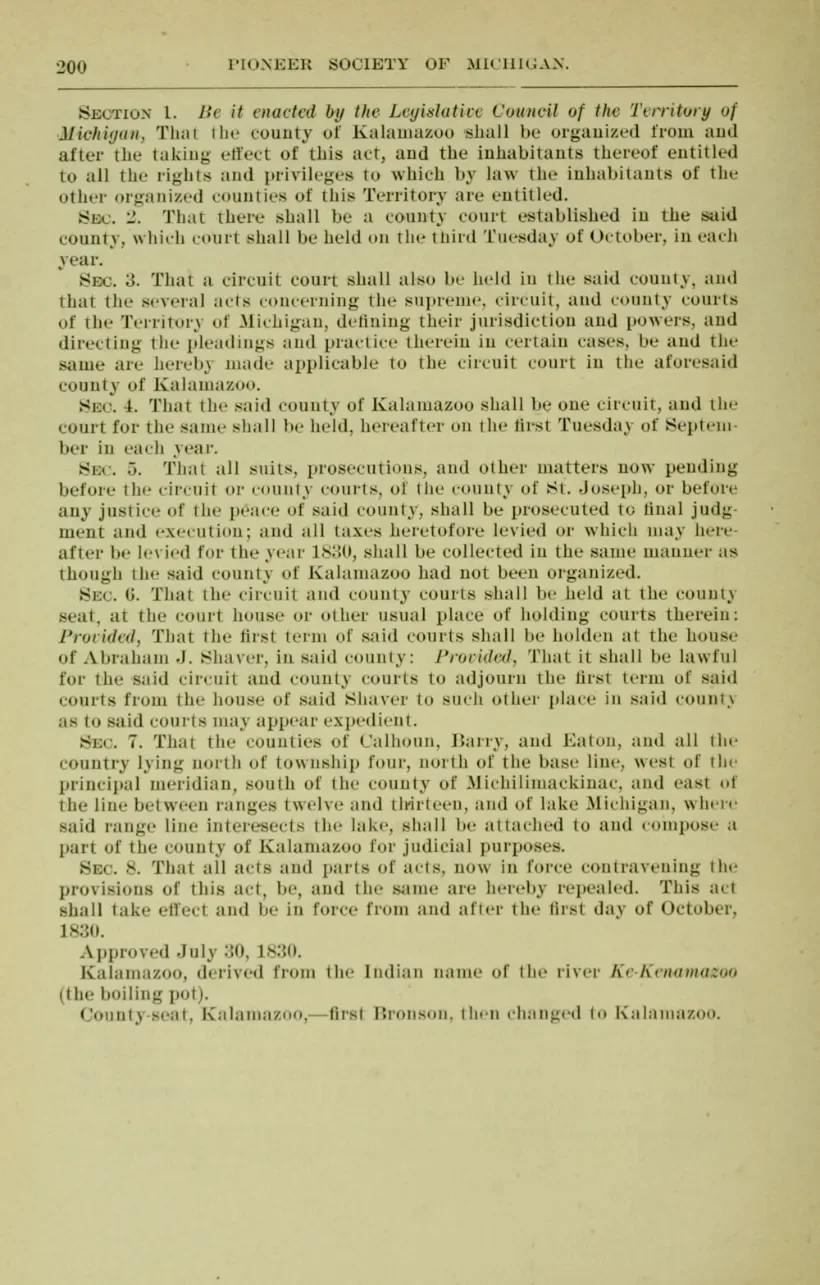
DocumentedKalamazoo County was laid out by a territorial act of 29 October 1829 and organized on 30 July 1830, when its northern half became the township of Arcadia. Titus Bronson and Stephen H. Richardson recorded the first plat of the village on 12 March 1831 (Durant, page 214), and named it Bronson. The county seat was Bronson. The Pioneer Society of Michigan’s county list of 1877 puts it in one line: “County-seat, Kalamazoo,—first Bronson, then changed to Kalamazoo.”
DocumentedThe change itself was made by the first legislature of the new State of Michigan, in “An act to alter the names of the township of Arcadia and the village of Bronson.” From 31 March 1836 the township and the village were both to be “known and called Kalamazoo.” It was approved on 2 March 1836, nearly eleven months before Congress admitted Michigan to the Union on 26 January 1837.
New findingThe Senate journal shows how the bill grew. On 17 February 1836 the Senate asked its committee on towns and counties “to inquire into the propriety of changing the name of the town of Arcadia in the county of Kalamazoo, to that of Kalamazoo.” Mr. Britain reported “A bill to alter the name of the township of Arcadia”: the township only. At the third reading, “on motion of Mr. Comstock,” the bill was amended to add “and also the name of the village of Bronson, changed and hereafter known and called Kalamazoo,” and the start was set at “thirty-first day of March next.” So amended, it passed the Senate. In the House, a “Mr. Burdick, of Kalamazoo,” sat among the members; a list in the House journal appears to name him as Cyren Burdick, of Bronson.
ReadingSo the village’s new name was added on the Senate floor, not written into the first bill, and one of Durant’s three men, Burdick, was in the House that passed it. Durant and the Pioneer Collections give the date as 3 March 1836; the printed act says approved 2 March. We follow the act.
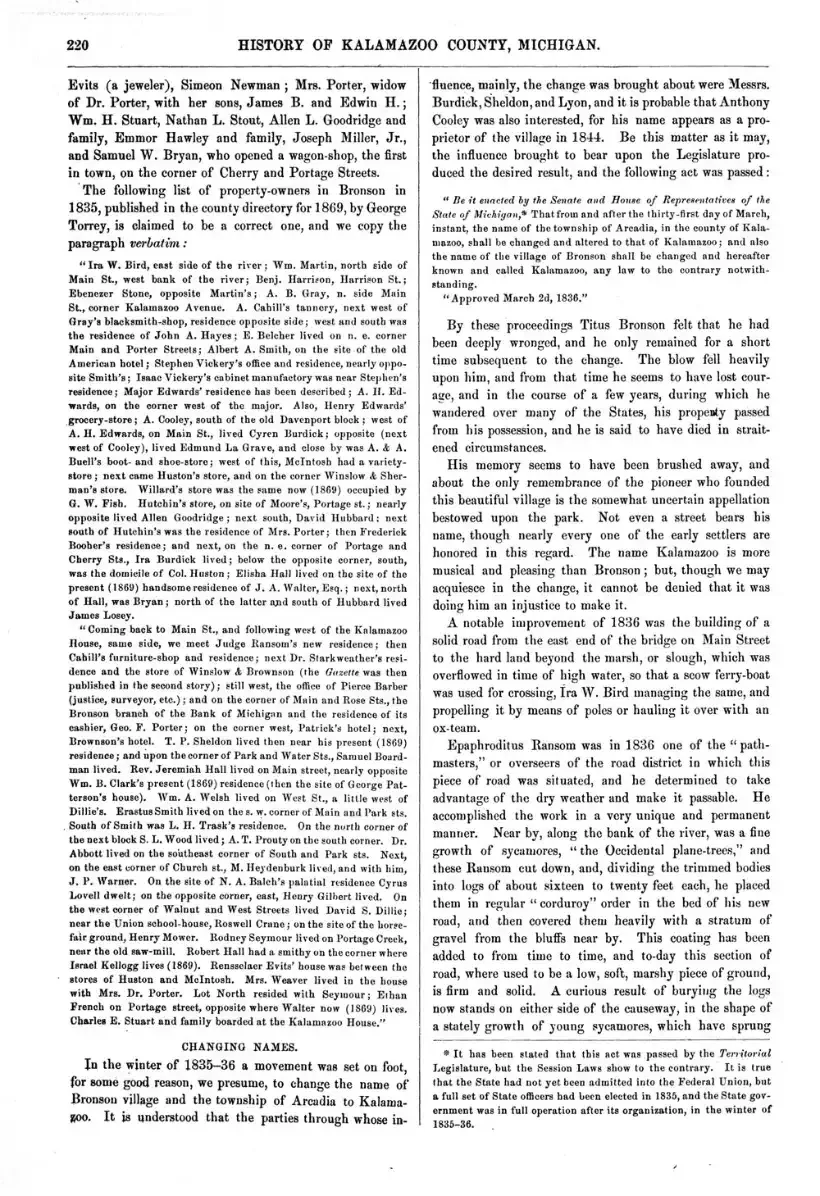
DocumentedDurant’s History of Kalamazoo County (1880) tells it on page 220, under the heading “Changing Names.” In the winter of 1835–36, he writes, a movement was set on foot “for some good reason, we presume,” and “the change was brought about” mainly through “Messrs. Burdick, Sheldon, and Lyon,” probably with Anthony Cooley, a proprietor of the village. Bronson “felt that he had been deeply wronged,” stayed only a short time, and later “is said to have died in straitened circumstances.” Durant adds a footnote: some had said the act was passed by the territorial legislature, but the session laws show otherwise.
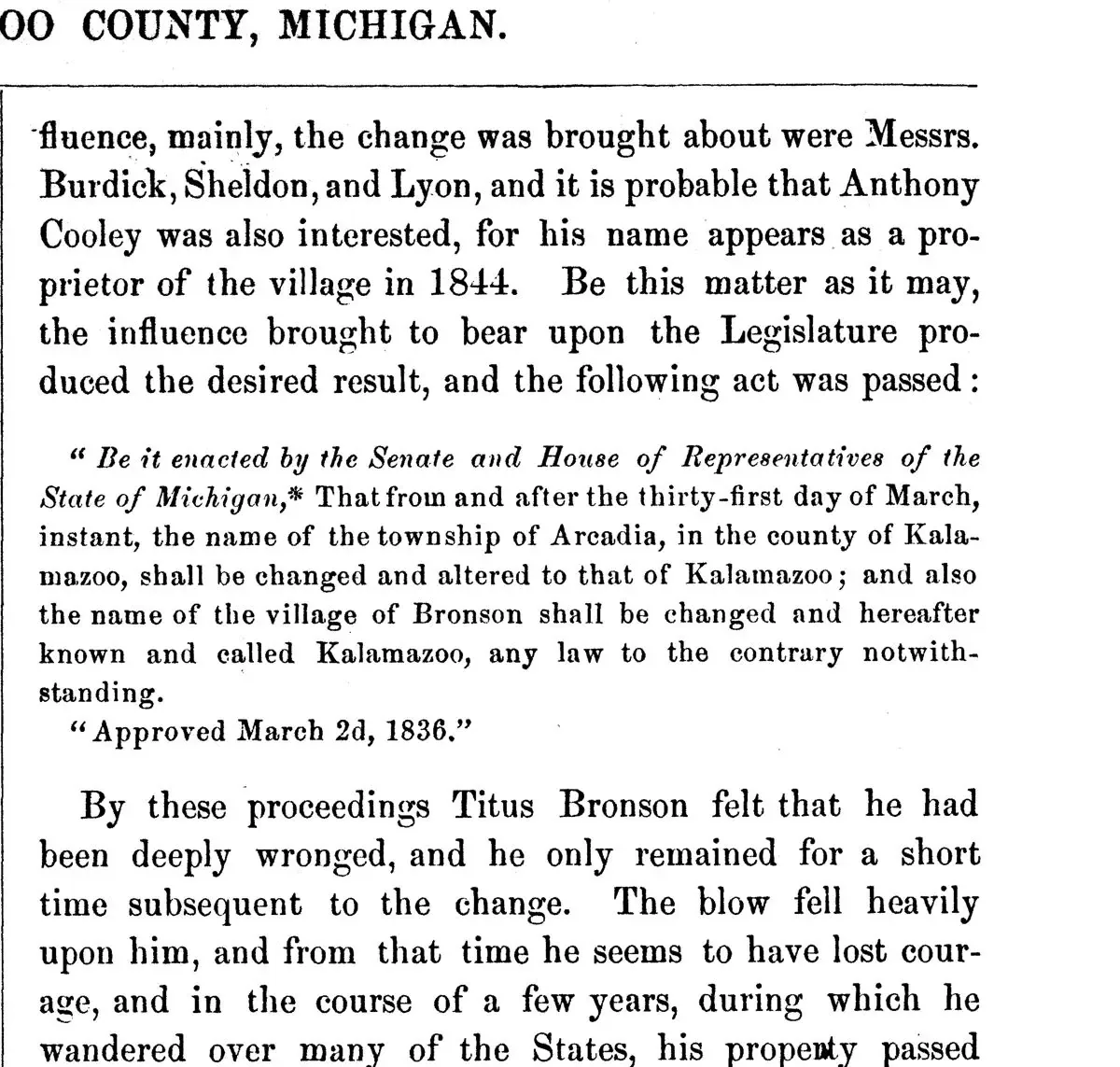
ReadingDurant gives only surnames. Lyon is almost certainly Lucius Lyon, the surveyor who became one of Michigan’s first two senators, and Burdick almost certainly one of the Burdick brothers: very likely Cyren Burdick, who began building the Kalamazoo House hotel probably in the spring of 1832 (Durant, page 214), and whom a list in the House journal appears to name as a member for Kalamazoo County in the House that passed the act (page 49). The town had more than one Sheldon. Durant himself, writing forty-four years later, did not know why they wanted the change, or would not say. He thought the new name “more musical and pleasing than Bronson,” but admitted it was hard to deny that the change had done the founder an injustice.
New findingGeorge Torrey did say why, eleven years before Durant. In the county history he wrote for the Kalamazoo County Directory of 1869: “This change of name was brought about through the influence of Burdick, Sheldon and Lyon, who, disgusted with the eccentricities, obstinacy, and want of enterprise in their co-partner, Bronson, determined the village should no longer bear his name.” Bronson, he adds, “went to Illinois, and finally died in Connecticut, at the house of his brother, in 1851 (I think ), a penniless man.” The year is wrong, and Torrey hedged it himself; there is no cherry tree.
The cherry tree
DocumentedToday’s histories say that Bronson was fined for stealing a cherry tree. The city’s own page adds that his rivals then had the town renamed; the Kalamazoo Public Library’s biography says the fine fed the discontent against him.
New findingWe could not find the cherry tree anywhere in the nineteenth-century record. It is not in Torrey’s county history of 1869; it is not in Durant’s History of Kalamazoo County (1880), whose full text we searched; it is not in Fisher and Little’s Compendium of History and Biography of Kalamazoo County (1906); and it is not in the county’s report to the Pioneer Society (1877). Durant, who writes at length about Bronson and the renaming, gives no reason for it at all.
ReadingThat does not make the story false. Justice-of-the-peace dockets of the 1830s seldom reached print, and a neighbor’s complaint over a cherry tree is exactly the sort of thing a small town remembers and a county history leaves out. But as things stand, the most famous fact about the renaming is the least documented one.
DocumentedThe trail leads to Nick Kekic’s A Fine Place for a City: Titus Bronson and the Founding of Kalamazoo (1984), the book the library’s biography cites. Kekic tells it from “the court record”: in April 1833 Joseph Eddington “chopped down a cherry tree on unclaimed land ‘with the intention of using the same to make furniture.’” Titus Bronson “seized the tree and carried away the same.” The dispute came before Judge Basil Harrison, and “the next month a jury of six people decided that Bronson was guilty and fined him the cost of the tree, $4.62½, plus the court costs of $10.25.” Bronson appealed to the circuit court, Kekic adds, “but to no avail.” So the fine has a source, a court record of 1833 that Kekic cites in a footnote.
ReadingWhat has no source is the rest of the story: that the fine turned the proprietors against Bronson and cost him the name. Kekic himself says Lyon used his influence with the legislature for the change, and Torrey in 1869 blamed Bronson’s “eccentricities, obstinacy, and want of enterprise.” The cherry tree is a true story about Bronson; that it renamed Kalamazoo is a later joining of two stories. We have read Kekic only in search snippets; the original 1833 record, wherever it now is, is the next thing to find.
Exhibit F: the race to the river
New findingThe boiling pot is older in print than the race. John T. Blois’s Gazetteer of the State of Michigan (1838) begins its entry: “Kalamazoo river, (or Kekalamazoo, [Indian,] signifying a boiling pot,) takes its rise in the township of Wheatland.” And at the dinner for the twenty-fifth anniversary of the settlement, on 21 June 1854, a Mr. DeYoe raised his glass: “Ke Kalamazoo — the boiling pot, may it[s] aboriginal name be held ever sacred,” printed in the Quarter Centennial Celebration of 1855.
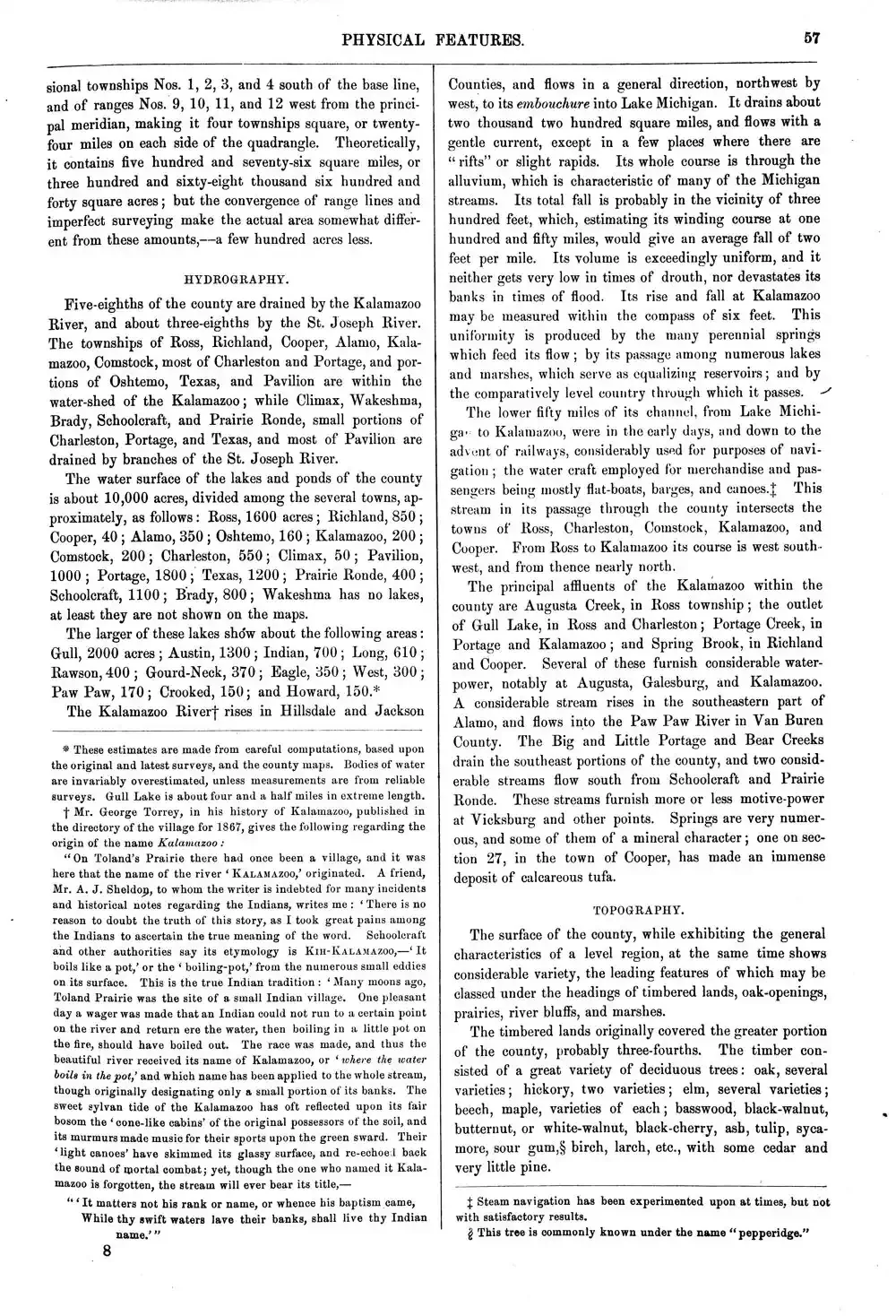
DocumentedThe oldest printing of the race story we have found is in George Torrey’s history of the village, in the Kalamazoo directory for 1867, as reprinted by Durant. Torrey quotes a letter from A. J. Sheldon, who said he “took great pains among the Indians” to learn what the word meant. On Toland’s Prairie, east of the town, a wager was made that a runner could not reach a point on the river and come back before a little pot of water on the fire boiled away. The race was run, and the river was named “where the water boils in the pot.” The name, Sheldon added, at first belonged only to that stretch of the river.
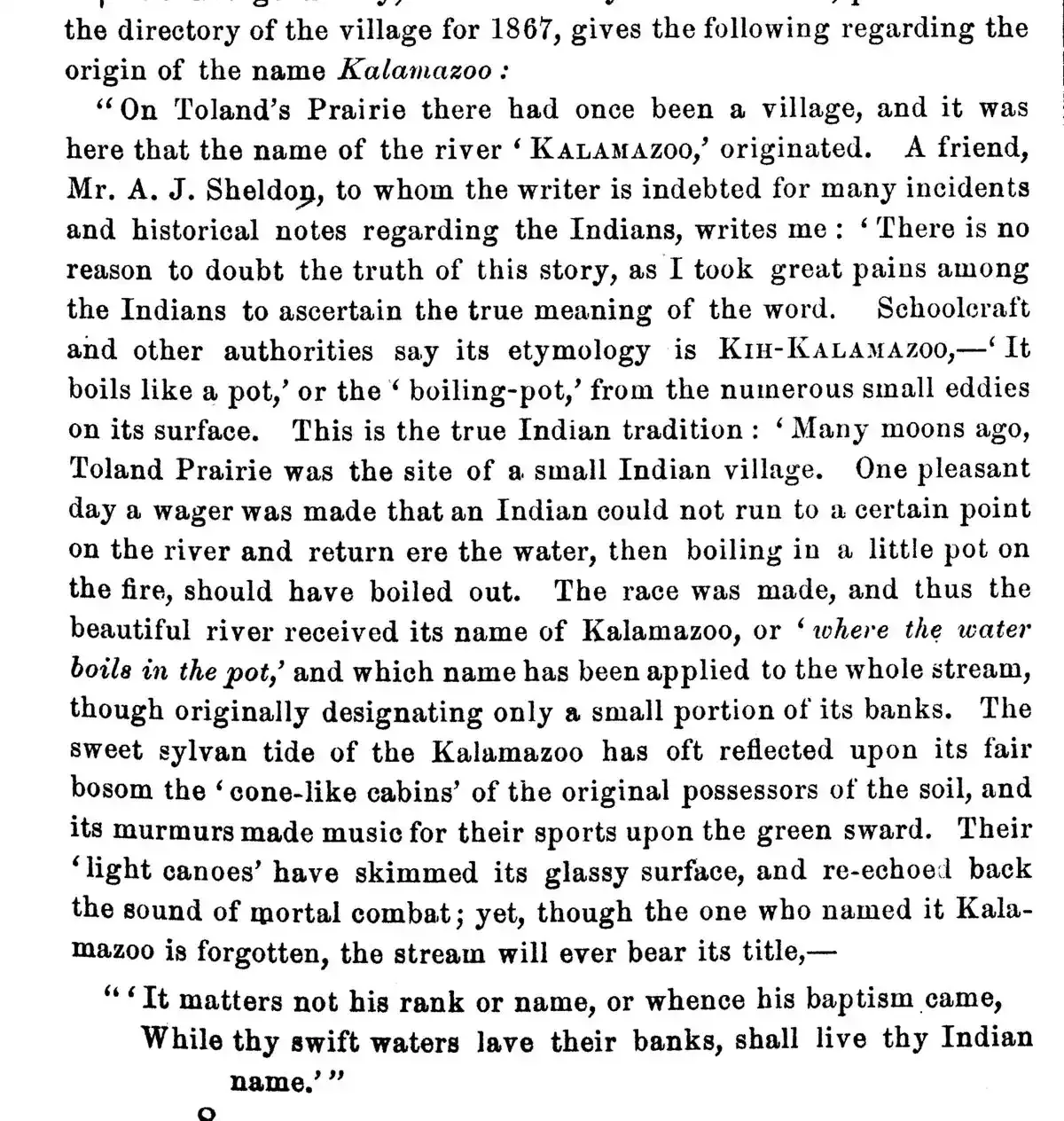
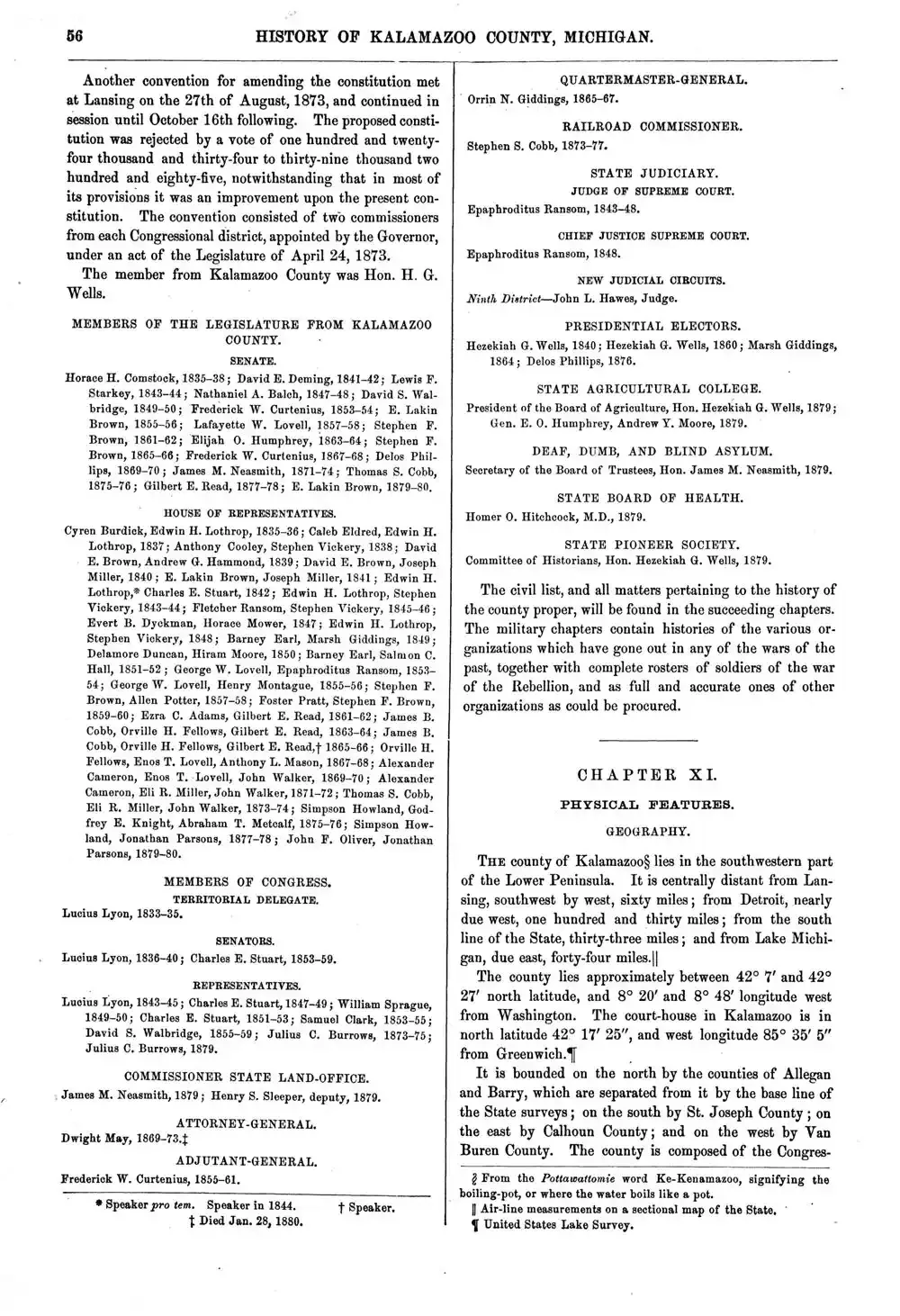
DocumentedDurant himself gives the meaning as “the boiling-pot, or where the water boils like a pot” (page 56), and so does the county report in the first volume of the Pioneer Collections of Michigan (1877): the river’s name was “Ke-Kenamazoo (the boiling pot).”
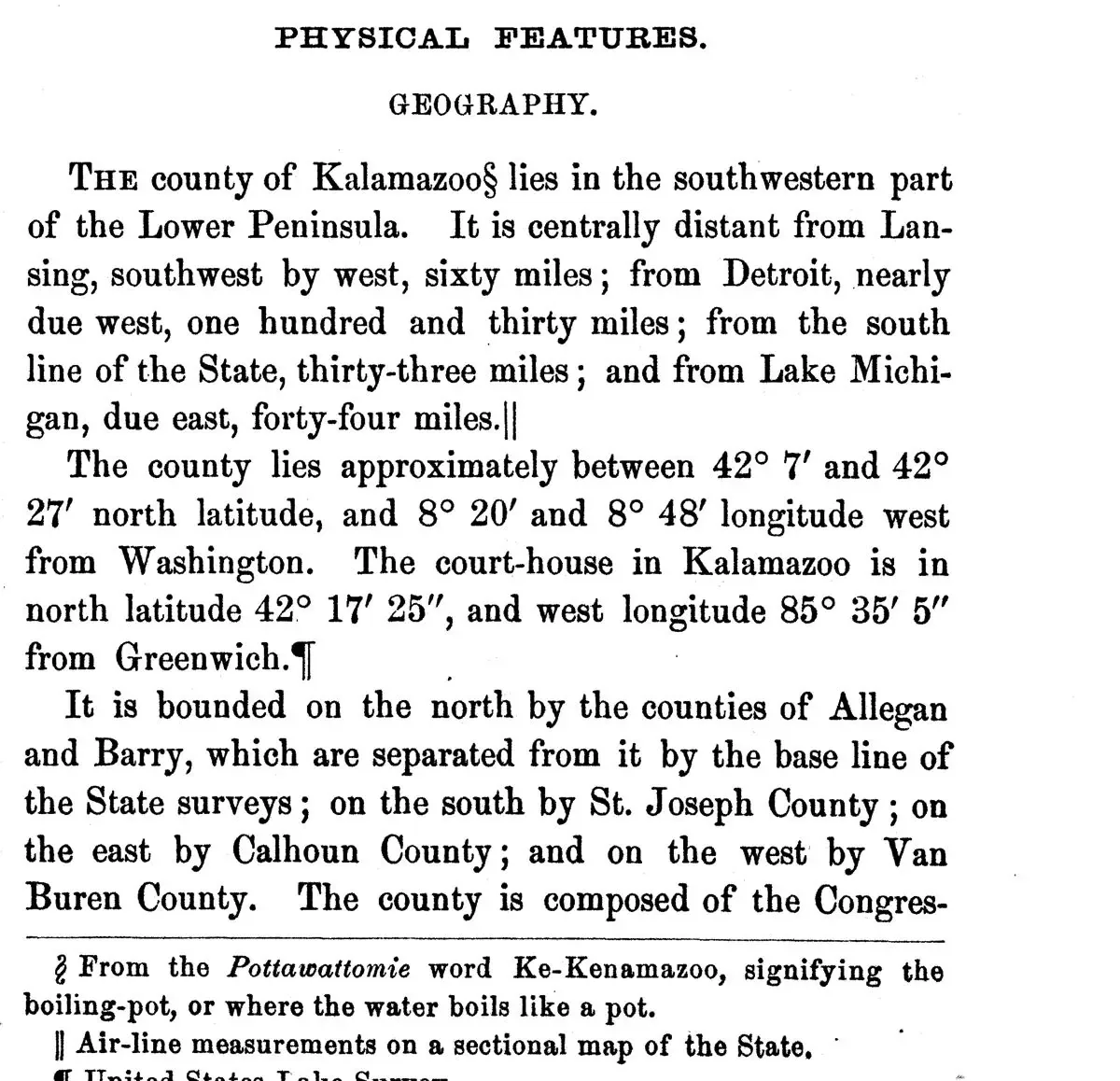
New findingTorrey told it again in 1869, in the county history of that year’s directory, and moved it to an Indian village on James Hopkins’s farm, “on the edge of the prairie”: “a wager was made that an Indian could not run to a certain place upon the river bank and return before the water then boiling in a little kettle upon the fire should have boiled away. The race was successfully accomplished, after a great many trials by the fleetest runners in the tribe, and hence the name commemorating the event, Ke-kalamazoo, ‘The Boiling Pot,’ or, ‘where water boils in the pot.’” The fleetest runner would become Fleet Foot.
DocumentedIn the 1867 telling the runner has no name, there is no bride and there is no date. The Kalamazoo Public Library’s files show the story growing. In a Kalamazoo Gazette article of 20 August 1922 the runner is “Fleet Foot,” he runs to win his bride, and the year is 1810. About 1951 the painter Zoltan Sepeshy put the race in a mural for the Fidelity Federal Savings and Loan on South Burdick Street.
DocumentedOther tellings kept multiplying. A county history of about 1925 says the river was called Kekalamazoo “because of its fanciful likeness to a ‘bright, bubbling kettle,’” and gives a later name for it, “Ki-ka-ma-sung,” the “race of the boiling kettle.” The Michigan Historical Collections of 1912 list the meanings in circulation: “bright sparkling water, boiling kettle (from the eddying waters), boiling water, beautiful water, and stones like otters.”
ReadingSo the boiling pot is genuinely old in local tradition: in print by 1838, seventeen years before Schoolcraft’s otters. The race to explain it is in print by 1867, and the romance came later. Sheldon also credited Schoolcraft with the “boiling pot” meaning, but Schoolcraft’s own published explanation, as the next exhibit shows, is about otters.
OpenWhere did Torrey get the story, and what did the Gazette of 10 March 1901, “Origin of the name Kalamazoo,” add? Torrey’s 1869 history is online; his 1867 directory and the 1901 Gazette are not. The library’s subject file holds both.
Exhibit G: the scholars
DocumentedCooper, 1848: the first syllable. James Fenimore Cooper set his novel The Oak Openings on the Kalamazoo, and once has his Indian scout call it “Kekalamazoo.” A footnote explains: “This is the true Indian word, though the whites have seen fit to omit the first syllable.” Cooper gives no meaning.
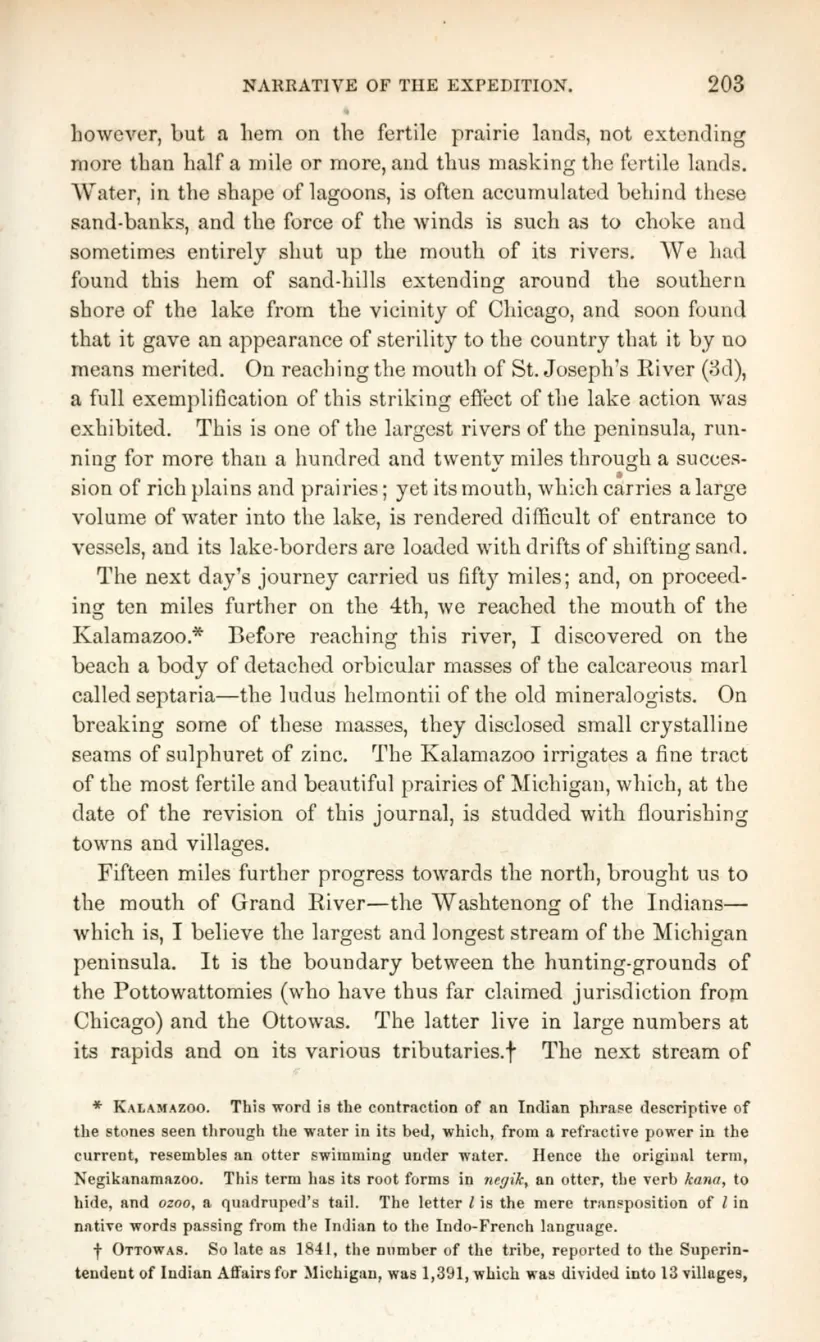
DocumentedSchoolcraft, 1855: otters. In the Summary Narrative of his 1820 expedition, published thirty-five years later, Henry Schoolcraft explained in a footnote that “Kalamazoo” contracted a phrase describing “the stones seen through the water in its bed” which, through the moving current, looked like an otter swimming beneath the surface. His original word was “Negikanamazoo,” from negik, an otter. He added a note that the letter L came in as Indian words passed into French.
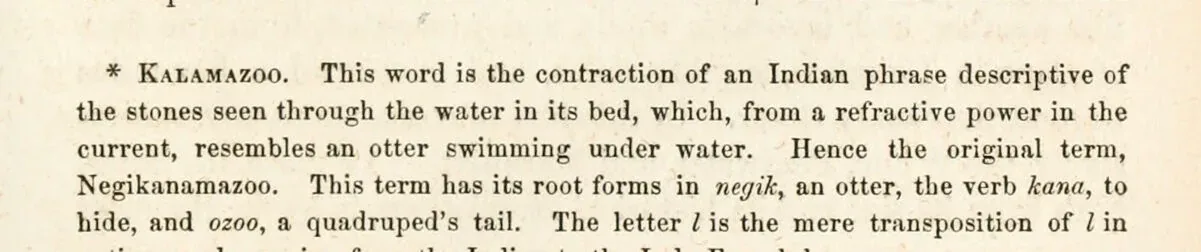
DocumentedVerwyst, 1892: smoke. Father Chrysostom Verwyst, who spent his life among Ojibwe speakers, called the name a “corruption of kikanamoso (it smokes, or he is troubled with smoke—e.g., in his wigwam),” pronounced kee-kah-nah-mo-zo.

DocumentedGannett, 1902 and 1905: all of the above. The federal Origin of Certain Place Names in the United States gave “otter tail” on “one authority,” and listed “beautiful water” and “boiling water” besides, without choosing; the edition of 1905 added “stones like otters.”
DocumentedGerard, 1911: not otters. William R. Gerard, writing in the American Anthropologist, called Schoolcraft’s explanations “etymological absurdities” and showed why the otter word could not be built that way. He argued that the name was an old Ojibwe word, kikalâmozo, “he is inconvenienced by smoke in his lodge,” and guessed, admitting it was only a guess, that it had once been a person’s nickname.
DocumentedVogel, 1986: none proven. Virgil Vogel’s Indian Names in Michigan treats “the boiling pot” as an alleged meaning, rejects the otters and the “mirage or reflecting river,” and suggests that the smoke explanations deserve Gerard’s label too. He thought it more credible that the name meant something like “it runs fast,” or that it was a mangled form of another river’s name, and he noted that forms with an L may come from the Miami language.
New findingThe “mirage” or “reflecting river” meaning, still repeated on many websites, is not modern. Charles R. Brown’s The Government of Michigan, printed at Kalamazoo in 1874, has it: “An Indian name, signifying ‘the mirage or reflecting river,’ applied to the stream which waters this county and parts of Calhoun and Allegan. It was originally spelled Kikalamazoo.” By 1912 the Michigan Historical Collections credit it to a name, “W. S. George says the name signifies the mirage or reflecting river,” and Walter Romig’s Michigan Place Names (1973) carried it into the modern books. Nobody gives a word it comes from, and Vogel rejected it.
DocumentedThe Kalamazoo Public Library also records a forest-fire legend, in which the name is translated “smothered.” It sits close to the smoke words of Verwyst and Gerard, though no early source for it has turned up.
Exhibit H: the missing L
DocumentedPotawatomi has no L sound. A Potawatomi language specialist made the point on WMUK in 2018: if “Kalamazoo” comes from a Potawatomi word, it is not a close copy. The linguistic descriptions of the language agree. In Ojibwe, too, the old Algonquian sound that became L in some languages became N.
ReadingNow set the spellings side by side, in the order they were written:
- c. 1760 kikanamaso (Potier)
- c. 1763 Kikanamaso (a French memoir)
- c. 1771 Reccanamazo (a British road description)
- 1779 Kikanamaso (log of HMS Felicity)
- 1820 Kikalemazo (Schoolcraft)
- 1821 Kekalamazoo; Ke-kal-i-ma-zoo (Treaty of Chicago)
- 1822 Kikalemazo (Carey & Lea)
- 1829–30 Kalamazoo (the county)
- 1838 Kekalamazoo (Blois’s gazetteer)
- 1848 Kekalamazoo (Cooper)
- 1855 Negikanamazoo (Schoolcraft, explaining)
- 1867 Kih-Kalamazoo (Torrey and Sheldon)
- 1869 Torrey: “the fleetest runners in the tribe,” and the partners “disgusted” with Bronson.
- 1874 Brown: “the mirage or reflecting river.”
- 1877 Ke-Kenamazoo (Pioneer Society)
- 1892 kikanamoso (Verwyst)
- 2026 Giknamezo zibé, the river (Gun Lake Tribe)
ReadingThe oldest form and the tribal form of today both have an N in the middle. The L belongs to the years when American officials and mapmakers wrote the word down, beginning, so far as we can find, with Schoolcraft in 1820, and it may come from interpreters who spoke a language that had one, as Vogel and Gerard both suggested in different ways. The “Ke-” or “Kik-” at the front, lost in the English name, is in the oldest and in the newest forms alike.
Exhibit I: the names today
DocumentedPotawatomi has its own names for the place and the river. On WMUK in 2018, a Potawatomi language specialist gave Gzigmezé as the Potawatomi name for Kalamazoo and said it describes a boiling, adding that he was not sure of the word’s origins.
DocumentedIn July 2026 the Gun Lake Tribe (the Match-E-Be-Nash-She-Wish Band of Pottawatomi Indians) presented a talk in Kalamazoo under the title “Gzigmezék mine Giknamezo Zibé.” The event notice glosses Gzigmezék as the past Potawatomi village and present-day Kalamazoo, and Giknamezo zibé as the Kalamazoo River.
ReadingTwo names, then: one for the place, which describes a boiling, and one for the river, which is very close to the oldest spelling on paper. Giknamezo and Potier’s kikanamaso share their consonants in the same order. Verwyst’s kikanamoso of 1892, the “it smokes” word, is close too. If that is right, the old river name and the old village name may both lie behind the English “Kalamazoo,” and the town’s favorite story, the boiling pot, may preserve the place name while the spelling preserves the river’s.
OpenWhat Giknamezo means, and how Gzigmezé and Giknamezo are related, are questions for the people whose language it is. We have not asked them to confirm anything on this page, and nothing here should be taken as their view.
What became of Titus Bronson
DocumentedBronson left Kalamazoo soon after the change. The library’s biography follows him to Davenport, Iowa, where he lost what he had in a land swindle in 1842, the year his wife Sally died, and then to Illinois. He went home to Connecticut and died there, at his brother’s house, in January 1853. His gravestone, in the Middlebury Cemetery, calls him “A Western Pioneer, Returned to Sleep with his Fathers.”
ReadingDurant thought Kalamazoo had forgotten him; in 1880 not even a street bore his name, only the park. Today a hospital, the park and a boulevard do.
The other Kalamazoos
DocumentedKalamazoo has been the name of other places too. Larry Massie told WMUK that two other communities once called themselves Kalamazoo: one in Sheridan Township near Albion, and the village at the river’s mouth that became Saugatuck. The first was a post office: Reuben Abbott’s, in Calhoun County, called Kalamazoo from 1834 until it became Waterburgh at the end of 1835. The second was William G. Butler’s village, platted in 1833 and recorded as Kalamazoo in 1834; its post office was named Saugatuck in 1835, but in 1838 the state gazetteer still called the village “Newark, (called Kalamazoo on the maps).” Allegan County’s histories of 1880 and 1907 also record a paper town, Kalamazoo Harbor, laid out at the mouth of the river.
DocumentedThe painting at the top of this page, William Greason’s Bayou on the Kalamazoo River, Douglas (1934), was made near that mouth, at Douglas, across the river from Saugatuck.
OpenThe Sheridan Township Kalamazoo is in no Calhoun County history we have read; its dates come from the postmaster records as compiled by postal historians (and Kit Lane, 1992). We have not yet seen the appointment record itself.
DocumentedThe name itself became famous for sounding like nowhere in particular: “from Timbuktu to Kalamazoo.” Carl Sandburg put it in a poem title, “The Sins of Kalamazoo” (1920), and Glenn Miller’s orchestra took “(I’ve Got a Gal in) Kalamazoo” to the top of the charts in 1942.
A glossary
- Plat
- A surveyed map of a new village, dividing it into streets and lots, recorded with the county.
- Reserve
- Land held back from a treaty cession for a band or a person. The reserve at Match-e-be-nash-she-wish’s village lasted from 1821 to 1827.
- Zibé
- Potawatomi for “river,” as in Giknamezo zibé, the Kalamazoo River.
- Folk etymology
- An explanation of a word made up afterwards to fit how it sounds, rather than traced from what it once meant.
- Itinerary
- In Potier’s papers, a list of the stages of a journey, river by river and portage by portage.
A timeline
- 1684 Franquelin’s map puts a “Maramee” where the Kalamazoo runs.
- 1744 Bellin’s map shows a “R. Marameg” on Lake Michigan’s east shore, where the Kalamazoo should be.
- c. 1760 Potier’s itinerary names the “little” and “great” kikanamaso.
- c. 1763 A French memoir of the lake shore, by its editor’s dating, names the “Kikanamaso.”
- c. 1771 A British road description from Detroit to Fort St. Joseph: “Reccanamazo River.”
- 1779 The log of HMS Felicity: “the Kikanamaso.”
- 4 Sep 1820 Schoolcraft passes the “river Kikalemazo” (printed 1821): the first L.
- 29 Aug 1821 Treaty of Chicago: a reserve “at the head of the Kekalamazoo river.”
- 1822 Carey & Lea map of Michigan Territory: “Kikalemazo R.” (reissued 1823).
- 1827 Treaty of St. Joseph: the reserve is ceded.
- 1829 Titus Bronson settles on the site; the county is laid out on 29 October.
- 30 Jul 1830 Kalamazoo County organized; Arcadia township created.
- 12 Mar 1831 The Village of Bronson platted.
- Apr 1833 A cherry tree cut on unclaimed land; Bronson fined $4.62½ (the court record, as quoted by Kekic, 1984).
- 17 Feb 1836 The Senate asks about renaming Arcadia; Comstock’s amendment later adds the village of Bronson.
- 2 Mar 1836 Act approved changing Bronson and Arcadia to Kalamazoo, effective 31 March.
- 1838 Blois’s Gazetteer: Kekalamazoo, “signifying a boiling pot.”
- 1848 Cooper’s Oak Openings: “Kekalamazoo,” “the true Indian word.”
- Jan 1853 Titus Bronson dies in Connecticut, at his brother’s house.
- 21 Jun 1854 A toast at the quarter-centennial: “Ke Kalamazoo — the boiling pot.”
- 1855 Schoolcraft’s otters.
- 1867 Torrey’s village history prints Sheldon’s race to the river.
- 1877 Pioneer Collections: “Ke-Kenamazoo (the boiling pot).”
- 1880 Durant’s History of Kalamazoo County.
- 1892 Verwyst: “it smokes.”
- 1911 Gerard rejects the otters.
- 20 Aug 1922 Kalamazoo Gazette: “Fleet Foot,” his bride, and the year 1810.
- c. 1951 Sepeshy’s mural of the race.
- 1984 Kekic’s A Fine Place for a City: the cherry tree, from the court record of 1833.
- 1986 Vogel’s Indian Names in Michigan.
- 2018 Gzigmezé, “describes a boiling,” on WMUK.
- Jul 2026 The Gun Lake Tribe’s Gzigmezék and Giknamezo zibé.
The poster
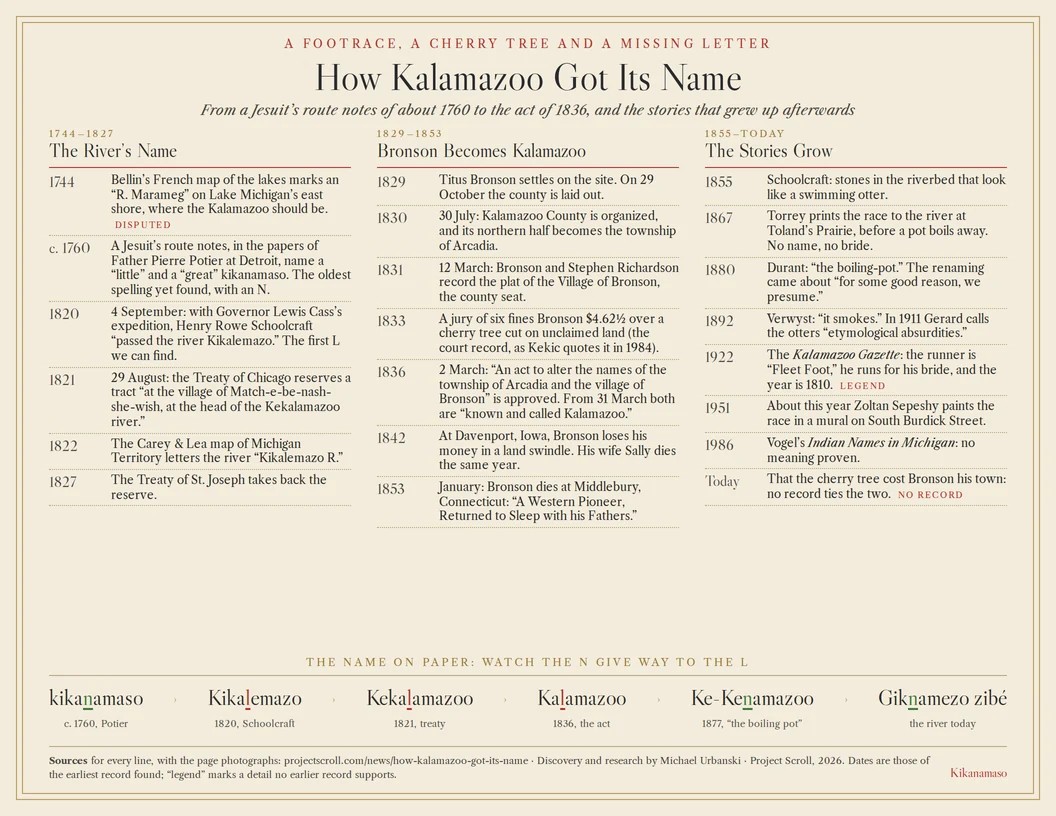
The whole story on one page, for a classroom, a library wall or a refrigerator door: “How Kalamazoo Got Its Name,” from about 1760 to today, every date from the record, with the spellings in order along the foot. Letter size, landscape; it prints well larger.
What we are not saying
- Not that we know what Kalamazoo means. Nobody has a speaker’s explanation on record from the time the name was first written down. Every meaning on this page is somebody’s explanation.
- Not that the race never happened, or that the cherry tree is false. We say only where each story first appears in print, so far as we can find.
- Not that “Marameg” on Bellin’s map is certainly the Kalamazoo. The position fits; the identification is disputed.
- Not that Potier walked the river in 1760. The date is his editor’s, and the notes may have been compiled from other travelers.
- Not that we speak for any Potawatomi nation. We report the names as they have been published, and nothing more.
If anyone can show the cherry tree in a record of the 1830s, or the race story in print before 1867, we will say so on this page, with thanks.
The picture album
Every picture on this page in one place. The maps, the painting, the portrait and the book pages are all in the public domain; each caption names the library that holds the original. Press any picture to see it full size.
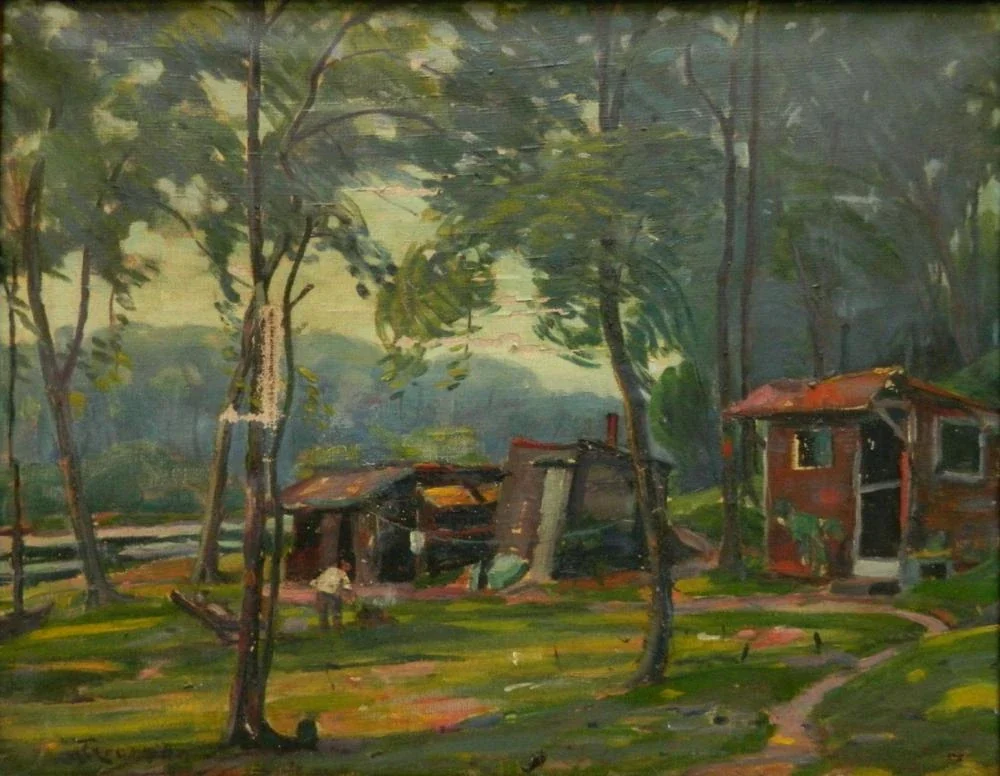
Pictures we know of but cannot yet show. The photograph of Zoltan Sepeshy’s mural of the race, about 1951, is in the Kalamazoo Public Library’s collection; whether the mural itself survives we have not learned. The original plat of the Village of Bronson, 1831, is at the Kalamazoo County Register of Deeds. Titus Bronson’s gravestone stands in Middlebury, Connecticut.
The case file: what we asked, and what we found
The questions this story set out to answer, and what the record showed.
- Answered Who brought the bill, and why? The Senate journal has it. A resolution of 17 February 1836 asked about renaming Arcadia township; Mr. Britain’s committee brought in a bill for the township alone; and at the third reading, “on motion of Mr. Comstock,” the village of Bronson was written in. A “Mr. Burdick, of Kalamazoo,” sat in the House that passed it; a list in the House journal appears to name him as Cyren Burdick of Bronson. As for why, George Torrey said it plainly in 1869: Burdick, Sheldon and Lyon were “disgusted with the eccentricities, obstinacy, and want of enterprise” of their partner. The Senate’s roll gives Comstock’s first name: Horace H. Comstock, of the third district.
- Answered What else did Torrey say? More than we knew. His county history in the directory of 1869 is online. It moves the race to an Indian village on James Hopkins’s farm, calls the runners “the fleetest … in the tribe,” and gives the reason for the renaming that Durant would not.
The pages
Read them yourself. Every book on this page is free online, and the passages are short. The page photographs are below; the full books are linked under Sources.
To cite this page: Michael Urbanski, “How Kalamazoo got its name,” Project Scroll, first published 22 October 2026, revised 25 October 2026, https://projectscroll.com/news/how-kalamazoo-got-its-name/. To cite a single finding, use its own link on our Discoveries page. Corrections are welcome, and any we make are noted on this page.
Sources
- Robert Toupin, ed., Les Écrits de Pierre Potier (Ottawa: Presses de l’Université d’Ottawa, 1996), pp. 144–151: the itinerary naming the petit and grand kikanamaso, dated to autumn 1760. Internet Archive (borrow).
- Jacques-Nicolas Bellin, Carte des Lacs du Canada (Paris, 1744). Michigan State University Libraries.
- Treaty of Chicago, 29 August 1821, Article 2 and the note on the reserve, in Indian Treaties, and Laws and Regulations Relating to Indian Affairs (Washington, 1826). Internet Archive.
- Charles J. Kappler, ed., Indian Affairs: Laws and Treaties, vol. 2 (Washington, 1904): the Treaty of Chicago, 1821, from p. 198, and the Treaty of St. Joseph, 1827. Internet Archive.
- H. C. Carey and I. Lea, Geographical, Statistical, and Historical Map of Michigan Territory, in A Complete Historical, Chronological, and Geographical American Atlas (Philadelphia, 1822; reissued 1823). Michigan State University Libraries.
- Acts of the Legislature of the State of Michigan, session of 1835–36, p. 81: An act to alter the names of the township of Arcadia and the village of Bronson, approved 2 March 1836. Internet Archive.
- Samuel W. Durant, History of Kalamazoo County, Michigan (Philadelphia: Everts & Abbott, 1880), pp. 56–57 (the name; Torrey’s 1867 account of the race), 214 (the plats; Cyren Burdick’s hotel, the Kalamazoo House, begun probably in the spring of 1832), 220 (Changing Names). Internet Archive.
- Pioneer Society of the State of Michigan, Pioneer Collections, vol. 1 (first published 1877; 2nd ed., Lansing: Robert Smith Printing Co., 1900), Reports of Counties, Towns, and Districts, p. 200: Kalamazoo, the river’s name (“the boiling pot”) and the county seat, “first Bronson, then changed to Kalamazoo.” Internet Archive (the edition of 1900).
- David Fisher and Frank Little, eds., Compendium of History and Biography of Kalamazoo County, Mich. (Chicago, 1906): frontispiece portrait of Titus Bronson. Internet Archive.
- Henry R. Schoolcraft, Summary Narrative of an Exploratory Expedition to the Sources of the Mississippi River in 1820 (Philadelphia, 1855), p. 203, footnote. Internet Archive.
- Chrysostom Verwyst, Geographical Names in Wisconsin, Minnesota, and Michigan, having a Chippewa Origin, Collections of the State Historical Society of Wisconsin 12 (1892), pp. 390–398, at 391. Internet Archive.
- Henry Gannett, The Origin of Certain Place Names in the United States, 2nd ed., U.S. Geological Survey Bulletin 258 (1905), p. 171. Internet Archive.
- W. R. Gerard, Kalamazoo, in Anthropologic Miscellanea, American Anthropologist n.s. 13 (1911), pp. 337–338. Internet Archive.
- Virgil J. Vogel, Indian Names in Michigan (Ann Arbor: University of Michigan Press, 1986), chapter 14. Open access, Fulcrum.
- Sehvilla Mann, “Why’s That” Asks the Eternal Question: What Does “Kalamazoo” Mean?, WMUK, 8 February 2018 (the historian Larry Massie, and a Potawatomi language specialist).
- WMUK community calendar, Since Time Immemorial talk at Ladies’ Library: Gzigmezék mine Giknamezo Zibé (Kalamazoo and the Kalamazoo River), presented by the Gun Lake Tribe, 23 July 2026.
- Kalamazoo Public Library, How Kalamazoo Got Its Name with its bibliography (Kalamazoo Gazette, 10 March 1901, p. 8; 20 August 1922, p. 10; 16 July 1978, p. S6).
- City of Kalamazoo, About Kalamazoo (the city’s history page: the cherry tree, Fleet Foot, and the meanings of the name).
- Frederick Webb Hodge, ed., Handbook of American Indians North of Mexico, part 1 (Washington, 1907), Marameg, pp. 804–805. Internet Archive.
- Kalamazoo Public Library, Titus Bronson: Founder of Kalamazoo.
- Kalamazoo Public Library, Match-E-Be-Nash-She-Wish.
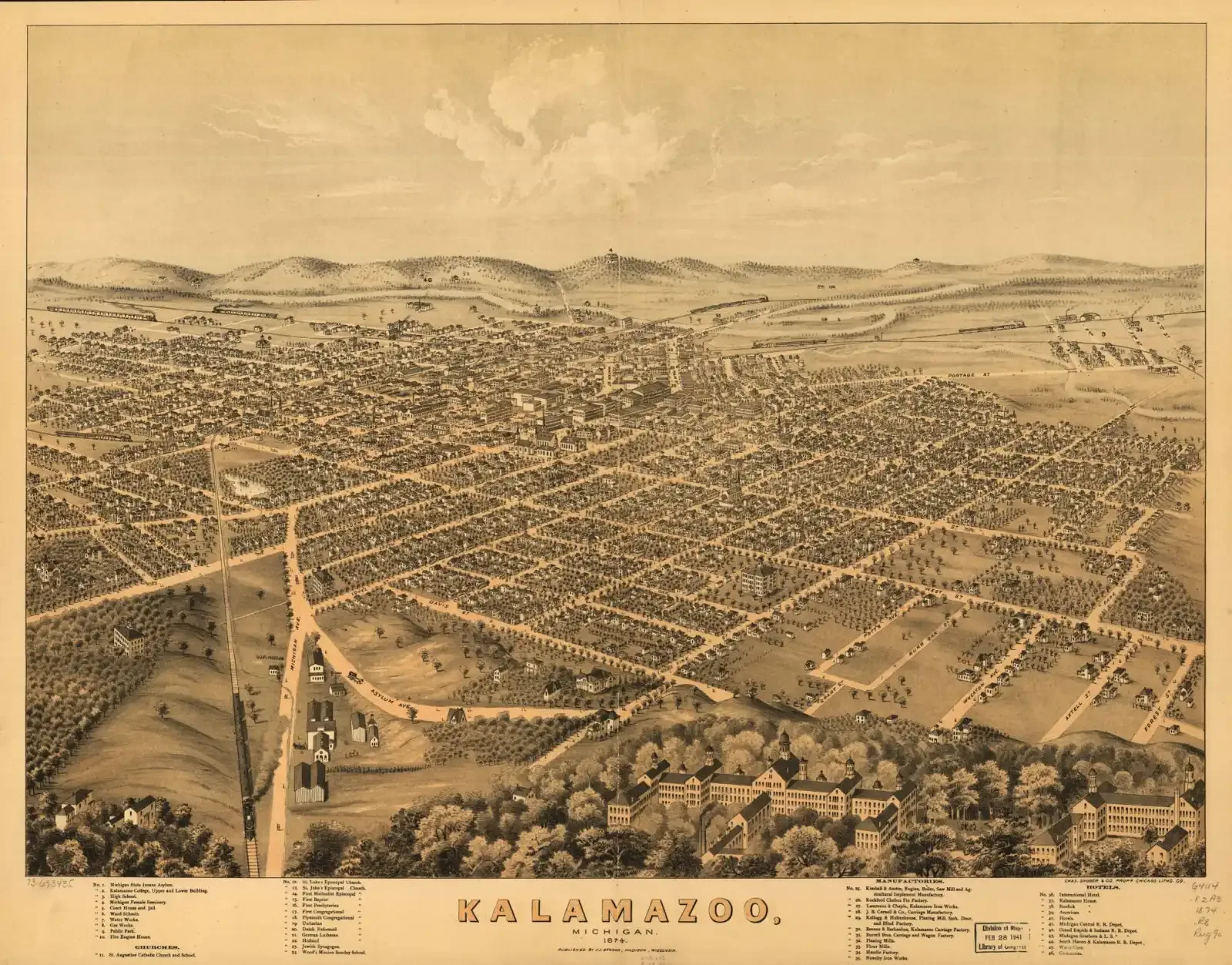
- Albert Ruger, Kalamazoo, Michigan, 1874 (bird’s-eye view). Library of Congress, Geography and Map Division.
- William Greason, Bayou on the Kalamazoo River, Douglas, oil on canvas, 1934. Wikimedia Commons (public domain).
- “Mémoire sur la partie occidentale du Canada, depuis Michillimakinac jusqu’au fleuve du Mississipi,” Le Bulletin des recherches historiques 26 (1920), pp. 25–32 (dated by the editor “1763 ou peu après”): “celle de Kikanamaso.” Internet Archive.
- “The Road from Detroit to Fort St Josephs by land,” Haldimand papers, Michigan Pioneer and Historical Collections 10 (1886), p. 248, between papers of 1771 and 1772: “Reccanamazo River, or Pusawpaco Sippy.” Internet Archive.
- Log of H.M.S. Felicity, autumn 1779, printed in Claude T. Hamilton, “Western Michigan History (Colonial Period),” Michigan History Magazine 13, no. 2 (Spring 1929), pp. 225–227: “for the Kikanamaso” (p. 226). Internet Archive.
- Henry R. Schoolcraft, Narrative Journal of Travels through the Northwestern Regions of the United States (Albany: E. & E. Hosford, 1821), p. 396, entry of 4 September 1820: “the river Kikalemazo.” Internet Archive.
- Robert Toupin, “Les routes de canot et de terre au pays des Illinois et dans la vallée de la Ouabache au XVIIIe siècle: les recueils de Pierre Potier,” in Georges Gauthier Larouche, ed., 450 ans de noms de lieux français en Amérique du Nord (Québec: Commission de toponymie, 1986), pp. 446–454: Potier’s copies of other travelers’ itineraries, p. 448; the petit and grand kikanamaso, p. 452. Internet Archive.
- Charles A. Weissert, ed., An Account of Southwest Michigan and St. Joseph County, in George N. Fuller, ed., Historic Michigan: Land of the Great Lakes, vol. III ([Dayton, Ohio]: National Historical Association, undated, about 1925), p. 17 (Franquelin’s “Maramee,” Charlevoix’s “Meremek”), p. 18 (“bright, bubbling kettle”), p. 128 (“Ki-ka-ma-sung”). The book reports events as late as 1925; the date 1900 in the library record is not its date. Internet Archive.
- William L. Jenks, “History and Meaning of the County Names of Michigan,” Michigan Pioneer and Historical Collections 38 (Lansing, 1912), pp. 439–477, at 455–456: the Haldimand road’s “Reccanamazoo,” “probably a misprint of the ‘R’ for ‘K’” (p. 455); the meanings of the name, and “W. S. George says the name signifies the mirage or reflecting river.” Internet Archive.
- John T. Blois, Gazetteer of the State of Michigan (Detroit: Sydney L. Rood, 1838), p. 305: “Kekalamazoo, [Indian,] signifying a boiling pot”; p. 331: Newark, “(called Kalamazoo on the maps,) is a village and post office … in the county of Allegan.” Internet Archive.
- Quarter Centennial Celebration of the Settlement of Kalamazoo, Michigan (Ladies’ Library Association, 1855), p. 10: the toast of 21 June 1854, “Ke Kalamazoo — the boiling pot.” Internet Archive.
- George Torrey, history of the county, in Kalamazoo County Directory, with a History of the County (Kalamazoo: J. M. Thomas, 1869), p. 60 (the reason for the renaming; Bronson’s death in Connecticut) and pp. 108–109 (the race on Hopkins’s farm). Internet Archive.
- Charles R. Brown, The Government of Michigan (Kalamazoo: Moore & Quale, 1874), p. 28: “the mirage or reflecting river.” Internet Archive.
- James Fenimore Cooper, The Bee-Hunter; or, The Oak Openings, vol. III (London: Richard Bentley, 1848), p. 195, footnote: “This is the true Indian word.” Internet Archive.
- Journal of the Senate of the State of Michigan, of the First, Adjourned, and Extra Sessions of the Legislature, in the Years 1835 and 1836 (Detroit: John S. Bagg, 1836), p. 4 (the roll: Horace H. Comstock, third district), pp. 123–124 (the resolution of 17 February 1836), 139 and 148 (the bill), 152–153 (Mr. Comstock’s amendment adding the village of Bronson; the bill passed). Internet Archive.
- Journal of the House of Representatives of the State of Michigan; First Session (Detroit: Morse & Bagg, 1836), p. 49 (the members for Kalamazoo County: Edwin H. Lothrop and Cyren Burdick, of Bronson), and pp. 157, 161, 165, 168, 175 (the bill to alter the names of the township of Arcadia and the village of Bronson). Internet Archive.
- Nick Kekic, A Fine Place for a City: Titus Bronson and the Founding of Kalamazoo (Kalamazoo: Oak Opening Press, 1984): Joseph Eddington’s cherry tree, April 1833. Internet Archive (borrow).
- Jean-Baptiste-Louis Franquelin, Carte de la Louisiane ou des voyages du Sr. De La Salle (1684), facsimile. Library of Congress, Geography and Map Division.
- Walter Romig, Michigan Place Names (Grosse Pointe: Walter Romig, 1973): “said to mean the mirage or reflecting river.” Internet Archive (borrow).
- David Rumsey Map Collection, catalogue record for Carey & Lea, A Complete Historical, Chronological, and Geographical American Atlas (1822), on its editions of 1822, 1823 and 1827.
- The Minute Man (National Society of the Sons of the American Revolution) 19, no. 4 (March 1925), pp. 65–66: Kent Chapter’s report of Claude T. Hamilton’s talk of December 1924 on the Felicity log, “for the Kikanamaso (Kalamazoo)” (p. 66). Internet Archive.
- Albert F. Butler, “Rediscovering Michigan’s Prairies,” Michigan History 33:3 (September 1949), p. 225: “Reccanamazo, or Ke-Kalamazoo.” Internet Archive.
- The Rag Picker (Paper Money Collectors of Michigan) 19, no. 4 (October 1984): the 1822 Finlayson map “spells the Kalamazoo River as Kikalemazo.” Internet Archive.
- Parker Cleaveland, An Elementary Treatise on Mineralogy and Geology, 2nd ed., 2 vols. (Boston: Cummings and Hilliard, 1822), vol. 2, p. 775: “between the rivers Black Water and Kikalemazo. (Schoolcraft.)” Internet Archive.
- Joseph E. Worcester, A Geographical Dictionary, or Universal Gazetteer, Ancient and Modern, vol. 1 (Boston: Cummings and Hilliard, 1823), p. 852: “Kikalemazo, r. Michigan, which flows into lake Michigan, 20 N. Black water river.” Internet Archive.
- William H. Keating, Narrative of an Expedition to the Source of St. Peter’s River, Lake Winnepeek, Lake of the Woods, &c., vol. 1 (Philadelphia: H. C. Carey & I. Lea, 1824), p. 425: “between St. Joseph and Kikalemazo rivers.” Internet Archive.
- Henry Gannett, The Origin of Certain Place Names in the United States, U.S. Geological Survey Bulletin 197 (Washington: Government Printing Office, 1902), p. 149. Internet Archive.
- Henry F. Thomas, ed., A Twentieth Century History of Allegan County, Michigan (Chicago: Lewis Publishing Co., 1907), p. 35: Kalamazoo Harbor, “near the river’s mouth,” platted but never settled; pp. 124–125: Butler’s village “popularly called” Kalamazoo, whose post office “was never known as Kalamazoo by the postal department.” Internet Archive.
- Darla Welshons, “Titus ‘Potato’ Bronson: Ann Arbor’s Pioneering Potato Man,” Ann Arbor District Library, 2024: his death in January 1853 “while visiting his brother back in Connecticut,” and his headstone in the Middlebury Cemetery.
- Charles F. Hockett, “Potawatomi I: Phonemics, Morphophonemics, and Morphological Survey,” International Journal of American Linguistics 14, no. 1 (1948), pp. 1–10: the sounds of the language.
- Wikipedia, “Potawatomi language”: the consonants, after Hockett (1948), include no L or R.
- Wikipedia, “Ojibwe phonology”: “Proto-Algonquian *r and *θ became Ojibwe /n/.”
- Carl Sandburg, “The Sins of Kalamazoo,” in Smoke and Steel (New York: Harcourt, Brace and Howe, 1920), pp. 49–53. Internet Archive.
- Discography of American Historical Recordings, Victor 27934: Glenn Miller and his Orchestra, with Tex Beneke, Marion Hutton and the Modernaires, “(I’ve Got a Gal in) Kalamazoo,” recorded 20 May 1942, released 10 July 1942.
- Wikipedia, “(I’ve Got a Gal in) Kalamazoo”: by Mack Gordon and Harry Warren for the film Orchestra Wives (1942); Glenn Miller’s record spent eight weeks at number one on the Billboard charts.
- Crisfield Johnson, History of Allegan and Barry Counties, Michigan (Philadelphia: D. W. Ensign & Co., 1880), p. 325: William G. Butler’s village, platted in 1833 and called Kalamazoo, the plat recorded 17 July 1834; the post office named Saugatuck in 1835; and p. 331: “the paper town of Kalamazoo Harbor, laid out at the mouth of the river.” Internet Archive.
- Jim Forte Postal History, post offices of Michigan: “Kalamazoo, Calhoun County (1834–1835)”; “Waterburgh, Calhoun (1835–1843).” Compiled from the postmaster appointment records.
- Kit Lane, The Wreck of the Hippocampus and Other Tales of Saugatuck (Douglas, Mich.: Pavilion Press, 1992): the Kalamazoo post office in Calhoun County, established 2 May 1834 with Reuben Abbott as postmaster, changed to Waterburgh on 23 December 1835. Internet Archive (borrow; seen in the full-text search).
- John Melish, The Traveller’s Directory through the United States (New York: A. T. Goodrich, 1825), the account of Michigan Territory, second pagination, p. 36: “Rivers. … Black Water, Kikalemazo, Grand Maskagon….” Internet Archive.
- John Farmer, Map of the Surveyed Part of the Territory of Michigan (Detroit, 1826; engraved by V. Balch and S. Stiles, Utica): “Kekalamazoo R.” and “Kekalamazoo Res.” Library of Congress, Geography and Map Division, G4110 1826 .F3.
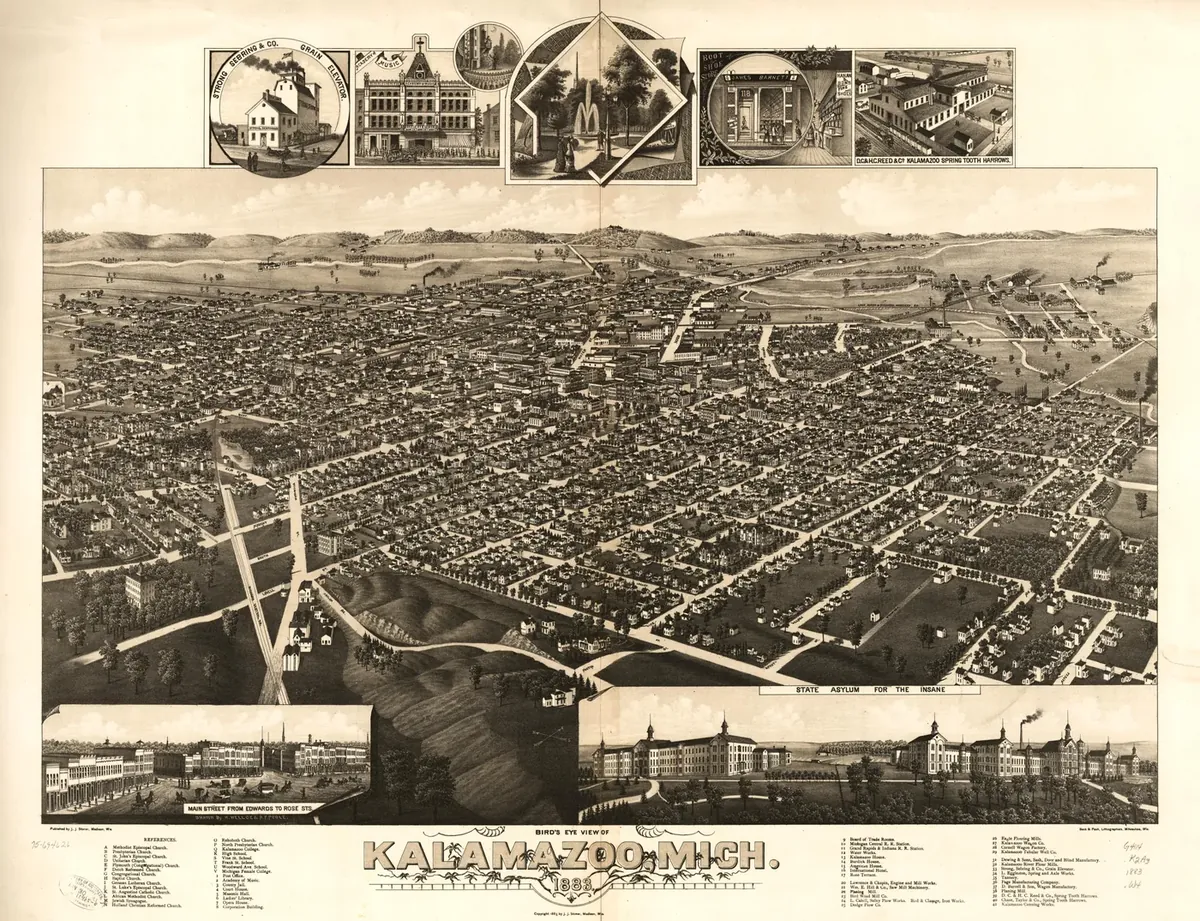
- H. Wellge, Bird’s Eye View of Kalamazoo, Mich. (Madison, Wis.: J. J. Stoner, 1883). Library of Congress, Geography and Map Division.
Numbers in the text point to this list; entries without a number are further sources we consulted. How we research › · The libraries behind all our stories ›
Read the act of 1836 Print the poster Write to us All the news
Corrections (3)
First published 22 October 2026; last updated 25 October 2026. Like all our pages, it is expanded from time to time with new records, pictures and features. Factual corrections are listed here, with their dates.
- Michigan joined the Union nearly eleven months after the act, not ten; the Potier pages are 144 to 151; Bronson’s death given as January 1853, as the library has it.
- The first L is Schoolcraft’s “Kikalemazo” of 1820, not the treaty of 1821; the boiling pot is in print by 1838, not 1867; the mirage meaning is in print by 1874, not modern.
- The French memoir dated as its 1920 editor dated it, 1763 or a little after, pp. 25–32; the two English N-spellings no longer counted as new findings; the cherry tree: Kekic (1984) quotes the 1833 court record and the fine, and only the link to the renaming is unsourced; The Minute Man passage is of March 1925, not 1923; no source names Middlebury as the place Titus Bronson died; Burdick built the Kalamazoo House, not “the first hotel.”
About this research
Research and reporting Michael Urbanski Project Scroll
- Sources
- Every fact on this page is drawn from the sources listed above, and each can be checked where it is held.
- Corrections
- Errors are corrected on the page, and each correction is noted there.
- Contact
- To report an error or share a record that adds to the story, write to research@projectscroll.com.
- Method
- How we research ›
© 2026 Michael Urbanski and Project Scroll. All rights reserved. The text, original maps, charts and illustrations may not be reproduced without permission; brief quotations with credit and a link back are welcome. Material from other sources belongs to its holders and is credited where it appears; public-domain material is marked as such.


