The story
Welcome to Athens
Athens stands on the Nottawa Creek in the southwest corner of Calhoun County, where seven pioneers took up Dry Prairie in 1831 and cholera struck the next summer. The village grew after 1854, and from 1862 its mills ran on a race from the creek; it remains, as the 1913 county history put it, a home of the Potawatomi.
On June 3, 1831, a party of seven, Warren Nichols and his brothers Ambrose and Othorial, Benjamin F. Ferris, Alfred Holcomb, Isaac Crossett, Asahel Stone and a Mr. Brown, came into the township and the next day claimed nearly all of what is called Dry Prairie. Brown, a Vermonter, had gone ahead alone from Ypsilanti and found the prairie, which was not on the surveyor’s map. The township’s first name, Berlin, was suggested by Holcomb, but another place in the state already had it, and Athens was chosen instead. The Nottawa-seepe and Pine creeks join in the township and flow on to the St. Joseph.
Holcomb recalled that the Potawatomi crowded onto his wagon to look at the tinware on a stove they took for silver, and that a score of mounted men came the next day to see it again and the day after brought a quarter of venison in friendship. In the summer of 1832 cholera reached the settlement: Warren Nichols, his wife and three daughters, and Isaac Crossett died, and were buried on land that later lay inside the village. The first prayer meeting in Athens was held in Holcomb’s house in those weeks.
Read the full story
Before 1840 many Potawatomi lived on a reservation in the center of the township. In 1840, the 1877 county history says, soldiers came to take them west; many escaped to Canada, and six families slipped away on the Illinois prairies and came home after six weeks. The Nottawasippi Reservation, with its Indian church about a mile west of the village, is now a Michigan State Historic Site, and in 1913 about sixty Potawatomi still lived near Athens.
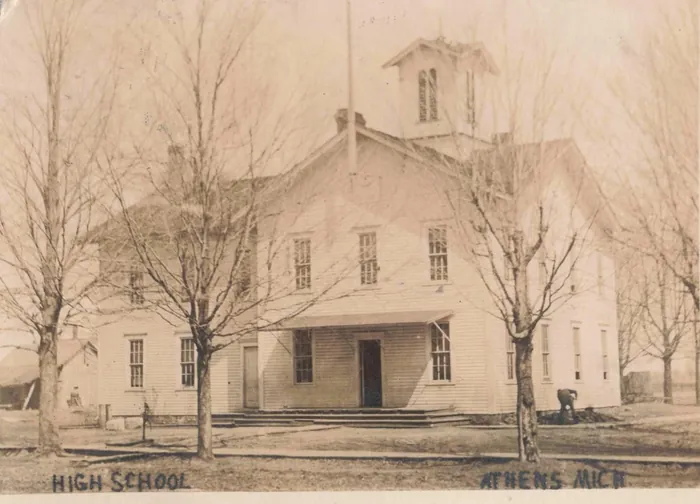
The village began in 1854, when William Simons built the first store; before that L. B. Holcomb had kept a trading place, mostly for the Indians. Work on the mill race from the Nottawa began in the fall of 1862, and in 1865, when A. Holcomb & Co. and A. C. Waterman had the village surveyed and put lots on the market, a sash and door factory, a gristmill and a sawmill were all at work. Seventeen houses went up in 1866 and thirty-three in 1867. A union church was built by several denominations in 1869, and by 1877 the village had some four hundred people.
Athens was incorporated as a village in 1896, with William Lehr as its first president. The Goshen branch of the Michigan Central, built in 1888, ran through it from Battle Creek to Goshen, Indiana, and by 1913 the Athens Mill and Power Company lit the streets with power from the Nottawa. The 2020 census counted 936 people in Athens.