Lore and legend
The Indian Lake Sea Serpent: Twelve Feet Long, and Shy
In October 1898 a “huge sea serpent” terrorized the cottagers on Indian Lake, near Dowagiac, and men went out with guns to hunt it. Two weeks later the papers said it was an otter and a fish. The next summer it was back, twelve feet long. We read every report we could find, on the page.
By Michael Urbanski · Project Scroll · First published · Updated · 8 min read

New finding 1 new finding in this story. See what’s new ›
Indian Lake, Mich. In the autumn of 1898, something in a lake five miles west of Dowagiac frightened the cottagers so badly that men went out with guns to hunt it. The papers called it a sea serpent. Two weeks later they said it was nothing of the kind. And then, the next summer, it came back.
The story ran in newspapers all over Michigan, a line or two at a time. We went back and read every one of them we could find, on the page.
October 1898: something in the lake
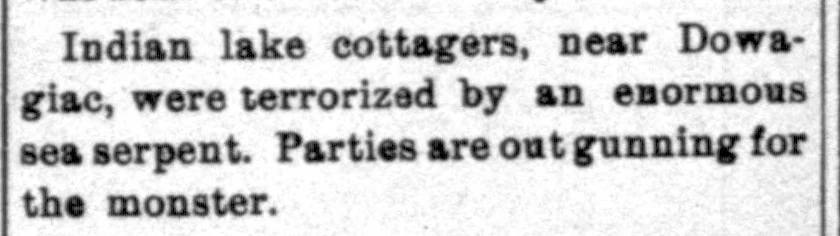
DocumentedThe first word we can find is a single line in the Grand Traverse Herald of 13 October 1898, in its round-up of news from around the state: “Indian lake cottagers, near Dowagiac, were terrorized by an enormous sea serpent. Parties are out gunning for the monster.”
DocumentedThe next day the same news reached Mount Pleasant. The Isabella County Enterprise of 14 October put it this way: “Residents of the vicinity of Indian lake, near Dowagiac, have been terrorized of late by a huge sea serpent in the lake.” The Clare Sentinel ran the same words that day, and the Saline Observer a few days later.
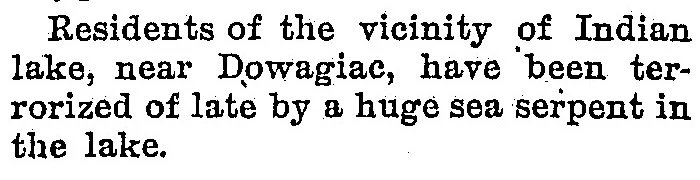
Reading“Of late” is the telling phrase. Whatever it was, it had been seen more than once before anyone sent the story out of the county. And “parties are out gunning for the monster” means just what it says: men in boats, with shotguns, on a lake of summer cottages.
Two weeks later: an otter and a muskalonge
DocumentedBy the end of October the state columns had an answer. The Evart Review of 28 October, like the Isabella County Enterprise, the Clare Sentinel and the Milford Times that week, and the Saline Observer a few days later, printed one sentence: “The sea serpent in Indian lake, near Dowagiac, proved to be an otter and a muskalonge.”


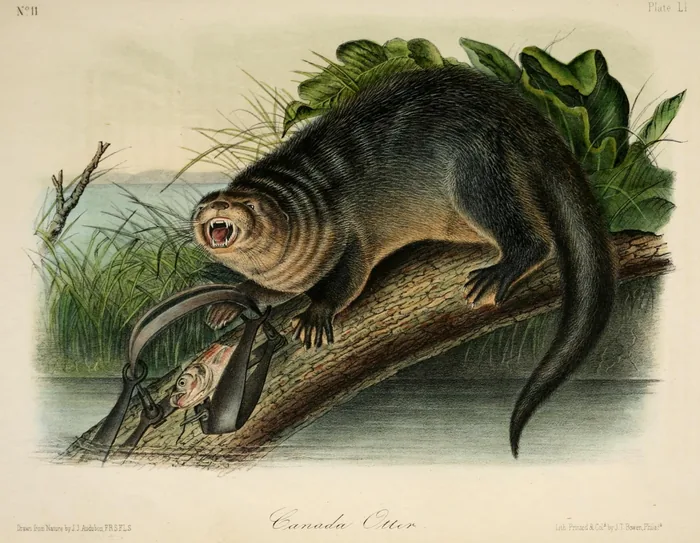
ReadingNotice that the answer is two animals, not one. An otter swims low, its long body arching in and out of the water; a big muskellunge is a long, narrow fish that lunges at the surface. Seen together from a cottage dock at dusk, one chasing the other, they might well look like one long thing moving fast. Notice too what the answer does not say: who caught the otter, who landed the fish, or whether anyone saw either one up close.
OpenNone of the papers says who decided it was an otter and a muskalonge, or how. The answer may have come from the same local correspondent who sent the first report. We have not yet found the Dowagiac or Cassopolis paper that printed the story first.
July 1899: back again, and twelve feet long
DocumentedThe next summer it was back. On 20 and 21 July 1899, under the heading “Cass County’s Sea Serpent,” the same paragraph appeared in the Grand Traverse Herald, the Gladwin County Record, the Clare Sentinel, the Isabella County Enterprise, the Evart Review and the Mount Clemens Monitor, and in Milford and Saline soon after:
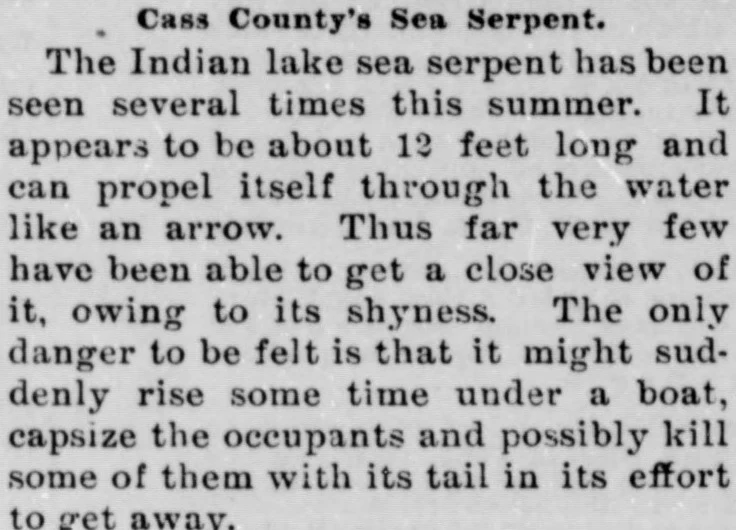
ReadingRead it twice. It is shy; it flees; hardly anyone has had a close look. The only danger anyone can name is that it might come up under a boat by accident, trying to get away. That is not how people write about a monster they believe in. It is how they write about something real and quick in the water that they cannot quite see, and are a little afraid of anyway. Either the writer was half joking, or the otter of 1898 had not convinced everyone.

The lake itself
DocumentedIndian Lake lies in Sections 30 and 31 of Silver Creek Township, in the south-west corner of the township, about five miles west of Dowagiac. The Michigan Department of Natural Resources gives it 499 acres and a greatest depth of 26 feet, in a single basin. An unnamed stream enters at the north end, and an outlet leaves the south-east side for the Dowagiac River, with a dam on it that holds the lake level.
ReadingOne modern retelling calls Indian Lake a 500-acre lake “with no inlets or outflows,” and so no way for a serpent to get in. The state’s own survey says otherwise: a stream comes in, and one goes out. A large fish, or an otter, had a way in.
New findingThe same state report lists what was put into the lake before the scare. Five thousand lake trout fry went in in 1878, and five thousand more in 1879. Then, in 1893 and again in 1897, four hundred thousand walleye fry each time: the year before the serpent, the lake had just been filled with young fish. The first fisheries survey, in 1887, had found bluegills, perch, crappies, pumpkinseeds, suckers, bullheads and shiners. The record lists no muskellunge, stocked or found.
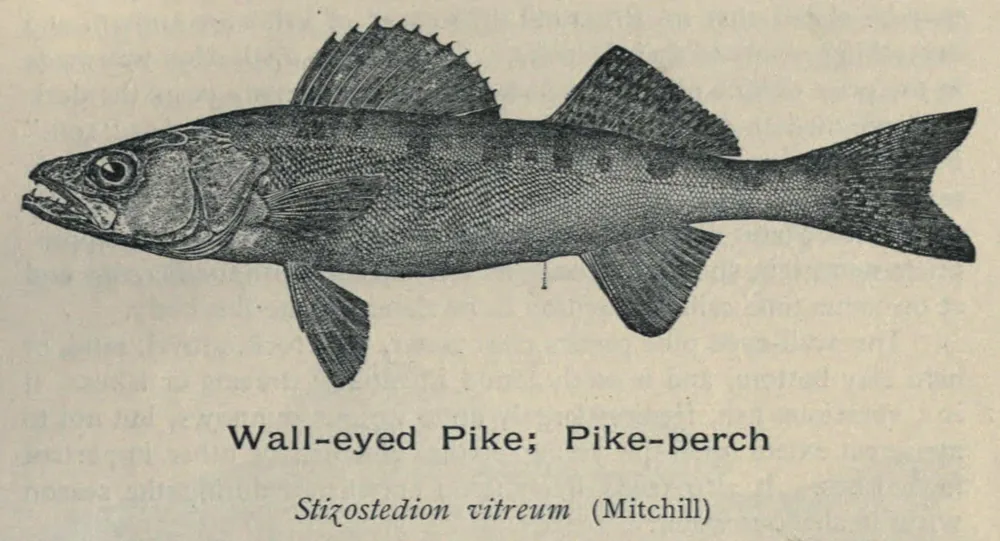
ReadingAn otter would have had a very good autumn in 1898. Whether a muskellunge was ever in Indian Lake at all, the record we have does not say.
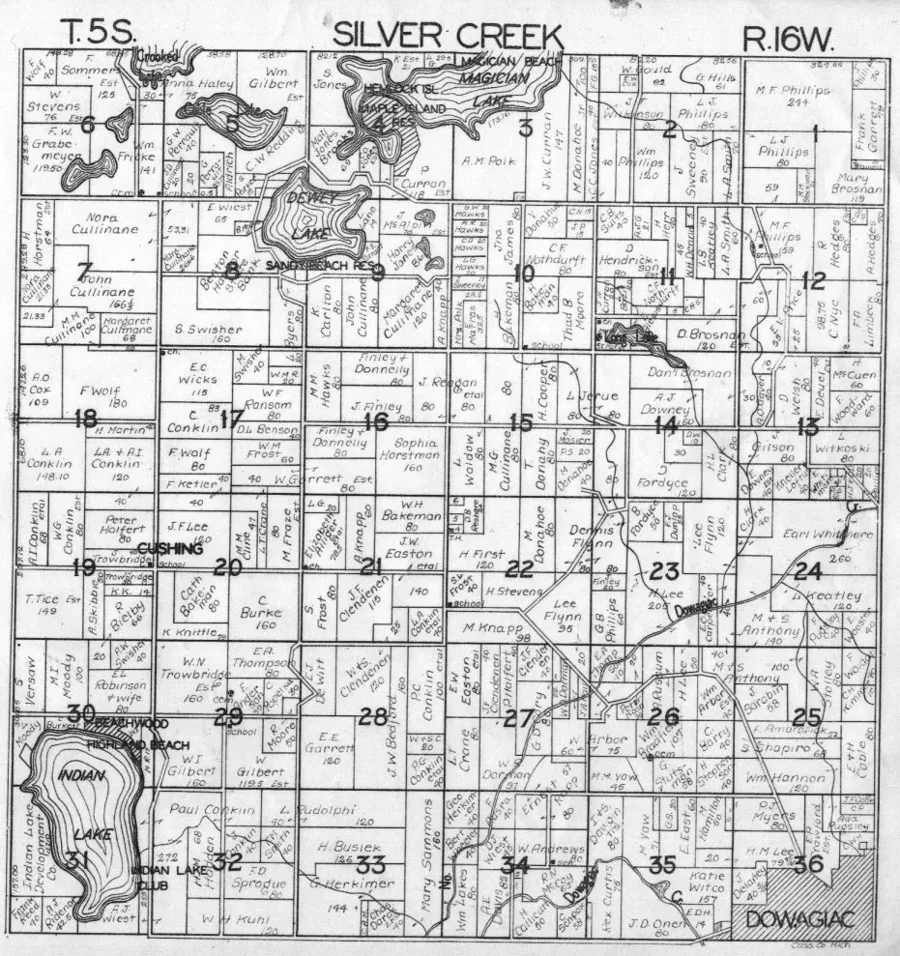
ReadingIndian Lake is the same lake where, in the late 1830s, the Treat family picked up a track running north-east toward a fork in the road and a tree marked in red chalk: “Turn to the left and go to the Devil.” The left-hand road, by our reading of the plat, led to Dewey’s Lake. Sixty years later the serpent swam at one end of that road; sixty-six years after that, the Dewey Lake Monster walked at the other. Read the story of the Dewey Lake Monster ›
How a lake story traveled in 1898
ReadingEvery one of these items comes from a paper’s column of state news: a run of one-line paragraphs about fires, deaths, crops and curiosities from every county, set side by side. Papers took them from one another and from the cities, so the same words turn up in Traverse City, Mount Pleasant, Clare, Evart, Milford, Saline and Mount Clemens within a week. That is why the serpent is “near Dowagiac” in every one: the first report came from Cass County, and nobody along the way changed a word.
ReadingIt also means that all of these papers together are one witness, not eight. Somebody at Indian Lake told somebody at a Dowagiac or Cassopolis paper, and the state took it from there.
To cite this page: Michael Urbanski, “The Indian Lake Sea Serpent: Twelve Feet Long, and Shy,” Project Scroll, projectscroll.com/news/the-indian-lake-sea-serpent/, first published 2026. Corrections are welcome.
Sources
- Grand Traverse Herald, 13 October 1898, p. 4; 20 July 1899, p. 3. Digital Michigan Newspapers.
- Isabella County Enterprise, 14 October 1898, p. 4; 28 October 1898, p. 7; 21 July 1899, p. 7. Digital Michigan Newspapers.
- Evart Review, 28 October 1898, p. 8; 21 July 1899, p. 6. Digital Michigan Newspapers.
- Gladwin County Record, 21 July 1899, p. 6 (“Cass County’s Sea Serpent”). Digital Michigan Newspapers.
- Clare Sentinel, 14 and 28 October 1898, 21 July 1899; Milford Times, 29 October 1898, 22 July 1899; Saline Observer, 20 October and 3 November 1898, 27 July 1899; Mount Clemens Monitor, 21 July 1899. Digital Michigan Newspapers.
- Brian Gunderman, Indian Lake, Cass County, Status of the Fishery Resource Report 2015-199, Michigan Department of Natural Resources (area, depth, inlet and outlet, stocking 1878–1897, the 1887 survey).
- “The Lure of Lake Monsters, Part 2,” The Observer Magazine (the “no inlets or outflows” claim).
- History of Cass County, Michigan (Chicago, 1882), p. 356: the Treats, Indian Lake and the red-chalk sign. Internet Archive.
- Plat map of Silver Creek Township, Cass County, about 1928, on the Project Scroll map room.
- “The Great Sea-Serpent,” Illustrated London News, 28 October 1848; Sherman F. Denton, Muskellunge, 1896. Wikimedia Commons.
- J. J. Audubon and J. Bachman, The Quadrupeds of North America, vol. 2 (New York, 1851), plate 51, “Canada Otter.” Duke University Libraries copy, Internet Archive.
- David Starr Jordan and Barton Warren Evermann, American Food and Game Fishes (New York, 1902), p. 361. Internet Archive.
Numbers in the text point to this list; entries without a number are further sources we consulted. How we research › · The libraries behind all our stories ›
More lore and legends The Dewey Lake Monster Write to us
Corrections (1)
First published 23 October 2026; last updated 25 October 2026. Like all our pages, it is expanded from time to time with new records, pictures and features. Factual corrections are listed here, with their dates.
- The road to Dewey’s Lake is our reading of the plat, not a certainty.
About this research
Research and reporting Michael Urbanski Project Scroll
- Sources
- Every fact on this page is drawn from the sources listed above, and each can be checked where it is held.
- Corrections
- Errors are corrected on the page, and each correction is noted there.
- Contact
- To report an error or share a record that adds to the story, write to research@projectscroll.com.
- Method
- How we research ›
© 2026 Michael Urbanski and Project Scroll. All rights reserved. The text, original maps, charts and illustrations may not be reproduced without permission; brief quotations with credit and a link back are welcome. Material from other sources belongs to its holders and is credited where it appears; public-domain material is marked as such.


