The Underground Railroad · Part 1
The Bonine House at Vandalia
A Quaker family from Indiana, a farm of 1,600 acres, an elk park that answered to its owner’s call and sent elk to the King of Italy, and a house now kept by the Underground Railroad Society of Cass County. What the record says about the James E. Bonine House, and what it has yet to show.
By Michael Urbanski · Project Scroll · First published · Updated · 40 min read

New finding 10 new findings in this story. See what’s new ›
Vandalia, Mich. At the corner of M-60 and Penn Road, just west of Vandalia, stands a brick house with a tall mansard tower, and across the highway a small Gothic carriage house. They were built, by the society’s account, by James E. Bonine, a Quaker farmer whose family came to Young’s Prairie from Indiana in the 1840s, and since 2010 they have belonged to the Underground Railroad Society of Cass County, which opens them to visitors and tells the story of the freedom seekers who passed through this country before the Civil War.
The house is now the best-known Underground Railroad site in the county. We went back to the county histories of 1875, 1882 and 1906, and to the first national list of Underground Railroad workers, to see what the record says about the Bonines, the house and the farm around it.
The case in brief
What the record shows
- The Bonines were Quakers of the anti-slavery kind. Isaac Bonine “could not tolerate slavery,” says the 1882 history, and the Anti-Slavery Friends met in a log building in a grove that was, by 1906, “the farm of the late James E. Bonine.”
- James E. Bonine married into the Bogue family. His wife, Sarah Ann, was the daughter of Stephen Bogue, whose farm the Kentucky raiders struck in 1847.
- The farm was famous for its elk. The 1882 history says seven of its elk were sold to “King Emmanuel, of Italy, who sent a war vessel for them.” And in April 1875 James E. Bonine wrote it himself, in a letter to the sporting paper The Rod and the Gun: “I sold seven which went to the King of Italy.” So the sale was made before April 1875, to Victor Emmanuel II. A visitor of 1885 wrote “two”; he may have confused the sale with the pair Bonine kept, but that is our reading.
- The elk outlived the family who started them. James E. Bonine’s son, grandson and great-grandson kept the herd; it was still there, 12 to 15 head on 40 acres, in 1953, the year the farm passed out of the family.
- James E. Bonine died on 18 February 1897, at his home in Niles, after an illness of four months. His obituary ran in the Quaker weekly The American Friend.
- Wilbur Siebert’s national directory of 1898 names a Bonine: Isaac, the father, at whose house English Quaker ministers stopped in the snow of January 1850.
- James E. Bonine lies at Silverbrook Cemetery, Niles, beside Sarah Ann, in the block where his son, grandson and great-grandson were later buried.
Story or record? Play along
Here are ten things people say about the Bonine House. For each, make your call: true, false, or no record either way. Then see what the paper shows.
“James E. Bonine’s wife was the daughter of Stephen Bogue.”
True
The 1882 history’s sketch of Stephen Bogue names “Mrs. J. E. Bonine” among the children of his first marriage.
“The 1898 national list of Underground Railroad workers names James E. Bonine.”
No
Wilbur Siebert’s list gives, for Cass County, “Bogue, Steven. Bonine, Isaac. Shugart, Zachariah.” The Bonine it names is Isaac, James E.’s father.
“The tower was a lookout for slave catchers.”
No
The mansard tower came with the remodeling after the Civil War, by the society’s own account. It did not exist in the years of the Underground Railroad.
“Elk from the Bonine farm were sold to the King of Italy.”
True
Seven, in the owner’s own words: “I sold seven which went to the King of Italy” (J. E. Bonine, The Rod and the Gun, 17 April 1875). The 1882 history says seven too, carried off by a war vessel; a visitor of 1885 heard “two.” No Italian record we have found names the Bonines.
“The Bonine elk came when they were called.”
True
In 1885 James E. Bonine took a pail of salt to the park and called “Come Bill! come Bill!” Nine of the ten elk came and licked the salt thrown through the fence. The old bull, with “five feet of branching horns,” did not.
“The elk park was gone by 1900.”
No
It lasted more than half a century longer. A 1953 newspaper photograph shows a herd of 12 to 15 elk on the 40-acre park, still owned by James E. Bonine’s great-grandson.
“A tunnel ran from the house to the carriage house.”
No record
No tunnel has been found, and the society itself says the story “has yet to be verified.”
“The 1882 county history tells of freedom seekers hiding in the carriage house.”
No
It describes the building opposite the house only as “the finely-built storehouse,” and says nothing of fugitives there.
“The Anti-Slavery Friends worshipped on the Bonine farm.”
True
Glover’s history of 1906: their meeting “was held in a log building in the grove on the farm of the late James E. Bonine in Penn township, and known as the Elk Park.”
“The Bonine House is on the National Register of Historic Places.”
No record
We have found no listing. In 1957 the state registered an “Underground Railroad” historic site at “Bonine Elk Park,” which is a marker site, not a listing of the house.
Quakers from Indiana
DocumentedIsaac Bonine, the 1882 history says, was “born of Quaker parents, he accepted their religious faith, and could not tolerate slavery.” He came to Young’s Prairie from Wayne County, Indiana, in 1842 (other sources say 1843), and his son James E. Bonine “came in one year subsequent to his father, and purchased eighty acres of land.”
DocumentedThe family’s road north began farther south. Isaac Bonine was a native of Tennessee, where he married Sarah Talbert; the couple “emigrated to Wayne County, Ind., shortly after their marriage, and were among the first settlers there,” where Isaac farmed and “was interested in a grist, saw and oil mill.” They raised eleven children, eight sons and three daughters, and both were “active workers” in the Friends’ church (Portrait and Biographical Record, 1893, the sketch of their son Lot Bonine of Penn Township). One of the eight sons was Dr. Evan J. Bonine, born at Richmond in 1821, whose parents the state’s legislative biography names as Isaac and Sarah Bonine. As a young doctor at Cassopolis he was a charter member of the town’s burlesque lodge of E Clampus Vitus in the spring of 1846 (A lodge of E Clampus Vitus, in Cassopolis, in 1846), and from 1851 he was physician and postmaster at Vandalia, a short ride from his brother’s farm.
New findingOne more record disagrees on the order. The roll of the county’s Pioneer Society, printed by Glover in 1906, gives the year each member came to the county: “James E. Bonine … Indiana … 1841,” and, further down the same page, “Isaac Bonine … Indiana … 1842.” By that roll the son came first. Every modern account we have read says 1843. (The Pioneer Society itself is the subject of A museum before there was a museum.)
New findingThe family genealogies give the dates the modern accounts leave out. James E. Bonine was born in Wayne County, Indiana, on 5 September 1816, and Sarah Ann Bogue in Preble County, Ohio, on 30 April 1825. They were married at Cassopolis on 8 August 1844. Sarah Ann died at Vandalia on 17 September 1909.
DocumentedYoung’s Prairie, in Penn and Calvin townships, was already a Quaker settlement. James E. Bonine married Sarah Ann Bogue, a daughter of Stephen Bogue, the Quaker whose farm on the prairie the county history calls one of the two Underground Railroad stations in Cass County.
New findingIn the first days of 1850 the English Quaker minister Robert Lindsey, travelling the Friends’ meetings of the West, came across Michigan in deep snow. “It was eight o’clock in the evening when we arrived at our friend Isaac Bonine’s, of Prairie Grove,” his journal says for 2 January. Young’s Prairie, he noted, was “only from two to three miles across,” its soil “a rich black earth of a good depth, which produces large crops, particularly of Indian corn.” It is the earliest visitor’s account of the Bonine household we have found, and it shows Isaac’s house as a stopping place for travelling Friends.
DocumentedThe house was a place of worship too. Ann Burton’s abstracts of the Michigan meetings record an “Indulged Meeting approved to be set up” at “the house of Isaac Bonine,” in the entry just before one of April 1848.
An elk park

DocumentedBy 1882, the county history says, James E. Bonine was “the possessor of 1,600 acres, containing five houses and eight barns. Everything around him betokens the man of thrift and cultivated taste, from the elegant brick house, with fine fountain and attractive surroundings to the farthermost field.”
Documented“On his farm is a beautiful grove, twelve acres of which are included in an elk and deer park, established some twenty years since by procuring one pair of elk from Iowa, and one pair of deer, also from the West. Since that time he has sold $1,000 worth of elk, seven of which were sold to King Emmanuel, of Italy, who sent a war vessel for them and numerous other animals of this country, he had purchased for his park of fifteen hundred acres, where they doubtless are to this day.” There were buffalo, too, “which adds a certain picturesqueness to the scene.”
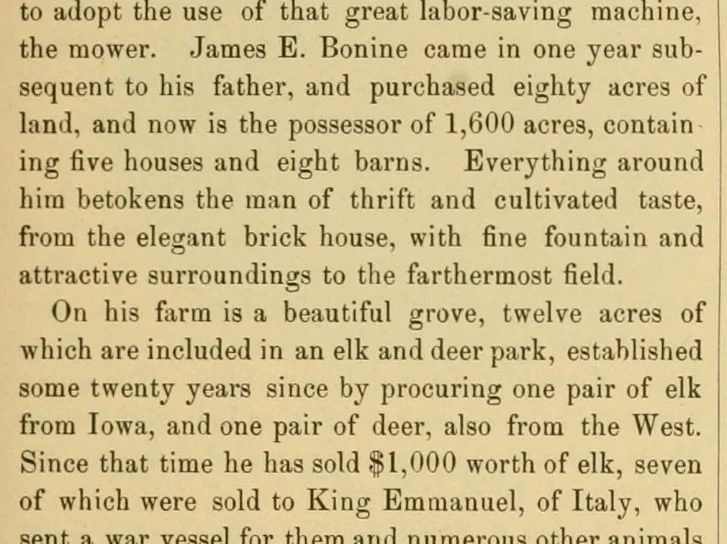
New findingThe same page describes, “exactly opposite his residence, which is on a corner,” “the finely-built storehouse,” with “two rows of arbor vitæ” running from it. Standing where it does, opposite the house on the corner, this is probably the building now called the carriage house. If so, it is the earliest description of it we have found, and it calls it a storehouse.
“Come Bill!” A visit in 1885
New findingIn August 1885 a writer for the Michigan Farmer, signing himself A. C. G., toured the farms of Young’s Prairie and stopped at “the famous farm of James E. Bonine, covering 1,600 acres.” His account is the earliest eyewitness description of the elk park we have found.
New findingBetween the house and the village, he wrote, lay “a park of 40 acres enclosed by a picket fence ten feet high on two sides,” with rails and stakes of the same height on the other two. “In this enclosure are ten elk and thirteen deer. This is the only private park in Michigan.”
New findingThen the owner put on a show. “Mr. Bonine procured a pail of salt and went with us to the park,” and called, “Come Bill! come Bill!” “Nine of the elk came at the call, and timidly licked at the salt which was thrown through the fence.” The elk, the visitor thought, were “natural trotters,” circling “like a shy horse.” Only “the old patriarch, with his five feet of branching horns,” would not come. A hound and a bird dog had tried “an excursion through the park” the year before: “they were bound to have a hunt.”
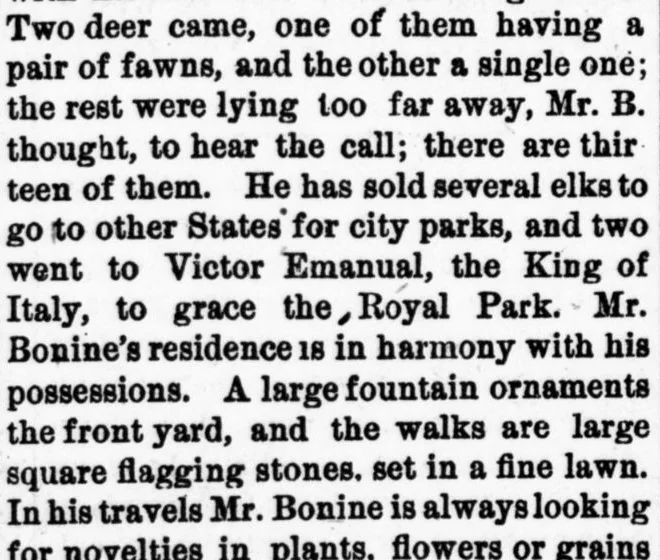
New findingThe house matched the park. “Mr. Bonine’s residence is in harmony with his possessions. A large fountain ornaments the front yard, and the walks are large square flagging stones, set in a fine lawn.” By then the 1,600 acres were “divided into four farms and occupied by his children.” The fountain, which the 1882 history mentions in passing, and the flagstone walks appear in no modern account of the house we have read.
Two elk or seven? The King of Italy
DocumentedThe 1882 history’s story is grand: seven elk, sold to “King Emmanuel, of Italy, who sent a war vessel for them.” The visitor of 1885, who walked to the park with the owner, tells it more modestly: “He has sold several elks to go to other States for city parks, and two went to Victor Emanual, the King of Italy, to grace the Royal Park.” Two elk, a royal park, and no warship.
New findingThe owner gives the count. On 1 April 1875 James E. Bonine wrote from Vandalia to The Rod and the Gun, a New York sporting weekly, replying to an article on whether wounds from deer antlers are poisonous, and described his farm along the way: “I have a farm of 1600 acres … I have a park containing two elk, a very fine pair; I sold seven which went to the King of Italy. I find no trouble in breeding them; they require no shelter during the winter, and can be kept cheaper and easier than cattle.” The letter was printed on 17 April 1875. It is the earliest record of the sale, it is in the seller’s own words, and it agrees with the 1882 history’s seven. It also dates the sale: before April 1875, and so to Victor Emmanuel II, who died in January 1878. It says nothing of a ship.
New findingThe Italian side has its own record, and it explains why a king would buy elk from a Michigan farm. In 1872 Benvenuto Comba, the naturalist of the royal park of La Mandria, near Turin, reported to the Acclimatisation Society of Paris on the king’s wapiti. Two bought at Antwerp and four in London in 1863 died within days. Then, he wrote, “M. le comte de Castiglione fut envoyé par Sa Majesté en Amérique pour y acheter des Cerfs wapiti”: the king sent the Count di Castiglione to America to buy elk. “The first shipment was of 60 animals, of which 47 arrived alive in Italy,” and those died too. In 1865 the count sent more.


DocumentedThe losses went on. Comba’s report of 1873 counts eleven wapiti dead at La Mandria in 1871, ten in 1872 and six in 1873 to the time of writing; a French hunting writer, Henri de la Blanchère, repeated his figures in 1876. Comba blamed the animals’ diet; the royal vets blamed disease.
DocumentedWhere the king’s first elk came from was printed in Turin at the time. In March 1864 the newspaper L’Opinione, translating a report in the London Morning Post, told of the expedition of the Count di Castiglione and Major Devecchi, sent to explore “le più remote parti dell’America settentrionale e della Columbia britannica,” and among its trophies “trenta daini di Wapiti,” thirty wapiti brought alive to Europe, “che trovansi ora in uno dei regii parchi del Re d’Italia. Essi vennero presi nelle Montagne Rocciose e su le coste del Pacifico”: now in one of the King of Italy’s royal parks, and taken in the Rocky Mountains and on the coasts of the Pacific. The king’s American herd came from the West, not from Michigan.
DocumentedAnd the king bought from an American farmer. In May 1866 the Daily Davenport Democrat of Iowa, copying a New York paper, told of a farmer named Stratton “in the western part of the State,” who had bred a herd from “a pair of young elk, that he saw a few years ago in Indiana.” “Somebody bought a pair and sent them a present to Victor Emanuel … In due time orders came from the king of Italy for an increased supply,” until “some thirty of these wild American elk were transferred from the woody hills of Western New York to the pleasant parks of the king of Italy, at a profit to the enterprising farmer of some five hundred dollars each.” By 1866, then, Victor Emmanuel II was ordering elk from a private American breeder, as the Bonine story has him do. (The government’s game-farming bulletin of 1910 also noted that Stratton’s elk went partly “to Italy.”)
ReadingA king whose elk kept dying was a king who kept buying them, all through the years when the Bonine park was selling. Comba names no state and no seller, so his report does not prove the Bonine sale. It makes it believable, and it shows where the proof would be: in the royal household’s accounts for the elk Castiglione and others bought in America.
DocumentedBy 1908 a syndicated newspaper story was back to seven elk and a “man-of-war.” It claimed too that “the elk procured of the Bonines were the beginning of a herd which has become world famous.” The Italian records contradict that: the king’s American wapiti came from the Rockies and the Pacific coast in 1863–65, after a first few bought at Antwerp and London had died (L’Opinione, 1864; Comba, 1872), and by 1866 he was buying from a New York breeder. It added that the Bonine elk sold for $100 a head at any age over six months, that others had gone to parks in Detroit and Grand Rapids, “where some were placed in the parks at the Soldiers’ home,” and that the family had given up its buffalo, which “did not do well here except in summer.”
ReadingThen why did the visitor of 1885 write “two”? In 1875 Bonine had “two elk, a very fine pair” in the park beside the seven he had sold; ten years later a visitor, writing up a long tour, set down the smaller number. The farm’s accounts of 1882, “$1,000 worth of elk” in twenty years, seemed to leave no room for seven to one buyer; the owner’s letter shows the sale was made all the same.
ReadingThe calendar fits. Carlo Bovolo’s history of Turin’s royal menageries (Rivista Savej, 2024) counts the king’s American purchases as two shipments, eighty animals in all, of which only the second survived; Comba’s own figures differ. A park begun with a single pair about 1862 could not have spared seven grown elk for the shipments of 1863 to 1865. So the Bonine elk most likely went later, between 1865 and April 1875. A family account printed in the 1930s, which we have seen only in a search snippet, says the king bought a buck in 1869 and “had the elk shipped from New York on an Italian war vessel along with other animals for his royal park”.
ReadingSeven, then, in the owner’s own words of 1875 and in the county history of 1882; two in the visitor’s notes of 1885. We had trusted the smaller number, set down at the farm, until the owner’s letter turned up. What no record yet shows is the Italian side: an entry in the royal accounts naming Bonine, Michigan or the ship.
Friends against slavery
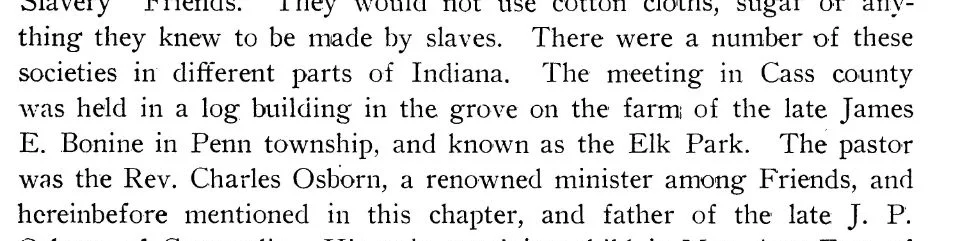
DocumentedSome Quakers of the time went further than their meetings would go. Glover’s county history of 1906 tells of the “Anti-Slavery” Friends: “They would not use cotton cloths, sugar or anything they knew to be made by slaves.”
New finding“The meeting in Cass county was held in a log building in the grove on the farm of the late James E. Bonine in Penn township, and known as the Elk Park. The pastor was the Rev. Charles Osborn, a renowned minister among Friends.” A school for their children met in the same building. Modern accounts say the Bonines were members of the Anti-Slavery Friends; we have not found one that says the meeting met on their farm.
DocumentedCharles Osborn, their pastor, was one of the best-known anti-slavery Quakers in the country. In 1879 James E. Bonine and others built the brick Friends’ church at Vandalia, and he and Sarah A. Bonine were among its first elders.
Station or story?
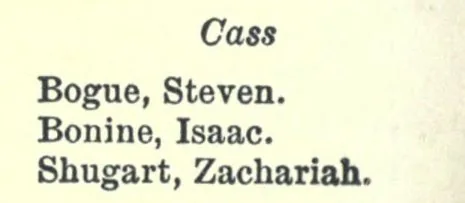
DocumentedThe national directory of Underground Railroad workers in Wilbur H. Siebert’s The Underground Railroad from Slavery to Freedom (1898), names three for Cass County: “Bogue, Steven. Bonine, Isaac. Shugart, Zachariah.” The Bonine it names is Isaac, the father, not James E. Floyd Streeter repeated the three names in 1918, and the society’s own history says that “Isaac Bonine became a stationmaster in the late 1830’s.”
DocumentedWe have found no letter, newspaper or court paper of the 1840s or 1850s that places freedom seekers at James E. Bonine’s house or carriage house. The society that owns the house says so itself: “To date there is little evidence of the house itself being a UGRR station.” The carriage house, it says, has a stronger tradition.
DocumentedIsaac Bonine’s own account book survives in the Friends Collection at Earlham College in Richmond, Indiana. Its finding aid calls him “an ‘Anti-Slavery Friend’” and describes “goods bought and sold and labor performed,” with “dozens of names of residents of Wayne County, Indiana, and Cass County, Michigan,” mostly from 1838 to 1846. The finding aid mentions no freedom seekers.
DocumentedIn 1918 the historian Floyd B. Streeter, in Political Parties in Michigan, 1837–1860, named the same three men as Siebert: “agents of the Quaker faith were Stephen Brogue [Bogue], Isaac Bonine and Zachariah Shugert of Cass County.” Neither book names James E.
ReadingThat is not the same as saying nothing happened there. The Bonines were anti-slavery Quakers, married into the Bogue family, on a prairie where freedom seekers lived and worked in the open by 1847, and where the Kentucky raiders came looking for them. What is missing is a written record that names this house.
DocumentedSome of what is told can be checked. The tower that is said to have been a lookout was added after the Civil War, and no tunnel has been found; the society’s own volunteers say both stories are unproven.
The house in the society’s telling: Cindy Yawkey
DocumentedThe Underground Railroad Society’s story of the house is best told in the work of Cindy Yawkey, the Bonine House’s head docent. She grew up in Cass County and calls herself an artist first: “I always wanted to be an artist, and I got to really do that,” she said in a StoryCorps interview recorded at the Kalamazoo Public Library in 2023. She joined the society about 2010, guided visitors through the house and the carriage house, and helped build its research library, copying the society’s research into more than a hundred notebooks. She writes and illustrates her own books; the society publishes them and says they inform its story.
DocumentedHer work has been honored three times. In 2016 the Historical Society of Michigan, which gives the State History Awards each year for the “collection, preservation, and/or promotion of state and local history,” gave her an award in its category Books: Children & Youth for They Have My Shoes, I Have My Freedom, presented at the State History Conference at Alpena, 23–25 September 2016. The society’s announcement said the book “describes how abolitionists, fugitive slaves, free blacks and Quakers came together in Cass County to combat slavery during the 19th century.”
DocumentedIn April 2021 the National Park Service added two of the society’s projects that she helped to make to its National Underground Railroad Network to Freedom: the Bonine House Underground Railroad Research Library, and the “Wax Museum in A Box,” a program for fifth graders. That September she was one of three from the society who went to Mackinaw City to accept the Michigan Humanities Council’s Outstanding Humanities Organization award, given to the society for its work to research, teach and preserve the history of the Underground Railroad in Cass County. In 2024 the Historical Society of Michigan honored the society itself, with its award for a local society.
DocumentedHer picture book They Have My Shoes, I Have My Freedom: A Story About the Underground Railroad, which won a Michigan State History Award in 2016, follows Lucinda, a woman escaping from Georgia barefoot after her master took her shoes. She crosses the Ohio, is carried by wagon from Levi Coffin’s Richmond to Bristol, and comes at last to Calvin Township, to “a light in the window of the Bonine house.” There James and Sarah Bonine meet her: “We have food, clothing, shoes, and a place to rest on the third floor of the carriage house,” Sarah says.
ReadingIt is a story, and it says so: Lucinda is a character, not a name from a record. What it preserves is the society’s tradition that the carriage house loft sheltered freedom seekers. That tradition is worth keeping; no written source of the 1840s or 1850s that we have read records it.
DocumentedHer second book, The Kentucky Slave Raid of 1847, Cass County Michigan (the society, about 2019), retells the raid farm by farm, with a hand-drawn map of the prairie on which “James E. Bonine” sits among the farms of the raid’s story. We compare it with the record in our story The Kentucky Raid of 1847.
The house today
DocumentedBy the society’s account, the house was begun as a Greek Revival farmhouse in the 1840s and, “soon after the Civil War,” enlarged and remade “in one of the most flamboyant American-Victorian styles, Second Empire,” with its central mansard tower. The Gothic Revival carriage house across the road is dated to about 1850.
DocumentedIn 1957 the state of Michigan registered an “Underground Railroad” historic site at “Bonine Elk Park, M-60.” The Underground Railroad Society of Cass County bought the house and carriage house in December 2010, and has been restoring them since. The story of how it came to own them is told below.
The people who saved it
DocumentedThe house was nearly lost. It had stood empty since 2001, and by 2009 one of its walls was failing, the brick pulling away from it. In October 2009 a new group, the Underground Railroad Society of Cass County, announced that it meant to buy the house and the carriage house for $100,000, and that it had thirty days to raise a $25,000 down payment. “This house has been at risk for a long, long time,” said Dave Bainbridge of the Northern Indiana Center for History in South Bend, the society’s first president, who had first seen the house eight years before. “We just feel it’s now or never.” Carol Bainbridge, executive director of the Fort St. Joseph Museum in Niles, was its treasurer, and Mike Moroz of Dowagiac joined as chairman of buildings and grounds. “It’s a labor of love,” he said.
DocumentedThat first deal fell through. A year later the house came back on the market, and by then Moroz was the society’s president. “We felt this was our last opportunity since the Bonine House is coming to the point of being irreparably damaged,” he said; “everyone rallied to the cause and we were able to close within two weeks.” The society bought the house and the carriage house in the last days of December 2010, and that winter its volunteers began emergency work on the roof and on draining the water away from the walls.
DocumentedThe money came a little at a time. By January 2012 gifts of $10 to $10,000 had raised $100,000, against an estimate of about $500,000 to finish the work. “I think we were pretty close to losing the house for good,” Moroz said. Cathy LaPointe, a founding member who became the society’s treasurer and, in Moroz’s words, its “unofficial director,” put the aim plainly: “Telling that story and using the Bonine House as a focal point for telling that story is what we’re trying to do.”
DocumentedIn December 2012 the house opened its doors for its first Christmas, with nineteen decorated trees. Volunteers dressed it room by room: Dorothy Mickey made the children’s room, Patty Walker Dresser the bedroom, with a bed made of boxes and an old door for a headboard, and Gary Weaver of Dowagiac played Santa upstairs.
DocumentedThe work began in the fall of 2011 at the southwest corner, after structural engineers warned that the house was in danger of collapse; that corner was finished by December. In March 2012 the Michigan Architectural Foundation chose the society for its Evans Historic Preservation Award, $7,500, which LaPointe had written for, to restore the mansard roof of the entrance tower. When the contractor, Dale Layman, took off the old fish-scale shingles, he found that the tower’s first color had been a deep green, not grey. The check was handed to Moroz, LaPointe and Lin Pollard at the Michigan Historic Preservation Network’s awards in Flint on 11 May 2012, and that summer a gift from Mary Anne Bonine, in memory of her husband, Alan Bonine, paid to re-roof the whole house.
DocumentedBy 2016 the house was sound again: the southwest corner and the north wall repaired and the front porches rebuilt. That spring the society’s “It’s Time” campaign, for $375,000 to finish both buildings, reached its halfway mark. “Our members dug deep and stepped up to the challenge,” LaPointe said. The carriage house came next. Its foundation, patched with concrete and wood in the 1940s, was rebuilt from 2015 to May 2017 as it had first been laid, field stone inside and cobblestone outside, by Quality Masonry of Vandalia, while Bullseye Construction of Vandalia, with Amish and Mennonite crews, replaced its perimeter beams. “This is really serving as part of the renaissance of Cassopolis,” LaPointe said.
DocumentedMary Anne Bonine (1947–2013), one of the society’s founding members, created its Wax Museum program for school classes; the society still keeps the program’s resources for students on its website. The society’s own papers, with the family and local research gathered with Veta Smith Tucker, Estella Sanders Lawson, Tom Kovalak and Barbara Wood Cook, are kept at Western Michigan University’s Archives and Regional History Collections.
DocumentedVolunteers keep the doors open. On Underground Railroad Days in July 2023, the society’s volunteer Patricia Dryer welcomed visitors into the Bonine House; she estimated that about 200 people came through over the event. At the same gathering Jennifer Ray, a retired director of the Cass District Library who chairs the society’s Friends of Brownsville School, spoke on Brownsville School No. 1, a one-room schoolhouse the society had lately taken on. A few weeks later, on 4 August 2023, Moroz and LaPointe sat down at the Kalamazoo Public Library to record the society’s beginnings for StoryCorps; Cindy Yawkey and Jennifer Ray recorded their own conversation there the same day.
DocumentedThe family came back too. Mary Charlotte Bonine Roberts, the daughter of G. Elwood Bonine, the last of the family to live on the farm, lent the society her photographs of the house and the carriage house when it bought them, and came to Underground Railroad Days every year from 2012. She died at Valdosta, Georgia, on 15 January 2021, at 86. That week the society left the Christmas candles burning in every window, lit the front doors and the tower in amber, and on the evening of the national day of mourning for the country’s COVID dead, 19 January, rang the tower bells for her and for them. “The lighting of the house is especially meaningful for us and everyone who knew her,” LaPointe said.
A man of affairs
DocumentedJames E. Bonine was more than a farmer. In the 1850s he took premiums at the state fair for Durham heifers, a French and Spanish buck and the best boar; the federal agriculture reports of the 1860s list his Merino sheep; and in 1883 the Michigan Farmer wrote of “a flock of one thousand head belonging to J. E. Bonine of Cass County.”
New findingIn 1870 he was one of the first directors of the First National Bank of Cassopolis. In 1869 he was named among the directors of the Michigan Air Line Railroad Company, and he was superintendent of the Air Line railroad through Penn Township, to which, the 1882 history says, he gave “three years time, $6,000 right of way, and $6,000 cash.” That was the Michigan Air Line, built from Jackson to Niles and opened through Vandalia in 1871, which gave the village its station. No modern account of the house we have read mentions his part in it.
DocumentedIn 1879 he and his brother Lot built the brick Friends’ church at Vandalia. By the society’s account it later became the Masonic lodge, and it has since been torn down. In 1887 the Sharpless family genealogy still called him “a banker and farmer, Vandalia”; by 1906 Glover writes of “the late James E. Bonine.” After his death his widow, by the 1908 account, was the largest stockholder of the Cassopolis bank.
New findingJames E. Bonine died on 18 February 1897. The Quaker weekly The American Friend reported it that April: “Died at his home in Niles, Michigan, Second month 18th, 1897, James E. Bonine, in the eighty-first year of his age.” He had been “for many years an elder,” it said, and had given so freely to the church that he built “principally one house for worship,” very likely the Vandalia church of 1879, and helped to build three others. His last illness lasted four months.
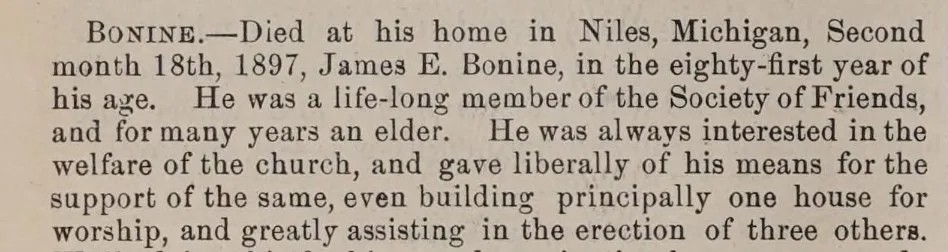
DocumentedA Berrien County history of 1906 gives a fuller sketch, and a different year. It calls him “the leading banker of Cass county for many years,” says he cleared 800 of his 1,600 acres, and says he moved to Niles in 1866, went back to the farm, and spent his last days in Niles, “where he died in 1898 at the age of eighty-two years.” A syndicated newspaper piece of 1908 on the elk farm says the same: “He died in Niles in 1898 at the age of 82 years.” The obituary, printed weeks after his death, is the one to trust.
DocumentedHe is buried at Niles. The grave register of Silverbrook Cemetery, kept by the Friends of Silverbrook, records James E. Bonine, born 5 September 1816, died 18 February 1897, buried 20 February, in the City section, block 43, lot 12; Sarah A. (Bogue) Bonine was laid beside him on 20 September 1909. His son Isaac A., his grandson Dr. J. Gordon Bonine and his great-grandson G. Elwood Bonine lie in the same block. His parents, Isaac and Sarah Talbot Bonine, are at Prairie Grove, the Friends’ burying ground in Penn Township.
The Elk Park’s later life
DocumentedThe elk did not end with James E. Bonine. On 14 October 1907 his son Isaac A. Bonine wrote to the federal Biological Survey that he had been breeding elk and deer “for about thirty-five years.” The government printed his letter in a 1910 bulletin on raising game animals.
Isaac A. Bonine to the Biological Survey · 14 October 1907
“We find that deer are not so hardy as elk and require more care. Elk winter well on hay and corn fodder with a little grain, and they live and thrive during summer months on blue grass. … The growing of both elk and deer for park purposes may be made profitable.”
ReadingHis “thirty-five years” would start the herd about 1872; the 1882 history’s “some twenty years since” points to about 1862. The family’s own telling settles it. Before the farm was sold in 1953, G. Elwood Bonine told a schoolboy writing a paper on the farm that it “has had it since 1862,” when a man gave “his grandfather” a pair of elk; in an undated newspaper piece he added, “Grandfather fenced in a 12-acre lot and grandmother took care of them.” Twelve acres is exactly the park of the 1882 history. Elwood’s “grandfather” must be his great-grandfather, James E., since Isaac A. was a boy of thirteen in 1862. Isaac A.’s “thirty-five years,” and the “about thirty years” that Fur-farming in Canada credited to him in 1913, are best read as his own years in charge of the herd.
New findingIsaac’s son, Dr. J. Gordon Bonine, kept the herd in his turn. When he died in 1934 his obituary called the farm of 1,500 acres “the famous Elk park farm,” where “he kept [a] herd of elk that drew many tourists at all times of the year,” and “a show place in Cass county.” In October 1953 a newspaper photograph showed “a herd of 12 to 15 elk at Bonine Elk Park” on M-60, “an outstanding tourist attraction,” on a forested 40-acre park owned by G. Elwood Bonine, the founder’s great-grandson.
DocumentedBy 1941 the park was a sight on the highway, and the WPA’s guide to Michigan sent motorists to it.
Michigan: A Guide to the Wolverine State · 1941
“On the western border of Vandalia … is Bonine Elk Park (R), a woodland tract of 60 acres. Here more than a score of American elk browse in the open, except during the most severe weather. They are sold to zoos, parks, and private gardens, and sometimes to Elk lodges for ceremonial purposes.”
New findingThe farm left the family in 1953. When G. Elwood Bonine died in 1976 his obituary said he had “farmed the Elk Park Farms which had been in his family from 1837 to 1953.” He moved to Lansing that year.
New findingThe elk did not leave with him. The schoolboy’s paper, pasted into a Decatur scrapbook, carries a note from its editor: “The farm has been sold since this story was written, but we understand the new owners are maintaining the elk.” Elwood had kept the herd at about twenty-five head on forty acres, butchering at two years old, because fewer than half the cows calved in a year.
ReadingNot for long. In 1963 a guide to commemorative tokens wrote that “for many years a forty-acre Elk Park was located on the Bonine farm just west of the Vandalia” village limits: the past tense. The last elk most likely left between 1953 and 1963. A modern driving tour says the park became one of Michigan’s first state parks in 1950 and closed in 1979; we have found no record of either, and the 1963 past tense argues against the later date. The state’s 1957 marker, which stood at “Bonine Elk Park,” now stands in Vandalia’s Milo E. Barnes Park.
Who’s who
The farm through the years
- 1816 James E. Bonine born in Wayne County, Indiana, 5 September (Sharpless 1887)
- 1841–43 Isaac Bonine and his son come to Young’s Prairie; the sources disagree on the year and on who came first
- 1844 James E. Bonine marries Sarah Ann Bogue at Cassopolis, 8 August
- 1847 The Kentucky raiders come to Young’s Prairie
- 1850 The English Quaker minister Robert Lindsey arrives at Isaac Bonine’s, Prairie Grove, in the snow, 2 January
- 1850s State-fair premiums for his cattle, sheep and hogs
- 1862 The elk park begun with a pair of elk from Iowa, on twelve fenced acres (1882 history; the family’s own date)
- 1863–65 The King of Italy sends the Count di Castiglione to America to buy elk; most of the first herds die
- 1866 The Bonines move to Niles for some years, then go back to the farm
- 1870 A first director of the First National Bank of Cassopolis
- 1871 The Michigan Air Line opens through Vandalia, with Bonine its superintendent in Penn Township
- 1872 Isaac Bonine, the father, dies; about this time his grandson Isaac A. takes charge of the elk
- by 1875 Seven elk go to Victor Emmanuel II, King of Italy, by James E. Bonine’s own account (letter of 1 April 1875)
- 1879 The brick Friends’ church at Vandalia is dedicated
- 1882 1,600 acres, five houses, eight barns, an elk and deer park and buffalo (county history)
- 1885 A visitor finds ten elk and thirteen deer in a 40-acre park, and a fountain on the lawn
- 1897 James E. Bonine dies at his home in Niles, 18 February; buried at Silverbrook, 20 February
- 1906 Glover writes of “the late James E. Bonine”
- 1907 Isaac A. Bonine writes to the Biological Survey on raising elk
- 1908 Elk selling at $100 a head; the buffalo given up
- 1909 Sarah Ann Bonine dies at Vandalia, 17 September
- 1934 The Elk Park farm called “a show place in Cass county”
- 1941 The WPA guide: “more than a score of American elk browse in the open”
- 1953 12 to 15 elk still on the park; the farm leaves the family, and the new owners keep the elk
- 1957 State historic site registered at “Bonine Elk Park, M-60”
- 1963 The Elk Park spoken of in the past tense
- 2001 The house stands empty
- 2009 The Underground Railroad Society of Cass County forms to save it: $100,000 asked, $25,000 down in thirty days; the first deal falls through
- 2010 The Underground Railroad Society of Cass County buys the house and carriage house, in the last days of December
- 2011 Restoration begins at the southwest corner
- 2012 The Evans Historic Preservation Award pays for the tower roof; the whole house re-roofed; the first Christmas at the house, with nineteen trees
- 2015–17 The carriage house’s foundation rebuilt in field stone and cobblestone
- 2021 The tower bells rung for Mary Charlotte Bonine Roberts and the country’s COVID dead, 19 January
- 2023 Underground Railroad Days in July; the founders record the society’s story for StoryCorps in August
The case file: what we asked, and what we found
The questions this story set out to answer, and what the record showed.
- Answered Two elk or seven? Seven, by the owner’s own word. On 1 April 1875 James E. Bonine wrote to The Rod and the Gun (printed 17 April 1875, p. 43): “I have a park containing two elk, a very fine pair; I sold seven which went to the King of Italy.” The sale was before April 1875, so the buyer was Victor Emmanuel II. The 1885 visitor’s “two” is most likely the pair Bonine mentions in 1875; that is our reading.
- Answered Where is James E. Bonine buried? At Silverbrook Cemetery, Niles, buried 20 February 1897, with Sarah Ann beside him.
To cite this page: Michael Urbanski, “The Bonine House at Vandalia,” Project Scroll, first published 22 October 2026, revised 30 October 2026, https://projectscroll.com/news/the-bonine-house/. To cite a single finding, use its own link on our Discoveries page. Part 1 of 2; part 2 is The Kentucky Raid of 1847. Corrections are welcome, and any we make are noted on this page.
Sources
- History of Cass County, Michigan (Chicago: Waterman, Watkins & Co., 1882): Isaac Bonine and his family, p. 250; James E. Bonine’s farm, the storehouse and the elk park, p. 251; the Air Line, p. 258; the First National Bank, p. 170; Stephen Bogue’s family. Internet Archive.
- L. H. Glover, A Twentieth Century History of Cass County, Michigan (Chicago, 1906): the Pioneer Society roll, p. 352; the Anti-Slavery Friends and the Vandalia church, pp. 385–386. Internet Archive.
- Howard S. Rogers, History of Cass County, from 1825 to 1875 (Cassopolis, 1875): the stations of Stephen Bogue and Zachariah Shugart, p. 132. Internet Archive.
- Wilbur H. Siebert, The Underground Railroad from Slavery to Freedom (New York, 1898), Appendix E, p. 412, Michigan, Cass County: “Bogue, Steven. Bonine, Isaac. Shugart, Zachariah.” Internet Archive.
- “An Agricultural Reconnoissance,” Michigan Farmer, 18 August 1885: the elk park, the King of Italy, the fountain. Internet Archive.
- Gilbert Cope, Genealogy of the Sharpless Family (Philadelphia, 1887), entry 2348: James E. Bonine and his family. Internet Archive.
- Virgil T. Bogue, Bogue and Allied Families (1944): Sarah Ann Bogue Bonine. Internet Archive.
- D. E. Lantz, Raising Deer and Other Large Game Animals in the United States, U.S. Department of Agriculture, Biological Survey Bulletin 36 (Washington, 1910), p. 31, quoting E. L. Stratton’s letter to Forest and Stream: his brother’s remaining elk “bought by some foreigners and shipped … thence some to Italy and the rest to Germany”; and p. 32, Isaac A. Bonine’s letter. Internet Archive.
- Michigan Farmer, 10 July 1883, the Bonine flock; Michigan State Agricultural Society Transactions (1850s); Report of the Commissioner of Agriculture (1862, 1865). Internet Archive.
- J. Gordon Bonine obituary, Niles Daily Star, 3 March 1934, transcribed by Friends of Silverbrook.
- East Jordan News-Herald, 8 October 1953, “Preserving Michigan’s Elk” (photograph caption).
- Carlo Bovolo, “Quando a Torino c’erano gli elefanti,” Rivista Savej, 10 July 2024: the wapiti of La Mandria.
- Underground Railroad Society of Cass County, Quaker timeline: the Vandalia church.
- “Died: Bonine,” The American Friend (Richmond, Ind.), vol. 4 (1897), p. 308: James E. Bonine’s obituary. Internet Archive.
- Orville W. Coolidge, A Twentieth Century History of Berrien County, Michigan (Chicago, 1906), pp. 700–701: Isaac A. Bonine and his father. Internet Archive.
- B. Comba, “Note sur deux nouvelles acclimatations faites dans le parc royal de la Mandria, près Turin,” Bulletin de la Société d’acclimatation, 2e série, vol. 9 (Paris, 1872), pp. 486–507, at p. 500 (announced p. 186); received at the meeting of 8 March 1872 and printed in the August number. New York Botanical Garden, LuEsther T. Mertz Library, via the Internet Archive.
- H. de la Blanchère, in La Chasse illustrée (1876), on the losses at La Mandria, as quoted in H. de Puyjalon, Histoire naturelle à l’usage des chasseurs canadiens (Québec, 1900). Internet Archive.
- Federal Writers’ Project, Michigan: A Guide to the Wolverine State (New York: Oxford University Press, 1941): Bonine Elk Park. Internet Archive.
- Gordon Elwood Bonine obituary, Lansing State Journal, 7 December 1976, transcribed by Friends of Silverbrook.
- Cindy Yawkey, They Have My Shoes, I Have My Freedom: A Story About the Underground Railroad, written and illustrated (Vandalia: Underground Railroad Society of Cass County).
- Cindy Yawkey, The Kentucky Slave Raid of 1847, Cass County Michigan, written and illustrated (Vandalia: Underground Railroad Society of Cass County, c. 2019).
- Ann Burton, Michigan Quakers: Abstracts of Fifteen Meetings of the Society of Friends, 1831–1960 (Decatur, Mich., 1989): the Vandalia church trustees and the Bonine marriage. Internet Archive.
- Willard Heiss, Abstracts of the Records of the Society of Friends in Indiana, Whitewater Monthly Meeting: James E. Bonine’s birth. Internet Archive.
- Curtis H. Hannum, Genealogy of the Hannum Family (West Chester, Pa., 1911): Elsie E. Bonine. Internet Archive.
- 1963 United States and Canadian Commemorative Medals and Tokens (1963): the Elk Park in the past tense. Internet Archive.
- “Michigan Air Line Railroad,” Wikipedia; and Michigan Railroads, Vandalia station: the line through Vandalia in 1871.
- Fondazione 1563, “Lo zoo dei Giardini Reali”: Verasis di Castiglione’s journey to buy elk.
- WikiTree, Isaac Bonine: burial at Prairie Grove Cemetery.
- Western Michigan University Archives, Underground Railroad Society of Cass County records (RH-A-4254): Bonine House, Elk Park and family folders (finding aid).
- The modern accounts we compared, to judge what is new: Leader Publications (Niles), 16 and 22 Oct 2009, 28 Jan 2011, 8 Nov 2012, 20 Feb 2014, 19 Feb 2015, 29 Jul 2016, 19 Feb 2021; Clio entries 199143 and 207874; 99 WFMK (2024); ABC57 (2021); Visit Southwest Michigan; the society’s pages and timelines.
- Historical Marker Database: the Stephen Bogue boulder.
- Underground Railroad Society of Cass County: the house, the carriage house, tours.
- Earlham College, Friends Collection: Isaac Bonine (1790–1872) account book, 1838–1850, finding aid by Thomas Hamm (2013).
- Michigan historical marker S137, “The Underground Railroad” (1957).
- Friends of Silverbrook, grave register of Silverbrook Cemetery, Niles: James E. Bonine (CITY-43,12,2), Sarah A. (Bogue) Bonine (CITY-43,12,3) and the family block.
- Friends of Silverbrook, photograph of the stone of James E. Bonine, d. 1897.
- Robert and Sarah Lindsey, Travels of Robert and Sarah Lindsey (London, 1886), pp. 42–43: at Isaac Bonine’s, Prairie Grove, 2 January 1850. Internet Archive.
- Bernard Abbott, “Bonine Elk Farm,” a school paper, and “Bonine Elk Farm One of the Show Places of State,” a newspaper clipping, in A Scrapbook History of Early Decatur, Michigan, 1829–1976, part 2, pp. 330 and 537. Internet Archive.
- J. Walter Jones, Fur-farming in Canada (Ottawa: Commission of Conservation, 1913), p. 123: Isaac Bonine of Niles. Internet Archive.
- Floyd B. Streeter, Political Parties in Michigan, 1837–1860 (Lansing, 1918): the “agents of the Quaker faith” in Cass County. Internet Archive.
- Cass County Council on Aging, “Cass County Underground Railroad Site Driving Tour”: the house, carriage house, Prairie Grove, the Bonine graves and the Elk Park.
- Historical Society of Michigan, “Winners of the 2016 State History Awards Announced,” news release, September 2016: Cindy Yawkey, Books: Children & Youth.
- Historical Society of Michigan, State History Awards.
- StoryCorps, “Cindy Yawkey and Jennifer Ray,” recorded at the Kalamazoo Public Library, 4 August 2023.
- “Cass County adds new attractions to Underground Railroad Network to Freedom Program,” Leader Publications, 2021.
- “Underground Railroad Society of Cass County wins Michigan Humanities Council 2021 Outstanding Humanities Organization Award,” Leader Publications, 23 September 2021.
- “Underground Railroad Society wins Michigan Historical Society Award,” Leader Publications, 14 October 2024.
- Underground Railroad Society of Cass County, Bonine Research Library; videos and podcasts (“The Kentucky Raid of 1847,” Adam Miedema and CMU Public Television, 2024).
- “Visitors from across the state attend Vandalia’s Underground Railroad Days,” Leader Publications, 10 July 2023.
- “A Michigan Elk Farm,” syndicated, as printed in the Ada Evening News (Ada, Okla.), 20 February 1908. Internet Archive.
- L’Opinione (Turin), no. 84, Thursday 24 March 1864, p. 2, under “Leggesi nel Morning Post del 21” (an Italian translation of a report in the London Morning Post of 21 March): the Castiglione–Devecchi expedition and its “trenta daini di Wapiti,” taken “nelle Montagne Rocciose e su le coste del Pacifico.” Internet Archive.
- “Curious Farming,” Daily Davenport Democrat (Davenport, Iowa), 22 May 1866, p. 2, from a New York paper: Stratton’s elk, “some thirty” of them sent to the parks of the King of Italy. Library of Congress, Chronicling America.
- “A Michigan Elk Farm,” syndicated, as printed in the Elbert County Tribune (Elbert, Colo.), 13 February 1908, p. 3: “the elk procured of the Bonines were the beginning of a herd which has become world famous.” Library of Congress, Chronicling America.
- The Rod and the Gun, vol. 6, no. 3 (17 April 1875), p. 43, “Deer Wounds—A Deer Park,” letter signed “J. E Bonine,” dated Vandalia, Mich., 1 April 1875. Ernst Mayr Library, Harvard University, via the Internet Archive.
- News (National Live Stock Producers Association), vols. 16–18 (about 1937), p. 49, on G. Elwood Bonine’s elk herd at Vandalia: the family account of a buck sold to Victor Emmanuel in 1869. Google Books (snippet).
- John James Audubon and John Bachman, The Viviparous Quadrupeds of North America, plate 62, “American Elk–Wapiti Deer” (New York, 1845). Missouri Historical Society, via the Digital Public Library of America and Wikimedia Commons.
- Andrea Markò, portrait of Victor Emmanuel II at a halt in the hunt, 1875. Catalogo generale dei Beni Culturali, no. 0900741413; via Wikimedia Commons.
- Benvenuto Comba, “Sur la mortalité des cerfs, daims, chevreuils et antilopes du parc royal de la Mandria,” Bulletin mensuel de la Société d’acclimatation, 2e série, vol. 10 (Paris, 1873), pp. 612–623, table at p. 623. Smithsonian Libraries, via the Internet Archive.
- J. D. Caton, “Wounds from Deers’ Antlers,” The Rod and the Gun, vol. 6, no. 2 (10 April 1875), p. 22, the article Bonine replied to. Internet Archive.
- Forest and Stream 48 (5 June 1897), p. 445: E. L. Stratton’s letter, as cited by Lantz (1910), p. 31; not seen.
- Portrait and Biographical Record of Berrien and Cass Counties, Michigan (Chicago: Biographical Publishing Co., 1893), pp. 537–538: Lot Bonine of Penn Township, with the lives of his parents, Isaac and Sarah (Talbert) Bonine. Internet Archive.
- Michigan Legislative Biography: Dr. Evan J. Bonine (born Richmond, Ind., 10 September 1821, to Isaac and Sarah Bonine). Library of Michigan.
- Portland Daily Press, 5 November 1869, p. 2 (the directors of the Michigan Air Line Railroad Company, among them J. E. Bonine, Vandalia). Library of Congress, Chronicling America.
- “Bonine house purchased by newly-formed history group,” Leader Publications, 16 October 2009.
- John Eby, “It’s now or never to save historic Bonine home,” Dowagiac Daily News (Leader Publications), 20 October 2009.
- “Bonine House purchased,” Leader Publications, 28 January 2011.
- “Cass County historic home getting second chance,” ABC57, 10 January 2012.
- “19 trees brighten Bonine House,” Leader Publications, 17 December 2012.
- “Rotary welcomes URSCC founder,” Leader Publications, 20 February 2015.
- “Bonine House offers local connection to Underground Railroad,” ABC57, 8 February 2021.
- StoryCorps, “Mike Moroz and Cathy LaPointe,” recorded at the Kalamazoo Public Library, 4 August 2023 (machine transcript).
- “Underground Railroad stops in southwest Michigan,” WXYZ Detroit, 12 February 2024: Cindy Yawkey, head docent, at the Bonine House.
- Underground Railroad Society of Cass County, “Evans Historic Preservation Award to URSCC” (press release of 4 April 2012, with restoration notes).
- Underground Railroad Society of Cass County, “Bonine House restoration” (timeline, 2010–2015).
- “‘It’s Time’ capital campaign reaches the halfway point,” Leader Publications, 5 May 2016.
- “Bonine Carriage House restoration continues,” Leader Publications, 1 June 2017.
- “Bonine House to honor COVID-19 victims with light ceremony,” Leader Publications, 19 January 2021.
Numbers in the text point to this list; entries without a number are further sources we consulted. How we research › · The libraries behind all our stories ›
The Kentucky Raid of 1847 Write to us All the news
Corrections (1)
First published 22 October 2026; last updated 30 October 2026. Like all our pages, it is expanded from time to time with new records, pictures and features. Factual corrections are listed here, with their dates.
- Page numbers for the Lindseys’ visit (pp. 42–43); Siebert’s naming of Isaac Bonine no longer counted as a new finding (Streeter printed it in 1918); the storehouse probably, not almost certainly, the carriage house; Comba’s report of 1872, not 1871; seven elk went to the King of Italy, not two, by James E. Bonine’s own letter of 1875; the citation of L’Opinione and of Caton’s article (p. 22, not 32) corrected.
About this research
Research and reporting Michael Urbanski Project Scroll
- Sources
- Every fact on this page is drawn from the sources listed above, and each can be checked where it is held.
- Corrections
- Errors are corrected on the page, and each correction is noted there.
- Contact
- To report an error or share a record that adds to the story, write to research@projectscroll.com.
- Method
- How we research ›
© 2026 Michael Urbanski and Project Scroll. All rights reserved. The text, original maps, charts and illustrations may not be reproduced without permission; brief quotations with credit and a link back are welcome. Material from other sources belongs to its holders and is credited where it appears; public-domain material is marked as such.


