How the towns got their names
How Dowagiac got its name
Dowagiac was a river before it was a town. The railroad made the village in 1848 and the village took the creek’s name; the county history of 1875 says the word means “fishing-water,” and a newspaper of 2023 says “foraging ground.” We went back to the record.
By Michael Urbanski · Project Scroll · First published · Updated · 9 min read

New finding 1 new finding in this story. See what’s new ›
Dowagiac, Mich. Dowagiac is the rare valley town that did not grow slowly from a cabin and a mill. It was made almost at once, in 1848, when the Michigan Central Railroad came through and two men laid out a village beside the depot. The name was already waiting for it: the Dowagiac was the creek, and had been in print for at least ten years.
What the word means is another matter. We went back to Michigan’s first gazetteer of 1838, the county histories of 1875, 1882 and 1906, and what is said about the name today.
The case in brief
What the record shows
- The name belonged to the creek first. A description of the territory printed in 1833 names “the Dowagiake” among Cass County’s streams, and Blois’s state gazetteer of 1838 lists the “Dowagiake river.”
- The village was made by the railroad. Its plat was recorded on 16 February 1848, and “Front street runs parallel to the track.”
- A paper town, Venice, had been laid out nearby in 1836 and never built.
- The first post office was kept in a boarding house for railroad hands, the Cataract House.
What it does not show, yet
- Who first called the new village Dowagiac.
- What the word meant to the people who first said it. The county history’s “fishing-water” gives no source.
- An earlier spelling than Dowagiake, on the maps of the 1820s and 1830s.
Story or record? Play along
Here are eight things people say about the name. For each, make your call: true, false, or no record either way. Then see what the paper shows.
“Dowagiac was a creek’s name before it was a town’s.”
True
Blois’s Gazetteer of the State of Michigan (1838) lists the “Dowagiake river” in Cass County, ten years before the town was platted.
“The Michigan Central Railroad chose the name Dowagiac.”
No record
Rogers calls the village “Born of the Michigan Central Railroad,” but no source says who picked the name. It was already the creek’s.
“The village plat was recorded in 1848.”
True
Glover, 1906: the original plat “was recorded in the register’s office February 16, 1848.”
“A town called Venice was laid out near the site twelve years earlier.”
True
Rogers calls Venice, laid out in August 1836, a “paper town … known only by name and record at the County Seat.”
“The 1875 county history says Dowagiac means ‘fishing-water.’”
True
Rogers: “The name Dowagiac is of Indian origin, and signifies fishing-water.” He gives no source for it.
“The nineteenth-century histories say the name means ‘foraging ground.’”
No
The 1875 and 1882 histories both say “fishing water.” “Foraging ground” appears in writing of our own century.
“Dowagiac had a long pioneer history before the railroad came.”
No
Rogers, 1875: “Dowagiac had little or no pioneer history.”
“The town’s first post office was kept in a railroad boarding house.”
True
Rogers: the Cataract House, built as a boarding house for railroad hands. “In it the Postoffice was first kept.”
The creek
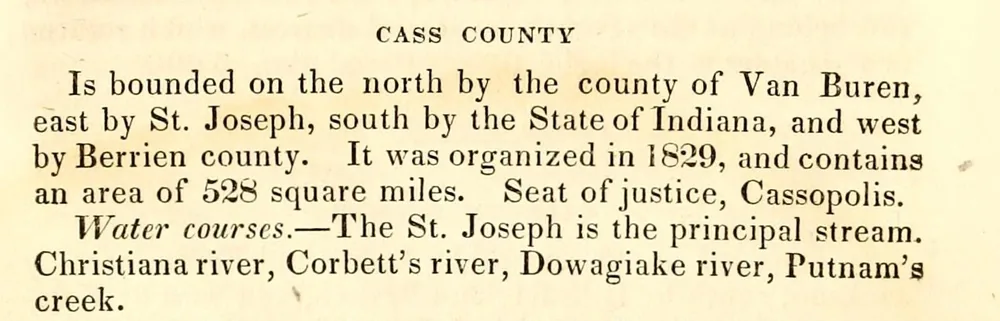
DocumentedThe first state gazetteer has the name too. John T. Blois’s Gazetteer of the State of Michigan (1838). Among the water-courses of Cass County it lists “Christiana river, Corbett’s river, Dowagiake river, Putnam’s creek,” and it says Putnam’s creek discharges “into the Dowagiake river.”
New findingThe name is in print five years before Blois. In 1833 the Scottish advocate and agriculturist Adam Fergusson, of Woodhill, published his Practical Notes Made During a Tour in Canada, and a Portion of the United States (Edinburgh), and in an appendix he reprinted an account of the “Territory of Michigan,” “from a small Tract of good authority, published in the States.” Of the southwest it says: “This part of the territory possesses several copious mill-streams, particularly Hog Creek, the Dowagiake, Christianna, Pigeon, Crooked and Portage rivers” (p. 320). Of Cass County, with “a population of about 2000,” it praises its streams, “particularly the Dowagiake and Christianna, which are rapid and durable streams” (p. 330). That is the earliest printing of the name we have found, and it already has the spelling Blois would use. The same text went round: Chambers’s Edinburgh Journal reprinted it that August, and A. A. Parker’s Trip to the West and Texas (1835) reprints the same account, “Ford’s saw and grist mill, on the Dowagiake” and all. These are copies of one account, not separate witnesses.
DocumentedThe low ground around the creek bore the name too. “In 1838,” Rogers writes, “the first road across the Dowagiac Swamp was partially built, and completed the next year.”
OpenThe hand-coloured maps of the territory from the 1820s and 1830s almost certainly letter the creek too. We have not yet read their lettering.
Venice, the town that never was
DocumentedBefore Dowagiac there was Venice, on paper. Rogers: “The ancient town of Venice, situated in that part of the Township, where Dowagiac now stands, was a ‘paper town’ laid out by Orlando Crane, in August 1836, and known only by name and record at the County Seat.” Glover, in 1906, found “a plat of the village of Venice, filed for record August 6, 1836,” and places it diagonally across the township corner from the later town.
ReadingVenice was one of many paper towns of the land boom of 1836, platted for sale and never built. It shares nothing with Dowagiac but the ground, or the ground next door.
A town born of the railroad
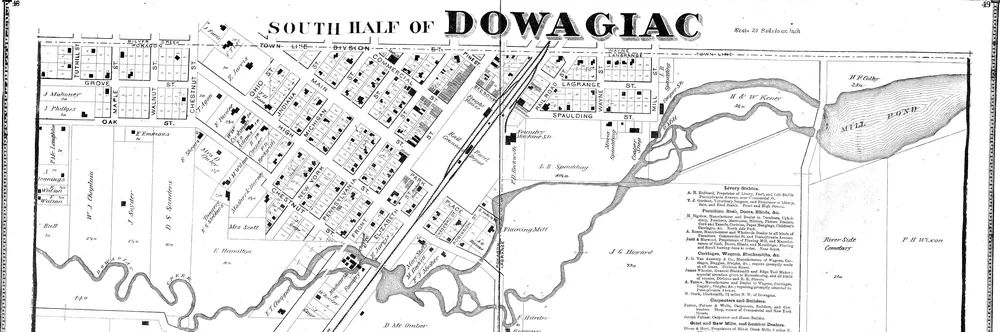
DocumentedRogers tells it plainly. In 1847 Nicholas Cheeseborough (Glover spells it Cheesebrough) “was employed by the Michigan Central Railroad Company to procure the right of way from Kalamazoo to Niles. As soon as the location of the depot sites was determined at headquarters, he associated with himself Jacob Beeson, of Niles, and together they purchased (in Mr. Beeson’s name) the northeastern eighty acres in Pokagon Township and soon after had it platted in village lots.” They gave the railroad its right of way and “spacious depot grounds, a portion of which was set aside as a public park.”
DocumentedGlover adds that the eighty acres, in the northeast corner of Pokagon township, were bought of Patrick Hamilton, and that the original plat of Dowagiac “was recorded in the register’s office February 16, 1848.” The railroad was not yet running; trains reached Niles that October. “In the words of the plat, ‘Front street runs parallel to the track of the Michigan Central railroad.’”
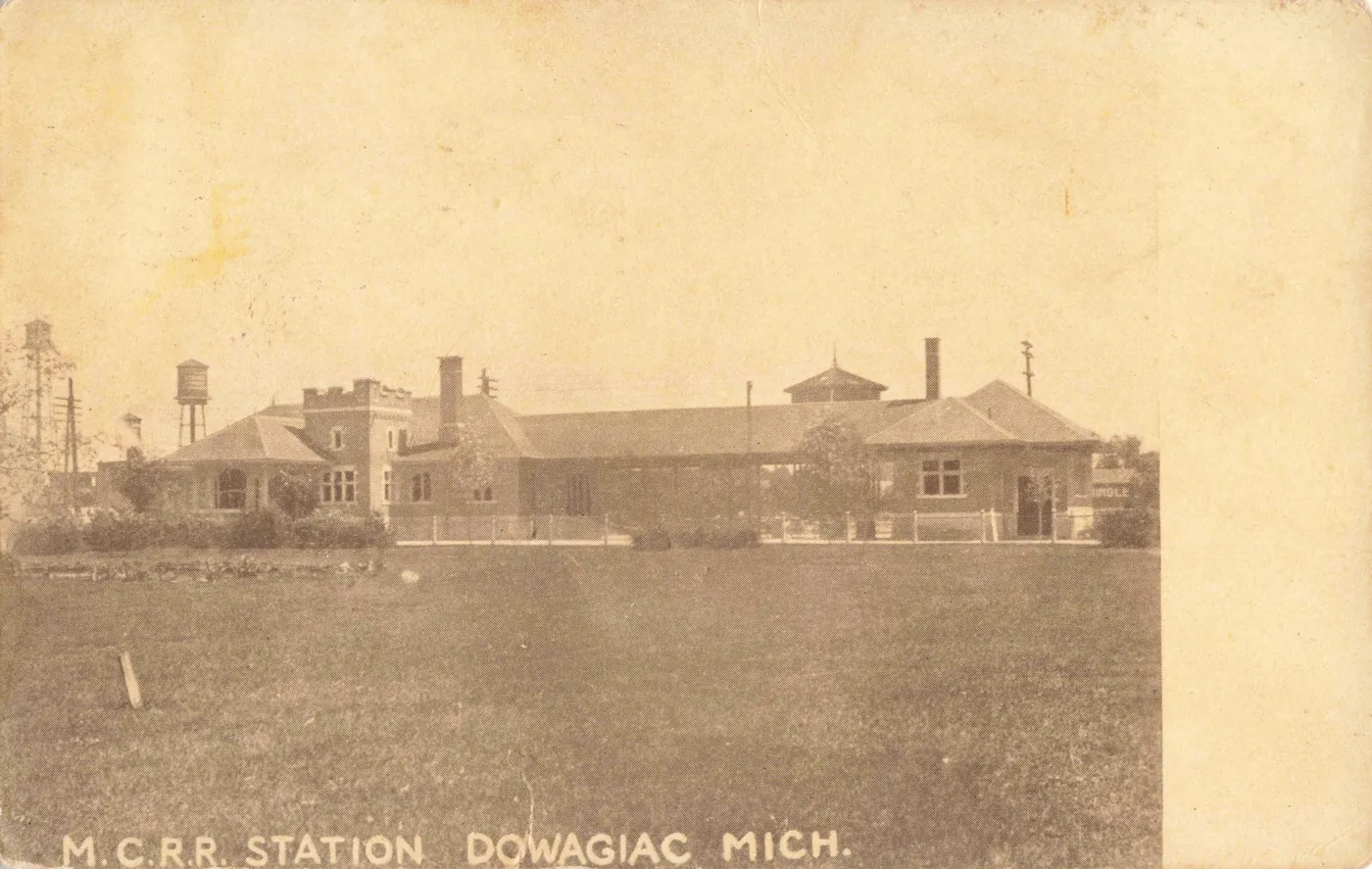
DocumentedThe first post office, Rogers says, was kept in the Cataract House, a boarding house built for the railroad hands. Postal listings date the Dowagiac office from 1848. The first sermon in the village was preached in July 1848. “Dowagiac,” Rogers sums up, “had little or no pioneer history.”
ReadingNobody records who decided to call the new village Dowagiac. The creek and the swamp already had the name, and the depot sat in the creek country; the name was the obvious one.
Fishing-water, or foraging ground?
DocumentedRogers, 1875: “The name Dowagiac is of Indian origin, and signifies fishing-water.” The 1882 history agrees: “The name of this stream is of Indian origin, and its meaning is ‘fishing water.’” Neither says who told them.
DocumentedSome writers today give “foraging ground.” A Dowagiac newspaper series for the city’s 175th anniversary, in 2023, gives the source word as Ndowagayuk and the meaning as “foraging ground,” reflecting the area’s game, fruit, grain and herbs.
DocumentedThe fullest modern study is more cautious than either. Virgil J. Vogel, in Indian Names in Michigan (1986), lists the meanings that authors have offered, “I am going hunting fish,” “scoop up,” “fishing river,” and “foraging ground,” and says: “None of these finds support in vocabularies of the Potawatomi who inhabited the area.” He notes instead, from James Clifton, a Potawatomi man named Dwagek, “Autumn,” tried and acquitted over the Indian Creek massacre in Illinois in 1832, and suggests that “a corruption of the Potawatomi word for autumn could have been adopted by whites” for the creek, while saying the man’s home is not known.
ReadingBoth meanings are explanations, not records. The nineteenth-century one came from settlers’ hearsay; the modern one is a reading from the language, and may well be the better. What the word meant to the people who first named the creek is not written down anywhere we have found.
The name on paper
Play the names in order, from the paper town to the city.
- 1833 the Dowagiake (a tract reprinted by Fergusson)
- 1836 Venice (the paper town nearby)
- 1838 Dowagiake river (Blois’s gazetteer)
- 1848 Dowagiac (the plat, 16 February)
- 1848 Dowagiac (the post office)
- 1875 Dowagiac (Rogers)
- 2023 Ndowagayuk (a modern reading)
To cite this page: Michael Urbanski, “How Dowagiac got its name,” Project Scroll, projectscroll.com/news/how-dowagiac-got-its-name/, first published 22 October 2026. Corrections are welcome, and any we make are noted on this page.
Sources
- John T. Blois, Gazetteer of the State of Michigan (Detroit, 1838; the Internet Archive copy is dated 1839), pp. 215, 348. Internet Archive.
- Howard S. Rogers, History of Cass County, from 1825 to 1875 (Cassopolis, 1875): the meaning, p. 113; the swamp road, p. 163; Venice, p. 164; the founding of Dowagiac, pp. 262–266, 268. Internet Archive.
- History of Cass County, Michigan (Chicago: Waterman, Watkins & Co., 1882), chapter I. Internet Archive.
- L. H. Glover, A Twentieth Century History of Cass County, Michigan (Chicago, 1906), pp. 154–156. Internet Archive.
- “Dowagiac 175: The Frontier Era,” Leader Publications (Dowagiac), 17 March 2023.
- Jim Forte Postal History, post offices of Cass County, Michigan (Dowagiac from 1848).
- Mill and Mill Pond, Dowagiac, Mich., colour postcard, Tichnor Brothers, about 1930–45. Boston Public Library, Tichnor Brothers Collection, via Wikimedia Commons.
- Adam Fergusson, Practical Notes Made During a Tour in Canada, and a Portion of the United States, in MDCCCXXXI (Edinburgh: Blackwood, 1833), Appendix No. I, “Territory of Michigan,” pp. 320, 330. Internet Archive (Canadiana).
- Virgil J. Vogel, Indian Names in Michigan (Ann Arbor: University of Michigan Press, 1986), p. 123. Fulcrum.
- Atlas of Cass County, Michigan (Philadelphia: C. O. Titus, 1872), “South Half of Dowagiac.” University of Michigan copy, Internet Archive.
Numbers in the text point to this list; entries without a number are further sources we consulted. How we research › · The libraries behind all our stories ›
The place-names map Write to us All the news
Corrections: none
First published 22 October 2026; last updated 25 October 2026. Like all our pages, it is expanded from time to time with new records, pictures and features. No factual corrections have been needed so far.
About this research
Research and reporting Michael Urbanski Project Scroll
- Sources
- Every fact on this page is drawn from the sources listed above, and each can be checked where it is held.
- Corrections
- Errors are corrected on the page, and each correction is noted there.
- Contact
- To report an error or share a record that adds to the story, write to research@projectscroll.com.
- Method
- How we research ›
© 2026 Michael Urbanski and Project Scroll. All rights reserved. The text, original maps, charts and illustrations may not be reproduced without permission; brief quotations with credit and a link back are welcome. Material from other sources belongs to its holders and is credited where it appears; public-domain material is marked as such.


